View Full Version : Any Welder recommendations for a newb
gesoffen
10-19-2007, 02:18 PM
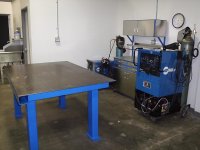
I'm looking to expand the tool selection with a welder in the near future. However, I'm a total newbie so am a bit lost in the world of MIG/TIG equipment. Obviously, I have more than a bit of learning to do but "how-tos" and books are much more useful if you can put the theory into practice.
So, I'm looking for MIG or TIG recommendations for a shade tree mechanic. This would be for typical automotive applications with the biggest jobs (once I'm semi-competent) probably dealing with sheet metal and cages (i.e., I'm not building Submarines out of HY steel in my garage:lol_hitti )
Off the cuff, I'm looking for:
- MIG or TIG setup
- Cheapish (prefer less than $500) which may rule out TIG. Used = good!
- 115V/220V (I'm at 115V now with plans to add 220V soon) but if push comes to shove, I'd take 220V over dual compatibility.
- Small (it'll be in your typical 24x24 garage along with 2 cars and other crap)
- Expandable/upgradable (i.e. don't need the whole ball of wax now but it would be nice if I could upgrade to Aluminum & Stainless welding in the future, add gas if I don't get it in the beginning, etc.)
Also, any references for a newb would be GREAT. I'd love to do a vocational school class but don't have the time between current hobbies, kids and projects. So, I'll have to learn the hard way.
Advice/suggestions/equipment to avoid are all welcome and appreciated!
Regards,
Brian
markb1
10-19-2007, 02:57 PM
Ask these guys.
http://shopfloortalk.com/forums/index.php
MXtras
10-19-2007, 03:13 PM
I would suggest a MIG machine. Look at the Hobart line - they have some decent little machines. Miller makes good stuff (It's all I own) but I don't think you will find a Miller for your price range. Maybe you could - don't know.
Go here for a lot of threads on the smaller machines.
http://www.hobartwelders.com/weldtalk
Scott
JCByrd24
10-19-2007, 04:14 PM
The Hobart 187 is mildly out of your price range but is a killer machine and probably won't leave you wanting more, which a 120V machine is almost guaranteed to. I have a Miller 175 which a couple years ago was the cats meow in the entry 220v MIG catagory. The hobart 187 and Miller 180 are todays model with the 187 being the cheaper of the two, but both excellent machines. I'd really recommned saving a little more to get the 220v machine. Look at it as a long term investment to justify it if you have to, the last thing you want to do it buy a $400 machine and then buy a $700 one a year or two or three later.
Franz©
10-19-2007, 06:52 PM
You want advice from the biggest bunch of retards on earth by all means go to ShytFloorTalk and take direction from the hairdresser in charge.
You want Chink plastic components go with HobFart if you don't hurl when you open the machine up.
Miller is slightly better, at least the wire drive mechanism is metal and works.
Definitely get a 220 volt machine, the dual voltage and 110 volt machines are far too limited in capability. Go down to the local welding suplier and test drive machines, and take along samples of what you intend to weld.
Don't waste your time even trying to go without gas. Cored wire flat sucks for the inexperienced person on light metal. Cored wirt can be a PITA for an experienced weldor.
MIG is NOT a process for cages, the mere ability to produce something that looks like a weld deposit with a hotgluegun has left too many "welds" that fell apart under strain. Figure on at least a year to learn the MIG process, because it ain't as easy as the guy peddling the machine at Homo Desperate makes it look.
TIG is way beyond your price projections. A decent torch setup with a cooler and a tank of gas will eat the $500 budget.
tommyj3
10-19-2007, 07:20 PM
I highly disagree with Franz about the Hobart machines, and shopfloortalk.com ( They are pretty decent people over there ) The Hobart HH187 is a very fine welding machine. So everybody knows Hobart and Miller are owned by the same parent company. The HH187 is a 220v machine. If you are going to do automotive welding I would recommend a 220v machine, because you could weld 3/8 material with no problem. The 110v machines are fine if you only going to weld materials in the range of 16ga and lighter. Using sheilding gas is the only way to go for good results IMHO.
rodnok1
10-19-2007, 08:33 PM
I have a Lincoln sp175 220v, with gas. I wouldn't get a tank until you get good at welding MIG(save your money) You can do alot of welding with shielded wire, not really good for sheet metal since it's .032 at the thinnest and you need .025 at least for sheet metal. For the money you want to spend you are going to have problems getting big enough unit to weld on cages. If it was me I would get a 110 with gas kit, find a welding store and buy some 5 lbs rolls of shielded wire and pratice your butt off. With shielded wire you don't have to get the metal that clean, with gas it can get a little tricky to adjust for a newbie. Buy a bigger/better welder when you need it later, you can always sell the first one.
SCOOTER
10-19-2007, 09:11 PM
You want advice from the biggest bunch of retards on earth by all means go to ShytFloorTalk and take direction from the hairdresser in charge.
You want Chink plastic components go with HobFart if you don't hurl when you open the machine up.
Miller is slightly better, at least the wire drive mechanism is metal and works.
Definitely get a 220 volt machine, the dual voltage and 110 volt machines are far too limited in capability. Go down to the local welding suplier and test drive machines, and take along samples of what you intend to weld.
Don't waste your time even trying to go without gas. Cored wire flat sucks for the inexperienced person on light metal. Cored wirt can be a PITA for an experienced weldor.
MIG is NOT a process for cages, the mere ability to produce something that looks like a weld deposit with a hotgluegun has left too many "welds" that fell apart under strain. Figure on at least a year to learn the MIG process, because it ain't as easy as the guy peddling the machine at Homo Desperate makes it look.
TIG is way beyond your price projections. A decent torch setup with a cooler and a tank of gas will eat the $500 budget.
Not looking for a fight..(maybe it's me) ..But you come off a lil prickish in this post......
But I do agree with everything 100% :thumbup:
gesoffen
10-19-2007, 09:52 PM
Thanks for the recommendations. I'm keeping my eyes and ears open for used ones. I'm torn between buying a cheap starter (i.e. 110V) and practicing and upgrading later or buying a 220V for the future (knowing I won't be able to use it for at least several months). Maybe I'll use that several months for research but that'll be a tough itch to leave untouched.
What's even more frustrating is that I work in a semi-industrial area with lots of big fabrication machinery laying around - lathes, brakes, welders, 5 axis milling machines that can cut 50 ft x 10ft blocks of whatever (yes 50 ft!) etc. but this is all BIG stuff. We have piles of 1" + sheet steel - everything from mild steel to HY 130, Aluminum, bronze, etc. Unfortunately, we're a Navy facility so its is very difficult (read illegal) to use any of the equipment for personal reasons. I'm a degreed Naval Architect so unfortunately "Fabricator" or "Machinist" isn't any where in my job title. So getting legit access to this equipment is rare.
Miller and Hobart seem to be more recommended. Any reason why Lincoln isn't on the list? Other makes?
I'll probably buy used so I might score a deal. I see this type of stuff pop up on the local craigslist fairly often - it hard to separate the wheat from the chaff when I know little about either to begin with!
Franz©
10-20-2007, 12:52 AM
Miller & HoFart are "more recommended" because they saw the homeowner market welder as a big dollar center and went after it. Both are divisions of IndochinaThug Works (holding company) and are far more into being PC and EEOC ghyno correct than they are into building welding machines. When the market was developing ITW had just bought Hobart Bros, and Lincoln sued to block what Lincoln aledged was a potential monopoly in big machines and engine drives. ITW dumped Hobart Bros product lines to Thermal Dynamics retaining only the small machines. ITW then whored the Hobart name, and went offshore with most component manufacture.
Lincoln tried coming into the light MIG market with machines built by an Italian company Lincoln bought after James T Lincoln left the company, and the diplomated bean counters took over. The war heated up about 10 years back between Lincoln & ITW. I wish I had saved some of the brilliant marketing crapola both companys put out. The brilliant bustards writing that crap couldn't have ever welded or been near a mchine in their lives.
Thermal managed to do a Manville Bankruptcy shortly after benefiting from the Hobart Bros line acquisition, and is now peddling machines made in Malasia to unsuspecting customers while they go hell for leather to get their factory in China producing. Their customer support sucks to the max, and they pissed all over every welding suplier whocarried their product, so if you can't make your own parts and fix the machine yourself Thermal machines are throwaways.
Lincoln bought Clark to gain market share, and is slowly morphing Clark into Lincoln. Word is James T Lincoln's grave looks like it was hit by a rototiller because of his spinning in his coffin.
ESAB is a good machine, but they have plenty of problems. I can show you 5 barrels of ESAB pc boards sitting at one welding suplier here waiting for warranty replacement.
Re: buy small and work up~ I have a 400 amp Hobart Bros. powersourse sitting in the shop with a feeder on top of it. I can turn it down and run .023 wire very well with that machine if I choose to. I can also run 1/16 wire with the same machine.
You can turn the big one down, but you'll never be able to turn a small machine up. 110 machines are a major PITA and more of them wind up collecting dust on slelves than welding.
SCOOTER "Not looking for a fight..(maybe it's me) ..But you come off a lil prickish in this post"
Sorry man, I'm a little off my feed tonight, let me take a second stab at the Slow Flushing Turds on ShytFloorTalk. I designed that shythole as a tax deduction for the soap salesman who owns it, and I got it running. The total cost of SFT for setup was under $300- and it delivered a tax writeoff of $10,000- the first year. Since I walked off it has become a collection of a$$lickers and fannypatters who are too stupid to understand Schedule C on a 1040 form. The dimwitts actually send money so the soap salesman can have a free beer fund.
The place is run by a sawed off hairdresser and his girlfriend (who he got on ePay) and the girlfriend is married to a retired Army officer. The hairdresser and the girlfriend get together a few times a year for fun & frolic to see if they really can perform up to their internet dreams.
Did that reach a sufficient level of prickish for you?
markb1
10-20-2007, 09:09 AM
I would buy a 220 mig from the dealer that you think will give you the best service. I think the miller might have an edge on resale value because of their popularity.
I've owned a Hobart 140 for about 10 yrs. and it just does not weld well on anything but sheet metal (can't get good penetration on heavier stuff) Nothing wrong with Hobart it's just a 110v welder.
It's easier to learn on heavy metal, then progress to lighter stuff and
I think a 220 machine will do anything an amateur mig welder would want.
jimvannoy
10-20-2007, 11:26 AM
My first Mig machine was a 110v Lincoln from Home Depot. It was less than $400.00 with gas set up. It worked fine for stuff like welding patch panels, new floors, etc. Still have it and still use it with no problems.
goodfellow
10-20-2007, 01:10 PM
This is "kinds" like the Craftsman vs. Snap-on, or Bud Light vs. Miller Lite discussions. Everyone has a recommendation based on varied experiences. Franz is correct though, those 110v machines are cheap and will do a fair job on light sheet metal, while flux only machines leave a lot to be desired for hobby use. Regardless of flux only or gas, they quickly show their limits and wind up on the shelf.
I know at least a dozen guys in my car club that initially bought the 110v "hobby" MIGs and within a couple of years had upgraded to 220v machines.
Take the advice given and go test these things out. Local Welding Suppliers will steer you in the right direction, give you good support and most of all will fix it when something goes wrong. A good relationship with an LWS is worth a lot.
dxdexter
10-20-2007, 05:57 PM
I have a Millermatic 175 and am very pleased with it. It is 220V and will weld 1/2" plate in multiple passes with no pre-heat using .035" wire with shielding gas. It is equally great at sheet metal work with .023" wire.
The machine I had previous was a Lincoln MigPak 100. The Lincoln was a good machine for a 110V , but was very limited in capabilities. It was mainly good for 3/16" steel plate and under (3/16" is a stretch).
The larger Miller will probably exceed your budget, but you may want to save a little more and get the larger machine or you may regret it in the future. Lincoln also makes a similar size machine which I'm sure is great as well. As far as I am aware the comparable Hobart machine is very similar if not identical to the Miller.
VDubJoe
10-20-2007, 09:36 PM
Watch on craigs list and local paper. I got a old lincoln 300 amp tig with hf and, with water cooler and a shit load of wire and collets for 450.00 from an old guy retiring. Went to school and learned tig and its all i use except for heavy stick welding which it does too. or i use the small mig for quick tacking.
Joe
Franz©
10-20-2007, 11:18 PM
Let me clarify the Miller -v- HoFart situation a little;
Miller is a full slope electronicly controlled heat range. HoFart is a stepped transformer. It doesn't make a damn bit of difference to a weldor, and is far too confusing for a beginner to try understanding.
Miller uses an all metal wirefeed drive. HoFart uses a plastic wire drive.
Both use imported from China drive motors.
Miller generally used Fan on Demand in their machines, this is a good thing when the machine lives in a dusty environment. HoFart different systems on different machines (whatever is cheapest). Miller machines are at least built to be welders. HoFart machines are built to sell in large numbers to people who will generally stuff the machine on a shelf when they get frustrated.
The automatic wire feed control on new Millers will drive an inexperienced operator nuts unless he gains enlightenment from a weldor who knows how to wring welds out of the machine. Miller refuses to install a switch that will disable the automatic feed. Miller is following tradition, like when they decided to build some "fantastic" machines in the past.
Both are owned by ITW and I encourage anyone to research the ITW 80/20 phylosophy of doing business. I guarandamntee you the single machine buyer picking up his first small MIG isn't going to get much service from any ITW company other than Smith Torch.
I and a lot of other people believe the best machine Miller ever made was the MM-200 back in the 70s and 80s, and Miller should have followed on that line. Miller chose instead to employ engineering developements.
JCByrd24
10-21-2007, 11:23 AM
So Franz are you just going to rant or actually make a recommendation...
P.S. I work at one of 2 shipyards in the US that builds US Navy destoryers; the only color welder in the yard is Miller blue....also partnered with a company in Mobile, AL building an all aluminum tri-hull...same thing.
PAToyota
10-21-2007, 12:13 PM
For those interested, a commentary on ITW's 80/20 model as mentioned by Franz: http://www.businessweek.com/innovate/content/oct2005/id20051019_063711.htm
Personally, I'm not sure that it is a bad thing. At the most basic, it says that they are concentrating on innovation where it is most profitable. Another point I give ITW credit for:
ITW owes its outsize achievements to an unorthodox business model. Like many old-line outfits, ITW gets most of its growth from acquisitions. It has averaged 28 deals a year over the last decade. But management doesn't merge new units into old ones as most companies do in order to reduce payroll and other expenses. Instead, it retains them as freestanding entities to maintain their entrepreneurial drive and keep them close to their customers.
So instead of buying something up, sucking it dry, and dissolving it - they are letting the "individual" companies continue to do what they do best.
I've got two "blue" units - a MM250X and a Syncrowave 250DX. I've had "red" units in the past and recommend them as well. These two were based on what was available in the used market that met my needs.
I guarandamntee you the single machine buyer picking up his first small MIG isn't going to get much service from any ITW company other than Smith Torch.
Even though both are used machines - not even purchased through the dealer - my local AirGas has been very good about getting answers and support for both of my blue units. They even set me up with the local Hypertherm rep when he was coming into their local store to go over my Powermax 1100 plasma unit - again, another unit I bought used. Although all of these machines are not "entry" level, I certainly don't do enough business with either Miller or AirGas (or Hypertherm) to expect to be treated at the level I have been treated and have to give kudos to those companies for the way that they have treated me.
Franz©
10-21-2007, 09:51 PM
PA, the businessweek article is a lovely story, but I suggest you go directly to ITW's corporate site where they state the 80/20 policy exactly as they see and employ it. 80% of all problems come from 20% of customers, it's more cost effective to get rid of the customer than it is to deal with the problem. 80% of all HR problems come from 20% of the employees acquired, get rid of the employees. Long time employees are liabilitys, and lead to no EEOC point gain, replace long time employees with new hires for EEOC point gain and lower cost per employee.
Acquire the company and leave it alone, that sure as hell would surprize a lot of men I knew in Appleton Wisconsin and Ohio who were acquired when ITW took over first Miller and then Hobart Bros. Within weeks they were being micromanaged and supervised by MBA equipped ghynoAmericans who knew nothing about welders, and came with a printout of ITW expectations of acheivment. ITW even took the extra step of running a credit report on each employee to determine how hard the employee could be pushed by the ghynoAmerican EEOC pointgain.
It didn't take long for ITW to shed old timers who actually knew the machines either, try finding anybody in Miller or Hobart who knows diddle about the machines made in the time before ITW owership of both companys. If yo do, they won't be an ITW employee.
ITW also maintains an absolute policy of company secrecy, and will not allow anyone who is not an ITW employee or dealer see inside the plant beyond reception or purchasing. I suppose they don't want anyone to know Miller and HoFart machines come down the same assembly line in Appleton, or that God himself won't be able to help any assembly employee who lets that cat out of the bag.
Lets talk about ITW's sophisticated real field testing by real weldors. They love to run that scam by potential customers. The reality is ITW has advantaged itself of the services of weldors in the real world to wring their concept machines out, and do a final wring out on the product in the prototype stage. I know because I was one of the testers. Unfortunately, engineering won't make changes to prototypes if they don't meet the approval of marketing, and the final eval period is limited to exactly 30 days.
Gues what, a lot of problems don't show up in 30 days in the field. ITW absolutely refuses to acknowledge any problem after the 30 day evaluation, because there is no mechanism to process such a discovery from the field.
You own an MM 250X, guess what, it's a first generation attempt to fix the fabled MM 250 a/k/a the Maledroit Escargo 250. The 250 was developed when ITW decided there needed to be a rebirth of the MM 200, and turned the clowns loose. My 26 year old MM 200 will still blow the doors off any MM 250 ever made, and your 250X as well as the 251 which became the third generation fix for the 250. ITW still won't acknowledge the 250 is a hunk of shyt, nor will they retro or upgrade the ones they sold to unsuspecting buyers.
ITW and Lincoln have also taken different roads when it comes to the current generation of TIG machines. Both equipped their machines with Modems for remote troubleshooting. Lincoln offers continuous software upgrades to their machine owners based on the concept you bought our best machine the day you purchased it, and we will continue to give you the best results as long as you own the machine. Miller on the other hand sends out mailers announcing improvements they have made to software, and informing the owner he can purchase the new software at substantial cost. Miller is playing toe old Polaroid camera game.
It all comes down to the local dealer in the end, and Miller has screwed the local dealer since ITW bought the company. In Rochester the Lincoln/P&H dealer for years badmouthed Miller machines from 1960 till 1980 while the little Miller dealer down the road plowed Miller's field and planted it. When ITW took over, they didn't give a damn about who plowed the field, they wanted to move more units, so they set the Lincoln dealer up with Miller machines as well, and told their long time dealer if he didn't like it they'd change his classification to subdealer and he would have to buy machines from the other dealer.
Yea, I know, it's all about selling machines when you make machines, but you damn well better service the end user as well, and I ain't referring to service the way a farmer is when he gets his cow serviced by a bull.
The service you're getting from Airgas is strictly a function of your local Airgas branch. Cherish it, and be happy while it lasts.
MXtras
10-21-2007, 11:51 PM
How about a recommendation for this guy?
I suggest saving a little cash and buying a decent, 220V machine. I prefer Miller. Their customer service is exceptional even if you only buy one machine from them. Trust me on that.
I put a lot of merit into what I see in industry. Both facilities I have worked at in my 20 year Engineering career have employed 100% Miller machines and Miller was my father's choice, too. He welded gas pipe for PG&E. I now work for Mitsubishi.
I have never had any machine related performance issues from either of my Millers.
With all that being said, the reason I would save your cash and buy a decent 220V machine is because I think you get better quality and in the long run will be more satisfied. The smoothness of power delivery is noticable when compared to a 110 machine - and yes, I have one of them too.
If your budget will simply not allow a more expensive machine, then buy a popular 110 machine - like a Hobart, and learn on it. You can sell it later if you decide on a larger machine - at least you will have something to learn on, right?
Scott
Franz©
10-22-2007, 12:15 AM
Scott I believe I've already said he needs minimally a 220 volt machine in the 200 amp range, AND that he should go to the local welding suplier and testdrive what is available in his market.
As far as I'm concerned a nonweldor starting with the concept he can buy a 110 volt machine, learn on sheetmetal from what he reads in books and on line and eventually weld cages is pure horseshyt! Welding isn't a game, and it damn well isn't something anybody can pick up reading. Welding is a learned set of skills that come over time. I recall well many of the wrong roads I went down in the learning process because I read something in a book, and am damn glad none of thouse mistakes led to a disaster. I've seen trailer hitches come apart because somebody believed they could weld one with a small hotglue gun.
Sorry, I don't take a skillset I've learned for the last 50 years as a joke, or believe it can be instantly learned, but I happen to have a bit of pride in my accumulated abilitys.
gesoffen
10-22-2007, 10:04 AM
Again, I appreciate the recommendations -
Franz, I'm sure somewhere in there I may have spotted something resembling a recommendation. However, I might have to reread it a few times to figure it out. Best I can tell from initial skimming is that your recommending AGAINST something. I've seen some of your other posts and you seem to have strong opinions on a lot of subjects. I'm sure many, and hopefully all, we're developed from experience but from a beginner's point of view, it sure would help if you'd dumb it down..... ALOT. I can give you a short synopsis of this discussion to date:
Me: "Hey Franz, you're a welder, right? I want to learn. Got any good recommendations on a welder?"
Franz: "Check out your local welding out fit"
Me: "Hey, good idea. Any brands or features to look out for?"
Franz: "We'll I'll tell you about that no good ITW.....<fade into 20 minute rant>. And thats all I have to say about that!"
Me: <blink>....<blink> "Ok, I'll check out my local welding shop!"
All kidding aside, I realize that welding is not something you pick up and master in the blink of an eye. Hell, drywall is not rocket science and I have a hard time making a 4x8 sheet look like something resembling a flat surface by the time I've put the taping knives away! However, its not something I'll learn by not doing it either. I figure a book or too to get me going (i.e. to keep me from looking like Don King with what little hair I have left) and experience (both from learning from my mistakes as well as from others) to build a skill set. Again, I'm not out to build a submarine - I realize that the $100k+ a year the navy and EB pay those HY welders is money well spent.
So back to the original question: What to look for in a welder for the non-welder?
From what I've gathered so far:
a) MIG since TIG is out of the $$ range
b) 220V (unless I plan on replacing a 110V once I get serious)
c) gas
d) Miller. No wait, anything but a Miller. No, a miller, no wait make sure its red, no.... blue.... did somebody say something about Australia... aaagggh!
A couple of remaining questions:
1) Being that I also have a physical size requirement, any recommendations. I'm thinking something along the lines of a Miller 180 sized unit. Can I go to a 200+Amp unit and keep size similar? I haven't seen any online anywhere.
2) Any bells and whistles that are necessary or completely worthless? I see a lot of welders out there that look pretty similar but vary in price from $1000 to $6000+. I know a lot is in the amp rating and duty cycles but is there anything else?
I do plan on visiting a local welding shop. However, I'm cautious about getting in over my head since I don't know how deep the water is! Perhaps someone has a recommendation for a publication or web site that might help me learn what I should know before buying. Unfortunately, there is no "BS" filter on google.
the dude
10-22-2007, 10:29 AM
FWIW
I have a MM135. It's one of those 110V jobbies. I like it. But I also know it's limitations. It's on gas and a 20amp circuit. I think that's the key to these units, using 12 gauge wire on a 20 amp circuit to get it's full potential. What I like about this welder is that it's semi-portable. For doing repairs at the lake, or places that don't have 220 it's great. A good starting point for a welder.
I also have a MM210 and my father-in-law has the MM251. We both like those machines as well.
We looked at some of the "off" brands but found consumable where going to be a problem.
Good luck on your search.
MXtras
10-22-2007, 10:29 AM
You know where I stand. No waffling here....
Scott
PAToyota
10-22-2007, 11:50 AM
I do plan on visiting a local welding shop. However, I'm cautious about getting in over my head since I don't know how deep the water is! Perhaps someone has a recommendation for a publication or web site that might help me learn what I should know before buying. Unfortunately, there is no "BS" filter on google.
I've recommended it before on this site - check into the local community college for some welding classes. The advantage are first and foremost that you can learn a heck of a lot more from experience than from trying to decipher a book. Next advantage is that you will likely be able to use gas, arc, MIG, and TIG and come to your own conclusions about what suits your needs and how well you are doing.
After you have some experience under your belt you will be much better able to make judgements on size of machine and process and features and... Then go down to the local welding shop and see what you can work out with them.
bmwpower
10-22-2007, 12:01 PM
Let's say you don't want to spend the money on a class... is it even possible to learn this on my own? Everything I've learned to date has been pretty much self taught. I can't see why I could not just start out with something, anything just so I can get started practicing.
I'm not looking to become a superstar welder, but I sure have seen way too many projects that could have used a welder (including the one sitting in my darn garage) and I just don't know how to do it.
Let's say you don't want to spend the money on a class... is it even possible to learn this on my own? Everything I've learned to date has been pretty much self taught. I can't see why I could not just start out with something, anything just so I can get started practicing.
I'm not looking to become a superstar welder, but I sure have seen way too many projects that could have used a welder (including the one sitting in my darn garage) and I just don't know how to do it.
read up,,look for used books and/or videos,,maybe the library,,,safety first :thumbup:
duggie
10-22-2007, 12:57 PM
I've also got a Lincoln MigPack 100 (110V) and it is OK for a starting welding machine. I have had it for about 4 years now and it works well for its size.
It is portable (which helps at the local racetrack) and I have also made my own cart for the welder & bottle. After starting with this welder, I will be upgrading in the near future to a 220V to welder the heavier stuff (frames, rollcages).
I am glad I bought the Lincoln first to "learn" to weld and did not spend a ton of money on it. Now that I weld regularly ... I need a bigger machine !!!
Recommendation: If you can afford a 220V, go for it ... if not, get a 110V and learn to weld ... than sell it in the future and buy a bigger one.
MXtras
10-22-2007, 01:07 PM
Learning on your own is not impossible, but it's a lot easier if you have someone over your shoulder to get you going.
There are suprisingly few things that have to happen to get a strong weld that looks good but if the basics aren't there, you do not stand a chance.
Scott
MXtras
10-22-2007, 01:10 PM
I am glad I bought the Lincoln first to "learn" to weld and did not spend a ton of money on it. Now that I weld regularly ... I need a bigger machine !!!
Recommendation: If you can afford a 220V, go for it ... if not, get a 110V and learn to weld ... than sell it in the future and buy a bigger one.
I think Duggie is typical of many hobbiests (including myself) - buy a small, more affordable machine to learn on then once competent buy a larger, more competent machine.
Scott
bmwpower
10-22-2007, 01:13 PM
For me, it makes more sense to start with 220v since I have the power and the cost isn't that much more. Hell, it might be enough for me forever.
PAToyota
10-22-2007, 01:34 PM
Let's say you don't want to spend the money on a class... is it even possible to learn this on my own?
...
I'm not looking to become a superstar welder, but I sure have seen way too many projects that could have used a welder (including the one sitting in my darn garage) and I just don't know how to do it.
I grew up with my grandfather and uncle welding, so I sort of knew what was going on. Out of college, I bought one of the little 110V units to play around with. Then I picked up a 220V stick welder for the heavier stuff. When I really started fabricating things I figured I'd better get a bit more serious about things - basically, when I started welding on things that mattered and I didn't want to have something come apart on the road...
Took a couple classes at the local community college and I'd say I learned more about the "proper" way to be doing things in the first couple weeks than I had learned in many years of "experience" trying things out on my own. Being able to use higher end equipment also showed me what I was missing with my little 110V machine and basic stick welder.
For me, the money spent on the courses was definitely worth it. If you're just playing around with some welded art or a grinder stand or stuff like that, you can probably get away with learning on your own. If you're going to start welding on vehicles or anything else where failure "matters" - such as a hydraulic press or such - I'd recommend the courses just so you know how much you don't know...
Now another matter is finding a course worth taking. The first class I took was held at the local vo-tech, but was offered through the community college. Most classes started off with our instructor looking at what was on the blackboard and left on the welding tables and telling us what was incorrect. A couple times the vo-tech teacher was still in there when we first arrived and the guy was definitely pumped up on his own ego... Ask around before spending your hard earned dollars to take a class taught by some wingnut... My one instructor worked in the aerospace industry and had come to the area to take care of some family matters and checked into teaching on the side. Another was a retired weldor who had managed his own shop and before that had worked with the local steel mill and was now teaching for some extra income.
Personally, I've seen a lot of welds done by people that didn't know what they were doing that looked good but just didn't have the penetration required and came apart. And I've seen a lot of welds that looked like some small animal couldn't control their bowels and defecated on the fabrication...
And please don't think I'm trying to be "holier than thou" by saying you can't learn from a book or something like that. Just for example, out of position welding was always an issue for me in my self-taught years. I could make a decent looking weld in flat or horizontal and vertical if it was just short and quick. But longer vertical welds got pretty sloppy and overhead was pretty much out of the question. One evening of watching the instructor do vertical welds and then working on it myself with his coaching and I was doing vertical with no trouble. I still think overhead is tricky, but I can do them... :)
MXtras
10-22-2007, 03:22 PM
Hey! I found the welder you need.
Just read the description - you'll be sold.....if you ever finish reading the description, that is!
http://cgi.ebay.com/ParkerMP-40A-Plasma-Cutter-160A-TIG-Stick-DUAL-VOLTAGE_W0QQitemZ120174491592QQihZ002QQcategoryZ11 3743QQcmdZViewItem
Scott
dxdexter
10-22-2007, 05:11 PM
Again, I appreciate the recommendations -
Franz, I'm sure somewhere in there I may have spotted something resembling a recommendation. However, I might have to reread it a few times to figure it out. Best I can tell from initial skimming is that your recommending AGAINST
something. I've seen some of your other posts and you seem to have strong opinions on a lot of subjects. I'm sure many, and hopefully all, we're developed from experience but from a beginner's point of view, it sure would help if you'd dumb it down..... ALOT.
Welding like most skills can be learned. Although not a welder by trade (although I have both welder and machinist brothers), I worked as a heavy duty mechanic in a large fabrication shop and picked up the skill and am always learning more. I'm sure you can as well. It does take practice to be proficient and some guidance from a pro would definitely help. This forum gives you access to people with many skill sets, many who are more than happy to let you "pick their brains" rather than deter your efforts with their typical cynical tirades.
Its funny I never see anyone recommend that members take a mechanics course if they want to buy the latest Snap-on offering. Why is that? I would consider working on ones braking system much more dangerous than welding a few odds and ends around the shop (assuming they are not life-safety items). The reason is that most of us are intelligent people who research the products and learn to use them with some sort of proficiency. I am not a carpenter either does that mean I should not have bought a table saw?
Weather it be Miller, Lincoln or ESAB they are all good machines regardless of their corporate politics. I would definitely opt for a 220V machine in the 150 to 200 amp range rather than buy twice.
Good Luck in your decision
goodfellow
10-22-2007, 05:22 PM
If I read your first post right, you have a budget of around $500. That would put you in the following categories
1) Used industrial equipment -- most of that equipment is older, a little/lot worn and will run on 220v or 3 phase power. Three phase is out for most people, so 220v is the defacto choice. Older industrial equipment is well made, but usually weighs a couple of hundred pounds and is not very portable; plus you have to haul it home, clean it, tinker with it and in most cases put in a high $$, high amp 220v service in order to make use of it (usually 75 - 100 amps for most medium duty older tranformer based machines) - I'm guessing by your post that you're not in that category of user
2) 110V MIGs -- plenty of 'em out there, generally ranging from 85 - 140 amps, but now you're constrained by your budget. The higher name brand 140amp 110v machines will be closer to $900 or $1K range, so you're stuck with the lower amp machines in the 85-120 amp range (like the Lincoln Weld-Pak 100HD, or similar machines from Hobart (Handler 125) etc.
The other option is to go the Horror Freight, Clarke, Campbell Hausfeld, etc route. They have higher amp (125-140amp) 110v imported Chinese or Italian machines that are questionable (some folks like 'em, some don't), but they are within your budget. Generally, the more experienced welders won't touch 'em, but many hobby guys buy 'em by the truck load and eventually sell 'em within a few years in order to upgrade to higher amp 220v machines.
3) 220v MIGs -- with your budget, the brand name machines are out of the question, but again, the 140-170 amp Horror Freight, Clarke and Campbell Hausfeld 220v imports are available for under $500. If you're inclined to go that route, I can vouche for the fact that many imported 220v Italian machines work quite well, but every machine will need parts sooner or later, and getting replacement parts from the discount stores after an outdated model has been dropped from the sales inventory is nearly impossible (aka "boat anchor")
There is a fourth option. Go to an local LWS and see what he has in his "used" inventory. In many cases very good equipment is traded in on a regular basis and sold for deep discounts. If the LWS sells it, he'll likely warranty it for some time and will support it for the forseeable future. In this case you can "test drive" the equipment with a knowledgable person there to answer questions, AND start a good relationship with the LWS at the same time.
PAToyota
10-22-2007, 06:26 PM
This forum gives you access to people with many skill sets, many who are more than happy to let you "pick their brains" rather than deter your efforts with their typical cynical tirades.
As good as this forum can be, I still say that there is a difference between reading words and then trying to translate them into action with something like welding. In my example above, learning vertical welding was very easy with a little bit of seeing the motions, hearing the sound of the weld, and getting immediate feedback from the instructor.
Its funny I never see anyone recommend that members take a mechanics course if they want to buy the latest Snap-on offering. Why is that? I would consider working on ones braking system much more dangerous than welding a few odds and ends around the shop (assuming they are not life-safety items). The reason is that most of us are intelligent people who research the products and learn to use them with some sort of proficiency. I am not a carpenter either does that mean I should not have bought a table saw?
I think the difference is that with the brake job you can take a look at how things are connected when you start and refer to diagrams as you go along to see what you are supposed to take apart and what gets replaced. With welding, you can make a good looking weld (or not even a good looking weld, considering some of the pictures that I have seen on the net) that holds things together for the time being but is in no way structurally sound. If you're lucky it is on a workbench you "fabricated" and the only damage is that it collapses when you set that transmission on it. Even then, maybe it falls on your foot when it collapses and does injure you. At worst, it is on a vehicle and holds up for the first month but comes apart later on when you are going down the highway at 70mph.
True, you could do that brake job and have it come apart. But chances are greater that it will have problems before you get it out of the driveway and realize your mistake.
As for the tablesaw... Again, you may not be able to cut straight or to exact dimensions. But if you understand that the blade can cut off body parts if you're not careful and it can fling the piece your cutting about the room if you're not careful - you can keep from getting into too much trouble with it.
1) Used industrial equipment
That is the route I've gone for all my welding equipment. Again, best to have some experience going into such a deal so that you have some idea of what you are looking for/at.
2) 110V MIGs
Again, having some experience with the larger equipment will let you realize what you are giving up with the smaller machines.
The other option is to go the Horror Freight, Clarke, Campbell Hausfeld, etc route. ... Generally, the more experienced welders won't touch 'em, but many hobby guys buy 'em by the truck load and eventually sell 'em within a few years in order to upgrade to higher amp 220v machines.
The thing with these is that they are so much harder to get a decent weld out of in the first place that it really puts a beginner behind the eight ball. With decent equipment and a little training a beginner stands a good chance of putting things together well. But those cheap HF things are hard for a good weldor to get a decent weld out of with the experience of knowing what is needed to coax the thing along.
3) 220v MIGs -- with your budget, the brand name machines are out of the question, but again, the 140-170 amp Horror Freight, Clarke and Campbell Hausfeld 220v imports are available for under $500.
See above...
There is a fourth option. Go to an local LWS and see what he has in his "used" inventory.
A decent option. Unlike used equipment from the classified ads or the auction sites, chances are that the shop has gone over it and it is in fairly decent shape. Of course, you are going to pay a premium for it because the shop is going to tack their profit onto it... But that extra money may be well spent over buying it from someone that you cannot expect any service from.
dxdexter
10-22-2007, 06:58 PM
As good as this forum can be, I still say that there is a difference between reading words and then trying to translate them into action with something like welding. In my example above, learning vertical welding was very easy with a little bit of seeing the motions, hearing the sound of the weld, and getting immediate feedback from the instructor.
I think the difference is that with the brake job you can take a look at how things are connected when you start and refer to diagrams as you go along to see what you are supposed to take apart and what gets replaced. With welding, you can make a good looking weld (or not even a good looking weld, considering some of the pictures that I have seen on the net) that holds things together for the time being but is in no way structurally sound. If you're lucky it is on a workbench you "fabricated" and the only damage is that it collapses when you set that transmission on it. Even then, maybe it falls on your foot when it collapses and does injure you. At worst, it is on a vehicle and holds up for the first month but comes apart later on when you are going down the highway at 70mph.
True, you could do that brake job and have it come apart. But chances are greater that it will have problems before you get it out of the driveway and realize your mistake.
As for the tablesaw... Again, you may not be able to cut straight or to exact dimensions. But if you understand that the blade can cut off body parts if you're not careful and it can fling the piece your cutting about the room if you're not careful - you can keep from getting into too much trouble with it.
Thanks Pat for the synopsis ,I did qualify that the welding not be life-safety items. What I was attempting to convey (perhaps unsuccessfully) is that people should not be deterred by negative commentary from learning new skills.
Stanger
10-22-2007, 07:58 PM
Franz,
Have you used the new HH187/210 models? They are really great machines. I spent a long time looking and couldn't find anything better than the HH187 except a MM212(in this price range). The Miller was over double what I payed for the Hobart and it welds GREAT. Why not look at a Hobart other than you seem to have issues with their company? Lets forget the company and just look at the welders for a second. If you choose not to buy something due to company policy that is fine but you shouldn't dis a product due to the company. If you really think the 187/210 machines weld that poorly then I guess that is just your opinion.
Grant
BTW, I highly suggest the HH187. It is perfect for an auto restorer. It welds 22 ga. great as well as 1/2 in. I am not just saying this, I have tried both thicknesses, great machine.
Roospike
10-22-2007, 09:53 PM
Can one learn welding on there own ?
Yes you can ..............
I went from almost 20 years in the big sales business to wanting to do something different.
Within 2 years i own and run my own welding and fabrication business that makes more money that i made after 20 years in sales as that takes up about 4 months of my year and i also work for a welding company as a master welder .......again making more money as a i did in 20 years in sales.
How ? .......... Reading , videos and welding forums .
If you want to make it happen , its doable.
If your a hard learner ......take collage classes.
Welder i would start out with ?....?.....? Millermatic 210 and go from there.
Franz©
10-22-2007, 10:28 PM
Well gosh, let me see here. You don't know diddle about welds, welding, or which process does what, but you're absolutely sure welding ain't that difficult to learn out in the back yard.
Your definition of welded is the shit ain't fell apart yet.
Your willingness to learn is a product of the US public Education system in the last 40 years.
Your attention span is shorter than the time it takes a mosquito's brain to go thru his ass when he hits a windshield.
You know the internet is the place that will make you a weldor.
Your self esteam is more important than anything.
Damn, youall remind me of my stepvermine. He couldn't master the craft in 10 minutes so he walked away.
Save your money, don't buy a welder, buy a case of JB weld. That shit will stick better than the welds you'll make.
markb1
10-22-2007, 11:38 PM
Take the plunge start welding..... weld weld weld weld and weld some more. You can learn, you'll get help. Hobart, lincoln, Miller it doesn't matter you'll get an adequate machine, when you need something better you'll know it and by then you'll know why. You just have to jump in, you'll be glad you did, welding is fun.
Deltarat
10-22-2007, 11:51 PM
I bought a Hobart 140 several months ago and have been very happy with it for the light stuff. Would a large Miller be a better machine? Sure it would. I do have a ac/dc stick machine for the heavy stuff.
As for teaching yourself, you can, but it will take a while. I have been welding for 40 years with out any formal training. The community college school would speed up the process. I have welded frames under 15 ton combines to 250 hp 4 wheel drive tractors to extending the beds of 40' semi trailers and it has always held. Could I pass a gas line welding test? Probably not, but what I weld stands up to what ever it is required to do. But this was not learned over night or over a year. It takes burning a 1000# of rods or 100s of pounds of wire. Practice-Practice-Practice
Just my .02.
gesoffen
10-23-2007, 06:50 AM
Goodfellow, Roo and PAT - thanks, that's the exact type of advice I was looking for. At this stage, I'm on the hunt for a welder on the local used market. Nothing serious yet as I'm still trying to figure out what I need and my path forward.
Mxtras - I clicked on that link even though I'd never consider buying anything serious on fleabay - what a CROCK. Some where in the jumble of multi colored text and "Turbo" this, "Upgrade" that is a welder/plasma/TIG that seems to be the all-in-one wonder - no thanks. Sounds like "all-season" tires - semi-functional in most scenarios but never works great.
Franz - I'm not sure what button I (or we're) pushing here but there was no intent to do so. I think I acknowledged the limitations of my planned approach but by the same token marathons were never run without taking the first step. From this and other posts, you have your opinions on things that seem to have been born from experience. I appreciate that. However, I don't appreciate opinions that come with the "My way is the only right way!" stipulation. That method of teaching works in very few instances (e.g. bootcamp) but it fails in most attempts to teach a student to think which is the ultimate goal.
I think everyone that has contributed on this thread has provided valuable advise (yourself included). In some cases that advice has been conflicting but it just proves there are several paths of approach.
If none of this sits right with you, I'll say thanks for your contributions to date in this thread and be done.
PAToyota
10-23-2007, 07:56 AM
DxDexter: I was just trying to point out the differences between "attempting" welding and "attempting" other things.
Although Franz puts it a bit more bluntly, I have to agree with him.
I realize that you said non-life safety items, but the problem is that someone starts welding and it sorta kinda holds together and next thing you know they are doing something like this:
http://pirate4x4.com/forum/attachment.php?attachmentid=331744&stc=1&d=1192976947
For those that are saying that they are self-taught and probably can't pass a welding test but that you can stick things together and they hold, I sure would not trust my life to your welding... If you actually know what you are doing, you can pass the tests.
Franz©
10-23-2007, 11:50 AM
Get back to me when you can explain the difference in arc density between
.035 fluxcore and .035 solid wire, and how it affects deposit.
Welding isn't a game, and ALL welds are life safety issues. Your opening statement says you intend to eventually work up to "welding" cages. There is a very good reason regulating authoritys specify all cages are to be TIG welded, and it has nothing to do with the differential deposit between a MIG weld and a TIG weld.
Deltarat
10-23-2007, 02:28 PM
For those that are saying that they are self-taught and probably can't pass a welding test but that you can stick things together and they hold, I sure would not trust my life to your welding... If you actually know what you are doing, you can pass the tests.
_
I meant that I probably couldn't pass a test to weld gas line or submarines. Maybe I could, I just don't know and would not claim to until I had taken it and passed it. The reason I said that was I do not know what is involved in a test. And I doubt 90% if the guys that weld for a living could do it either. All I know is what I do does hold and that is the bottom line.
I have fabricated farm implements from scratch that has been put to the test by the largest farm tractors on the market and passed with flying colors.I have cut over the road 36' semi trailers and extended them to 42' and they held up just fine for 20 years. I understand that you would not want to trust your life to my welding, because you don't know me or my abilities. I have friends that weld that I would not trust my life to either, but they trust theirs to me.
I was just trying the help a beginner take the first step. From the attitude of some here, if his weld can not pass Xray, he has no business trying.I did suggest that he take a course that would speed up his learning curve. If everyone had taken that attitude we would still be using rocks as implements. I do not suggest that after 3 months of welding he weld a cage for rock crawling and he may never be able to. But if he doesn't start, he will never be able to weld anything.
I am sorry if I offended anyone with my comments, because I did not mean to. I just wanted to give him some positive feed back to get him started. He may not like welding after he breathes the fumes and gets burned from the sparks, but he needs to decide that for himself.
MXtras
10-23-2007, 02:52 PM
Didn't offend me!
I am enjoying watching Franz have a little melt down on this topic!
Scott
the dude
10-23-2007, 04:46 PM
There is a very good reason regulating authoritys specify all cages are to be TIG welded, and it has nothing to do with the differential deposit between a MIG weld and a TIG weld.
Can you let me know what the reason is. And what regulating authority for what application.
As a guy that has built a few roll cages (slow speed/offroad situations) I would argue that material and design are just as, if not more important then weld type/quality. I understand that ALL are very important.
Aceman
10-23-2007, 06:18 PM
I am enjoying watching Franz have a little melt down on this topic!
Scott
No doubt! I think this forum gives him a place to vent, maybe it comes from spending too much time with the wife during retirement?:lol_hitti
Franz©
10-23-2007, 07:19 PM
Scott you know me well enough to know I ain't even warmed up yet or got my stinger hot. Hell this thing ain't even tacked up.
ACE, what the hell you talkin bout? I ain't retired yet, and I don't intend to retire any time soon. The wiff is still workin too, and I told her she don't even get to say the R word till she can spend 3 weeks straight with me and no job to go to. Hell, she's an "EXPERT" I heard the TV announcer call her that last night when she was on camera answering MRSA questions. All that stored knowledge in her head is worth money. Them experts don't come cheap, and she's got her eye on a 38 Rolls she fits in behind the wheel of perfectly.
Brad, please let me know where your contraptions will be breaking apart as I have no desire to be near there. I've already seen enough halfassed roll cages to fill my needs.
Aceman
10-23-2007, 07:30 PM
Still, it appears that it only makes the last 2 words of my statement incorrect. I thought I had read somewhere you were retired, my mistake.
the dude
10-23-2007, 07:32 PM
Brad, please let me know where your contraptions will be breaking apart as I have no desire to be near there. I've already seen enough halfassed roll cages to fill my needs.
LOL
I'll make sure and let you know so you have enough time to get out of the way!
question though, how do you know my contraptions will fall apart because I use a mig?? I just don't get it?
goodfellow
10-23-2007, 07:41 PM
No doubt! I think this forum gives him a place to vent, maybe it comes from spending too much time with the wife during retirement?:lol_hitti
Personally I think his on-line criticisms of LN is just a cover. I'll bet when he's done venting about her, he still likes to chase her around the house for "lustful" purposes. :)
As far as the thread is concerned, I've been welding for some 30 odd years, and I'm not certified. I was a sheetmetal and body restoration tech in my 20's and like many of you learned several welding processes via OJT (O/A on steel and aluminum, MIG, TIG, and stick). In all those years I have done my share of good quality cosmetic "non-structural" repairs that looked flawless, BUT I have never solicited for, nor attempted to weld anything structural.
Many aquaintances and friends come to my shop and they assume that because I have all this welding equipment that I can weld anything. Not so, and I tell 'em right off the get go that I refuse to do any structural work on their projects, and I won't let them use my equipment to attempt it themselves either. I have seen my share of accidents that were caused by "semi-pro" weldors who though that just because they could lay a good bead, they were qualified to make their own hitches, control arms, rear multi-link suspensions, bike frames, etc.
A good friend of mine died when his chopped MC frame came apart at 80 MPH on I95 in Richmond. He welded for years, had a good side business doing it, and had built sereral frames himself, but he never had any experience with chrome-moly. One mistake -- Gone!!
I'm sure there are many excellent non-certified weldors out there, but unless I see a cert, I wouldn't trust my life to them.
Franz©
10-23-2007, 08:18 PM
Certified don't mean shyt! 20 years ago I had a 16 year old girl certified for basic structural, after I taught her how to weld overhead with a Lincoln Toumbstone. She spent the summer as office girl and chasing "certified" weldors out the door when they came in looking for a job. You got no idea how funny it is watching a teeniebopper blow the doors off some azzwipe who walks in claiming he holds papers thinkin he's God's gift and any shop is gonna be thrilled he came in for a paycheck.
Today the cert process is job specific, primarily because many years ago a trainload of phoney paper caused a lot of defects and eventually reworks. In Canada certification operates a little differently, where a weldor maintains his certification in his personal book, but in the US a weldor has to be certified every 6 months onthe specific job he's doing. When he walks off the job the certificate dies.
Whenever anybody claims to be a certified weldor your suspicion detector needs to go to FULL ON.
Most work, even structural isn't done by certified weldors. Probably 75% of production work is lucky if one piece in 1000 gets cut, polished and developed. Miller and now even Lincoln marketing have been using the term "welding machine operator" as a replacement for weldor for 5 years, pushing the idea to purchasing people that any pair of hands can weld. That idea was the biggest reason for installing DRO on machines. Don't worry though, the robots are getting better every day, and plenty of trainable single job weding machine operators are arriving from South of the border every day.
Goodfellow, ain't no need to waste energy that can be put to better use chasin. All I gotta do is yell "WOMAN" and she comes a runnin to me. The girl knows she has it good.
MXtras
10-23-2007, 10:23 PM
All I gotta do is yell "WOMAN" and she comes a runnin to me.
Now that's impressive!
:bounce:
I would like to argue your comment about certification not being shyt. If this is the case then why is it so revered? Why are certs required for structural work - certifications don't mean shyt, so why bother?
As difficult as it may be, I will leave it at that for now....
Scott
Franz©
10-24-2007, 12:01 AM
Scott the cert is job specific.
Let me try to splain it so you can understand.
I hire on at MX Fab to weld columns & beams for a bridge that is government financed, and MX Fab is required to deliver SubArc welded components meeting a standard. Part of that standard may be that the work must be done by weldors certified in the SubArc process. There will probably be UT or Xray requirements too for acceptance of the beams.
IF the spec calls for Certified weldors, MX Fab must hire a certification Service to test every weldor on that job for that process. That costs MX anyplace from $300- per weldor on up, and recertification is required every 6 months for the duration of the job. The Cert will have my name on it, and MX Fab's name on the paper, along with a renewal date.
Now, lets say MX Fab got me certified, and that miserable buzzard who runs the place gets in my face because he's cheap and wants to rerun the flux to cut $$ out of the job. He actually expects me to shovel it up and run it thru a screne back into the hopper. Bein that I'm just as cantankerous as he is, I tell him exactly what he can do wit the gun, flux and barrel of wire, and walk out.
The Cert with my name on it is now worthless as used toilet paper. Even if I go across the street and hire on at Goodfellow Iron (he really ain't that good) and he has a job building another bridge with SubArc, I still have to retest and recert and Goodfellow has to pay for the certification.
The only place in the US it works different is in the Paciffic NW where some of the Union Locals are acting as the employer on the Cert. Those guys can go from job to job and employer to employer and only have to test for each process they carry paper for every 6 months.
It didn't used to be that way, and certs were sort of tiered for want of a better word. A weldor certified for SS pipe on nukes was also considered certified on all processes below that requirement. Oddly it turned out a lot of those guys were only competent in a single process when they got into the field, and a lot of reworks resulted. Normally a rework is something the weldor eats, but on jobs where each weld isnt stamped the contractor eats the rework.
As far back as the 60s, phoney certs were on the market, and plenty of contractors and "weldors" used them. The shyt hit the fan hard when BecTel and Babcock & Wilcox got caught using phoney weldors on a Nuke. Somebody redesigned the system, and now every weldor has to cert for each job and recert every 6 months on that job.
There is also a dirty scam being pulled on a lot of kids by VoTecs and Community Colleges where they issue a Certificate of Completion for each element of their welding program. First semester the kid gets a certificate for stick welding. Next semester he gets a Certificate for MIG, and the next he gets a Certificate for TIG. The kid don't know any better cause he has never been in the real world, so he walks around looking for a job claiming he's a certified weldor. I've met more than a handfull of them kids, and they generally get real hostile when they are informed they are NOT certified.
Generally they claim I'm trying to rip them off on pay because they can't begin to understand they got taken in by the school. Worse yet, most of them can't weld to commercial requirements. The real world ain't like the booth at ScRu Teck. A joining flange on a 10" I beam is good for a pretty exact number of minutes welding, and it better be square and able to pass UT when it's done. You don't get Monday to set the flange up, Tuesday to check the alignment and Wednesday to weld it, you get X minutes. Also you need to deliver every weld perfect, or at least within tolerence in that time.
I haven't carried paper other than MSAH in years because I don't need it and I ain't payin to test. Is a Certified Weldor better than one without Certification? Probably not. I've known guys who could knock out perfect welds all day every day, who couldn't get & hold paper because they couldn't test for anything. Some of the best couldn't even read or write, but they could make good welds and good money.
arkracing
10-25-2007, 03:20 PM
Well back to the recommendation. I would say that a Miller or Lincoln in the 150-200 range would be good.
I understand where Franz is coming from on the structural stuff etc. Welding is not something that should be taken lightly by anyone.
As far as the "cage" - I guess it all depends on what it's designed purpose is - 300+ mph, 8k HP, Top Fuel Dragster - yeh got to be Tig welded and x-rayed etc. etc.
How many small time stock car track are there across the country? - dirt tracks, small oval tracks. Most of the classes that run on these tracks don't have to have Tig'ed cages as far as I know.
FYI - anyone who doesn't trust a non-certified welder to weld anything structrual that thier life depends on - make sure that if you ever have your car repaired @ a body shop, that the technician has an ICAR certification for welding. 99% of Autobody Technicians working would not be able to pass this test.
Think about how many cars are on the road that have structural parts welded due to collision damage - (Think Uni-Body Cars)
SpiderGearsMan
10-25-2007, 04:48 PM
allstate would not pay for i car certified - or a legal citizen for that matter
vBulletin® v3.8.1, Copyright ©2000-2010, Jelsoft Enterprises Ltd.