Part 2 of the series is out… This is the last of the sort of introductory videos. Next week, I’m gonna start building something with all of this stuff and see what’s what. So, stay tuned…
***
***


***
***
I started following this video series after you posted on FOG. It's well done and casual, which I can appreciate. And I like that you aren't afraid to give it to Festool when they deserve it.
I have a strange question and please don't take this wrong, but. Why is your left arm so skinny? Have you by chance had some spinal issues?
I ask because I have.

I dig it because you use all the Festool stuff the same way that I do.
Question: Do you think that the cost of the MFT table is really worth it? Or, do you think that you could design a basic workbench / work surface which would work similarly for significantly less?
I ask because I need a worksurface, and I already have a TS55 / CT26 / and a PS420. I like the idea of the MFT folding up when I don't need it, and I dig it's functionality, but it's expensive. I am tempted to just get nice sawhorses and some sacrificial plywood / foam insulation to make a similar work surface.
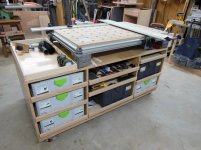
A little deeper... I'm gonna build something like this:
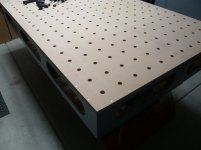
That clamp table has me intrigued. Looks like the floor is holding up decently.
A little deeper... I'm gonna build something like this:

I've only observed Festool from a distance, but I have always wondered what the point of this MFT table really is. It seems to me that the biggest disadvantage of the track saw is that you don't have the ability to make repeat cuts. When building cabinets I am more interested in having everything exactly the same than exactly the right size. For example, if all my casework is 1/16" big, that really doesn't matter to me, so long as it's all the same.
Is the MFT table trying to fix that? It seems to me that if you really set it up right, you could do lots and lots of repeat cuts.