

You are using an out of date browser. It may not display this or other websites correctly.
You should upgrade or use an alternative browser.
You should upgrade or use an alternative browser.
What is the fuss about Flare Nut Wrench
- Thread starter Hamster
- Start date
TheGrooveking
Well-known member
flare nut wrenches are designed to engage more corners of the fastener, and since many flare nuts are for tubing many of the flare nuts are made of brass and to minimize rounding/stripping the nut contacting more corners spread the force out over a greater area of contact. In the last 50 years more of the fasteners have become steel, when it comes to tubing and like, but the same theory applies.
TheGrooveking
TheGrooveking
moparmuscle88
Well-known member
old stuck on fittings can strip if there stuck on try a corroded brake line fitting with an open end wrench and dont strip it
there are alot of things you can get away without them, then otheres where they are a must have if you dont want to buy new fittings
there are alot of things you can get away without them, then otheres where they are a must have if you dont want to buy new fittings
caper
Well-known member
Try working on ten year old brake lines in the north east without flare nut wrenches and get back to me.The area you live in and the amount of salt and corrosion will affect whether you need flare nut wrenches or not.
Try working on ten year old brake lines in the north east without flare nut wrenches and get back to me.The area you live in and the amount of salt and corrosion will affect whether you need flare nut wrenches or not.
No doubt...
Step 1. I dont need no stinkin Flare wrench
Step 2. Round Nut
Step 3. Buy New Flare Wrench only to find out it wont fit on rounded nut.
Step 4. Grab the Vice Grips
Step 5. Either Replace Line or continue to damage fastener with Vice Grips.
sweetk30
Well-known member
RUST gets in the fittin and locks it up. then reg wrench rounds it off before you even get a chance to crack it loose.
Now I understand! I live in Florida and usually assemble new fittings.
I work on commercial cooking ranges and it is usually better, quicker and cheaper to ditch the old fittings and replace with new. So I just angle grind the old stuff off and use a socket to remove the remainder.
I work on commercial cooking ranges and it is usually better, quicker and cheaper to ditch the old fittings and replace with new. So I just angle grind the old stuff off and use a socket to remove the remainder.
Try working on ten year old brake lines in the north east without flare nut wrenches and get back to me.The area you live in and the amount of salt and corrosion will affect whether you need flare nut wrenches or not.
e-tek
Well-known member
Does anyone else find that flare nut wrenches will "flare" (spread) when torqued on, thus doing damage they where "designed" to prevent? If the fitting is loose, then a regular wrench or line-wrench is fine. But I've had old-timers tell me that if I need more torque, use a crescent wrench with the nut seated all the way into the wrench, which does seem to work! Anyone also find that?
regguy1
Well-known member
I never thought there was a "fuss"....... 
Flare nut wrenches do in fact give you the ability to put more torque on the tubing nut with less chance of deforming it. Also you can sometimes loosen and remove a tubing nut that otherwise would've been ruined. I always use them, as a deformed nut has the distinct look of "amatuer" work.
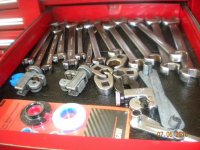
FYI: some FNW's have 4 point contact, I have Snap-On that have 5 point contact and do much better job. (see photo) My Snap-On wrenches have never "flared"
If you don't care how things look......just use visegrips.
Flare nut wrenches do in fact give you the ability to put more torque on the tubing nut with less chance of deforming it. Also you can sometimes loosen and remove a tubing nut that otherwise would've been ruined. I always use them, as a deformed nut has the distinct look of "amatuer" work.
FYI: some FNW's have 4 point contact, I have Snap-On that have 5 point contact and do much better job. (see photo) My Snap-On wrenches have never "flared"
If you don't care how things look......just use visegrips.
Attachments
Last edited:
Does anyone else find that flare nut wrenches will "flare" (spread) when torqued on, thus doing damage they where "designed" to prevent? If the fitting is loose, then a regular wrench or line-wrench is fine. But I've had old-timers tell me that if I need more torque, use a crescent wrench with the nut seated all the way into the wrench, which does seem to work! Anyone also find that?
The only Flare Wrenches ive ever had problems with is the Craftsman Raised Panels. They would spread under heavy Torque, To be completely Honest we are talking Rust Belt on 25+ year old vehicles.
alex71
Well-known member
Does anyone else find that flare nut wrenches will "flare" (spread) when torqued on, thus doing damage they where "designed" to prevent? If the fitting is loose, then a regular wrench or line-wrench is fine. But I've had old-timers tell me that if I need more torque, use a crescent wrench with the nut seated all the way into the wrench, which does seem to work! Anyone also find that?
I found my Craftsman professional did that, that's why I ditched them.
caper
Well-known member
Around here anything more than 5 yrs old usually requires a torch to get them loose,line wrench or not.Turn the fitting red,dump some water on it till the color comes out and then you can crack them loose and spin the fitting off with your fingers.Anything else usually results in replacing the lines.But hey,I live on an island in the north atlantic.
e-tek
Well-known member
The only Flare Wrenches ive ever had problems with is the Craftsman Raised Panels. They would spread under heavy Torque, To be completely Honest we are talking Rust Belt on 25+ year old vehicles.
****! Funny you mentioned Crafstman wrenches (not!)......

I found my Craftsman professional did that, that's why I ditched them.
they are professional, must be good.
afazz
Well-known member
As several above have said, working on rusty old junk requires flare nut wrenches. Here in PA, that basically means any brake lines older than 2006! I also made a lot of scrap trying to use my Craftsman flare nut wrenches. They should include a tubing cutter, flaring tool, and a pack of flare nuts with the set!
Snap-on are the best I've found. I have a full set of metric and inch. If I were only allowed to have one set of Snap-on tools, it would be the flare nut wrenches hands down.
Snap-on are the best I've found. I have a full set of metric and inch. If I were only allowed to have one set of Snap-on tools, it would be the flare nut wrenches hands down.
regguy1
Well-known member
As several above have said, working on rusty old junk requires flare nut wrenches. Here in PA, that basically means any brake lines older than 2006! I also made a lot of scrap trying to use my Craftsman flare nut wrenches. They should include a tubing cutter, flaring tool, and a pack of flare nuts with the set!
Snap-on are the best I've found. I have a full set of metric and inch. If I were only allowed to have one set of Snap-on tools, it would be the flare nut wrenches hands down.
..................

they are professional, must be good.
they were made by SK which many have begun to regard as amazing since the bankruptcy!
Garys Garage
Well-known member
I love my Snap On flare nut wrenches. I have the ones that are open on the other side but much thicker that standard wrench. Never flared on me. Cheap one are not worth buying.I bought some for my home box years ago and all of them stretched I think. I have Matco in some metric sizes that I bought when I thought Metric was a fad (lol). Just bought a larger set of metric's off here this week. Matco's will go to back up box.
nissan_crawler
Well-known member
Does anyone else find that flare nut wrenches will "flare" (spread) when torqued on, thus doing damage they where "designed" to prevent? If the fitting is loose, then a regular wrench or line-wrench is fine. But I've had old-timers tell me that if I need more torque, use a crescent wrench with the nut seated all the way into the wrench, which does seem to work! Anyone also find that?
You have the wrong ones.
I absolutely love the single ended 12 point protos for what I do, but good luck finding them.
For brake lines, 6 point is king.
gatewaysysop
Well-known member
Not trying to stir the pot, honest to God, but I have a question on the spreading issue. I have a few loose raised panel Craftsman and some of the pro versions as well. They've never caused me issue, but I'm in Arizona so I can see why.
My question for those experiencing the spreading as compared to Snap On, what exactly is happening here? Is a brass fitting holding up against and deforming a steel wrench OR is it that this is related to the Snap On wrenches fitting more precisely and allowing more force on the fastener before it rounds out/deforms itself under the stress?
I dunno, I've always been confused by how the softer material of the nut/fitting is able to spread a steel flare nut wrench. I haven't seen it first hand but I can imagine that if the wrench didn't fit as snug as, say, Snap On, then maybe it would round itself out without having to deform the wrench.
Does anyone who's experienced this first hand have some insight on whether it was the former or the latter? Has anyone slapped a micrometer on Snap On vs. other brands they have to see if they indeed fit more snugly perhaps? It would really be useful information at least to me. I'm all for buying the Snappy's if they work better, but I'd really like to understand if it's for the reason I suspect.
My question for those experiencing the spreading as compared to Snap On, what exactly is happening here? Is a brass fitting holding up against and deforming a steel wrench OR is it that this is related to the Snap On wrenches fitting more precisely and allowing more force on the fastener before it rounds out/deforms itself under the stress?
I dunno, I've always been confused by how the softer material of the nut/fitting is able to spread a steel flare nut wrench. I haven't seen it first hand but I can imagine that if the wrench didn't fit as snug as, say, Snap On, then maybe it would round itself out without having to deform the wrench.
Does anyone who's experienced this first hand have some insight on whether it was the former or the latter? Has anyone slapped a micrometer on Snap On vs. other brands they have to see if they indeed fit more snugly perhaps? It would really be useful information at least to me. I'm all for buying the Snappy's if they work better, but I'd really like to understand if it's for the reason I suspect.
afazz
Well-known member
It's a combination of the fit and the design of the wrench. For example my Snap-on 7/16" fits tighter than my Craftsman Pro 11mm, even though 7/16" is actually larger. And yes cheapo wrenches do spread, even on soft fittings. Think of a simplified version, like an open-end wrench, the two edges are being forced to bend out. It's like a diving board - you can make it bend down just by standing on it, even though your bare feet are surely softer than the fiberglass it's made from. It's a stiffness issue rather than a hardness or strength issue. The compressive stiffness of even the softest nuts is higher than the bending stiffness of some wrenches.
I would be curious to measure the outside diameter of the wrench itself as it starts to deform on a nut, I might give that a try this week.
I would be curious to measure the outside diameter of the wrench itself as it starts to deform on a nut, I might give that a try this week.
gatewaysysop
Well-known member
It's a combination of the fit and the design of the wrench. For example my Snap-on 7/16" fits tighter than my Craftsman Pro 11mm, even though 7/16" is actually larger. And yes cheapo wrenches do spread, even on soft fittings. Think of a simplified version, like an open-end wrench, the two edges are being forced to bend out. It's like a diving board - you can make it bend down just by standing on it, even though your bare feet are surely softer than the fiberglass it's made from. It's a stiffness issue rather than a hardness or strength issue. The compressive stiffness of even the softest nuts is higher than the bending stiffness of some wrenches.
I would be curious to measure the outside diameter of the wrench itself as it starts to deform on a nut, I might give that a try this week.
Definitely would like to see those numbers, this is quite useful information.
My single Snap-On tool (gasp) is a 7/16 flare nut wrench. Bought it to remove fuel and oil lines on my genset. These lines are pushing 40 years old, and they came right off with a shot of PB-Blaster and the wrench. Nothing rounded, and definitely reusable after a little clean up. I may even buy both sets at some point in the near future.
Tatsuya
Well-known member
What are the most common sizes of flare nut wrenches for automotive applications?
Interex
Well-known member
Flare wrenches are a MUST for taking off ATF lines. Even then, cheap flare wrenches will bend and you can still strip the nuts. I've got a set of Proto flare wrenches now (thanks to the GJ FS section) and they work awesome! No more bending!
when i was young i bought a cheap set of flare wrenches and managed to round off every brake line I worked on with the spreading issue...I had no idea it was the wrench doing it at first either....death to flare wrenches!!!
Fedwrench
ALLIANCE MEMBER
What are the most common sizes of flare nut wrenches for automotive applications?
It really depends on what you work on but, 3/8, 7/16, 8, 10, 15, and 18mm are the most worn out of mine.
mrshaun
Well-known member
The only Flare Wrenches ive ever had problems with is the Craftsman Raised Panels. They would spread under heavy Torque, To be completely Honest we are talking Rust Belt on 25+ year old vehicles.
the only ones that ever caused me hours of grief were EASCO branded. borrowed some snap ons from my uncle ( back in the day ) and have never used another brand since.
you cant go wrong buying snap on flare nut wrenches. Only 1 I had to warranty was because of chrome peeling..........
crewchief888
Well-known member
my more popular sizes seem to be 11/16" 3/4" 17mm & 18mm. mostly on old rusted power steering lines seems like ive had to remove more PS hoses in the last couple years than i have in the previous 20+ years.
<17mm is real popular on japanese diesels for inj lines>
but i did an engine swap in my s-10 4 years ago, and just recently changed the steering box, and replaced leaking lines on a friends smallblock wrangler that had been used to plow snow for quite a few years.
ive been picking up So, mac & sk flare nut wrenches for less than $5 in new condition at flea mkts and swap meets.

<17mm is real popular on japanese diesels for inj lines>
but i did an engine swap in my s-10 4 years ago, and just recently changed the steering box, and replaced leaking lines on a friends smallblock wrangler that had been used to plow snow for quite a few years.
ive been picking up So, mac & sk flare nut wrenches for less than $5 in new condition at flea mkts and swap meets.