To avoid these ads, REGISTER NOW!

“Cheater Bars” Discussion

oldschoolcraft

Well-known member
Joined
Dec 31, 2017
Messages
1,829
Location
Bay Area, California
Over the last few weeks I’ve seen different posters mention 6’, 8’, and one guy even a 10’ cheater bar. I understand the concept is to insert the handle of a tool into a pipe which lengthens the “lever arm“ and provides more leverage.

What I don’t understand is the specific ways of going about this.

What are you using for cheater pipes? What diameters and lengths do you keep? And is it just steel water pipe or what? Are you wrapping tape or anything around the pipe for grip? Are you drilling holes in it to add a strap? Are you painting it to look pretty, declare ownership, and prevent rusting? How do you store them in your garage?

What are the dos and donts for using them? What tools do you use them on and which do you never use them in? Do you wrap anything around the handle of the tool to avoid the end of the pipe from marring the chrome on your $200+ snap on breaker bar? Any safety tips?
 
To avoid these ads, REGISTER NOW!

DemoFly

Well-known member
Joined
Jan 13, 2016
Messages
271
Location
Port Orchard, WA
1" black steel pipe from the depot fits over my chrome handles. 1.5" would fit over comfort grips. You can buy galvanized if you're fancy.

Dos and don'ts? Understand that you're inputting serious torque. I use them on a breaker bar. Rarely do I use them on a ratchet because you'll snap the anvil or pawl of a ratchet quite easily. Obviously, you can use your judgement for this. If you just want to take off lug nuts with little fatigue you can use the cheater bar with a 1/2" ratchet no issue.

I store it upright in a corner with my brooms. Because it's just a piece of pipe.
 

tamaraw

Well-known member
Joined
Jun 6, 2022
Messages
843
Over the last few weeks I’ve seen different posters mention 6’, 8’, and one guy even a 10’ cheater bar.
Damn, those are pretty extreme examples. Seems like more industrial applications or maybe axle nuts/crank pulleys on a few consumer vehicles?

What are you using for cheater pipes? What diameters and lengths do you keep? And is it just steel water pipe or what? Are you wrapping tape or anything around the pipe for grip? Are you drilling holes in it to add a strap? Are you painting it to look pretty, declare ownership, and prevent rusting? How do you store them in your garage?
Sure, we'll say yes :LOL:

It's going to range from scrap that happened to be laying around at the right time to stuff someone found or made for a particular job. I know I used a copper pipe with a 90 degree bend once because it happened to be laying in the garage.

What are the dos and donts for using them?
Manufacturers for most wrenches, ratchets, or breaker do not officially support use of extensions or breaker bars, so that's a "don't" right off the bat if you are doing things 100% by the book.

Comparatively few tools officially support a cheater bar. These would be things like certain large ring spanners or 3/4" and up ratchets use round handles designed specifically for tubular extensions.

s-l1600 (5).jpg
Example of a Stahlwille spanner set, picture taken from ebay listing

s-l1600 (6).jpg
Example of a Snap-On 3/4" ratchet with removable handle, picture taken from ebay listing

Now, reasonably speaking, that doesn't mean that you can't use a cheater on a smaller drive tool; just use common sense. For example, if a manufacturer makes two different lengths of 1/2" ratchet both using the same head, you could probably fit a pipe over the shorter one to match the longer factory option and be pretty safe. Pushing length past that is where your luck may vary.

What tools do you use them on and which do you never use them in?
I probably wouldn't use one on most 1/4" drive stuff for fear of shearing the drive. I also might avoid using one over a lot of comfort grip handles because they don't fit inside a pipe very well and might pull off or get torn up.

When I suggested a cheater in your 3/8" trunk ratchet thread earlier, I was thinking of a 7.5" ratchet with a pipe that brings overall length to maybe 15-17" when you need the leverage. Nothing too crazy.

Do you wrap anything around the handle of the tool to avoid the end of the pipe from marring the chrome on your $200+ snap on breaker bar?
Chrome scratches are a regular part of use over time. But if you wanted to avoid really chewing up the metal with the end of a pipe (reasonable) or the pipe diameter was a is a bit larger than optimal, you could try wrapping the handle with a rag or sheet of rubber..

Any safety tips?
Use common sense. Don't put body parts in the path if something does let go. Try to size cheaters so that they fit the handle with minimal play. Don't exceed max length for a particular drive size or you might shear the drive off.
 

rockettauto

Well-known member
Joined
May 12, 2023
Messages
745
Just a pipe...I have a 4ft piece of fencepost and some random steel pipes.

In the army we had these


What's not shown is the body of that has a hole to run a bracing bar through it. On the rare occasion the impacts wouldn't cut it I'd chuck up an extension in the drill, pull the trigger and wait.....nothing that ever didn't see things my way. I think it did like 100:1 or something. ( Just checked ....it's well over that, max input is 15 ft lb to achieve 2500ftlb output)

But I think it would be reasonable if you work on any larger equipment to have of one of these around


Or these


Well before I'd regularly use a breaker over 4ft.
 
Last edited:

cvairwerks

Well-known member
Joined
Aug 12, 2016
Messages
7,246
Location
Within hearing distance of Texas Motor Speedway
We had a 10’ cheater in the research lab that was actually calibrated. Insert the specific wrench to a specified depth. Two people, each weighing 200+lbs, place their hands in marked locations and then haul down and reset as required. When both people could hang from the cheater and there was no movement, the required torque was achieved.

We had borrowed a Sweeney to proof out the cheater, as we didn’t have 20k$ in the budget for one with the adapters we would need.

Required torque on these nuts was 1200-1400 lb/ft.
 

MushCreek

Well-known member
Joined
Jan 14, 2015
Messages
9,814
Location
Upstate South Carolina
We routinely used modest cheater handles on Allen wrenches when tearing down injection molds. Some of the plastic outgas corrosive gases, and the fasteners have to be TIGHT. That, and hex keys aren't all the comfortable to really torque on.
 

Hannahranga

Well-known member
Joined
Mar 8, 2023
Messages
217
I needed one to get a crank bolt off (480Nm) so took my breaker bar off to my local steel shop and bought 2m of the heavy wall pipe that fit the best.

It's vaguely oiled with a millscale covering so it's slowly rusting in the corner of my shed between uses, if it get more than vaguely rusty I'll paint it.

My breaker bar is a cheapy so don't super care if I put some scratches in the chrome plus you don't really use a cheater bar all that often.

Yeah mostly just be careful of the fastener (or something) snapping or suddenly releasing while you're straining (the massive cheater pipe helps there)
 

dr_clyde

Well-known member
Joined
Jan 7, 2009
Messages
6,463
Location
Holland, MI
It’s not an exact science lol. I just grab whatever looks to be about right off the material rack, do the job, then put said pipe back for later.

I don’t keep any in my shop toolbox or anything.

I do keep a special piece of pipe in my trailer toolbox that is used for the lever style chain binders. That stays in the trailer. The only thing that makes it special is it fits in the toolbox.
 

strutaeng

Well-known member
Joined
Dec 12, 2011
Messages
2,288
Location
Dallas, TX
I once used a galvanized metal fence post (8' long IIRC) on a 18" Rigid pipe wrench to remove the gooseneck ball on my old K3500.

Sometimes you got to do what you gotta do.
 

RyanE

Well-known member
Joined
Feb 4, 2013
Messages
201
Location
Golden, BC
Yeah sometimes you do what you gotta do. Many years ago I was at the Pick and Pull and spotted a new looking set of rear leaf springs on a 3/4 ton truck. All I had was a basic socket set and my trusty Princess Auto 1/2" drive flex handled ratchet. Well, the U-bolt nuts were tight as frig and rusty to boot. They wouldn't budge.

I looked about for a snipe and lo and behold, the next truck over in the row had a 1 piece aluminum driveshaft lying underneath it with a twisted off yoke. Perfect! I slid that 6' driveshaft over the ratchet and got to it! With that kind of leverage, I didn't have to strain at all. I just walked back and forth with the driveshaft in my hands. And, the aluminum didn't even mar up my nice PAuto chrome......Win!
 

CoogarXR

Well-known member
Joined
Jan 11, 2016
Messages
6,867
Location
Ohio
I have had the same length of fence post in my garage for 30+ years. I don't know what it's made of, probably galvanized steel. I only use it as a cheater on my 3/4" drive stuff. It's a little baggy fit over the handle, but I slide it down about 15" or so, and it gives me 4-5ft of total leverage. I only need it about once a decade, lol. The last time I needed it was for a rusty hitch ball nut. I literally pushed the van sideways I was cranking so hard on it.

Hopefully I'll never need it again. I'm getting too old and fat to work that hard, lol.
 

American Locomotive

Well-known member
Joined
Jan 8, 2017
Messages
11,010
Location
Rhode Island
I use whatever is handy and fits the tool I'm using. If I'm using a wrench, I'll grab another wrench of approximately the same size and hook them together for "double wrenching". If I'm using a ratchet and happen to have a big wrench handy, I'll often put the box end around the ratchet handle. Otherwise I'll grab whatever piece of pipe is handy and fits over the ratchet handle. I've used jack handles, copper water pipe, pieces of PVC pipe (works surprisingly well), steel pipe, square tube. Whatever is handy. I've even used exhaust pipe and a transmission dipstick tube at a junk yard before!

I don't have a dedicated cheater (although I probably should).
 

NakeDiesel

Well-known member
Joined
Sep 6, 2007
Messages
2,750
Location
oklahoma
I'm probably one of the ones you saw talk about using long cheater bars, I was working on removing a rear wheel on a 60's john deere industrial tractor and air impacts weren't strong enough and used a 10' cheater pipe on my 3/4" ratchet with me standing and bouncing on it. It was just a piece of pipe we had laying around. I have various scrap pieces of pipe in my shop left over from one project or another and just grab one that fits the tool I'm using when I need one. I have one I carry in my truck that's about 1.5" id and about 2' long that I use to latch my boomers when chaining stuff down. Got another one about that size on the bottom tray of my tool cart that I've used with my 36" crescent or pipe wrench to break various hydraulic cylinders apart to rebuild them.
 

Ike Carlson

Well-known member
Joined
Jun 14, 2019
Messages
168
Location
Wisconsin
I removed the crank pulley from a northstar once. Long cheater and two of us on the end and it still barely came loose. It sounded like a rifle shot when it finally let go.
 

Al Borland

Well-known member
Joined
Jan 20, 2016
Messages
1,599
Two 3-4' lengths of pipe. Smaller fits 1/2" breaker, larger fits 3/4". And the smaller fits in the larger. So, effectively 8' of lever, and 300 lbs. of me. grand total of 2400 ft/lbs.
 

ItsNemo

Well-known member
Joined
Mar 5, 2016
Messages
4,806
Location
Canada
I've never needed a cheater...there's almost always a better way of doing it, while simultaneously also not breaking my tools or the thing I'm trying to take apart. If the big impact won't move it and the 3/4" drive breaker bar won't move it, then the blue wrench comes out, or worse case I'll just cut the hardware and replace it. Mind you, I don't work on heavy equipment or anything that needs 500+ ft-lbs of torque.

I do have a 4 foot chunk of 3/4" black gas pipe though, but I've only ever used it for bending rebar lol
 
To avoid these ads, REGISTER NOW!

AEAdam

Well-known member
Joined
May 27, 2023
Messages
2,785
Location
SE PA
I think the cheater bar lengths you are talking about are for heavy equipment or agricultural stuff and 3/4” or 1” drive.
A long pipe on a snap on 1/2” breaker doesn’t make much sense. Snap On 1/2” drive is good for around 750ftlbs.

I could be wrong but I think a hard one arm pull could be around 100lbs of load. 2 hands and putting your legs and back into it, could be double that pretty easily.

So you can do the math and see how long a bar is smart.

Also, if the socket you are turning isn’t huge, you’ll probably fail the bolt in shear with a long breaker.

The answer is an impact.
 

2ndGearRubber

Well-known member
Joined
Mar 24, 2014
Messages
14,185
Location
Pittsburgh
Pipes and jack handles work well. I now have a 36" 3/4 ratchet. Add a 4ft pipe on that gets you to 48", that's mostly enough for what I see.

Otherwise get a torch first
 

no704

Well-known member
Joined
Apr 27, 2016
Messages
5,229
Used a conduit bender on a four way a couple weeks ago. Worked great!
 

Firebrick43

Well-known member
Joined
May 12, 2015
Messages
14,166
Location
West central Indiana
I use 2 or 2 1/2 inch pipes for cheaters, because 3/4 or 1 will just kink. I am sliding a 6' pipe 2' on a 42 inch handled 3/4 or 1" snap on ratchet.

I love the "there is a better way of doing things" mantra

Sure their is. We could buy a $4,000 hydraulic drive reaction wrench, $500 in hoses, 1000 in the reaction bar, and another $3-4,000 in a hydraulic power pack and spend an hour setting it up or you can just get the ratchet and a cheater and have it done in 15 minutes.

We are not talking about repetitive assembly work which the above works great

nor are we talking about repairing ridgelines or santa cruz's

Warning, many 3/4 inch ratchets are pathetic and wont take the abuse. Craftsman 3/4 will explode in short order, their breaker bars were even worse. SK will bend the handles up by the head. I have had great luck with snap on and several guys I know are happy with their wright railroad ratchets.
 
Last edited:

Zewnten

Well-known member
Joined
Jun 11, 2017
Messages
1,839
My 1" torque wrench comes with a factory one so do my 1" breaker bar/ ratchet and tubular wrenches. Also seen a company that makes them for pipe wrenches.
 

RPH

Well-known member
Joined
Dec 17, 2006
Messages
4,190
Location
Michigan Thumb
Tekton 40” breaker bar. Rated to 1000 foot pounds, might as well start with length and ratings in your favor.
 

ItsNemo

Well-known member
Joined
Mar 5, 2016
Messages
4,806
Location
Canada
I use 2 or 2 1/2 inch pipes for cheaters, because 3/4 or 1 will just kink. I am sliding a 6' pipe 2' on a 42 inch handled 3/4 or 1" snap on ratchet.

I love the "there is a better way of doing things" mantra

Sure their is. We could buy a $4,000 hydraulic drive reaction wrench, $500 in hoses, 1000 in the reaction bar, and another $3-4,000 in a hydraulic power pack and spend an hour setting it up or you can just get the ratchet and a cheater and have it done in 15 minutes.

We are not talking about repetitive assembly work which the above works great

nor are we talking about repairing ridgelines or santa cruz's

Warning, many 3/4 inch ratchets are pathetic and wont take the abuse. Craftsman 3/4 will explode in short order, their breaker bars were even worse. SK will bend the handles up by the head. I have had great luck with snap on and several guys I know are happy with their wright railroad ratchets.

As I clarified, I'm not doing anything that requires that sort of torque in my home garage...the worst I might get is an axle nut or a seized control arm bolt or similar. I think that applies to most people here...and even then, some heat is usually enough to solve those problems if the 1000ft-lb impact wrench doesn't cut it.
 

22george

Well-known member
Joined
Jan 26, 2011
Messages
1,637
Location
SW Ohio
Back when l was replacing DC-9 trunnions we has special made crows feet and used a 4 foot long Snapon breaker bar with a 8 foot cheater bar to torque the nut until the pli washer wouldn't spin.
 

larry_g

Well-known member
Joined
Apr 28, 2007
Messages
16,893
Location
oregon
On the other end of the spectrum I carried a variety of 1/8" and 1/4" pipe ******* to use as cheaters on hex keys. In our industry a majority of fasteners were socket head screws from #2 to 3/8" threads. A pipe nipply cushioned a lot of the sting imparted when breaking loose tight ones.

lg
no neat sig line
 
Last edited:

bwringer

Well-known member
Joined
Jan 1, 2013
Messages
10,318
Location
Indianapolis
I've rummaged around a junkyard for a hunk of exhaust pipe... didn't realize that was so common.

The patrons at my local junkyard tend to be pretty friendly; if you're visibly struggling with something, someone will often come and help.


I don't often use cheaters, but when I do it's often not exactly because I need the leverage to get the job done; it's more a way to keep the forces involved slower, lower, and more controllable. Rather than bouncing on a breaker bar and possibly falling off when it breaks free, it's much safer to use a hunka pipe.

I recall a crank bolt with monster torque and terrible access where the accepted procedure was to place a socket and breaker bar with the end of the bar against the ground and bump the starter... always a white knuckle moment when the damn thing finally gave up with a lurch and a mighty bang.
 

dnschmidt

Well-known member
Joined
Oct 3, 2014
Messages
7,287
Location
Phoenix, AZ
All of these uses for cheater bars seem like manual labor to me which I've managed to avoid doing my entire life and at 71 I've got no intention of starting now. If I can't do it with my Aircat 1250K or my THOR impact I'll cut the sucker off with my plasma cutter. I hate sweating which I why I live in the desert with 15% humidity. The only thing I've ever needed to use a 24" breaker bar on was Subaru head bolts which are a foot long and are immune to impacts as they act like torque sticks.
 

G-ManBart

Well-known member
Joined
Jan 24, 2015
Messages
2,059
Location
Michigan
One don't.....don't put one on the handle of your bench vise and crank on it. That's a quick way to need a new vise.

I recently used one that was somewhere between 3ft and 4ft long to loosen a stuck lathe chuck backing plate. It had been on there for decades and wouldn't budge with all the usual methods. I have a spindle locking block to protect all the gearing while keeping it from turning, so I bolted the cheater to two bolt holes on the backing plate, and lifted myself off the ground with it...a couple of seconds later it popped loose. No beating, no banging, nothing damaged.
 

bigfunwmu

Well-known member
Joined
Oct 26, 2013
Messages
411
Location
S. MN
We have a 6 foot chunk of 2" OD heavy wall tubing we use on the chain wrench when servo cans won't spin out of the pump housing. Make sure the bench is bolted to the floor, or the whole thing spins instead of coming loose. The bad ones you get one guy on the chain wrench and another guy on the air hammer, those usually get thrown out by the time they're apart.

Your impact won't take any of the bad ones loose, they're round and the flats on the top are only rough cast so the socket just hammers its way off until the can is rounded over.
 

Ike Carlson

Well-known member
Joined
Jun 14, 2019
Messages
168
Location
Wisconsin
As gas been said, cheater bars are not used most of the time, only when appropriate. We all know people who would use one to tighten the lug nuts on a toyota......

Most of the time they are not needed or uncalled for. They can (and do) do more harm than good in the wrong hands. Don't just jump to "get a bigger hammer" syndrome. Many times there is a better way to do something with less force, or at least where more force is applied with understanding.
 

F-22

Well-known member
Joined
Jan 23, 2022
Messages
1,830
If I use a cheater bar, it's usually with the sliding T handle. I think that design is overall the strongest and they're also probably the cheapest tool to dive a socket if they do fail.
 

Samuel D

Well-known member
Joined
Apr 9, 2019
Messages
638
v9Daf1.jpg

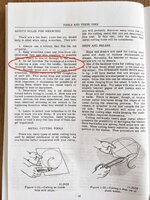
That’s from Rate Training Manual 10085-B by the US Bureau of Naval Personnel, original edition (1971), republished for a wider audience as Tools and Their Uses.
 
To avoid these ads, REGISTER NOW!
Top Bottom