David Jackson
Well-known member
A pretty special piece of work, that's for sure!

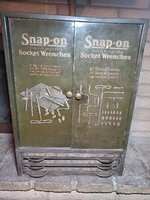
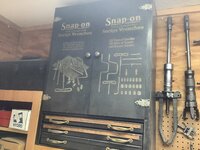
Retail units. Point of sale for distribution in hardware stores, etc...
Hardware store boxes.


I'm not questioning when they were made, Otg. I don't think X is, either. Clearly for 20s stuff. I'm not questioning what they were for, either. Clearly for organizing dozens of tools. And I've seen the label with the reference to "store" before. I'm just saying it contradicts their own literature. Nowhere in their own booklet describing their beginnings does it mention retail, and the narrative goes to great lengths describing and even celebrating the virtues of their direct selling operations. How can we ignore that? How do we explain that?The merchandisers were a 20s thing
Thanks for posting this. I'm not reading it to say definitively that there was never a retail effort or at least a hedge, but in extolling the virtues of direct sales etc. you'd think instead of not mentioning retail, if they were in fact doing it, they'd juxtapose those sales figures with the direct sales "experiments" to make their point about the superiority of direct. I only read thru it once but If someone came up with evidence of a retail presence I don't think it would contradict anything in that brochure. Anyway I wonder if the cabinets were not available/ intended for distribution to traditional retail locations if that might be part of their relative scarcity.Retail store merchandisers don't jibe with Snap-on's vaunted direct sales history. I don't think Snap-on tools were being sold out of hardware stores in the 30's and 40's, either. They were shunned by jobbers and retailers from the outset. In response, the tools were sold directly to garages, service stations, and mechanics by salesmen operating out of branches of the Motor Tool Specialty Company, which was set up explicitly for that purpose. Inventory was pre-positioned on consignment in those branches and, if I had to guess, that's exactly what these deep cabinets were for. Then, from the lessons they learned during WWII, the branches and salesmen went mobile, and the merchandise went into the trunks of cars and station wagons and trucks, and salesmen eventually became dealers and franchisees. That's the story that The Snap-on Story pamphlet tells. Published in 1960 for the occasion of the 40th anniversary stockholders' meeting.
Here are some key excerpts, yellow highlighting mine, but I highly recommend you read the whole thing. I am confident you'll reach the same conclusions.
 , but for me, it would be impossible to reach the conclusion that their tools were ever sold in retail stores based on The Snap-on Story booklet. Where, exactly, I ask myself, is there a place for a hardware store merchandiser to fit inside the implicit sequence of the 1930 "From Factory - to Branch - to You" slogan? I'm always open to additional evidence. All I am saying is I think that arguing with what Snap-on's founders are saying on the occasion of slapping themselves on the back about their early years would require it.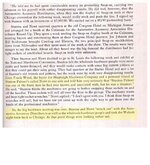
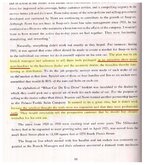
I don't know that anyone has ever done any objective neutral research to prove who had the first ever tool truck, but I thought the explanation in The Snap-on Story certainly went a long way in lending credence to the generally accepted idea that it was them and MAC and Cornwell followed suit.I wonder if other manufacturers may have either set the precedent or followed it to distribute tools from the truck, determining to follow the Snap-on lead initially or deciding that the Snap-on model represented more profits for the company. Did Mac initially distribute the same way? I know I saw S-K in stores long before I saw a truck. Cornwell also at some point followed the Snap-on lead.

Just think how well off we'd be as collectors if all the other 600-lb gorillas of the hand tools industry had the good hindsight and foresight to publish their "Story" for their own 40th anniversary stockholder meetings!Well this thread is droppin' some knowledge.
One of my someday projects is to find a 1923-25 Model T roadster and build a SO Dealer's box for it...
I’ll give it a try.I have had luck removing spray bomb with laquer thinner.
No way Bruh! I'm pushin all my chips in. Throw caution to the wind. Cry Havoc and let slip the dogs of war!....Once more into the breach! and all that.....Yes caution is advisable
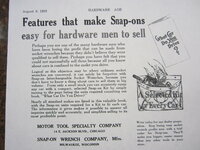
This makes me want one of these cabinets more than ever. It's in the top three treasure search list to this very day.Here are the references to the hardware store trade, including mentioning Shapleigh directly, that ended in early failure for Snap-on.
Here are the founders' referring directly to the merchandisers as a failed attempt and why I think there are so few. The 1923 ad snapmom just posted is an example of their efforts during this failed idea juncture. Again, leading to their direct to trade approach.
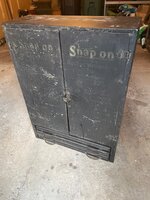
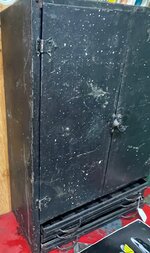
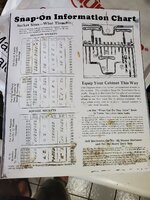
I've done very well with Dollar Store acetone nail polish remover. Same caution as with other chemical scrubs. You have to be very careful and know when to stop.So I'm not exactly going to the head of the class with this one but I did recognize it in an antique mall, the tag said only "industrial cabinet" and it looked like the first picture but from the side you could see the shape of the decals under the spray paint? maybe. Anyway I lightly hit it with a green pad and then wiped with water and made a little progress. Don't think that's going to work as well with the smaller letters etc. Any ideas for something that might remove a little paint without destroying the decals? BTW, hardly any rust at all even on the bottom or in the drawers which are straight and have the original handles and the little wheel inside for sliding. Looks like the original cabinet door handles were replaced. The shelf inside is present but the hangers have been ripped out the hardware on the inside of the doors is good.
'Zackly!This makes me want one of these cabinets more than ever.
Zoinks!!!So I'm not exactly going to the head of the class with this one, but...
Private Lugnutz said:"...SG absolutely WILL strip the old paint off an object left soaking in it..."
Did it say or do you have an idea when Midnight Blue Lou Graham was on tour?I don't know that anyone has ever done any objective neutral research to prove who had the first ever tool truck, but I thought the explanation in The Snap-on Story certainly went a long way in lending credence to the generally accepted idea that it was them and MAC and Cornwell followed suit.
That is, until I ran into this photo and blurb in one of the Plomb newsletters that @mritchie77 very generously scanned and posted for our endless enjoyment and information back in 2022! As I said on the 'Plomb Newsletters' thread at the time I was obsessively going through them..., I think this seriously challenges Snap-on's claim.
Yes, really. This isn't the first time I have reported this. I don't know about multiple layers, but I have literally stripped entire toolboxes with it by submerging one side at a time in a vat. I have no idea what chemical component of what kind of paint it breaks down, but it softens it up and it peels or falls right off after 24 hours or so.really? so... the 8-inch Danielson and Proto adjustables I picked up last week, both coated with multiple layers of 60-year-old-baked-on-spray-paint will clean up with just a soak in SG?
No. Zero effect on steel.will it cause the metal to rust or blacken?
No specific years are mentioned, in either of the two references to Mr. Graham and his truck, but the context is historical, not contemporary, and early 1920's is strongly implied.Did it say or do you have an idea when Midnight Blue Lou Graham was on tour?

A high def pic of the tools on the ground names to the players, and year on that shop pic and year and high def pic of tools on Lou’s carriage would be sweet.Yes, really. This isn't the first time I have reported this. I don't know about multiple layers, but I have literally stripped entire toolboxes with it by submerging one side at a time in a vat. I have no idea what chemical component of what kind of paint it breaks down, but it softens it up and it peels or falls right off after 24 hours or so.
No. Zero effect on steel.
No specific years are mentioned, in either of the two references to Mr. Graham and his truck, but the context is historical, not contemporary, and early 1920's is strongly implied.
The caption in that photo, which appears in Anvil Chorus Vol. 10, No. 14 (Apr 6, 1945) if you want to check it out yourself, says, "when Plomb tools were in their infancy," and, the article about Plomb roots accompanying the photo says that Graham was with the company for 22 years, only two fewer than Morris Pendleton. With a little math I read that as 1923.
A blurb on page 2 of Anvil Chorus Vol. 9, No. 26 (Jun 30, 1944) confirms this.
The Newsletters thread can be found in the A-Z Index in the Sticky.
(My research and analysis is copyrighted and shall not be used without mentioning me as the source. (Inside joke.))
I saw it earlier and was trying to figure out what to offer. I was reviewing that thread to see what it was supposed to look like. I wasn't losing sleep over it like I might have been with some other item especially since it was gonna be kind of like buying a chore.Zoinks!!!
Did you just happen to find that at an antique store 9 days after you bumped this 4-years old thread with an innocent question, as if the bump conjured it into existence? Or were you holding out on us?
That is a terrific, well-spotted, envy-inducing find.