

You are using an out of date browser. It may not display this or other websites correctly.
You should upgrade or use an alternative browser.
You should upgrade or use an alternative browser.
Show your new tool arrivals
- Thread starter sarel.wagner
- Start date


Prospecter
Well-known member
I like those trailer light testers. I also like these trailer lights for testing. I put them on the hood in front of the steering wheel where I can see them when I try signals and brakes.Had a Zoro code to burn so filled a few gaps.
Recently had trouble with trailer running lights (everything else worked fine) and I find testing with a DMM to be a PITA so I bought a couple of testers for the truck-side connectors and a new test light.
The CDI clicker replaces a Pittsburgh that was a raging POS. I liked the 5-75 ft-lb range on it, as it gives me good overlap at the low and high ends with my other "good" torque wrenches.


stevobeavo
Member
- Joined
- Feb 24, 2024
- Messages
- 16
Picked up an astro pneumatic 1/8 pencil die grinder of amazon USA for £37 ($48) delivered. Only took a week to get to me in the UK.
Seems pretty much identical to the blue point one my boss has.
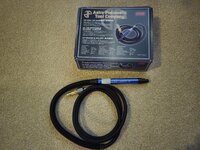
Seems pretty much identical to the blue point one my boss has.

Anywhere you might find Robertson fasteners, nothing specific in my case.Curious what you use those for? I hear Robertson and I think 3" deck screws.
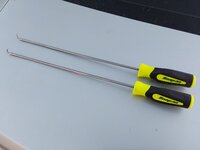
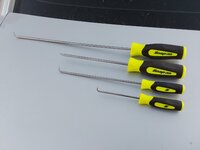
I had a couple old beat up Craftsman drivers, but not the full size range. I was looking at the Gray set but the current ones are unfortunately imported from USA. Not a big fan of the Klein or Mayhew handles, and none of the Japanese brands make them, so I decided to splurge and try the Snap-On ones. Kind of a buy it for life type deal.
Not sure why I felt the need to buy these, but these Craftsman v-series tools are nice and these Lowe’s sales prices are a really good value. Redundancy for the redundancy for the redundancy… Holiday gifts is a better explanation for this over buying.

Since UPS managed to F up yet another delivery and I won't be throwing in some much needed
upgrades into my T4R, I comforted myself with some Icon middies. (Great deal with a borrowed ITC!)
Speaking of comfort, I'll let you razz my tender digits from my 2 current favorite ratchets*.
Honestly, the Tekton handle is great fit and I sometimes kind of wish I could switch the two

*bonus points if you can spot the diy "lock" for the flex head
upgrades into my T4R, I comforted myself with some Icon middies. (Great deal with a borrowed ITC!)
Speaking of comfort, I'll let you razz my tender digits from my 2 current favorite ratchets*.
Honestly, the Tekton handle is great fit and I sometimes kind of wish I could switch the two
*bonus points if you can spot the diy "lock" for the flex head
Fedwrench
ALLIANCE MEMBER
You don't have to justify your purchases hereNot sure why I felt the need to buy these, but these Craftsman v-series tools are nice and these Lowe’s sales prices are a really good value. Redundancy for the redundancy for the redundancy… Holiday gifts is a better explanation for this over buying.
 I have everything you posted aside from the SAE stuff and I opted for the all metal handle flex head ratchet set. Great job!! now get the tools dirty!
Fedwrench
ALLIANCE MEMBER
I think Tekton got their soft grip handle design down pat. It feels great. I do wish that flex head was an inch or two longer though.Since UPS managed to F up yet another delivery and I won't be throwing in some much needed
upgrades into my T4R, I comforted myself with some Icon middies. (Great deal with a borrowed ITC!)
Speaking of comfort, I'll let you razz my tender digits from my 2 current favorite ratchets*.
Honestly, the Tekton handle is great fit and I sometimes kind of wish I could switch the two
*bonus points if you can spot the diy "lock" for the flex head
four.cycle
Well-known member
^ How many negative comments have we seen on that stuff other than a couple complaints about backdrag on the 1/4" model?
Not sure why I felt the need to buy these, but these Craftsman v-series tools are nice and these Lowe’s sales prices are a really good value. Redundancy for the redundancy for the redundancy… Holiday gifts is a better explanation for this over buying.
Gifts for friends and loved ones?
Or the unspoken category? Which I call "Merry Christmas TO ME!"
I gave into the peer pressure and smoked the dope bought the tiny Titan ratchet. It's comical!
On the left, my now-old Griot's Garage (Astro, likely) gearless tiny ratchet, which for years I have hectored people to get, it's my best close-quarters ratchet. Only drawback is the lack of a reverse switch. I'm not sure they make'em like they used to, but in my day, they were smooth as silk. Backdrag is very light. "Number of teeth" is not a real metric for these things but they sure aren't 0 degrees backlash. But they're as good as any other good ratchet on that metric.
On the right is another Titan a friend of mine persuaded me to get about two years ago, at the O'Reilly's or some such place.
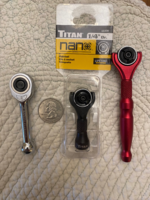
On the left, my now-old Griot's Garage (Astro, likely) gearless tiny ratchet, which for years I have hectored people to get, it's my best close-quarters ratchet. Only drawback is the lack of a reverse switch. I'm not sure they make'em like they used to, but in my day, they were smooth as silk. Backdrag is very light. "Number of teeth" is not a real metric for these things but they sure aren't 0 degrees backlash. But they're as good as any other good ratchet on that metric.
On the right is another Titan a friend of mine persuaded me to get about two years ago, at the O'Reilly's or some such place.
Last edited:
SouthernIllinois
Well-known member
- Joined
- Jan 14, 2024
- Messages
- 1,777
1980's Era KR Series box and chest. Twins to the set I had back in the day.
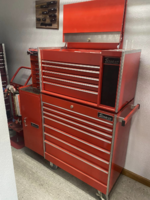

SouthernIllinois
Well-known member
- Joined
- Jan 14, 2024
- Messages
- 1,777
Ordered today - be here in a few days

manwithtools
ALLIANCE MEMBER
Got a shop building project underway. Decided that warranted a couple of tools to help finish the inside framing and strapping. 30 degree framing nailer and 3 plane laser.

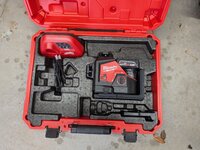
Dave455
Well-known member
Well if those screwdrivers are French made they are basically Facom, and very decent.Not sure why I felt the need to buy these, but these Craftsman v-series tools are nice and these Lowe’s sales prices are a really good value. Redundancy for the redundancy for the redundancy… Holiday gifts is a better explanation for this over buying.
Ditto that bit driver, which may well have a lovely ratcheting action.
The socket sets are only minor variations on Facom so I suspect not rubbish either.
I’m not sure you can ever have too many complete little sets like this, so If you're getting good prices I’d be going for it too!
IRQVET
Well-known member
This was one of those way overdo purchases, as I needed to replace that death trap of a floor jack my wife's father "gave us." In hindsight, I think he was trying to kill me . . . or trying to avoid a trip to the dump.
And I needed a low profile solution. HD had these on sale, so I had to take advantage. Black Friday prices and they shockingly let me use my veterans discount on top of that sales price, so it was a steal at $109 OTD.

And I needed a low profile solution. HD had these on sale, so I had to take advantage. Black Friday prices and they shockingly let me use my veterans discount on top of that sales price, so it was a steal at $109 OTD.
Last edited:
Placed an order today for some pliers organizers from The Jungle. They should be in Thursday, I believe.
Well if those screwdrivers are French made they are basically Facom, and very decent.
Ditto that bit driver, which may well have a lovely ratcheting action.
The screwdrivers are indeed made in France. The ratcheting bit driver is made in Taiwan - still very nice.
PugetDude
ALLIANCE MEMBER
Eric, were you and @BlakeTheCarGuy separated at birth?Added a few more sockets to the Hansen trays. More Carlyse coming from NAPA later today and getting shipped directly.

LoL, no. I believe I'm old enough to be his father.Eric, were you and @BlakeTheCarGuy separated at birth?
I'm just trying to fill out the Hansen socket trays.
02Xterra
Well-known member
Recent arrivals from Tekton, Cripe Distributing, and HJE, though I won't be keeping them. I acquired 8 of the mini buckets before they went out of stock and wasn't sure what to do with them.. but it turns out 8 is the exact number of brothers, brothers-in-law, dad/FIL, uncles i intend to give gifts to, so I decided to put these together for Christmas! ~$52/bucket


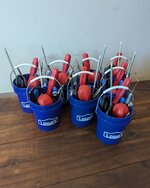
For now they are pretty full, but I'll probably find something else to put in there before I give them out
For now they are pretty full, but I'll probably find something else to put in there before I give them out
Beerhippie
Well-known member
^ No handles for the files? CHEAPSKATE
02Xterra
Well-known member
^ No handles for the files? CHEAPSKATE
 Honestly I've never used a file that small that had a handle so I hadn't even thought of it! I'll see what I can find
Beerhippie
Well-known member
What I really meant was "Do you have any unmarried sisters?"
rockinacummins
Well-known member
Tractor Supply finds. The bigger one was in the clearance section. I’ve been working inside a livestock trailer in the evenings and needed a magnetic light to stick on the roof. Been really pleased with it so far. The little one was in a bin by the register. The lady checking me out said hey do you need any more lights? These are $5 (she was right, it wasn’t $4.95 or $4.99, it rang up as $5 exactly). Been pleased with it as well.
In fact, I liked them both so much I went back and got another of each. I actually would have gotten a few more of the bigger one, but there was only one left so I was glad to get it.
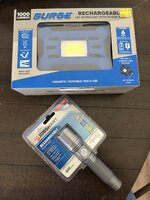
In fact, I liked them both so much I went back and got another of each. I actually would have gotten a few more of the bigger one, but there was only one left so I was glad to get it.
Recent arrivals from Tekton, Cripe Distributing, and HJE, though I won't be keeping them. I acquired 8 of the mini buckets before they went out of stock and wasn't sure what to do with them.. but it turns out 8 is the exact number of brothers, brothers-in-law, dad/FIL, uncles i intend to give gifts to, so I decided to put these together for Christmas! ~$52/bucket
For now they are pretty full, but I'll probably find something else to put in there before I give them out
Cool idea

jeffmoss26
Well-known member
nice!!
PugetDude
ALLIANCE MEMBER
Can someone just identify as a Brother in Law?What I really meant was "Do you have any unmarried sisters?"
( Asking for a friend)
BobsYourUncle69
Well-known member
I purchased a Klein ratcheting screw driver in May and I've been using it a lot. I didnt pay attention to the fact that it didnt take regular bits when buying it.I really like the mechanism and the whole thing in general except for the fact that it takes proprietary bits. I wore my PH2 bit finally today , not badly, but it now slips out when I apply a lot of torque (probbaly more than I should be anyway ). I got another klein ratcheting screw driver but one that takes impact bits as now replacing bits , finding replacement bits or using an adapter that takes 1/4 bits has made life a whole lot easier.
I do not like it when something that can be universal, isn't for the sake of not being universal which I've been ok with here as the bit lasted longer than I'd ever have expected but now that it did wear ,i had to stop and drive to HD when i should have just repalced the bit and carried on with the task at hand, something that can take universal bits had become a requirement.
This is my favorite ratcheting screw driver at this price point +-$20. The Lennox i bought a few mo ths ago has awful backgrag and is too heavy.
I do not like it when something that can be universal, isn't for the sake of not being universal which I've been ok with here as the bit lasted longer than I'd ever have expected but now that it did wear ,i had to stop and drive to HD when i should have just repalced the bit and carried on with the task at hand, something that can take universal bits had become a requirement.
This is my favorite ratcheting screw driver at this price point +-$20. The Lennox i bought a few mo ths ago has awful backgrag and is too heavy.
Attachments

Mr. Roboto
Well-known member
Set of axle nut sockets

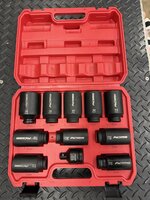
Wine bottle corks should do for those. (I'm joking, never done it, but now that I think of it... hmm...)
I purchased a Klein ratcheting screw driver in May and I've been using it a lot. I didnt pay attention to the fact that it didnt take regular bits when buying it.I really like the mechanism and the whole thing in general except for the fact that it takes proprietary bits. I wore my PH2 bit finally today , not badly, but it now slips out when I apply a lot of torque (probbaly more than I should be anyway ). I got another klein ratcheting screw driver but one that takes impact bits as now replacing bits , finding replacement bits or using an adapter that takes 1/4 bits has made life a whole lot easier.
I do not like it when something that can be universal, isn't for the sake of not being universal which I've been ok with here as the bit lasted longer than I'd ever have expected but now that it did wear ,i had to stop and drive to HD when i should have just repalced the bit and carried on with the task at hand, something that can take universal bits had become a requirement.
This is my favorite ratcheting screw driver at this price point +-$20. The Lennox i bought a few mo ths ago has awful backgrag and is too heavy.
I looked into the Vessel ratcheting bitdriver for you and alas, found this review:
It’s a nice driver. Fit and finish is fabulous. It’s well built and I imagine it’ll be nice over a long period of time. That being said, I’m docking a Star for it being very easy to move the direction ring while screwing. It’s not bad, but it’s gotten me a couple of times. Also, my big issue is that the stubby part really only works well with longer impact bits.
The ring that holds the bits in is so tight that if you put a regular drill bit in there, it’s going to be extremely difficult to remove. With the supplied Ph2 it’s easy, because it’s longer and has an area you can grab since its impact rated. If I put a similar ph2 from my tool check plus, it’s stuck and you can’t get enough purchase to remove the bit. You have to whip out pliers to remove it. Happens with every bit that doesn’t happen to be a little longer or impact rated. Weird issue but that’s part of the beast. Also the back drag is fine but it could be lighter.
PelicanPines
ALLIANCE MEMBER
What about Uncle Pines?Recent arrivals from Tekton, Cripe Distributing, and HJE, though I won't be keeping them. I acquired 8 of the mini buckets before they went out of stock and wasn't sure what to do with them.. but it turns out 8 is the exact number of brothers, brothers-in-law, dad/FIL, uncles i intend to give gifts to, so I decided to put these together for Christmas! ~$52/bucket
For now they are pretty full, but I'll probably find something else to put in there before I give them out
neophyte
Well-known member
There are lots of “proprietary” screwdriver bits, that aren’t really “proprietary”, they’re just a weird standard, designed years ago, before there was much in the way of a “Universal Standard” for screwdriver bits.I purchased a Klein ratcheting screw driver in May and I've been using it a lot. I didnt pay attention to the fact that it didnt take regular bits when buying it.I really like the mechanism and the whole thing in general except for the fact that it takes proprietary bits. I wore my PH2 bit finally today , not badly, but it now slips out when I apply a lot of torque (probbaly more than I should be anyway ). I got another klein ratcheting screw driver but one that takes impact bits as now replacing bits , finding replacement bits or using an adapter that takes 1/4 bits has made life a whole lot easier.
I do not like it when something that can be universal, isn't for the sake of not being universal which I've been ok with here as the bit lasted longer than I'd ever have expected but now that it did wear ,i had to stop and drive to HD when i should have just repalced the bit and carried on with the task at hand, something that can take universal bits had become a requirement.
This is my favorite ratcheting screw driver at this price point +-$20. The Lennox i bought a few mo ths ago has awful backgrag and is too heavy.
Many of these “Weird Standards” are used by multiple manufacturers, and still in production.
While 1/4” hex shank buts are common in the USA, there are still variations, such as “Insert Bits” with the small tiny groove, and “quick change bits” with the much larger round groove for a ball bearing lock (and If I’m not mistaken, there are at least two or more standards for this system with different dimensions).
In addition, there are “Long Shank 1/4” screwdriver blades” used in products like the Facom, and Craftsman, and USAG screwdrivers, as well as some Japanese made screwdrivers.
There are also the “Multi Bit 6 in 1” screwdrivers, with double ended bits with the ball lock mounted in the bits, which GJ members seem to love.
In Europe, hex shank multiblade screwdrivers were common, but 6mm and 4mm shanks seem to have been the standard, and Wiha, Wera, and some other manufacturers still make the screwdrivers and blades, as did Facom in the past, and some Japanese manufacturers.
4mm hex still seems to be a common standard for smaller screwdriver bits.
Even before hex shank bits became standard, there were other standard interchangeable screwdriver blade systems, such as the Yankee (Stanley) bits, which came in three standard blade shank diameters, and which may still be in production. (Although not by Stanley).
Goodell-Pratt had the Mr Punch, spiral screwdriver drill system, which used a standard but different bit type to the Stanley/Yankee drivers.
There are also multiple screwdriver designs that use flags or tabs pressed out of the driver shank for interchangeable bits, but these aren’t always interchangeable amongst each other, such as Excelite and PB Swiss.
There are also small screwdrivers, such as the Moody precision screwdrivers, that have their own interchangeable designs. (I think Moody actually has two separate systems), and one of these systems may be used by other precision screwdriver manufacturers like Starrett, although I’ve never checked.
While I would prefer it if larger screwdrivers had a holder for 1/4” insert bits, it is still not common, and there are plenty of reasons for this.
Some of the other screwdriver systems work better, either for carrying more bits in the same space, or for use in certain areas, such as deep screws in electronics, were even a 1/4” hex blade won’t fit (but a 6mm hex blade will).
PugetDude
ALLIANCE MEMBER
And Aunt Peg?What about Uncle Pines?
Wine bottle corks should do for those. (I'm joking, never done it, but now that I think of it... hmm...)
P.S. This fits in with my gripe: "Just because the file got smaller doesn't make my hands any less big!"
See also, sockets, etc, and related: "Just because the screwdriver tip got bigger doesn't mean the work is further away!" My new NOS FACOM 13mm nutdriver is almost 10" long, and that gets in the way sometimes.


PelicanPines
ALLIANCE MEMBER
FREE Vessel Screwdriver (ratcheting)... with Amazoon Credits. I like this one better than the ones that just have a defined head on them... I like to use my bits... so to speak.


SouthernIllinois
Well-known member
- Joined
- Jan 14, 2024
- Messages
- 1,777
stopped in Home Depot for the new model 3/8 impact and Harbor Freight for sockets and adapters
