To avoid these ads, REGISTER NOW!

Voltage at your house or shop

Brandon_oma#692

Well-known member
Joined
Apr 20, 2011
Messages
275
Location
North West corner of Illinois
Location based what is your incoming voltage and have you had any problems with something not working?

Illinois USA, The code I found is 113-127 so I am assuming 226-254 line to line?

My CNC lathe would not run sporadically the past couple weeks and this weekend was worse. I thought it was the spindle drive failing. I checked line to line and was usually around 253-253 and saw 255 once or twice this weekend. Daytime or night did not matter. I was trying to rule out overproduction from my solar. when I was wiring it up I think i was around 240-246 last year.

I called the utility and submitted a ticket this morning. Utility company called back today while I was at work. First guy went to the substation just across the field that feeds my line. He bumped it down a little. Said it was at the very top of the limits 252-254. I asked if my transformer at my driveway was adjustable with multiple taps. He wasn't sure.

Second guy called he was at my place. Transformer not adjustable with multiple taps. Said it could be swapped out if needed, but not today. These transformers are just for my place. Said he might turn it down a bit more at the substation. not sure if he did.

Just got home. 244 all leg to leg. Turned breaker on. Hit green button and fired up. Homed, turned spindle manual and worked. Auto cycle, turn down rapid because I'm a chicken, cycle start and good part! Great success!

I realized my solar did not run some days due to AC voltage to high error. When checking the logs this also happened in the middle of the night, so I assumed it was incoming not my production.

Time to prep for a new (used) machine delivery. totally unrelated. Then get back running parts again on this one after the move is complete.
 
Last edited:
To avoid these ads, REGISTER NOW!

mm08822

Well-known member
Joined
Jan 13, 2012
Messages
6,068
Location
NJ
Before you go that route:

Verify the fault that the hardware has. Check what the drive state may be. Cycle power, see if it persists at whatever the current voltage is.
Call the drive mfr and get the specs, explain the symptoms as found, etc.

Worst case you might need a buck-boost xformer to drop a few volts. This would only be something to do after you are certain the incoming voltage is over spec. Also would help to know the acceptable lower end voltage you are receiving. Any chance you can trend this for several days/weeks?

POCO may have changed their tap settings anticipating summer demand from ac units. Your problem could be seasonal. If so, I could show you what I did for a customer who was experiencing low voltage in his office building during the summer.

You may also have dc power supplies feeding the drives. The power supplies could be shutting down instead. Get the specs on them as well. Also measure their output and see if that is in an acceptable range for the drives.
 

paulsomlo

Well-known member
Joined
Jul 16, 2013
Messages
3,915
Location
Northern Colorado
Some friends of mine had a large solar array some distance from the house and the pole. On days with full sun, around noon, the inverter would shut itself down. I agreed to take a look, went out there with my DVM, looked up some specs online and spoke to the mfg of the inverter.

The installer just happened to arrive while I was out there poking around - he was not happy. Told me how I shouldn't be in there messing with it, very sensitive electronics, void the warranty, etc.. and how he passed the "solar test" that even licensed electricians can't pass. The solar test must not have included Ohms law, as he apparently (under) sized the wire by the NEC and the inverter was shutting down due to overvoltage. He got into a ******* contest with the POCO, thought they would solve his problem. A few weeks later, he was out there upsizing the wire (several hundred feet) - the kicker? The conduit needed upsizing as well - and at the time, they had a second conduit laid for future expansion; they forced him to dig that one up and replace it, as well.
 
  • Like
Reactions: Max

Codyboy

Well-known member
Joined
Jan 31, 2019
Messages
1,730
Location
S.E. TEXAS
+ or - 5% of nominal voltage was considered spec.

120 = 114 to 126
240= 228 to 252.

I find it really odd that you put in a voltage check and they went straight to the sub and started adjusting taps?
Not normal where I worked. That would be way down the line in protocol.

Come out check voltage at the house. High/low , check it all yhe way back to the transformer. If out of sorts,
Find another single phase transformer on the same phase and check it there.
If the next one or two houses check ok, then the transformer at your house could be bad. It could have a shorted coil and getting wonky voltage.
 

Codyboy

Well-known member
Joined
Jan 31, 2019
Messages
1,730
Location
S.E. TEXAS
Location based what is your incoming voltage and have you had any problems with something not working?

Illinois USA, The code I found is 113-127 so I am assuming 226-254 line to line?

My CNC lathe would not run sporadically the past couple weeks and this weekend was worse. I thought it was the spindle drive failing. I checked line to line and was usually around 253-253 and saw 255 once or twice this weekend. Daytime or night did not matter. I was trying to rule out overproduction from my solar. when I was wiring it up I think i was around 240-246 last year.

I called the utility and submitted a ticket this morning. Utility company called back today while I was at work. First guy went to the substation just across the field that feeds my line. He bumped it down a little. Said it was at the very top of the limits 252-254. I asked if my transformer at my driveway was adjustable with multiple taps. He wasn't sure.

Second guy called he was at my place. Transformer not adjustable with multiple taps. Said it could be swapped out if needed, but not today. These transformers are just for my place. Said he might turn it down a bit more at the substation. not sure if he did.

Just got home. 244 all leg to leg. Turned breaker on. Hit green button and fired up. Homed, turned spindle manual and worked. Auto cycle, turn down rapid because I'm a chicken, cycle start and good part! Great success!

I realized my solar did not run some days due to AC voltage to high error. When checking the logs this also happened in the middle of the night, so I assumed it was incoming not my production.

Time to prep for a new (used) machine delivery and get back running parts again.
If there is an incoming power problem why would "prep for a new machine" be in order?
 

wyliesdiesels

Well-known member
Joined
Aug 14, 2012
Messages
20,095
Location
Modesto, CA
Location based what is your incoming voltage and have you had any problems with something not working?

Illinois USA, The code I found is 113-127 so I am assuming 226-254 line to line?

My CNC lathe would not run sporadically the past couple weeks and this weekend was worse. I thought it was the spindle drive failing. I checked line to line and was usually around 253-253 and saw 255 once or twice this weekend. Daytime or night did not matter. I was trying to rule out overproduction from my solar. when I was wiring it up I think i was around 240-246 last year.

I called the utility and submitted a ticket this morning. Utility company called back today while I was at work. First guy went to the substation just across the field that feeds my line. He bumped it down a little. Said it was at the very top of the limits 252-254. I asked if my transformer at my driveway was adjustable with multiple taps. He wasn't sure.

Second guy called he was at my place. Transformer not adjustable with multiple taps. Said it could be swapped out if needed, but not today. These transformers are just for my place. Said he might turn it down a bit more at the substation. not sure if he did.

Just got home. 244 all leg to leg. Turned breaker on. Hit green button and fired up. Homed, turned spindle manual and worked. Auto cycle, turn down rapid because I'm a chicken, cycle start and good part! Great success!

I realized my solar did not run some days due to AC voltage to high error. When checking the logs this also happened in the middle of the night, so I assumed it was incoming not my production.

Time to prep for a new (used) machine delivery and get back running parts again.
yes i have had an issue with incoming voltage being too high.... troubleshooter had to go to substation to turn the voltage down on the transformer and called me back stating the circuitry inside the transformer that auto adjusts the line voltage was dead and needed to be repaired...

Ive also had an issue with the voltage being too low in mobile home park... customers breakers were tripping due to appliances drawing too much current

if your lathe is that sensitive to voltage i would look into getting a voltage regulator for it...
 

wyliesdiesels

Well-known member
Joined
Aug 14, 2012
Messages
20,095
Location
Modesto, CA
Some friends of mine had a large solar array some distance from the house and the pole. On days with full sun, around noon, the inverter would shut itself down. I agreed to take a look, went out there with my DVM, looked up some specs online and spoke to the mfg of the inverter.

The installer just happened to arrive while I was out there poking around - he was not happy. Told me how I shouldn't be in there messing with it, very sensitive electronics, void the warranty, etc.. and how he passed the "solar test" that even licensed electricians can't pass. The solar test must not have included Ohms law, as he apparently (under) sized the wire by the NEC and the inverter was shutting down due to overvoltage.
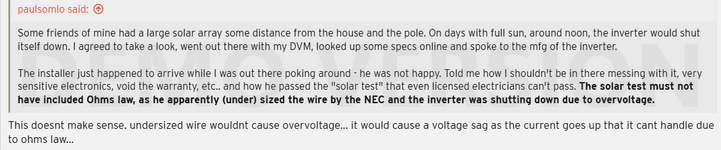
This doesnt make sense. undersized wire wouldnt cause overvoltage... it would cause a voltage sag as the current goes up that it cant handle due to ohms law...
 

mm08822

Well-known member
Joined
Jan 13, 2012
Messages
6,068
Location
NJ
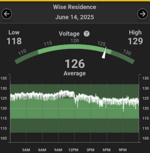
1750135592169.png
Actually it does, for a different reason.

The inverter has a bussful of energy it wants to push out to somewhere.....in this case the grid. (It doesn't care if it is your house or the grid or both.) In order for the inverter to be able to move that energy, the inverter has to raise its output voltage so current starts to flow. A higher voltage at the inverter than the 'lil can on the pole is outputting will cause that stored energy to flow back into the grid.

However, any current flowing along that wire creates a voltage drop due to resistance in the conductors. So the inverter keeps incrementing the voltage up to move a predetermined amount of current. Obviously, this has to have a limit otherwise it could burnout many things local to the inverter.

If that limiting voltage is reached at the inverter, the inverter will fault out and solar production stops. It's a software safety to prevent hardware burn up.
 
Last edited:

mm08822

Well-known member
Joined
Jan 13, 2012
Messages
6,068
Location
NJ
Exactly. Talk about jumping the gun. Op jumped the line before the starter even started squeezing the trigger.
Nail down the power problem first.
ETA
The new thing. Just throw parts at it i guess.
He's putting the problem out there for discussion/next steps. Had he ordered a new machine already, that would be a problem.

A buck boost xformer is real cheap compared to other options. (But even that might be jumping the gun.)
 
OP
B

Brandon_oma#692

Well-known member
Joined
Apr 20, 2011
Messages
275
Location
North West corner of Illinois
Before you go that route:

Verify the fault that the hardware has. Check what the drive state may be. Cycle power, see if it persists at whatever the current voltage is.
Call the drive mfr and get the specs, explain the symptoms as found, etc.

Worst case you might need a buck-boost xformer to drop a few volts. This would only be something to do after you are certain the incoming voltage is over spec. Also would help to know the acceptable lower end voltage you are receiving. Any chance you can trend this for several days/weeks?

POCO may have changed their tap settings anticipating summer demand from ac units. Your problem could be seasonal. If so, I could show you what I did for a customer who was experiencing low voltage in his office building during the summer.

You may also have dc power supplies feeding the drives. The power supplies could be shutting down instead. Get the specs on them as well. Also measure their output and see if that is in an acceptable range for the drives.

Drive would not do anything. The lcd screen with error codes was blank. No ready indicator. some led's were lit, but not the green "ready" one. I did have an over volt error before. I adjusted the accel and decel parameters. From what I found on decel it could cause it, and it was running parts stopping to switch directions when the error happened. This was 6 months ago and no problems till recently.

Changing for anticipated demands makes sense. Might be what happened.

Machine has a transformer. it has taps for 220 230 and 240 input. It is on 240 taps.

Drive and spindle motor are AC. Small power supply for 24v for controls.


Old picture from when I changed the taps. Right was as I bought it for 230 left of picture is how all 3 sets are and have been for 240.

1750136365702.png


+ or - 5% of nominal voltage was considered spec.

120 = 114 to 126
240= 228 to 252.

I find it really odd that you put in a voltage check and they went straight to the sub and started adjusting taps?
Not normal where I worked. That would be way down the line in protocol.

Come out check voltage at the house. High/low , check it all yhe way back to the transformer. If out of sorts,
Find another single phase transformer on the same phase and check it there.
If the next one or two houses check ok, then the transformer at your house could be bad. It could have a shorted coil and getting wonky voltage.

The way he made it sound on the phone with the smart meters they can see voltage live at all the houses. Or possibly it was some other way. He said it was high all the way to the end. I was hoping it was not low at the end as I am at the start.


If there is an incoming power problem why would "prep for a new machine" be in order?

I have been working on a deal to purchased a mill the last couple weeks. It is coming this Friday. Heading in tomorrow to prep it for transport. Unrelated to the problems with this lathe. Just happens to be at the same time.


1750136106910.png
 
OP
B

Brandon_oma#692

Well-known member
Joined
Apr 20, 2011
Messages
275
Location
North West corner of Illinois
and a new machine could have same problamo.

Exactly. Talk about jumping the gun. Op jumped the line before the starter even started squeezing the trigger.
Nail down the power problem first.
ETA
The new thing. Just throw parts at it i guess.

He's putting the problem out there for discussion/next steps. Had he ordered a new machine already, that would be a problem.

A buck boost xformer is real cheap compared to other options. (But even that might be jumping the gun.)


Sorry about the confusion. I edited the post. The new machine is additional different machine, not a replacement.
 

mm08822

Well-known member
Joined
Jan 13, 2012
Messages
6,068
Location
NJ
Had the same problem at a plant we had just installed a new web handling machine at in '98. It was in Joliet, ILL, coincidentally.
The machine had 4 vfds and ~24 servos, a few full voltage, single speed motors.
The largest vfd would fault out on buss overvoltage during stops as the forming wheel had high inertia. I increased the decel time to get below the buss trip voltage, but operation's people got all pissy about lost time and wasted product. (It was only validated at one speed and nothing below that.)

Turns outs the plant was first customer after after the switch yard and every summer, the POCO changed the taps. This new machine wasn't having anything to do with that out of spec value. It became a ******* contest with POCO and us. Eventually, the Plant shutdown and adjusted their own taps, but that was a big theatrical production as it became internal engineering's fault. BS!!! Some people you don't forget!
 

WildBill

ALLIANCE MEMBER
Joined
Aug 20, 2021
Messages
2,031
Location
PNW
We kill normal light bulbs around here in a couple months because our 120v lines shoot up to 135+ on a regular bases. I use the heavy duty 130v bulbs from home depot.
 

mm08822

Well-known member
Joined
Jan 13, 2012
Messages
6,068
Location
NJ
Drive would not do anything. The lcd screen with error codes was blank. No ready indicator. some led's were lit, but not the green "ready" one. I did have an over volt error before. I adjusted the accel and decel parameters. From what I found on decel it could cause it, and it was running parts stopping to switch directions when the error happened. This was 6 months ago and no problems till recently.

Changing for anticipated demands makes sense. Might be what happened.

Machine has a transformer. it has taps for 220 230 and 240 input. It is on 240 taps.

Drive and spindle motor are AC. Small power supply for 24v for controls.


Old picture from when I changed the taps. Right was as I bought it for 230 left of picture is how all 3 sets are and have been for 240.


The way he made it sound on the phone with the smart meters they can see voltage live at all the houses. Or possibly it was some other way. He said it was high all the way to the end. I was hoping it was not low at the end as I am at the start.


I have been working on a deal to purchased a mill the last couple weeks. It is coming this Friday. Heading in tomorrow to prep it for transport. Unrelated to the problems with this lathe. Just happens to be at the same time.
If only one axis drive is faulting on decel, maybe you can squeak by with adding a dynamic braking resistor if the drive is set up for that.
 
OP
B

Brandon_oma#692

Well-known member
Joined
Apr 20, 2011
Messages
275
Location
North West corner of Illinois
+ or - 5% of nominal voltage was considered spec.

120 = 114 to 126
240= 228 to 252.

I find it really odd that you put in a voltage check and they went straight to the sub and started adjusting taps?
Not normal where I worked. That would be way down the line in protocol.

Come out check voltage at the house. High/low , check it all yhe way back to the transformer. If out of sorts,
Find another single phase transformer on the same phase and check it there.
If the next one or two houses check ok, then the transformer at your house could be bad. It could have a shorted coil and getting wonky voltage

Hoping the transformers on the pole are good. They are only 2 years old.

1750137748288.png
 

u3b3rg33k

Well-known member
Joined
Dec 18, 2017
Messages
4,051
Had the same problem at a plant we had just installed a new web handling machine at in '98. It was in Joliet, ILL, coincidentally.
The machine had 4 vfds and ~24 servos, a few full voltage, single speed motors.
The largest vfd would fault out on buss overvoltage during stops as the forming wheel had high inertia. I increased the decel time to get below the buss trip voltage, but operation's people got all pissy about lost time and wasted product. (It was only validated at one speed and nothing below that.)

Turns outs the plant was first customer after after the switch yard and every summer, the POCO changed the taps. This new machine wasn't having anything to do with that out of spec value. It became a ******* contest with POCO and us. Eventually, the Plant shutdown and adjusted their own taps, but that was a big theatrical production as it became internal engineering's fault. BS!!! Some people you don't forget!
had a recycling extruder that was set for something nutty like a 10s decel to stop. normally they'll insta-stop if you do FRS, but if unloaded they can take forever. commanding a 1.5s stop results in less time for injury after someone hits the big red button, but errors out the drive on DC bus overvoltage. braking resistor solved it permanently.
I think it has one. I'll look into it. It was not a problem since I adjusted the parameters slower. Currently it would just not start.
maybe once the voltage hit 256 you had a buffer overflow and the VFD was confusalated?
 

theoldwizard1

Well-known member
Joined
Feb 22, 2011
Messages
43,344
Location
SE MI
Dad had issues with voltage sags. Reported multiple times to POCO. Finally some one put a meter on the main panel when the well pump was starting. Way bellow spec !

New transformer solved it.
 
Last edited:
To avoid these ads, REGISTER NOW!

Max

ALLIANCE MEMBER
Joined
Jun 16, 2018
Messages
3,358
Location
Georgia
1750135592169.png
Actually it does, for a different reason.

The inverter has a bussful of energy it wants to push out to somewhere.....in this case the grid. (It doesn't care if it is your house or the grid or both.) In order for the inverter to be able to move that energy, the inverter has to raise its output voltage so current starts to flow. A higher voltage at the inverter than the 'lil can on the pole is outputting will cause that stored energy to flow back into the grid.

However, any current flowing along that wire creates a voltage drop due to resistance in the conductors. So the inverter keeps incrementing the voltage up to move a predetermined amount of current. Obviously, this has to have a limit otherwise it could burnout many things local to the inverter.

If that limiting voltage is reached at the inverter, the inverter will fault out and solar production stops. It's a software safety to prevent hardware burn up.
OK. Inverter is at panels, driving house remotely? Then I could see a smart inverter cranking up the voltage too high to compensate.
 

dcg9381

Well-known member
Joined
Jun 20, 2018
Messages
11,927
Location
Austin, TX
We had high voltage problems too. The only way I knew is that my solar inverter was telling me. It would "turn off" at particularly high voltage, somewhere around 7-9%.

The utility came out and found it was within spec +/- 5%. Inverter continued to alert at the same time each day and shut off. So it wasn't out of spec all day, just "regularly" at a specific time of day.

I called the utility back. They began "monitoring" the line, agreed there was a problem. The adjusted something at the sub-station and haven't had an issue sense.

I have a 15kW transformer in my back yard, which directly feeds my panels. Whatever it was, it was upstream of the transformer.
 
Last edited:

TRWham

Well-known member
Joined
Aug 11, 2017
Messages
1,978
Location
East Cobb County, Georgia
+ or - 5% of nominal voltage was considered spec.

120 = 114 to 126
240= 228 to 252.

I find it really odd that you put in a voltage check and they went straight to the sub and started adjusting taps?
Not normal where I worked. That would be way down the line in protocol.

Come out check voltage at the house. High/low , check it all yhe way back to the transformer. If out of sorts,
Find another single phase transformer on the same phase and check it there.
If the next one or two houses check ok, then the transformer at your house could be bad. It could have a shorted coil and getting wonky voltage.
I experienced exactly this on a rural job we installed about 30 years ago. It was a 480 V supply and we were getting way over 500 V. It was within spec, if only barely, but the single phase/voltage protector could not be adjusted high enough to allow the unit to run. The POCO swapped taps and all was good. Apparently the reason the voltage was set so high to start was a plant down the line that would pull the voltage down enough when running that they just set it high to compensate. I don't know if they had issues after we left, but that wasn't my problem.
 

Codyboy

Well-known member
Joined
Jan 31, 2019
Messages
1,730
Location
S.E. TEXAS
Had the same problem at a plant we had just installed a new web handling machine at in '98. It was in Joliet, ILL, coincidentally.
The machine had 4 vfds and ~24 servos, a few full voltage, single speed motors.
The largest vfd would fault out on buss overvoltage during stops as the forming wheel had high inertia. I increased the decel time to get below the buss trip voltage, but operation's people got all pissy about lost time and wasted product. (It was only validated at one speed and nothing below that.)

Turns outs the plant was first customer after after the switch yard and every summer, the POCO changed the taps. This new machine wasn't having anything to do with that out of spec value. It became a ******* contest with POCO and us. Eventually, the Plant shutdown and adjusted their own taps, but that was a big theatrical production as it became internal engineering's fault. BS!!! Some people you don't forget!
Ran across a few of those fancy electronic things that always seemed to have trouble. Yeah they do not tolerate voltage variances very well.
A guy had built a new car wash and kept having issues with I guess a vfd. Out of 20 or 30 of those things only one would trip every few days.
I went over there several times and everything was always fine. His guy that installed all of it said it was the POCO fault. But I never found anything wrong and had no other complaints on that same feeder circuit. We checked cap banks, regulators, connections all the way back to the sub. Nothing.
He finally paid to have a chart recorder set up . Nothing, all within spec for the week the recorder was online.

I think it finally turned out the settings on his equipment was incorrect or whatever it was controlling was faulty.
 

Codyboy

Well-known member
Joined
Jan 31, 2019
Messages
1,730
Location
S.E. TEXAS
We kill normal light bulbs around here in a couple months because our 120v lines shoot up to 135+ on a regular bases. I use the heavy duty 130v bulbs from home depot.
Not sure what would cause that. Not normal by any means. What does the poco say? Maybe you have a neutral issue.
 

wyliesdiesels

Well-known member
Joined
Aug 14, 2012
Messages
20,095
Location
Modesto, CA
Not sure what would cause that. Not normal by any means. What does the poco say? Maybe you have a neutral issue.
its caused by the substation transformer not regulating the voltage properly. usually the auto tap changer breaks and nobody fixes it until a customer complains.
 

WildBill

ALLIANCE MEMBER
Joined
Aug 20, 2021
Messages
2,031
Location
PNW
Not sure what would cause that. Not normal by any means. What does the poco say? Maybe you have a neutral issue.
It's this whole area, no idea why. My house and work are in different towns 15 miles apart and both have the issue. We had to get some sort of special transformers installed at work to protect the equipment.
 

Codyboy

Well-known member
Joined
Jan 31, 2019
Messages
1,730
Location
S.E. TEXAS
its caused by the substation transformer not regulating the voltage properly. usually the auto tap changer breaks and nobody fixes it until a customer complains.
Could be I guess. On the feeder I'm on we had an issue with a regulator bank that would basically skip a few cycles and blink the lights ever so slightly. Almost undetectable. I'm guessing the tap changer had a bad spot in it .
I've never seen one increase voltage though. Possible i guess.
ETA
It's stuff like this that makes me want to UPS the whole house.
 

paulsomlo

Well-known member
Joined
Jul 16, 2013
Messages
3,915
Location
Northern Colorado
OK. Inverter is at panels, driving house remotely? Then I could see a smart inverter cranking up the voltage too high to compensate.
Yes, the inverter was at the panels, with a long run to the house and pole.

You might think of it as voltage drop in reverse, so to speak - at high noon, the inverter is supplying lots of current through a "large" resistance (the under sized conductors), which causes the voltage to rise at the inverter itself.
 
  • Like
Reactions: Max

dcg9381

Well-known member
Joined
Jun 20, 2018
Messages
11,927
Location
Austin, TX
Can anyone tell me what these are on the transmission lines? They're some sort of indicator light. I've seen them activate before, but don't know what they mean.

1750185148983.png
 

Max

ALLIANCE MEMBER
Joined
Jun 16, 2018
Messages
3,358
Location
Georgia
Yes, the inverter was at the panels, with a long run to the house and pole.

You might think of it as voltage drop in reverse, so to speak - at high noon, the inverter is supplying lots of current through a "large" resistance (the under sized conductors), which causes the voltage to rise at the inverter itself.
Yeah, I get it. But it does require that the inverter has a remote voltage sense which requires more wires. On the other hand it will compensate for reasonable IR drops which is an advantage.
 

Codyboy

Well-known member
Joined
Jan 31, 2019
Messages
1,730
Location
S.E. TEXAS
Can anyone tell me what these are on the transmission lines? They're some sort of indicator light. I've seen them activate before, but don't know what they mean.

1750185148983.png
You looked at them? You shouldn't have done that! Those are the same thing as the flashy thing in MIB.

Or they're fault indicators. Ive never seen any that light up though. The ones we use work off a magnetic field ( I think) .
When the line is energized it will show white.
If there's a fault on the line behind it it will turn red if the power is still out. Once reenergized it will reset itself.
Each phase has one so you'll know which phase has the fault.
Real handy especially if you have a junction in the line and it splits and goes two directions or when lines split off and go through the woods for miles.
Saves time when troubleshooting.

Eta.
Thats a distribution line, not transmission.
 

wyliesdiesels

Well-known member
Joined
Aug 14, 2012
Messages
20,095
Location
Modesto, CA
How's that work without a ground?

/Ducking
doesnt need one. it pickups normal voltage thru inductance and when there is a fault, it senses the abnormal voltage and activates the light

Ive seen it happen with nearby lightning strikes
 
Last edited:
To avoid these ads, REGISTER NOW!
Top Bottom