CRSINMICH
Well-known member
Soleinmyhead: That was an interesting vise find. Here is an item from a 1959 issue of POPULAR SCIENCE. An interesting fact is the vise wasn't patented until 1960.
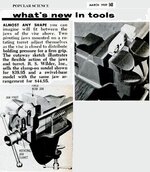



Soleinmyhead: That was an interesting vise find. Here is an item from a 1959 issue of POPULAR SCIENCE. An interesting fact is the vise wasn't patented until 1960.
 .) In the meantime, here's a bit of Fortis information for you.
Kinda, sorta, like a SevoSoleinmyhead: That was an interesting vise find. Here is an item from a 1959 issue of POPULAR SCIENCE. An interesting fact is the vise wasn't patented until 1960.
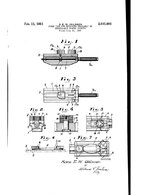
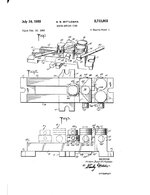
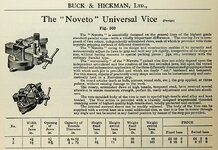
here's a Fortis, steel, with the swivel jaws, and the later French Noveto, with same ---- I did have some link to Jerrim patent, but can't find just now ----------- I realise a distinguishing feature of the small Wilder is that the 2 swivelling jaws are themselves held in a swivelling turret - this could be the usp of the patent ps, thanks -- I say patent either (or eyether) way but ads with the short idannyr: Do you have any advertisements, patents, or catalogue entries you could share? (In my head I gave these words a short i and a long a sound so you wouldn't have trouble understanding my question
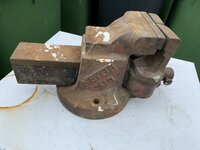
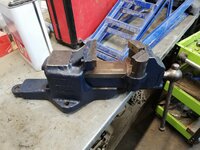
I have a Columbian 204 1/2 with the exact same issue. Always assumed somebody replaced the screw, and maybe the one for the 205 was what was in stock that day.Last weekend, I picked up an older Reed 104 4” vise (pre-R version.) It has two sets of (mmyy date) stamped “628” (June 1928) on the non-logo’d/ non-named side of each jaw.
It has the 3-hole fixed base, a (center drilled) round, “meatball”-style nose on the spindle and It uses the older collar inside the slide rather than the split nut retainer.
As opposed to being too short (as some others have seen,) the spindle length was a generous 1-1/4” too long for the dynamic jaw slide. Surely it wasn’t initially sold this way. We’ve assumed the original spindle with handle was replaced with this longer (too long) spindle early in the vise’s life (still before the transitionary period to R’s). I used a small cut-off saw to trim the spindle to the appropriate length. The spindle is long enough to still extend beyond the nut when the slide is fully opened.
As some others had found, the retainer pin for the main nutscrewwas missing. The main nutscrewwas marked Reed on one side and 2306-4-4 1/2 on the other.
For the paint color, this is my first experiment with a matte black that I had seen used on a pair of Holland vises (16H and 13H) that I had seen on FB. It is Kimball Midwest Rustmaster Plus Black.

Kevin, thank you. That is incredibly helpful! Do you happen to recall what era the Prentiss #20 was from or remember whether it bore any markings?Only one, a Prentiss #20. Also it looks like I did not add a center drill on most of my other Prentiss restorations. I did have access to a large lathe in Colorado.
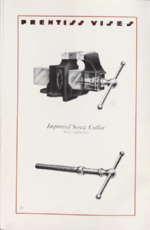
It's not hard to add a 1/4" ball backed up by a spring and a 5/16 set screw to add a friction break for the handle, tap drill sie for a 5/16:18 thread is .257 diameter.
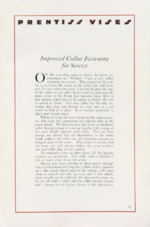
I worked on a Prentiss that had a flat spring in the meatball that acted like a break. I looked for pics while going thru my Prentiss restorations but could not find one. They machined a pocket in side the meatball where a flat spring was set and bent like a banana. If that makes sense.
I will gladly provide more pics if that is helpful. Thanks! EDIT: Awkwardly added a close-up of the 5 1/2 Made In USA.
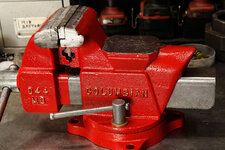

It's so close!! But it has zero manufacturer embossment anywhere in the metal. It's a solid 39 lbs. It's 5 1/2 jaws and the bottom states 51871-03 which is mostly thought to be Craftsman but it has all the shapings and contours of a Columbian! That's why I'm so confused! lolIt's a dead ringer for my Columbian D44:
Mine claims to be made in Cleveland, USA, but I have my doubts....
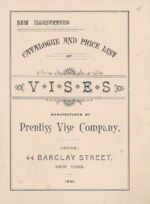
Thanks for pulling those together, CRS! Here's a picture of Prentiss' #20 included in their 1891 catalog as well as the same vise (though with no serial numbers at that time) on their March, 1882 price list. I've owned and seen a handful of virtually NOS Prentiss vises from the teens, and given their excellent condition but the absence of the spring in the meatball, I'm thinking Prentiss probably did away with the spring in the early 1900s at the latestmicah: Prentiss #20 (along with 18 ,19, 191/2, 21, 22, and 23) was in an 1896 catalog and in 1904, 1905, 1909, 1922. The newest one I found was 1925.

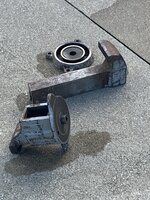
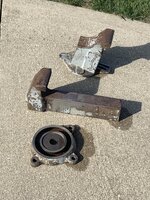
 pretty decent shape. I will have to massage the top of each jaw to clean up the casting, someone liked to cut on it. I’ll post more as I go…
Micah. I wish I can remember what Prentiss or vise the shim imbedded handle break. I drew up two drawings one showing a coil spring break like what Parker uses and the other drawing shows the inside pocket machined and the banana style flat spring pressing against the handle.Kevin, thank you. That is incredibly helpful! Do you happen to recall what era the Prentiss #20 was from or remember whether it bore any markings?
And to clarify - was the spring mechanism on both the #20 and on the other Prentiss that you mentioned the flat spring? Your "banana" description makes complete sense. Wrapping my head around the installation of the spring - would I be correct that, if a small hole was drilled and a screw extractor was used on the meatball, it would reveal a plug or grub screw behind which the spring can be accessed?
Those drawings make alot of sense, thank you, Kevin! I have yet to see any literature that even hints at the presence of such a mechanism inside Prentiss' meatballs, so it's rather a unicorn to me.Micah. I wish I can remember what Prentiss or vise the shim imbedded handle break. I drew up two drawings one showing a coil spring break like what Parker uses and the other drawing shows the inside pocket machined and the banana style flat spring pressing against the handle.
My memory is going and I can’t remember what Prentiss or vise the shim design came out of. Hope this makes sense to others.



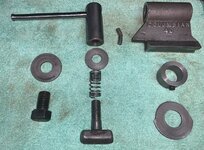
I know, I know... I ****.
Depends on how flexible you are.C'mon you know the rules: "You cannot **** yourself on GJ. I't's just not done."
Not very on that topic...Depends on how flexible you are.
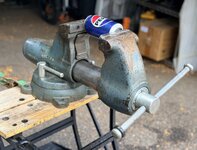
I like the fact that the 115lb.? vise is sitting on a Black & Decker workmate, which seems to support the vise just fine.I've had this Monster Wilton C2 for quite some time, I really wish I had a great place to mount it. But I make do with a few other smaller Wilton bullets...
The workmate 200, one of the smallest, can carry 350 lbs. the 225 - its replacement, will go to 450... others are bigger with more capacity...I like the fact that the 115lb.? vise is sitting on a Black & Decker workmate, which seems to support the vise just fine.
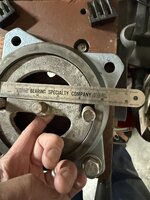


Yes I’ve seen the listed weight capacity specs for the different models of Workmate.The workmate 200, one of the smallest, can carry 350 lbs. the 225 - its replacement, will go to 450... others are bigger with more capacity...
It's the 1903 made for the Springfield.Looks like an M1917 bayonet: https://en.wikipedia.org/wiki/M1917_bayonet
Not specific to any particular gun.

Great tang stamp! Flaming bomb proof mark AND Rock Island Armory stamp!It's the 1903 made for the Springfield.
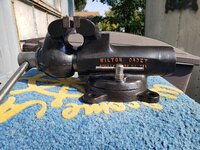
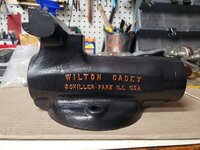
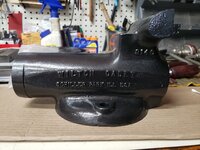
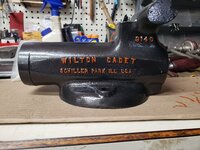
Nice job! A 4.5” Cadet was my first real vise and I still think it’s a classic looking, solid tool. It’s great that the jaw shelf on yours is intact.In my recent down time I decided to spruce up an old Cadet. Date stamp is kinda neat, 12/31/59. Was a mess when I first picked it up.
Broken jaw, screws broke off in the static side etc...
I like the fact that the 115lb.? vise is sitting on a Black & Decker workmate, which seems to support the vise just fine.
Yeah, I put the C2 on the workmate to re-lube it and take some pictures... It's not really ideal as a platform for that monster. For a static load, probably fine, but even just winding the jaws in and out creates some flex in the workmate boards.The workmate 200, one of the smallest, can carry 350 lbs. the 225 - its replacement, will go to 450... others are bigger with more capacity...
Not sure why, but I also like the looks of the Cadet. I think they just look good.Nice job! A 4.5” Cadet was my first real vise and I still think it’s a classic looking, solid tool. It’s great that the jaw shelf on yours is intact.
I didn’t realize the jaw shelf on mine was cracked until many months later.


Just how many Lewis' designed and patented vises?micahd: The swivel lock was Mortimer Lewis' own design.
Thanks for the visual, CRS!The swivel lock was Mortimer Lewis' own design
Last year, I combed the USPTO publications and their advanced database, and these are the ones I've found. 21 patents in total over 23 years. 17 were bench vise patents (several of which I don't believe were every ultimately produced by the Lewis Tool Co or by the Prentiss Vise Co), and four others were unrelated to bench vises (see descriptions of those below)Just how many Lewis' designed and patented vises?