To avoid these ads, REGISTER NOW!

Tools of Japan

C4RBON

Active member
Joined
Feb 16, 2015
Messages
33
Location
Iowa
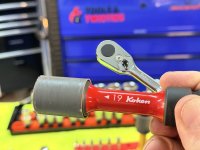
The Ko-ken Z-Series 3/8" SAE sockets were an immediate purchase for me. They arrived yesterday, and the first question on my mind was: "Is the 3/4 socket the same as the 19mm?". I've heard that many tool companies simply re-label their 3/4" sockets as 19mm (or vice-versa) since 3/4" = 19.05mm. But would my beloved Ko-ken, maker of "high-performance tools of convincing quality", belittle themselves with such underhanded tactics? Or would they free their engineers to design a true 3/4" Z-series socket? The question gnawed at my consciousness as I tried to sleep: I had to know. As I lay awake, I devised a plan that would convince me of Ko-ken's quality.
RS3400AZ.jpg
Due to a (likely-unhealthy) fear of not having the right tool for the job, I have amassed a large assortment of 6-point 19mm Ko-ken sockets. Using this collection, I could establish the typical flat-to-flat opening for Ko-ken Z-series and normal 19mm sockets. I could also infer a manufacturing "consistency" of their machining process: a perfect socket should have the same measurement across all three pairs of flats. I'm defining "consistency" as the largest flat-to-flat measurement minus the smallest one. With my trusty Mitutoyo calipers in hand, I set about measuring the flat-to-flat opening of all three sides of my 19mm Ko-ken socket collection. Three times, just to be sure. I also measured the outer diameter and the length, because why not.

Ko-ken Socket Series
Average Size
Consistency
Z-Series (3300MZ, 3300XZ, 4400MZ, 3400MZ)
19.174 mm
0.037 mm
Normal (4300M-110, 4300M, 3300M, 3400M)
19.301 mm
0.033 mm

Ko-ken claims that Z-series sockets have a tighter fit on fasteners by reducing the flat-to-flat opening. The data supports this. Anyone who has used the Z-series knows they fit tighter on fasteners. Looking at flat-to-flat consistency measurements, the data does not support that the overall manufacturing tolerance is better on the Z-series; the normal sockets are just as good. Note that my copy of the 3300MZ 19mm had one flat-to-flat measurement substantially larger than the other two opposing sides; this is likely skewing the data. Without that "defect" (using that term lightly), the Z-series would have had an average size of 19.166mm and a consistency of 0.023mm, which is better than the normal sockets.

This data establishes that Ko-ken usually has about a 19.17mm opening for a Z-series 19mm socket. Their consistency (for both normal and Z-series) is about 0.03mm. Given that 3/4" is 19.05mm, I would expect a true 3/4" socket to be about 0.05mm larger than 19.17mm. And, the 3400AZ 3/4" socket is indeed larger; it is 19.27mm, (a full 0.05mm more than needed!), with a very good consistency of 0.01mm.

Comparison.jpg

So, did Ko-ken design and build a true 3/4" Z socket? My conclusion is that this is not simply a re-label of the 19mm Z. What I think they did was use the same forging and machining process for the outer dimensions (the length and diameter are nearly identical), and then used a dedicate broach for machining the flats. It is unlikely that a normal series 19mm socket broach would have created the 3/4" Z-series, since the inside geometry of the Z-series is not the same as their normal sockets.

I can now rest easy knowing that Ko-ken is not taking short-cuts in their products. I'm sure the rest of you Japanese tool zealots will also appreciate this is a true 3/4" socket, not some re-labelled metallic swill dumped on the market to appease Americans.
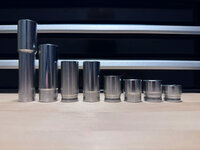
Koken 19mm family.jpg

Below you will find a table of my measurements. The "average size" and "consistency" are the average of all three sides measured 3 times. I've highlighted the normal Z 19mm socket in blue and the new Z 3/4" socket in red. I've also included a Ko-ken 13401M (3/8" impact socket, standard length) and a Nepros 1/2" 19mm socket, for comparison.

Model
Length [mm]
Diameter [mm]
Average Size (mm)
Consistency [mm]
4300M-110
110.38
25.80
19.278
0.013
4300M
77.11
26.44
19.289
0.023
3300MZ
55.07
24.87
19.202
0.103
3300M
55.11
24.94
19.337
0.057
3300XZ
35.03
24.84
19.207
0.017
3400M
30.11
25.78
19.301
0.037
4400MZ
29.15
25.30
19.146
0.030
3400MZ
22.10
24.79
19.141
0.027
3400AZ (3/4")
22.12
24.83
19.272
0.010
13401M
32.09
26.02
19.143
0.010
KTC Nepros NB4
34.53
25.69
19.211
0.010
 
To avoid these ads, REGISTER NOW!

Steel_Rain

Well-known member
Joined
Apr 23, 2024
Messages
1,363
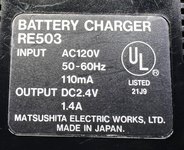
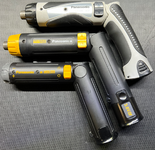
To further prove my status a major tool weirdo, I did purchase ANOTHER older/vintage Panasonic EY503 as NoS on eBay for $35 bucks:

1763913656616.png
1763913707667.png
1763913754668.png
1763913806769.png
1763913848486.png
1763913886338.png

There is something about the asthenic of these old Panasonic's that I just love. They feel solid and well built. I love the bit storage in the charger :ROFLMAO: .

Added to my weirdo collection:

1763914018915.png
 

Bad Mojo

Well-known member
Joined
Sep 2, 2012
Messages
117
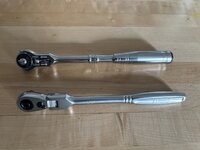
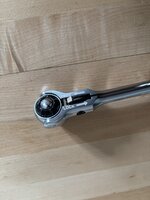
I got in the Tone RH3VHW (Top) pictured with the RH3FH (Bottom). It's different from what I am used to, but I sure do like having a locking flex head compared to a non-locking. The ratchet itself is snappy enough for what I will ever need. I wasn't expecting the wrench flats on the handle, which is something I've never seen before on a ratchet.

This ratchet is going in my tool bag that I use on almost every project. I wanted something that could be pretty flexible and I think a Wera hex bit adapter will live on most the time. Wrenches Together.jpg
Wrench Head.jpg
 

Fedwrench

ALLIANCE MEMBER
Joined
Dec 9, 2007
Messages
14,955
Location
Valley of the sun
I got in the Tone RH3VHW (Top) pictured with the RH3FH (Bottom). It's different from what I am used to, but I sure do like having a locking flex head compared to a non-locking. The ratchet itself is snappy enough for what I will ever need. I wasn't expecting the wrench flats on the handle, which is something I've never seen before on a ratchet.

This ratchet is going in my tool bag that I use on almost every project. I wanted something that could be pretty flexible and I think a Wera hex bit adapter will live on most the time. Wrenches Together.jpg
Wrench Head.jpg
Interesting, I've never seen a locking roto head other than the Wera before. Is the handle hollow?
 

Bad Mojo

Well-known member
Joined
Sep 2, 2012
Messages
117
Interesting, I've never seen a locking roto head other than the Wera before. Is the handle hollow?
I think so, it has a plastic cap on the end that I adhered pretty good otherwise I would know for sure. The feeling in hand also makes me suspect that it is hollow as well.

I would like to have it next to a Wera Zyklop for comparison.
 

terrific

Well-known member
Joined
Nov 22, 2021
Messages
329
Has anyone tried using a 1/4" Koken nut grip socket as a bit holder?
I know they make dedicated bit holders, but I'm curious if it would work.
 

mattstevens

Active member
Joined
Jun 3, 2023
Messages
44
Has anyone tried using a 1/4" Koken nut grip socket as a bit holder?
I know they make dedicated bit holders, but I'm curious if it would work.
Not really, the 1/4 nut grip is quite shallow (much more so than their standard sockets) and a bit will barely go in. Can't really recommend their 1/4 nut grip style bit holder either, for some reason they only used one retaining ball in that one and the retention is not very strong. The 3/8 version is fine.

Not tools of Japan, but for 1/4 the Hazet 2250-1 fits well on Ko-ken anvils, has strong retention, and basically no play in the bit. It is a little heavier and wider than typical bit holders though. The Stahlwille 412 also fits on their anvils well, has strong retention, and a slimmer profile, but if dropped the coil spring inside it is likely to come flying out and good luck finding that thing. The Gedore 620 is a little loose on their anvils but also has strong retention and is inexpensive. Not sure if any of the Japanese brands offer something similar, would be nice if Ko-ken updated theirs to have similar retention to the nut grip sockets.
 

HannibalLecter

Well-known member
Joined
Aug 26, 2023
Messages
402
To further prove my status a major tool weirdo, I did purchase ANOTHER older/vintage Panasonic EY503 as NoS on eBay for $35 bucks:

1763913656616.png
1763913707667.png
1763913754668.png
1763913806769.png
1763913848486.png
1763913886338.png

There is something about the asthenic of these old Panasonic's that I just love. They feel solid and well built. I love the bit storage in the charger :ROFLMAO: .

Added to my weirdo collection:

1763914018915.png
I love the form and function of these. Light and cool looking.
In your opinion which one between the two smaller ones should one buy?
One i think is 2.4 volt, the other 3.6
 

merkyworks

Well-known member
Joined
Nov 11, 2016
Messages
587
Location
Texas
....... Without that "defect" (using that term lightly), the Z-series would have had an average size of 19.166mm and a consistency of 0.023mm, which is better than the normal sockets.
Great info and write up, Koken does not disappoint.

Only comment is the term "outlier" is more appropriate than "defect".
 
Last edited:

Steel_Rain

Well-known member
Joined
Apr 23, 2024
Messages
1,363
I love the form and function of these. Light and cool looking.
In your opinion which one between the two smaller ones should one buy?
One i think is 2.4 volt, the other 3.6

@HannibalLecter Your forum name also proves to me that your a fellow weirdo. I like it.

Eh, I really like the EY6225. It's also 200rpm faster (total 600rpm in high) then the EY503 and packs more power, but is heavier.

My modern Makita "Pen" drivers (including a pen impact) destroy these in terms of power, but they lack the precise mechanical feel of the older Panasonic's. In the right application, these older units really are a joy to use.
 

mobiledynamics

Well-known member
Joined
Mar 14, 2010
Messages
5,037
Location
Gotham City
Has anyone ordered from Amazon JP Lately.

I placed an order last month or so. On the last day of the expected delivery date, they have moved the goal post a month later into December. It has not entered the shipping phase even though the listing on Amazon USA shows the typical ships in 7-10 days.

The same goes with another order as well

Be curious if others are having their stuff processed or it's just -hanging out- in the system
 

gilbo

Well-known member
Joined
Feb 1, 2010
Messages
716
Has anyone ordered from Amazon JP Lately.

I placed an order last month or so. On the last day of the expected delivery date, they have moved the goal post a month later into December. It has not entered the shipping phase even though the listing on Amazon USA shows the typical ships in 7-10 days.

The same goes with another order as well

Be curious if others are having their stuff processed or it's just -hanging out- in the system
Yes, I ordered 2 Koken ratchets when they were on sale. Order was place Nov 4th. At that time expected delivery was Dec. Then next thing I know they showed up at the door unannounced, on the Nov 14th.
 

C4RBON

Active member
Joined
Feb 16, 2015
Messages
33
Location
Iowa
I don’t think I’ll be able to measure the flat-to-flat distance of an 8mm socket reliably with my calipers. Maybe if I made a mold of the inside… 🤔
 

GeoBruin

Well-known member
Joined
May 5, 2018
Messages
3,738
I don’t think I’ll be able to measure the flat-to-flat distance of an 8mm socket reliably with my calipers. Maybe if I made a mold of the inside… 🤔

Seems like a task that's within the capability of most calipers. What's the challenge?
 

Ohio Andy

Well-known member
Joined
Jul 31, 2024
Messages
2,298
Location
Columbus, Ohio
This Koken 72T Z-EAL flex-head arrived today. I've been slowly building my Koken collection over the last year. Very impressed so far.

James


IMG_5110.jpeg
I tried a Koken ratchet once. It was very nice. I then gave it to a mechanic who was working on my car. He liked it too.
 
To avoid these ads, REGISTER NOW!

C4RBON

Active member
Joined
Feb 16, 2015
Messages
33
Location
Iowa
Seems like a task that's within the capability of most calipers. What's the challenge?
The caliper jaws to measure an interior distance are sharp since they are intended to make line contact on the inside of a cylindrical surface (a hole). When you apply force to the jaws, they will spread out (still parallel to the centerline of the hole) until the two contact lines are as far away as possible; this is the hole diameter.

The interior of a socket is not a circle/cylinder, but approximately a hexagon. When trying to measure the distance between faces, the jaws will push apart and move to the corners of the hexagon. This introduces significant measurement error. To make matters worse, the faces of a socket are not planar, they are curved.

I am trying to measure the minimum distance between opposing curved faces. To improve measurement repeatability, I was holding the calipers at an ~45deg angle to measure the minimum distance between opposing faces. I don’t think an 8mm socket will have enough room for the jaws to go in at any significant angle (not helped by the chamfer on the inside lip). If I come straight in (parallel to the centerline of the socket), then when I apply an outward force to make contact with the faces, the jaws will slide towards the corners and increase error.

I think some telescoping gauges would do the trick, but I don’t own any.
 

GeoBruin

Well-known member
Joined
May 5, 2018
Messages
3,738
The caliper jaws to measure an interior distance are sharp since they are intended to make line contact on the inside of a cylindrical surface (a hole). When you apply force to the jaws, they will spread out (still parallel to the centerline of the hole) until the two contact lines are as far away as possible; this is the hole diameter.

The interior of a socket is not a circle/cylinder, but approximately a hexagon. When trying to measure the distance between faces, the jaws will push apart and move to the corners of the hexagon. This introduces significant measurement error. To make matters worse, the faces of a socket are not planar, they are curved.

I am trying to measure the minimum distance between opposing curved faces. To improve measurement repeatability, I was holding the calipers at an ~45deg angle to measure the minimum distance between opposing faces. I don’t think an 8mm socket will have enough room for the jaws to go in at any significant angle (not helped by the chamfer on the inside lip). If I come straight in (parallel to the centerline of the socket), then when I apply an outward force to make contact with the faces, the jaws will slide towards the corners and increase error.

I think some telescoping gauges would do the trick, but I don’t own any.
I'm not the most advance caliper user, but I feel like in situations like that I would allow the calipers to slide to the corners of the hex, then slowly rotate the socket which would cause the jaws to close slightly while keeping an eye out for the minimum reading before they start to get wider again. In fact, since the distance between the flats should be the smallest possible distance you could measure, you can kind of just move the calipers around through a range of angles and note the smallest measurement you see.

Yes, a small hole bore gauge is preferable, but for the tolerances we're talking about, calipers should be sufficient.
 

Ultradog MN

Well-known member
Joined
Jan 20, 2024
Messages
766
Location
Twin Cities
Not your everyday/ordinary tool but nicely made in Japan.
I needed one of these to punch screw holes into heavy felt for "way wipers" on my lathe.
Had an old POS one but it was crude and worthless.
Found this one at an estate sale.
It is very nice, heavy duty and quite precision. You normally see these used by leather workers for punching holes in belts, etc.
They also work well for punching holes in gaskets.
I'm glad to have it. Paid $3 for it. Seller did not know what it was.
PS
It would also work for noses, ears, cheeks and your nether regions if you like that ***** pierced look :)
 

Attachments

  • 102720259727.jpg
    102720259727.jpg
    535.9 KB · Views: 43
  • 102720259738.jpg
    102720259738.jpg
    894.9 KB · Views: 42

JerseyBoatBuilder

Well-known member
Joined
Mar 3, 2012
Messages
1,593
Location
Florida
I got in the Tone RH3VHW (Top) pictured with the RH3FH (Bottom). It's different from what I am used to, but I sure do like having a locking flex head compared to a non-locking. The ratchet itself is snappy enough for what I will ever need. I wasn't expecting the wrench flats on the handle, which is something I've never seen before on a ratchet.

This ratchet is going in my tool bag that I use on almost every project. I wanted something that could be pretty flexible and I think a Wera hex bit adapter will live on most the time. Wrenches Together.jpg
Wrench Head.jpg

I sold a bunch of my Snap On ratchet's before we moved to Florida. I was going to buy another Snap On 3/8 Roto head ratchet but after seeing that and reading the spec's I think I am going to try one of those
The bottom part of the handle is Hollow with the cap. They claim to for better weight balance. And I see they updated it with 72 teeth.
 

kyrbz

Well-known member
Joined
Jan 30, 2012
Messages
1,315
Location
midwest US
Picked up a Tajima drywall rasp. As much as I hate doing drywall, I like this Tajima rasp way better than a Surform style rasp. It has coarse and fine teeth. The pyramid shaped teeth do not clog whatsoever, and cleaning up the drywall edges seems much smoother and controlled. It also has teeth on the edges for cleaning up inside corners. It wouldn't replace a surform for sculpting and shaping, but for doing drywall edges it excels. Picked mine up at locally Epstein's which I'm happy is getting quit the line up of Japanese made tools.

t1.png

t2.png

t3.png

t4.png

t5.png
 

Andres26tnt

Well-known member
Joined
May 11, 2018
Messages
994
The Ko-ken Z-Series 3/8" SAE sockets were an immediate purchase for me. They arrived yesterday, and the first question on my mind was: "Is the 3/4 socket the same as the 19mm?". I've heard that many tool companies simply re-label their 3/4" sockets as 19mm (or vice-versa) since 3/4" = 19.05mm. But would my beloved Ko-ken, maker of "high-performance tools of convincing quality", belittle themselves with such underhanded tactics? Or would they free their engineers to design a true 3/4" Z-series socket? The question gnawed at my consciousness as I tried to sleep: I had to know. As I lay awake, I devised a plan that would convince me of Ko-ken's quality.
RS3400AZ.jpg
Due to a (likely-unhealthy) fear of not having the right tool for the job, I have amassed a large assortment of 6-point 19mm Ko-ken sockets. Using this collection, I could establish the typical flat-to-flat opening for Ko-ken Z-series and normal 19mm sockets. I could also infer a manufacturing "consistency" of their machining process: a perfect socket should have the same measurement across all three pairs of flats. I'm defining "consistency" as the largest flat-to-flat measurement minus the smallest one. With my trusty Mitutoyo calipers in hand, I set about measuring the flat-to-flat opening of all three sides of my 19mm Ko-ken socket collection. Three times, just to be sure. I also measured the outer diameter and the length, because why not.

Ko-ken Socket Series
Average Size
Consistency
Z-Series (3300MZ, 3300XZ, 4400MZ, 3400MZ)
19.174 mm
0.037 mm
Normal (4300M-110, 4300M, 3300M, 3400M)
19.301 mm
0.033 mm

Ko-ken claims that Z-series sockets have a tighter fit on fasteners by reducing the flat-to-flat opening. The data supports this. Anyone who has used the Z-series knows they fit tighter on fasteners. Looking at flat-to-flat consistency measurements, the data does not support that the overall manufacturing tolerance is better on the Z-series; the normal sockets are just as good. Note that my copy of the 3300MZ 19mm had one flat-to-flat measurement substantially larger than the other two opposing sides; this is likely skewing the data. Without that "defect" (using that term lightly), the Z-series would have had an average size of 19.166mm and a consistency of 0.023mm, which is better than the normal sockets.

This data establishes that Ko-ken usually has about a 19.17mm opening for a Z-series 19mm socket. Their consistency (for both normal and Z-series) is about 0.03mm. Given that 3/4" is 19.05mm, I would expect a true 3/4" socket to be about 0.05mm larger than 19.17mm. And, the 3400AZ 3/4" socket is indeed larger; it is 19.27mm, (a full 0.05mm more than needed!), with a very good consistency of 0.01mm.

Comparison.jpg

So, did Ko-ken design and build a true 3/4" Z socket? My conclusion is that this is not simply a re-label of the 19mm Z. What I think they did was use the same forging and machining process for the outer dimensions (the length and diameter are nearly identical), and then used a dedicate broach for machining the flats. It is unlikely that a normal series 19mm socket broach would have created the 3/4" Z-series, since the inside geometry of the Z-series is not the same as their normal sockets.

I can now rest easy knowing that Ko-ken is not taking short-cuts in their products. I'm sure the rest of you Japanese tool zealots will also appreciate this is a true 3/4" socket, not some re-labelled metallic swill dumped on the market to appease Americans.

Koken 19mm family.jpg

Below you will find a table of my measurements. The "average size" and "consistency" are the average of all three sides measured 3 times. I've highlighted the normal Z 19mm socket in blue and the new Z 3/4" socket in red. I've also included a Ko-ken 13401M (3/8" impact socket, standard length) and a Nepros 1/2" 19mm socket, for comparison.

Model
Length [mm]
Diameter [mm]
Average Size (mm)
Consistency [mm]
4300M-110
110.38
25.80
19.278
0.013
4300M
77.11
26.44
19.289
0.023
3300MZ
55.07
24.87
19.202
0.103
3300M
55.11
24.94
19.337
0.057
3300XZ
35.03
24.84
19.207
0.017
3400M
30.11
25.78
19.301
0.037
4400MZ
29.15
25.30
19.146
0.030
3400MZ
22.10
24.79
19.141
0.027
3400AZ (3/4")
22.12
24.83
19.272
0.010
13401M
32.09
26.02
19.143
0.010
KTC Nepros NB4
34.53
25.69
19.211
0.010

It should be noted that Koken never takes Shortcuts. It's why they don't release new tools often, and why once release and something is wrong it takes them a long time to re-release a tool.
 

Andres26tnt

Well-known member
Joined
May 11, 2018
Messages
994
I got in the Tone RH3VHW (Top) pictured with the RH3FH (Bottom). It's different from what I am used to, but I sure do like having a locking flex head compared to a non-locking. The ratchet itself is snappy enough for what I will ever need. I wasn't expecting the wrench flats on the handle, which is something I've never seen before on a ratchet.

This ratchet is going in my tool bag that I use on almost every project. I wanted something that could be pretty flexible and I think a Wera hex bit adapter will live on most the time. Wrenches Together.jpg
Wrench Head.jpg

This is made by I forget who in Taiwan, rebranded by tone and proauto. I have the longer pro-auto version, also swapped the gear for the tone to see if it was truly the same(it's the same).
 

RonnieC

Well-known member
Joined
Aug 7, 2013
Messages
797
Location
Orlando, FL
So there is a ball detent inside the socket that holds the nut when it’s removed? So how do you then get the nut out of the socket? Slam it against the workbench or use a pick? Honest question- I’ve never seen a socket like this.
 

66HertzClone

ALLIANCE MEMBER
Joined
Dec 6, 2006
Messages
4,038
Location
Long Valley, NJ
Koken RS4450M/10, RS3450M/11 and RS2450MS/11:

IMG_5070.jpeg
IMG_5071.jpeg
IMG_5072.jpeg
IMG_5073.jpeg
IMG_5074.jpeg
IMG_5075.jpeg

Been wrenching for years guys, but these are my first sets of nut grips and Im grateful to have them.
I toyed with purchasing those when they were running the 25% off sale on their website but just couldn't bring my self to do it, seeing your pictures I now regret not going for them.
 

Steve_P

Well-known member
Joined
Sep 15, 2010
Messages
5,185
I toyed with purchasing those when they were running the 25% off sale on their website but just couldn't bring my self to do it, seeing your pictures I now regret not going for them.

I have the 1/4 and 3/8 drive metric sets and rarely use them, but for that occasional time, they're worth it. In retrospect and doing it again, I'd probably just buy the few sizes that I regularly use as Koken doesn't charge a premium, or much, for singles. 1/4 drive 10mm in straight and universal are definitely the one to start with IMO if you want to try; that's what I use 90% of the time.
 

autobon7

Well-known member
Joined
Oct 27, 2010
Messages
730
To further prove my status a major tool weirdo, I did purchase ANOTHER older/vintage Panasonic EY503 as NoS on eBay for $35 bucks:

1763913656616.png
1763913707667.png
1763913754668.png
1763913806769.png
1763913848486.png
1763913886338.png

There is something about the asthenic of these old Panasonic's that I just love. They feel solid and well built. I love the bit storage in the charger :ROFLMAO: .

Added to my weirdo collection:

1763914018915.png
For $35 that is a great price.
 

Dave455

Well-known member
Joined
Mar 19, 2013
Messages
5,816
Location
Sussex, England
What do you you use the 12 pointers for mostly? Also what drive 3/8 or 1/2?
You use any triple squares by koken?
Not my set but I can tell you those are 3/8” drive - the ”3” prefix to the part number tells you.

I do have a set of XZN / triple square by KoKen and they have been fine. Must admit I don’t use them as much as a pro at a VW dealer might (only had one vehicle in the family that used them) but I used one size a lot.

I pretty much use KoKen as my “go to” for all these male bit sockets now - hex, Torx, XZN - everything (regular not Z Series). Some sizes, like T20/25/30, see an awful lot of use and hold up well.

If you do wear out or twist one, KoKen will supply a replacement bit, which is great. I keep spare bits on hand for most of my hex and Torx bit sockets.
 

Steel_Rain

Well-known member
Joined
Apr 23, 2024
Messages
1,363
So there is a ball detent inside the socket that holds the nut when it’s removed? So how do you then get the nut out of the socket? Slam it against the workbench or use a pick? Honest question- I’ve never seen a socket like this.

Hi Ronnie, sorry this reply took so long. Nah, the ball detents aren’t that strong, just light axial pressure, enough to hold it snug, but not enough to capture it completely. The metal spring bands are a good compromise between durability and elasticity. The retention, It just has a great “feel”, ya know?
 
To avoid these ads, REGISTER NOW!
Top Bottom