My wife inherited a home from her parents who are now deceased. The home has been in their family 55 years. The one car garage was turned into an en-suite bedroom with full bath. We have it rented out, the house. The tenants complained of a foul smell so I went over to take a look at it.
The floor of the garage / bedroom is raised so there is a crawl space about 20 inches to the bottom of the floor joists. I went and crawled in and found that one of the fittings off of the toilet closet flange to the soil pipe had shattered, dwv pvc.
I cut out the old P-trap and replaced that. I decided to use no hubs instead of gluing it in so it can be detached if necessary. I did install a T fitting with a threaded plug and the downpipe from the toilet closet flange if I ever needed to snake it. The way I have it set up now with no hubs, it probably would be just as easy to remove the entire P-trap and snake directly into the open pipe. Still probably easier than pulling the toilet and snake-ing down through the toilet flange and the P-trap.
That was
nasty work dealing with the soil pipe and what got caught in the broken fitting so I bought some Sam Adams to reward myself in dealing with a nasty problem (once work was done for the day, of-course). My wife had called a local plumber to come out and look at the house (they did arrive on-time) and they wanted to charge us $650 to camera scope the entire house's soil lines, before any work was to be done. No thanks, I solved it for probably $25 worth of dwv-pvc fittings.
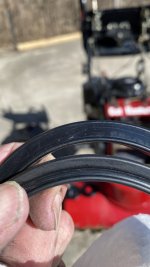
The nasty:

Don't look too closely!

I have to return tomorrow to hang some perforated plumber's strap to support the P-trap, and to scrub the concrete floor of what used to be the garage floor, with cleaner and then bleach. I'll use a floor fan to air-out the entire house crawl-space, and do a check of the other full bath and a half-bath, to ensure there are no other issues. I kind of want to remove some abandoned in-place ductile cast iron dwv pipe elsewhere in the crawl-space. Years ago, I installed a pair of fluorescent 4' light fixtures, a GFCI single outlet w/a switch in the garage crawl space, and it's helped many times since then, when I've gone into the crawl space. Other crawl spaces beneath the house's floor joists are yet to be wired for lighting or outlets, but I have a 100 ' extension cord to reach anyplace under the floor joists, and as-partitioned by stem walls. There are openings in the stem walls so you can enter at one place, and make your way on hands and knees throughout the entire house's crawl-space.
Last week at our son's, our son & I installed a Rheem heat pump and 65 gallon electric water heater which he had bought on sale. A local plumber wanted $1,600 for that and that's just labor not including the cost of the water heater. Everything is plumbed and working if not the prettiest installation it's all functional. CPVC, copper fittings and pipe, soldered; s.s. woven flexible hose and aluminum coil hose. I saved $2,250 over prices we were quoted from plumbers, for these two jobs. The price would have been much higher because the work to fix what turned out to be shattered PVC waste pipe fittings at the single family rental was not included.
I have the cold-in and the hot-out, the TPRV and the condensate drain for the heat pump set up so the water heater can be disconnected if necessary for any servicing, w/o having to cut either the CU pipe or the CPVC, by disconnecting the woven s.s. hoses.
After a bit of coaching, my son demonstrated his mastery of soldering. I had given him a Bernz-O-Matic propane torch (a Rochester NY product) years ago, I use an acetylene plumber's torch, and I had to run to get a refilled tank, exchange at a local welding supplies store, Discount Weld, 2745 NW 21 St. Miami FL. I get my acetylene & O2 torch and brazing gases there, and my MIG and TIG gases. I am only an amateur, but having decent equipment helps. I have friends who can help me if needed.
I want to plumb a water heater pan drain, but our son doesn't want to have any more holes in the cbs wall. I still have some patching to do on the wall stucco inside and outside.
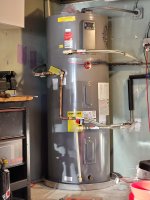
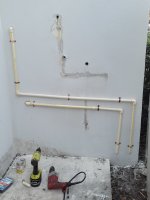
The outside condensate drain and the temperature and pressure relief valve drain are all CPVC. Code says max. 6" to floor or to grade for the discharge. My son wanted to use the water heater drain pan for the discharge from the TPRV, the drain pan didn't have any plumbing to a floor drain or to outside. I finally got him to agree to allowing me to plumb the TPRV and the heat pump condensate lines through an exterior block wall. I showed him the FL Building Code about the TPRV being terminated outside, and he finally agreed to go forward in that fashion (I'm a retired plans examiner licensed by the State of FL and a Lifesafety Code Inspector). As I used to tell the people submitting plans: "It's simple to get your plans approved quickly
when you comply with code." tree pruning accomplished. The pine was overdue, and I have been managing it in stages.


 Standard creeping biomass of crabgrass.