bagged89s10
Well-known member
6in lathe for sale in my area. How much is fair to pay for it? He said its restored.

~Veeps
~Veeps


No tooling, that's only a fair price. But you need to see and check the ways before you spring for it. If it's been well taken care of and not used a ton, that would be a good price here.
I have the same lathe only with a longer bed. A half nut shouldn't be to hard to find for it. Wave some cash around and bring it home. Put a cheap quick change tool holder on it and start making chips. Spindle hole is small but you can still do quite a bit with the machine for cheap. Don't expect any love for this lathe on the machine shop forums. There are many hate threads on the atlas. Still a better machine that a chinese brand.
Any change gears? If not, you may not have to worry about half nuts.
My advice is walk away - lathes are not exactly rare in your neck of the woods. Look for a 9" South Bend or a small Logan with a quick change gearbox.
If this is in time, one method for checking ways is to feel for the cross slide backlash way down at the end where the tailstock sits. Then move it near the chuck and check it. If there is more backlash the ways are worn. You can live with this making small parts but making long parts with a consistent diameter will be tough.
The other way is to adjust the gibs tight with the slide near the chuck and if it binds when moving to the other end, the ways are worn.
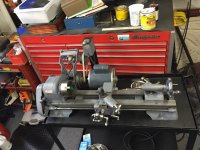

That does look like a nice restoration. The ways appear to have been resurfaced, too.
You may find that it vibrates a bit on that lightweight cart, but bolting it to a stationary cabinet would fix that.
Sweet deal for $300
New half nuts can be found on Ebay
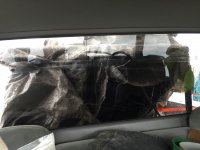


The seller was really nice. He sprayed it with anti rust oil and wrapped it up so it wouldn't rust. It was snowing.
In my garage now.
Now I have to learn how to properly use it.
~Veeps
That's a nice knurling toll in the pile. Those are pretty handy when you need it!


There's a lot of info online. South Bend's HTRAL (link below) is one of the classic intro booklets that most everyone has read. You might also check at your local library or college library for books on the basics of operating machine tools. Once you understand the basic operations and controls for that lathe, get out the bench grinder and grind a tool bit, chuck up some aluminum stock, and have fun but be safe. It may take a bit but watching how the machine cuts and experimenting a bit with your grinding will help you improve.
http://vintagemachinery.org/pubs/1617/3789.pdf
Definitely looks like an interesting machine, the PO obviously hit the ways with a flaker and I'd be curious to see some close-ups just bc those machines werent scraped nor flaked originally, only ground.
You should probably be told that this is made of gold.
It is also the intended weakest link if the carriage is run into the headstock (or in my case the chuck key that was balanced between the ways). It will shear off to prevent damage.
If it breaks, do this.
There's a lot of info online. South Bend's HTRAL (link below) is one of the classic intro booklets that most everyone has read. You might also check at your local library or college library for books on the basics of operating machine tools. Once you understand the basic operations and controls for that lathe, get out the bench grinder and grind a tool bit, chuck up some aluminum stock, and have fun but be safe. It may take a bit but watching how the machine cuts and experimenting a bit with your grinding will help you improve.
http://vintagemachinery.org/pubs/1617/3789.pdf
Definitely looks like an interesting machine, the PO obviously hit the ways with a flaker and I'd be curious to see some close-ups just bc those machines werent scraped nor flaked originally, only ground.

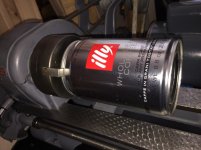
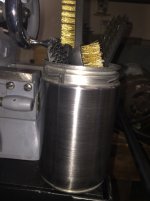
It wasnt evident in the pics but do yourself a favor if youre sanding/polishing on the lathe if you arent already, lay a rag over the ways to keep grit and **** off of them.
Thanks for the pics of the ways. I'm a bit of a sucker for scraping and flaking, to me its more beautiful than engine turning, polishing, or a lot of other decorative work.
 I too am curious on the scraping. If it was actually done on a freshly ground bend with care or just for decoration on a worn surface. The fact that he PO sold it as "restored" with a bad half nut is a bit questionable. Like a restored car with a worn out differential.
The frustrating thing about something broken on your lathe is that you could make the part if only you had a working lathe.
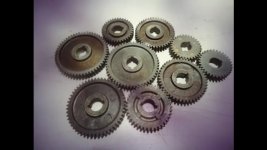
In my garage now.
Now I have to learn how to properly use it.
~Veeps
NOS or old gears are probably old and brittle. You can adapt some better gears if you can find them in the right sizes. I've had several Atlas/Craftsman lathes, 6 and 12 inch. They are OK but not very stout when compared to a South Bend or a modern lathe with inverted V ways. It's a capable machine, though.
I have a few manual pdfs I can send if you message me an email address. http://www.lathes.co.uk/ is a good source.
This page is good, too, as many of the minilathe tools and ideas can be applied toward your machine:
http://www.varmintal.com/alath.htm
You might find some TAIG stuff useful.
Taigtools.com
littlemachineshop.com
lathemaster.com
The TAIG milling attachment, while small, will allow you to mill things with a milling cutter mounted in the lathe chuck.
If/when you're ready to upgrade two important things are hardened inverted V ways and the diameter of the hole through the headstock.
Most of the parts for your lathe are available brand new from Clausing. They bought Atlas somewhere along the line and still support the older stuff. I bought brand new parts for my 10" Atlas for less than what used parts would've cost on eBay.
Congrats, I got my first lathe 6 mo ago and I know how excited I was and still am everytime I use it.