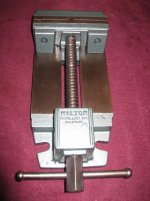
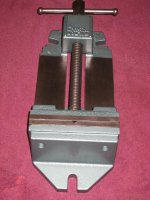
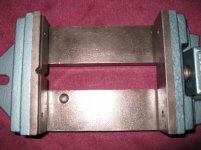
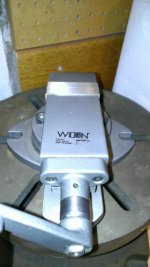
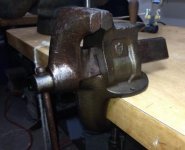
Okay vise fans: The mystery deepens. I checked the Parker 239X and the dingus. First, I took the dingus out. (No off color jokes please.) The only thing unusual about it is that it has been filed flat at the tip. Next, I examined the vise. There is no play in the slide. None! Up or down or side to side – no play. I looked at the top of the slide where the dingus hits it and there is only one circular spot. I expected to find a scratch pattern along the slide as wide as the dingus or a series of circular spots. One spot only. Next, I looked at the jaws and jaw inserts. Here is where it gets interesting. With or without the dingus they fit together perfectly across the top and on either side. The faces of the inserts are even more amazing. They are smooth and dead flat. I mean bagged smooth. With no attempt at clean up, I could see reflections in the faces. When the jaws come together the faces meet without the slightest gap anywhere. No gap!
The mystery continues. The garage shop where we found this vise was a woodworker’s shop. He had a nice bench with a Columbian woodworker’s vise. One possible clue to the Parker may be that the owner had a large collection of wooden hand planes many of which were user made and of GOOD quality. I suspect that he needed to do fairly precision work to make the planes. However, that still doesn’t explain the dingus. Maybe it just served as a lock for when the vise was not in use. What do YOU think?
Similar solution with adjustment screws you can find in Dolex vise http://www.dolex.fr/en/
Unfortunately it is not the answer in your case.
 :
: