To avoid these ads, REGISTER NOW!

10hp 230v single phase compressor wiring help

thinktwicez71

Well-known member
Joined
Jun 29, 2013
Messages
201
Location
Ogdensburg New York
For wiring the motor starter on my compressor to the motor will 6 guage wire be ok or do I need 4 guage ? I plan on running on a 60 amp breaker ..thanks


Sent from my iPad using Tapatalk
 
To avoid these ads, REGISTER NOW!

mm08822

Well-known member
Joined
Jan 13, 2012
Messages
5,895
Location
NJ
You need to use the FLC spec'd in the nec not FLA's from the motor n/p.
10HP @230vac >>FLC =50A

50 x 1.25 = 62.5A

#6 copper thhn/thwn is needed. Good for 65a.

60A cb probably too small for inrush. Consider 90/100a.
 

mm08822

Well-known member
Joined
Jan 13, 2012
Messages
5,895
Location
NJ
I guess I would go with 6 guage wire and try the 60 , could always go up to 70 and be good with the wire I guess

Sent from my SM-G930V using Tapatalk

Its a motor circuit so you can be up to 250% of flc with an inverse time cb. If you have a cb now put it in and try it. If you have to buy a cb, buy the cheapest between 70 - 100a for your make panel.
 

wyliesdiesels

Well-known member
Joined
Aug 14, 2012
Messages
19,998
Location
Modesto, CA
My book shows #6 (THHN, THHW) good for 75 amps.

Looks like MM beat me to it.

youre reading the wrong column

90*c is for derating only.

Ok so 90 amp seems excessive would 70 or 80 be ok

Sent from my SM-G930V using Tapatalk

90a is not excessive.

NEC code allows upto 250% of NEC FLC table current for inverse time breakers.

50*2.5= 125a.

The 70a or 80a may trip but try it and see.

This is because motors have whats called in rush current that can be 4-8x FLA for fractions of a second.

I guess I would go with 6 gauge wire and try the 60, could always go up to 70 and be good with the wire I guess

Sent from my SM-G930V using Tapatalk

Make sure you use #6 THWN.

#6 NM-b is too small.

So 60 amp is safe and might work fine , 6 guage wire is 0k , just might trip breaker?

Sent from my SM-G930V using Tapatalk

A bigger question is whether your PoCo will allow a 10HP motor.

Most have limits on HP.

What size service do you have?

Are you the only one on the transformer?

Are you at the end of the line?

A 10HP may cause considerable voltage sag on the service. If youre on a shared transformer, you may cause issues for your neighbors as well..
 

mm08822

Well-known member
Joined
Jan 13, 2012
Messages
5,895
Location
NJ
A bigger question is whether your PoCo will allow a 10HP motor.

Most have limits on HP.

Good point. My POCO wants to know of any/each motor over 5Hp before installation to verify supply adequacy. They don't spec an upper size limit, but Im sure it depends on individual supply.
 
OP
T

thinktwicez71

Well-known member
Joined
Jun 29, 2013
Messages
201
Location
Ogdensburg New York
The transformer is right in my front yard, and right above it is the 3 phase lines feeding the big farm down the road

Sent from my SM-G930V using Tapatalk
 
OP
T

thinktwicez71

Well-known member
Joined
Jun 29, 2013
Messages
201
Location
Ogdensburg New York
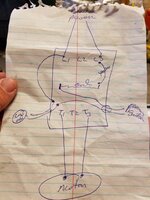
Can anyone verify if this is the correct wiring for the motor starter , circle on the left says low oil switch , on the right of box is pressure switch , thanks

Sent from my SM-G930V using Tapatalk
72539a162b27f8f7436c3be6042c1f29.jpg
 
OP
T

thinktwicez71

Well-known member
Joined
Jun 29, 2013
Messages
201
Location
Ogdensburg New York
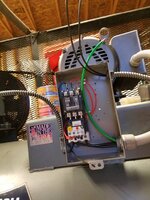
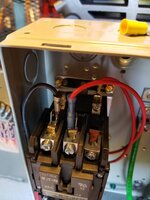
This is where I'm at so far , just gotta finish hooking it up tommorow . I got all the new wire installed from the pressure switch and to the motor 0be89fc76d95a41164ae6a443fe51dc1.jpg

Sent from my SM-G930V using Tapatalk
 

Attachments

  • 0be89fc76d95a41164ae6a443fe51dc1.jpg
    0be89fc76d95a41164ae6a443fe51dc1.jpg
    105.4 KB · Views: 3

matt_i

Well-known member
Joined
Mar 14, 2008
Messages
10,725
Location
SE Michigan
It seems like there could be a problem here. Part of the control wiring appears to be landed on L2.

In addition, a 3 pole starter and overload section is going to give you phase loss very fast and very consistently, when used on 1 phase. Two options are either to connect T1 to L2 and then T2/T3 to the motor, or eliminate the normally closed (NC) contact from the control circuit and run without the overload protection.
 
Last edited:

wyliesdiesels

Well-known member
Joined
Aug 14, 2012
Messages
19,998
Location
Modesto, CA
Can anyone verify if this is the correct wiring for the motor starter , circle on the left says low oil switch , on the right of box is pressure switch , thanks

Sent from my SM-G930V using Tapatalk

The diagram needs to be changed around. Also, the control wiring on the diagram doesnt match the actual wiring you have. (more on this below).

As pointed out by matt_i, your solid state overload will most likely almost instantaneously trip as there is no current going through the T2 coil and it will see that as a phase loss.

Incoming supply line 2 needs to go to L2. You can use the 3 phase starter(as long as its rated for the 10HP in single phase- more below) but you will need to run a #6 THWN from T2 to L3 to prevent the phase loss tripping. Motor connects to T1 and T3 as on your diagram.

Control wiring needs to be adjusted.

You can leave the overload relay hooked up to L2 and A2 for the coil(i cant tell if its hooked up to L3 or A2).

The black lead from the pressure switch (or low oil switch) can connect to low oil switch (or pressure switch) and then on to A1 for the coil.

Make sure the other end of that is connected to L1.

In regards to HP rating on the starter, do you see any ratings?

If not how about model numbers?

Starters have lower HP ratings when used on single phase. You definitely want to make sure its rated for that beast.

It seems like there could be a problem here. Part of the control wiring appears to be landed on L2.

In addition, a 3 pole starter and overload section is going to give you phase loss very fast and very consistently, when used on 1 phase. Two options are either to connect T1 to L2 and then L2/L3 to the motor, or eliminate the normally closed (NC) contact from the control circuit and run without the overload protection.

Control wiring can stay on L2 if wired as i pointed out above.

I Typically see manu. wire T2 to L3.

I would NOT run without overload protection...
 
Last edited:
To avoid these ads, REGISTER NOW!

mm08822

Well-known member
Joined
Jan 13, 2012
Messages
5,895
Location
NJ
If your ps does not have an integral on/off switch as part of it, you will want an on/off switch in the control circuit.

Double check the coil voltage before energizing. Make sure its rated and set for 230vac.
 
OP
T

thinktwicez71

Well-known member
Joined
Jun 29, 2013
Messages
201
Location
Ogdensburg New York
In regards to the starter it is listed as a 10hp single phase 230 volt starter, overload protection from 40-57 amps adjustable

Sent from my SM-G930V using Tapatalk
 
OP
T

thinktwicez71

Well-known member
Joined
Jun 29, 2013
Messages
201
Location
Ogdensburg New York
I also spoke with one of my buddies who works for the power company (lineman 10 years ) . He said no hp limit that he knows of , said with my service , being on my own transformer there won't be an issue .

Sent from my SM-G930V using Tapatalk
 

86turbodsl

Well-known member
Joined
Jul 1, 2005
Messages
6,556
Location
Michigan
Am i the only one thinking you're *ON* a 3 phase line and not using a 3Ph motor and that's just WRONG?

I'd give my left eye teeth to get 3ph where i'm at.
 
OP
T

thinktwicez71

Well-known member
Joined
Jun 29, 2013
Messages
201
Location
Ogdensburg New York
No no I'm not on 3 phase . Single phase here . I have my own transformer and it only takes 2 of the 3 legs . This is a single phase 10hp 230v motor I'm wiring

Sent from my SM-G930V using Tapatalk
 
OP
T

thinktwicez71

Well-known member
Joined
Jun 29, 2013
Messages
201
Location
Ogdensburg New York
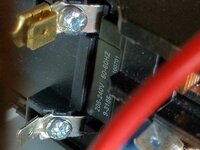
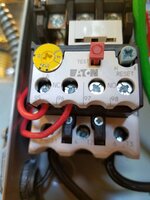
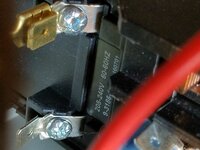
96 wired from the factory goes to L2 and 95 from the factory goes to one leg of the coil which is 230 volt coil acc645988da2e9c11daacb4dc96b3d17.jpgcf19b1c024531581df04d9f8051abf82.jpg

Sent from my SM-G930V using Tapatalk
 

Attachments

  • acc645988da2e9c11daacb4dc96b3d17.jpg
    acc645988da2e9c11daacb4dc96b3d17.jpg
    68.9 KB · Views: 1
  • cf19b1c024531581df04d9f8051abf82.jpg
    cf19b1c024531581df04d9f8051abf82.jpg
    216.2 KB · Views: 1
OP
T

thinktwicez71

Well-known member
Joined
Jun 29, 2013
Messages
201
Location
Ogdensburg New York
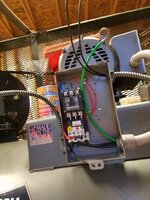
More views in case u need themf131f5bf635df0513ce08ca1b2ed6839.jpge979a350d08e828f32929a7397eeba75.jpgebea651556dd508d764ca0b08b365fd2.jpg

Sent from my SM-G930V using Tapatalk
 

Attachments

  • ebea651556dd508d764ca0b08b365fd2.jpg
    ebea651556dd508d764ca0b08b365fd2.jpg
    74.1 KB · Views: 2
  • e979a350d08e828f32929a7397eeba75.jpg
    e979a350d08e828f32929a7397eeba75.jpg
    94.8 KB · Views: 2
  • f131f5bf635df0513ce08ca1b2ed6839.jpg
    f131f5bf635df0513ce08ca1b2ed6839.jpg
    76.7 KB · Views: 2

wyliesdiesels

Well-known member
Joined
Aug 14, 2012
Messages
19,998
Location
Modesto, CA
Am i the only one thinking you're *ON* a 3 phase line and not using a 3Ph motor and that's just WRONG?

I'd give my left eye teeth to get 3ph where i'm at.

Yes.

I almost always assume single phase on GJ as 99% are single phase.

Even if he had 3 phase service he could still use a single phase motor so thats inconsequential...
 
OP
T

thinktwicez71

Well-known member
Joined
Jun 29, 2013
Messages
201
Location
Ogdensburg New York
Wyliesdiesels...just in case you don't check private messages ....Wiring my starter box help

You've been a big help on my post about wiring my motor starter. Lemme see if I understand this correctly . Power feeding the motor starter go to L1 and L2 . I need a #6 jumper from L3 to T2 so it doesn't phase trip. T1 and T3 go to motor. Leave the control wires on L2 and the other on the coil ? Is that a2 ? Then the oil switch one wire goes to L1 , the other is spliced to one wire from the pressure switch and the other pressure switch wire goes to the other side of the coil ? Thanks


Sent from my iPad using Tapatalk
 
OP
T

thinktwicez71

Well-known member
Joined
Jun 29, 2013
Messages
201
Location
Ogdensburg New York
Ok so power lines in to L1 and L2 , jumper from L3 to T2 . Motor wires are T1 and T3 . I just get confused on the coil portion with the pressure switch and low oil wires. Please forgive all the questions , this stuff isn't my specialty . Might take a little bit but I just wanna do it right the first time . Thanks

Is there a orientation for the 2 pressure switch wires and low oil wires ? Or as long as they're hooked up your fine ? Like can the 2 be wrong and need to be flipped ?
Sent from my iPad using Tapatalk
 
Last edited:

Matt Matt

Well-known member
Joined
May 11, 2017
Messages
523
Location
Ontario
Here is how I would wire.


I second that wiring schematic. To have the contactor heater work adequately it needs all three contacts with power running through them. The only thing I would change is I would put two little in-line fuses on the control circuit. You're not supposed to have that amount of amperage at the controls. My bet is that the control coil uses less than 0.5 A. You can test this with a clamp on meter, and then use two fuses that are 1.5 times the size.
 

Attachments

  • IMG_1158.JPG
    IMG_1158.JPG
    90.2 KB · Views: 19
Last edited:

mm08822

Well-known member
Joined
Jan 13, 2012
Messages
5,895
Location
NJ
matt and matt were quicker than me.......

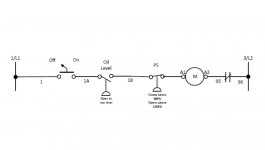
This has the oil sw and an on/off switch if needed otherwise ignore it. I didn't do the power side but it's been well covered.

Screen Shot 08-16-17 at 09.20 PM.jpg

Screen Shot 08-16-17 at 09.21 PM.JPG
 

wyliesdiesels

Well-known member
Joined
Aug 14, 2012
Messages
19,998
Location
Modesto, CA
Wyliesdiesels...just in case you don't check private messages ....Wiring my starter box help

You've been a big help on my post about wiring my motor starter. Lemme see if I understand this correctly . Power feeding the motor starter go to L1 and L2 . I need a #6 jumper from L3 to T2 so it doesn't phase trip. T1 and T3 go to motor.

I check PMs and respond when i can.

correct so far

Line in goes to L1 and L2
jumper T2 to L3
motor leads on T1 and T3

Leave the control wires on L2 and the other on the coil ? Is that a2 ?


yes correct, leave the red wires from the overload block alone.

The overload side of the coil/control wiring is already done by the factory so No sense in redoing it.

And im assuming the coil terminal is A2 since its on the right.

Then the oil switch one wire goes to L1 , the other is spliced to one wire from the pressure switch and the other pressure switch wire goes to the other side of the coil ?

What does the black wires in the metal flex on the left go to? the Oil switch? One black wire is already on L1 on the top.

Just complete the circuit by tying in the pressure switch to the oil switch, then other pressure switch lead goes to coil A1 behind L1.

Here is how I would wire.


Just curious why would you change the factory overload control wiring by adding in the pressure switch?

Why not leave it alone and just wire pressure switch and oil switch to L1/A1 side?

Unless Im misinterpreting your diagram..

Ok so power lines in to L1 and L2 , jumper from L3 to T2 . Motor wires are T1 and T3.

yup

I just get confused on the coil portion with the pressure switch and low oil wires. Please forgive all the questions,......

If you draw it out on paper it will make sense. The pressure switch and oil switch are just passing the voltage from L1 through to A1. Its the same concept as a single pole light switch in your house.

no need to ask for forgiveness on questions. Better to ask questions than let the magic smoke out.

Is there a orientation for the 2 pressure switch wires and low oil wires? Or as long as they're hooked up your fine? Like can the 2 be wrong and need to be flipped?
Sent from my iPad using Tapatalk

No orientation. Its a series circuit so no way to miswire. either wire on switch can go either way as long as you have a complete circuit from L1 to A1.

I second that wiring schematic. To have the contactor heater work adequately it needs all three contacts with power running through them. The only thing I would change is I would put two little in-line fuses on the control circuit. You're not supposed to have that amount of amperage at the controls. My bet is that the control coil uses less than 0.5 A. You can test this with a clamp on meter, and then use two fuses that are 1.5 times the size.

Im not following you here. Are you saying that there will be more amperage flowing through the control wire than it is rated for?

As you pointed out, the coil wont draw much current at all.

Why would you need fuses? they arent necessary.

Your comment is contradictory....

The only time i will use fuses is when there is a low voltage coil, and thus need a control transformer.
 
Last edited:

Matt Matt

Well-known member
Joined
May 11, 2017
Messages
523
Location
Ontario
:thumbup: I missed the low oil switch. Good idea on the control fuse also.

Sorry Matt to mark up the **** out of your drawing. I assumed that the low oil would have been run in series. But for the OP, a visual if he has a newbie is important.
 

Attachments

  • IMG_1158.JPG
    IMG_1158.JPG
    91.8 KB · Views: 15

Matt Matt

Well-known member
Joined
May 11, 2017
Messages
523
Location
Ontario
Wylie, anything that leaves the control box on a smaller line should be fused. Operating coils should also be protected as well internally. If I control wire that has a possible 60 A that touched a metal housing which is accessible by operator, is now considered a hazard. Low-voltage circuit's (direct current do not require this). Also a ground lead should follow. Maybe I'm nuts but this is how I'm required to do it.
 
Last edited:

wyliesdiesels

Well-known member
Joined
Aug 14, 2012
Messages
19,998
Location
Modesto, CA
Wylie, anything that leaves the control box on a smaller line should be fused. Operating coils should also be protected as well internally. If I control wire that has a possible 60 A that touched a metal housing which is accessible by operator, is now considered a hazard. Low-voltage circuit's (direct current do not require this). Also a ground lead should follow. Maybe I'm nuts but this is how I'm required to do it.

But thats why the control box is bonded to ground(should be) and any hot wire shorting to the grounded metal box will trip the breaker so thats not a good reason.

Manufacturers dont wire fuses into control wiring.

I use to hookup pump panels for submersible and turbine pumps and starters would sometimes come pre-wired. Never seen fused control wiring from factory.

BTW if the wires are terminated properly, there should be no loose wires that could touch the housing.

And when i said low voltage, I wasnt talking about DC/direct current controls. I was referring to 24VAC controls...
 

Matt Matt

Well-known member
Joined
May 11, 2017
Messages
523
Location
Ontario
But thats why the control box is bonded to ground(should be) and any hot wire shorting to the grounded metal box will trip the breaker so thats not a good reason.

Manufacturers dont wire fuses into control wiring.

I use to hookup pump panels for submersible and turbine pumps and starters would sometimes come pre-wired. Never seen fused control wiring from factory.

BTW if the wires are terminated properly, there should be no loose wires that could touch the housing.

And when i said low voltage, I wasnt talking about DC/direct current controls. I was referring to 24VAC controls...
pressure control switches are generally insulated with Teflon tape. This does not make for a good ground. I would like to see a pressure switch which is rated for more than .5 A without a ground terminal. The fusing only helps on both the circuit side and the safety side. You might consider this redundant, some manufacturers do as well (and they skate) under the NEC requirements for bonding.but it doesn't make it right.

Maybe the OP can show picture of the pressure control valve circuitry for more clarification?
 
Last edited:
To avoid these ads, REGISTER NOW!
Top Bottom