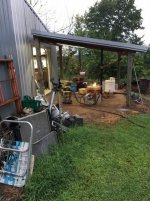
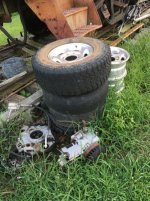
The foundry also helps clean up all the scrap aluminium into nice stack of muffins and ingots of course!

I knew I liked you!! Yes, that's it!! I'm cleaning up
Andy
It's been two years and 5281 posts since you started this thread. It has been enjoyable following along with you on your adventures. Looking forward to following some more.
Dwight
Thanks for your kind words!

You're right, I missed the anniversary

Andy,
Looks like a good time was had by all.
It's been two years since you started this thread and I have enjoyed following along with you. Looking forward to hearing from you in the days ahead.
Dwight
We had a very good time. I like visitors.
I am not sure if I should be embarrassed or thankful but I suspect its the first time I have replied to your thread.
Well it's a two way street. I've read your thread off and on and only the other day posted. There are too many good threads and it takes too much time to read them all so we all tend to settle in to our own community of threads we read regularly. Glad to have you look in.
Thongs like this makes this forum and its members awesome.
I like thongs too, but I'm so forgetful I don't know when thongs were mentioned here.
Call to Stas26: We need thong pictures.
And also makes the world very small.
Of course I now want to build a furnace too and melt everything in a 100 mile radius.
Really hope we get to meet up and make it up as far as you are in September.
Craig and I both think alike so it should be fun.
PS. Looks like I have some reading and catching up
To do.
Rian.
You'll be surprised how much aluminium there is within a few miles of your haouse. And it's pretty easy to cast stuff from cast offs.
Andy, maybe I missed it somewhere, what do you use to break down the scrap aluminum into ingots? I have thought about a 55 gallon barrel with holes into the bottom and a fire inside to break down wheels and whatnot to get the scrap into smaller peices.
Sent from my LG-TP450 using Tapatalk
Please skip this epistle if you're not interested in melting aluminum.
I pour ingots, but I try to use every tool I have to prepare scrap to go into the crucible.
You may have seen the 55 gal bulk melter. It is less than ideal. Aluminum oxide, while a great material, is created by oxygen and aluminum, at a greater rate when then aluminum is hot. So melting aluminum and having it drip down into incoming air is not the best. Holes inn the bottom of a drum would likely plug up with aluminum unless you can get the bottom to stay red hot. My grate has about three inch openings and with a lot of melting I find the aluminum starts piling up on top of the grating and will sometimes bridge across.
The melter leaves lots of big piles of aluminum which can be broken down with a hammer, but it is work. The resulting nuggets which do fall into the water (the majority of the melt) are tedious to separate from the aluminum oxide (heavier) and charcoal (lighter). I made a sluice box which helps but it is still slow. And all the product still needs to be melted if it is put into ingots.
The bulk melter is great for stuff like auto air conditioner compressors, small engines, etc. because the aluminum leaves the steel behind and the plastic burns up. Carbon is more beneficial than harmful when melting aluminum as it combines readily with oxygen when hot so reduces aluminum oxides. But brass and bronze bits (bushings, gaskets, etc.) can contaminate the aluminum and make a dross which is a higher melting temperature than pure aluminum and not useful. So in the end analysis anything which can be disassembled into crucible sizes saves time to manually break it down rather than bulk melting. Bulk melting in a large bonfire is better for eliminating oxygen but then you're left with a large pool of aluminum under the fire which must still be cut up.
You can cut up wheels nicely with a table saw. You roll the wheel into the blade to cut off each bead then work you way in to the center. It will rip long structural which is too wide. Specialty aluminum cutting blades are worth the money.
A porta-band is great for cutting up stuff like pistons, valves, engine crossovers and is also used to desprue after casting.
Reciprocating saw is great for radiators and large light pieces. I cut up a satellite dish that way. Here is a radiator I cut up this morning:
Easy cutting
Made eight pieces
In she goes!
Swallow sucker!
Two and a half pieces made 3.1 ingots.
Each about 1-1/2 pounds.
Beverly shear is incredible for light structural and thin material. Great for lawn chairs too. It's also the tool to cut up wire.
Plasma makes a big mess and is of less value.
So the summary of where I'm at now: Disassemble as much as is easy, then cut up everything you can, cut through pipe connections to get rusted steel out. Cut valves through to get rid of high alloy valve seats.
I try to get screws out of window frames, iron, cadmium and zinc are not good in aluminum but a little doesn't hurt. Rubber and caulk burn right up.
When aluminum is a few degrees below melting it is
hot short. Hot short is very weak and can be broken up. Cooking wheels on a grate over a fire can be done, you break off pieces with your tongs but the temperature soon rises and the wheel remnants fall into the fire and have to be dug out cold. I've not tried it but may be ready this fall when it's cool out.
Now back to real life

I think with the new forge in play he's lost interest in cleaning up the shop.


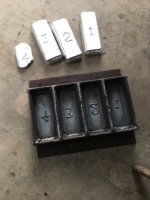

 I noticed the price of aluminum cans has been dropping around here. Guess you've flooded the market with muffins.
 I thought I was done. So I've started wire brushing it.