
You are using an out of date browser. It may not display this or other websites correctly.
You should upgrade or use an alternative browser.
You should upgrade or use an alternative browser.
My small but growing DBE wrench collection
- Thread starter BlueBomber
- Start date
OP
BlueBomber
Well-known member
Thanks for the data! I think in answer to your last sentence, it would depend on how tight the bolt it nut is...and how much crud is on it, like mine!
Sent from my SM-G950U using Tapatalk
Sent from my SM-G950U using Tapatalk
^^^ You might not want to do this, but some people grind flat the end on an old socket to eliminate the internal chamfer/lead-in to the hex/bi-hex service opening and then tap this socket onto the nut or bolt to cut through any dirt, mud, paint, underseal, or heavy rust that is in the way.
I know this wouldn't have helped on your Silverado in the example above due to lack of room but it might help elsewhere.
AL.
I know this wouldn't have helped on your Silverado in the example above due to lack of room but it might help elsewhere.
AL.
OP
BlueBomber
Well-known member
Interesting technique, Al--I'll have to remember that one.
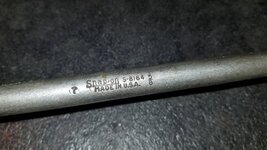
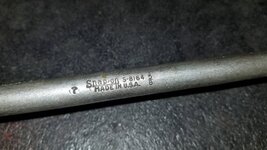
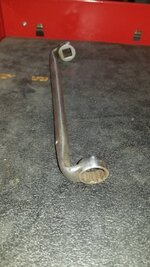
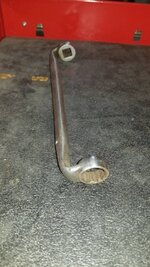
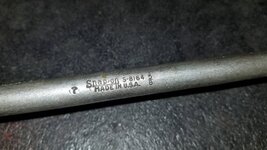
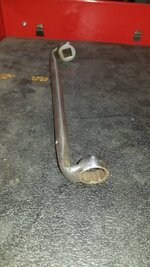
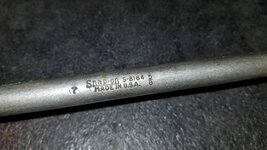
I found this specimen in an antique store in Gloucester today. Although technically not a double box end (one end is 1/2" square for a ratchet driver), I'm including it anyway because both ends are in fact boxed.
Snap-on S-8164, 5/8" 12-pt x 1/2" square, dated 1947
This is a specialty wrench, often described as being for head bolts, but CollectingSnapon describes it as for starter or distributor bolts. Anyone know?
Sent from my SM-G950U using Tapatalk
I found this specimen in an antique store in Gloucester today. Although technically not a double box end (one end is 1/2" square for a ratchet driver), I'm including it anyway because both ends are in fact boxed.
Snap-on S-8164, 5/8" 12-pt x 1/2" square, dated 1947
This is a specialty wrench, often described as being for head bolts, but CollectingSnapon describes it as for starter or distributor bolts. Anyone know?
Sent from my SM-G950U using Tapatalk
Attachments
Provincial
Well-known member
That Snap On is a torque adapter. The square drive is directly over the 12-pt. end so you get an accurate reading on the torque.
It is also useful for starters which have little clearance around the starter, and the mounting bolt circle is smaller than the starter body.
It is also useful for starters which have little clearance around the starter, and the mounting bolt circle is smaller than the starter body.
Interesting technique, Al--I'll have to remember that one.
I found this specimen in an antique store in Gloucester today. Although technically not a double box end (one end is 1/2" square for a ratchet driver), I'm including it anyway because both ends are in fact boxed.
Snap-on S-8164, 5/8" 12-pt x 1/2" square, dated 1947
This is a specialty wrench, often described as being for head bolts, but CollectingSnapon describes it as for starter or distributor bolts. Anyone know?
Sent from my SM-G950U using Tapatalk
Page 84 Cat UR 1954, Oldsmobile Pontiac Starter Wrench, 5/8" hex.
Are those era engines L head?
Attachments
Outlawmws
Well-known member
Not really enough offset for a distributor, and most were 1/2" or 9/16, not 5/8. Starter is much more reasonable, as is it being a torque adapter. I have a growing collection of torque adapters I'm adding to the torque tool drawer.
OP
BlueBomber
Well-known member
There must be something about a particular application that drive this design--otherwise why not just use a deep well socket on an extension? Maybe it was a nut on a long threaded shaft, too long for a deep socket...That Snap On is a torque adapter. The square drive is directly over the 12-pt. end so you get an accurate reading on the torque.
It is also useful for starters which have little clearance around the starter, and the mounting bolt circle is smaller than the starter body.
Sent from my SM-G950U using Tapatalk
Outlawmws
Well-known member
Don't think of it as going round and round, if it could, as you say, an extension does the trick. It's an obstruction tool, so you turn a part turn, lift, reset then turn again. Generally used for the final torquing, assuming enough space to hand tighten...
Provincial
Well-known member
To expand on Outlaw's post, imagine a starter that has a mounting flange where the fasteners are located in a recess that is smaller than the main body of the starter motor. You can only get to the nuts/bolts from the side, since the body of the motor blocks access with a socket and extension. You could use an open-end or box-end wrench if there are no other obstructions, but since the engine block is in the way for over half the diameter, you need a tool that can reach around the starter motor and get into the recess where the nuts are.
Now put a square drive directly over the box end at the far end of the beam of the wrench, and you have the type of tool you show.
In practice, that tool is properly used to torque bolts (it is the proper size for 7/16" SAE hex head bolts) where there is an obstruction (such as a rocker arm) that prevents use of a standard socket and extension.
Now put a square drive directly over the box end at the far end of the beam of the wrench, and you have the type of tool you show.
In practice, that tool is properly used to torque bolts (it is the proper size for 7/16" SAE hex head bolts) where there is an obstruction (such as a rocker arm) that prevents use of a standard socket and extension.
OP
BlueBomber
Well-known member
To expand on Outlaw's post, imagine a starter that has a mounting flange where the fasteners are located in a recess that is smaller than the main body of the starter motor. You can only get to the nuts/bolts from the side, since the body of the motor blocks access with a socket and extension. You could use an open-end or box-end wrench if there are no other obstructions, but since the engine block is in the way for over half the diameter, you need a tool that can reach around the starter motor and get into the recess where the nuts are.
Now put a square drive directly over the box end at the far end of the beam of the wrench, and you have the type of tool you show.
In practice, that tool is properly used to torque bolts (it is the proper size for 7/16" SAE hex head bolts) where there is an obstruction (such as a rocker arm) that prevents use of a standard socket and extension.
Aha, thanks gents--I can see it now. Thanks!
Provincial
Well-known member
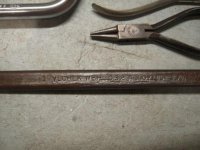
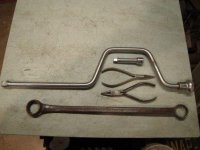
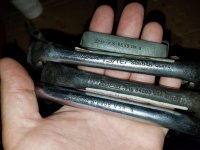
I have some of those Snap On torque adapters. The big one on top is a S-8666 for 1949-1953 Ford engines, it goes around certain engine compartment obstructions to get to some of the head bolts. The next one is a B4203 for Case and Minneapolis tractors, then a S8684B for John Deere and Oliver. Last is a S-8659 for a Ford oil pressure sending unit, notice it is an open end.
Attachments

Last edited:
I have some of those Snap On torque adapters. The big one on top is a S-8666 for 1949-1953 Ford engines, it goes around certain engine compartment obstructions to get to some of the head bolts. The next one is a B4203 for Case and Minneapolis tractors, then a S8684B for John Deere and Oliver. Last is a S-8659 for a Ford oil pressure sending unit, notice it is an open end.
So, as long as the drive square is perfectly in-line with the box on the other end it's used as a torque multiplier/adapter?
Provincial
Well-known member
If it is in line, it is a torque adapter. If the square drive is offset, it is a multiplier to the extent that it adds length to the arm of the torque wrench. A true torque multipler is a gear reduction and reaction bar that greatly reduces the effort applied to the input in order to get the desired torque applied to the output.
Outlawmws
Well-known member
If it is in line, it is a torque adapter. If the square drive is offset, it is a multiplier to the extent that it adds length to the arm of the torque wrench. A true torque multipler is a gear reduction and reaction bar that greatly reduces the effort applied to the input in order to get the desired torque applied to the output.

Username already in use
Well-known member
Here's a handful of Bonney torque multipliers/adaptors that I picked up last year and previously posted in the 'Bonney Affliction' thread. Some are engraved GE, presumably GE aircraft which is relatively close to me.

If it is in line, it is a torque adapter. If the square drive is offset, it is a multiplier to the extent that it adds length to the arm of the torque wrench. A true torque multipler is a gear reduction and reaction bar that greatly reduces the effort applied to the input in order to get the desired torque applied to the output.
Thanks!
Here's a handful of Bonney torque multipliers/adaptors that I picked up last year and previously posted in the 'Bonney Affliction' thread. Some are engraved GE, presumably GE aircraft which is relatively close to me.
Interesting!
How does that one at the top of the photo work? Looks like it has both an open end and a socket.

Username already in use
Well-known member
Interesting!
How does that one at the top of the photo work? Looks like it has both an open end and a socket.
Yea, your guess is as good as mine.
It's a Bonney socket too, that fits right onto that tab coming off the side. Very odd. I've never seen anything like it before.
Outlawmws
Well-known member
You guys thought about starting a torque adapter/obstruction wrench thread?
OP
BlueBomber
Well-known member
And now, back to our regular programming...
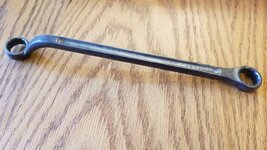
Months ago, I noted the GJ member LesserSon has been carrying a "Wrenches Wanted" signature line that included Bonney single offset wrenches. I rummaged through my pile of spares and found one he needed. It took us months to finalize the terms of the trade, but earlier this week, my half of the deal arrived:
Bonney 2824 single offset, 3/4" x 3/4"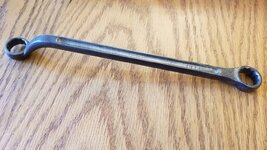
Sent from my SM-G950U using Tapatalk
Months ago, I noted the GJ member LesserSon has been carrying a "Wrenches Wanted" signature line that included Bonney single offset wrenches. I rummaged through my pile of spares and found one he needed. It took us months to finalize the terms of the trade, but earlier this week, my half of the deal arrived:
Bonney 2824 single offset, 3/4" x 3/4"
Sent from my SM-G950U using Tapatalk
Attachments
OP
BlueBomber
Well-known member
But wait, there's more! Last month, 454ragtop posted a picture of a box of single offset wrenches he'd seen in an antique store. We exchanged PMs and he was eventually able to pick them up for me and send them my way.
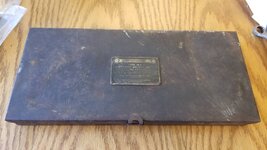
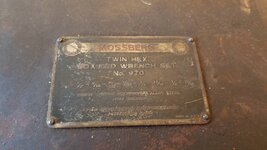
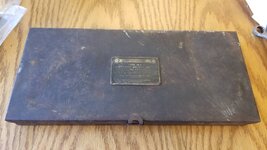
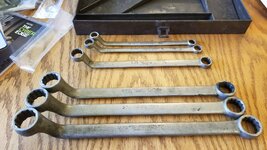
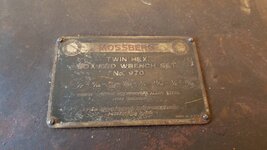
This is an APCO Mossberg #970 case, designed to hold nine of their double box, single offset wrenches! Although I've found examples of some of these wrenches on the Alloy Artifacts website, I've been unable to find any examples of the wrench box for the set anywhere on the web. Does anyone know of a repository of APCO Mossberg catalogs?
Inside were six of the nine wrenches that came in this case.
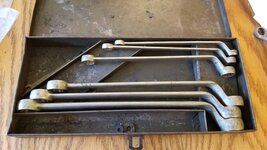
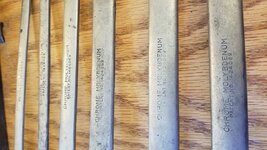
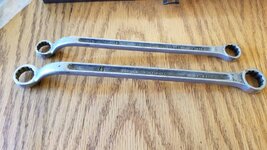
Here are the wrenches:
APCO Mossberg 971 single offset, 7/16" x 7/16"
APCO Mossberg 972 single offset, 1/2" x 1/2"
APCO Mossberg 974 single offset, 5/8" x 5/8"
APCO Mossberg 977 single offset, 13/16" x 13/16"
APCO Mossberg 978 single offset, 7/8" x 7/8"
APCO Mossberg 979 single offset, 15/16" x 15/16"
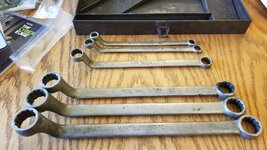


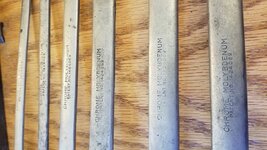
Also in the case were two Bonney Zenel single offset wrenches both with their Zenel stickers mostly intact. LesserSon will be wanting one of these as well.
Bonney Zenel Z 2818 single offset, 9/16" x 9/16"--June 1947 date code
Bonney Zenel Z-2822 single offset, 11/16" x 11/16"--October 1937 date code


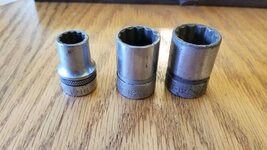
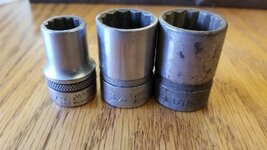
Also in the case were three Williams 1/2"-drive ST-series sockets
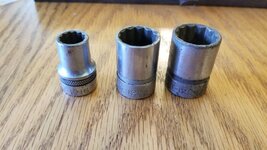
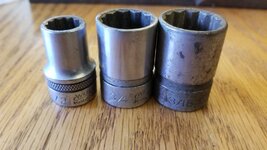
Not pictured were a handfull of tiny DOE wrenches.
I am super stoked to have this set in my collection, and am of course now on the lookout for the three wrenches required to complete the box set!
Sent from my SM-G950U using Tapatalk
This is an APCO Mossberg #970 case, designed to hold nine of their double box, single offset wrenches! Although I've found examples of some of these wrenches on the Alloy Artifacts website, I've been unable to find any examples of the wrench box for the set anywhere on the web. Does anyone know of a repository of APCO Mossberg catalogs?
Inside were six of the nine wrenches that came in this case.
Here are the wrenches:
APCO Mossberg 971 single offset, 7/16" x 7/16"
APCO Mossberg 972 single offset, 1/2" x 1/2"
APCO Mossberg 974 single offset, 5/8" x 5/8"
APCO Mossberg 977 single offset, 13/16" x 13/16"
APCO Mossberg 978 single offset, 7/8" x 7/8"
APCO Mossberg 979 single offset, 15/16" x 15/16"
Also in the case were two Bonney Zenel single offset wrenches both with their Zenel stickers mostly intact. LesserSon will be wanting one of these as well.
Bonney Zenel Z 2818 single offset, 9/16" x 9/16"--June 1947 date code
Bonney Zenel Z-2822 single offset, 11/16" x 11/16"--October 1937 date code
Also in the case were three Williams 1/2"-drive ST-series sockets
Not pictured were a handfull of tiny DOE wrenches.
I am super stoked to have this set in my collection, and am of course now on the lookout for the three wrenches required to complete the box set!
Sent from my SM-G950U using Tapatalk
Attachments
-
 2d71391650477853589116172fa2edfb.jpg87.2 KB · Views: 0
 -
 1d40fe545acf312f64c4881c42d2f1dd.jpg97.6 KB · Views: 0
 -
 915a53ed5f7c3870f789bdd2bf669efc.jpg50.1 KB · Views: 0
 -
 031c40cbbf199bab64e02dba7d31954d.jpg72.7 KB · Views: 0
 -
 aac5b0bad6cfad273fbe57ddf6e9d223.jpg69.6 KB · Views: 0
 -
 93ad541607ca45b444378f94793b82e0.jpg57.8 KB · Views: 0
 -
 472bd1d89ca47f67919969b8ebdef606.jpg83.3 KB · Views: 0
 -
 62713e798822e275cf15c76673af9ad4.jpg76.3 KB · Views: 0
 -
 6eb00b0ff9e18dff873e9f04d0fdff80.jpg57.9 KB · Views: 0
 -
 d6f991aabe506cab9b07a486ca469fe1.jpg87.9 KB · Views: 0
 -
 77c0048b2992849f12ea3c654e89a2ca.jpg100.7 KB · Views: 0
 -
 feb0838e6fbca6ae363b3bbc26fc33e0.jpg76.4 KB · Views: 0
 -
 ee5162938c7b81631416e104d92bcd9c.jpg59.3 KB · Views: 1
Last edited:
Private Lugnutz
Well-known member
That Mossberg set is beyond awesome.
I have never seen even one of those in the wild.
That Mossberg set is beyond awesome.
+2 **** like a black hole awesome!

PM sent!LesserSon will be wanting one of these as well.
Congrats on the Mossbergs, as well!
Rileysan
Well-known member
I guess I'll volunteer to be the guy who follows that which cannot be topped. Nice Mossbergs!
I picked up an ordinary Plomb yesterday for $20. Thr only thing that's special about it is the huge size.
Plomb 1164, 1 5/8" x 1 11/16"
Brian
I picked up an ordinary Plomb yesterday for $20. Thr only thing that's special about it is the huge size.
Plomb 1164, 1 5/8" x 1 11/16"
Brian
Attachments
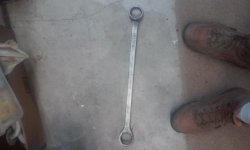
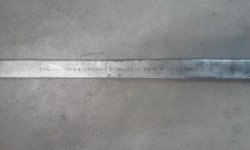
I guess I'll volunteer to be the guy who follows that which cannot be topped. Nice Mossbergs! .....Plomb 1164, 1 5/8" x 1 11/16"
Brian
Yeah. Nice wrench but........ can't be topped.
Where could we possibly go from here?
OP
BlueBomber
Well-known member


Sam'sAutoParts
Well-known member
That Mossberg set is amazing, love the DBE wrench sets with boxes.
WarrenJ
Well-known member
BB How do you organize all your DBE in a drawer or do you hag them on peg board Looking for some drawer ideas. Thanks
RagTopTA
Well-known member

OP
BlueBomber
Well-known member
WarrenJ,BB How do you organize all your DBE in a drawer or do you hag them on peg board Looking for some drawer ideas. Thanks
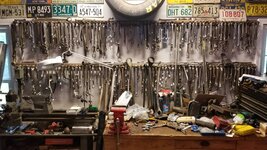
I hang my DBEs from a custom made rack:
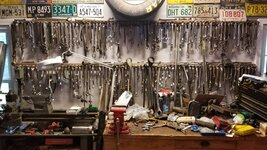
The rack has three 11-ft rows of nails, set on about 2-inch intervals. Each nail groups sets of wrenches. DBEs too big for the rack lean up against it.
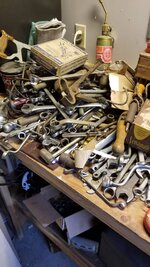
My extra keepers are currently just thrown into a drawer in my toolbox:

My tradable/sellable extras are piled on a workbench awaiting Ebay.
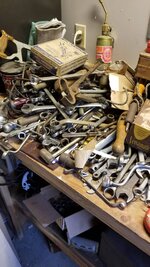
Sent from my SM-G950U using Tapatalk
Attachments

Last edited:
WarrenJ
Well-known member
BB thanks, I knew you had a large collection and wondered how you did it.
OP
BlueBomber
Well-known member
BB thanks, I knew you had a large collection and wondered how you did it.
No problem, WarrenJ!
And, on the occasion of this 2,000th post on a thread dedicated to box wrenches/ring spanners/double closed end wrenches, allow me to thank all of you for your interest and continued participation. This last week goes to show that we have not exhausted this topic--there are still DBEs to hunt and acquire, and when you do, this is the place to show them off.
Happy hunting!
Provincial
Well-known member

OP
BlueBomber
Well-known member
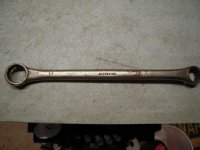
Nice example, Provincial!
OP
BlueBomber
Well-known member


disston
Well-known member
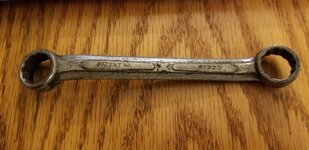
Molybdenum steel was the secret ingredient of steel works in Nazi Germany during WWII. The best we had has Magnesium I think. Saw this fact mentioned in one book recently. Have no idea of the details or if in fact there is any basis.
Cool wrench.
Cool wrench.