To avoid these ads, REGISTER NOW!

Detached garage walls bowing

DWinTX

Well-known member
Joined
Mar 20, 2006
Messages
81
Location
Woodland Park, CO
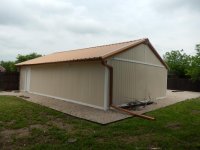
I have just purchased a small rental property. It has a detached garage that will not rent with the property, I'm going to use it to store some of my car projects. The garage has some issues and I received a decent discount on the price for it, but I need to figure out what to do to fix it.

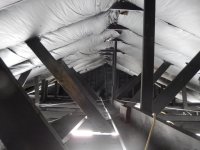
The garage is approx. 24x35. Stick built on a slab foundation. The walls are bowing on the sides (the 35 ft sides). On one side, the wall is bowing in, and on the other bowing out. I had a contractor look at it and he said that it's because the roof structure was not designed well and it's allowed the walls to bow. They used these V-shaped braces and they are not tied together. Each side of the V attaches only to the ceiling joist.

His proposal was to put anchors in the slab and use come-alongs to straighten the walls, then add rafters and cross-ties to reinforce the roof structure. He says that the spacing on the rafters is too much and that they used 2x4's instead of 2x6's. Some of the ceiling joists have been notched and sistered and he's going to replace those.

Another thing he didn't like it that the walls are built with 24" centers. He wants to add studs to bring that in. He could do them between all existing ones (12" centers) or between every other one (combo of 12" and 24" centers). He'll have to remove the sheetrock, but I'm going to go back with OSB, so there will no no taping and bedding.

He's also going to replace the insulation in the roof, between the rafters (the ceiling is open). He'll have to cust the insilation to fit since the rafter spacing will be non-standard.

He is quoting $10,500. So my questions are whether this sounds like a good plan, and is the cost fair? This guy has done work for me before and I was happy with it, but this is a different animal.

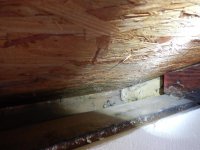
The pics don't really show the bowing that well, but maybe they'll help a little.
 

Attachments

  • DSCN1995.jpg
    DSCN1995.jpg
    68.4 KB · Views: 448
  • DSCN1996.jpg
    DSCN1996.jpg
    146.7 KB · Views: 447
  • DSCN1998.jpg
    DSCN1998.jpg
    117.2 KB · Views: 423
  • DSCN2002.jpg
    DSCN2002.jpg
    127.9 KB · Views: 426
  • DSCN2003.jpg
    DSCN2003.jpg
    115.2 KB · Views: 399
  • DSCN2011.jpg
    DSCN2011.jpg
    146.7 KB · Views: 437
  • DSCN2015.jpg
    DSCN2015.jpg
    94.5 KB · Views: 335
To avoid these ads, REGISTER NOW!

ford33

Well-known member
Joined
Feb 26, 2011
Messages
2,118
Location
Chicago, IL. USA
There have been several threads here on this very same issue. Some have had successful results while others not. People have suggested removal of the entire roof as the best approach while others will recommend pushing and pulling of the walls to get the roof right.

Your contractor is correct. The walls bowing are the result of the roof not providing sufficient support to keep the walls aligned. His suggestions sound reasonable for fixing the roof. The joists, rafters and ridge beam all play their part in keeping the walls aligned. Take a look at the roof ridge beam. It may be bowed down and if so will need to be lifted up into position.

It will take a lot of effort to move those walls using come-along's. It will require temporary removal of some of the joists. Removal of the roof insulation will allow him to see the roof structure and take measurements.

Adding additional wall studs will do nothing to help the wall situation. I would not spend the money for that option.

If you sign a contract, get it in writing about how out of alignment you will accept when finished. It's not going to be perfect when done but you need to determine how much is acceptable. Too much misalignment will impact the operation of the large door.

I have done this job on a garage I own. It was time consuming and moving those walls and correcting that roof was a lot of work. I cannot comment on the price proposed.

Good luck.
 

captain14

Well-known member
Joined
Dec 19, 2012
Messages
7,056
Location
Near College Park Maryland 20740
Two threads that come to mind are

1. Fergie’sDerelict Garage (first edition)

2. Talon’s Leaning Tower Of *%>?#.

Granted both threads have photos removed from the photo hosting debacle.
 

johnnyradiant

Well-known member
Joined
Mar 27, 2017
Messages
833
Location
Vancouver, BC
It's more common, at least around here on still functional buildings, to see both bowing out. That I find a little less troubling than the in/out thing you got going on. Once everything is 'solidified' I'd be tempted to call it done using your guy's plan. Meaning I don't think I would necessarily double up on the studs. 24" was a standard at one point. Obviously changed to 16" for structural reasons but I still tear into old and sound houses around here and find 24" on occasion. I would add studs anywhere there ends up being a rafter not already picked up by an existing stud.

What about closing in the ceiling and just using the ceiling to hold insulation? It'd be quick to rent a hopper and blow some cellulose in there.
 

Hot Rod Grampa

Well-known member
Joined
Jul 7, 2017
Messages
812
Location
Near Cooperstown New York
Do not follow the complete plan. Yes to come along the sides and straighten the building. If right now you measure the existing structure between the walls at the top plate, are the measurements equal? Are they all the same? If so, then changing the rafters will do nothing. After the walls are plumb and straight, adding diagonal braces from corner to corner or at least at a 45* angle from the corners would do wonders to stiffen the rafters. Then add a ceiling of OSB or tin, something stiff and that would further add ridgidity to the roof structure. If the walls are not parallel, then you can cut some rafters loose on one side, plumb the walls and re attach the rafters. Then proceed the bracing of the ceiling. This process is the same as in new construction, each truss package is designed with diagonal braces. Failure to follow the guidelines and properly brace the structure will cause it to rack.
 

BillK

Well-known member
Joined
Aug 24, 2006
Messages
9,348
Location
Beautiful Southern Maryland
Hard to tell from your pictures. My entire house and attached garage is all built with 24" on center studs. Has never been a problem so I don't see any reason to worry about that. Cant tell for sure but it looks like the ceiling joists are 2x6 ? You would think that would be good enough to hold everything in place unless they are not secured properly ? My house is all trusses.

I would pay for an engineer or architect to come out and look at it for a second opinion.

Of course all of this is being said without being there to look at it.
 

jask

Well-known member
Joined
Jul 4, 2009
Messages
314
Location
Gods Country, B.C.
Um... those trusses are a dogs breakfast of bad engineering, supported by walls that are wildly under built. Looking at the pics it looks like there have been a couple of attempts to address the bad engineering and a bunch of insulation to distract from how mickey duck the work is. that structure would not meet or pass any code or inspection. I am looking at randomly placed vertical elements that are screwed or nailed to the sides (??!) of the bottom chord at about the point I would expect to see a V shaped pair of web members ... spend a few bucks and have a real engineer look at the problem. they have training and will help you fix the problem right, for the last time.... 6 or 7 hundred bucks and an engineers seal and insurance is money well spent.
 

The Cobbler

Super Moderator
Staff member
Joined
Oct 24, 2013
Messages
25,928
Location
Niagara Region, Ontario, Canada
the quote sounds reasonable for the most part. (IMO)
it looks like someone tried to make " homemade trusses" rather than proper manufactured trusses or rafters and collar ties
I would not worry so much about the 24" centers , especially if you're planing on sheathing with OSB
 

matt_i

Well-known member
Joined
Mar 14, 2008
Messages
10,729
Location
SE Michigan
I dunno about all of this. There's a literal field of bottom chords out there. I agree the trusses are homebrew but I've seen pics of garages which were built with like 3 bottom chords in 24' of run and standing for many years.

It looks more to me like the step where you pull a string line down the walls to square the tops of them before you lock it into the bottom chord of the truss was missed/skipped. Or the bottom chords were added later on to address the outward pressure of rafters-only.

In either case I don't think there's a serious structural issue that says "impending collapse" The best improvement at this point imo would be to make sure that real uplift connectors are there, these are bound to be toenailed or even resting on the top plate via gravity alone. Definitely the alignment of the building could be improved to raise the "curb appeal" but its not where I'd personally spend my money. If I was going to do that I would demo the entire roof and go back with (engineered...they all are) factory-built trusses.
 

Bretny

Well-known member
Joined
Jul 31, 2017
Messages
3,918
Location
Dutchess county NY
For 10.5 you could almost tear it down and rebuild from the slab up.

My complete 24x24 was built for 11k with concrete.
 

rust in the eye

Well-known member
Joined
Oct 2, 2017
Messages
2,797
Location
Chicagoland
That repair sounds like throwing good money after bad to me.
With the entire roof structure removed the leaning walls could be pulled back into shape and then a proper roof structure could be made. Simpler and correct.
I'd prefer 16" wall stud centers but wouldn't be tearing this apart to add more.
What condition is the roof? perhaps a way to justify rebuilding from the top plate up.
Good luck
 
Last edited:
OP
D

DWinTX

Well-known member
Joined
Mar 20, 2006
Messages
81
Location
Woodland Park, CO
Thanks for all the responses guys. I'll try to address some of the questions and comments:

Looks like the prevailing opinion is that adding wall studs is pointless. I wondered about that. This guy does tend to overbuild, which is way better than the opposite. :) I had him build a detached garage a few years ago at my house. The local inspector commented very positively on his build quality. So I'll probably have him drop that from the estimate. I would think that would save a good bit. The county records indicate that this garage was built originally in 1963, which probably explains it.
Ceiling joists are 2x6, but a number of them are notched for the garage door openers. Seems really stupid when they could have just spaced the opener lower. A couple of others are splitting. These will all be replaced.

I know the best thing would be to hire a structural engineer, and I may still do that. I wanted to talk to a couple of contractors to see if they felt the fix was a no-brainer first. No reason to spend money that you don't have to.

A couple of people recommended tearing the entire roof off and replace with engineered trusses. One thing I'd like to do is to use cross-ties, rather than ceiling joists, in the back half of the garage to open the ceiling two or three of feet. The walls are only 8' high. I want to put a 4-post lift in there for additional storage. This contractor did that for me in my other garage for my 2-post and it has worked well.

The roof covering is metal. Don't know how that compares to shingles, but it doesn't seem to leak. We've had a lot of rain here lately, and I see no leakage.

If anyone has a contractor recommendation in the Dallas-Ft. Worth area (particularly the north part), please let me know. PM me if you prefer. I'd like to get a couple more bids.
 

Attachments

  • DSCN2026.jpg
    DSCN2026.jpg
    138.6 KB · Views: 108

ez-duzit

Well-known member
Joined
Jun 24, 2013
Messages
5,101
Location
Marina del Rey
...Looks like the prevailing opinion is that adding wall studs is pointless...So I'll probably have him drop that from the estimate. I would think that would save a good bit...

Very unwise to try to save such a tiny amount while undercutting this contractor's plan.
 
OP
D

DWinTX

Well-known member
Joined
Mar 20, 2006
Messages
81
Location
Woodland Park, CO
Very unwise to try to save such a tiny amount while undercutting this contractor's plan.

it's not really a tiny amount. Removing the sheetrock, adding wall studs around the entire perimeter, and re-sheetrocking was a significant part of the quote. I don't know exactly how much, but he stated that it was a significant factor in the quote being as high as it is.

If he absolutely insisted that it was required, then I'd reconsider. But like I said, he tends to overbuild. So I would at least ask if he thought it was essential.
 
OP
D

DWinTX

Well-known member
Joined
Mar 20, 2006
Messages
81
Location
Woodland Park, CO
I dunno about all of this. There's a literal field of bottom chords out there. I agree the trusses are homebrew but I've seen pics of garages which were built with like 3 bottom chords in 24' of run and standing for many years.

It looks more to me like the step where you pull a string line down the walls to square the tops of them before you lock it into the bottom chord of the truss was missed/skipped. Or the bottom chords were added later on to address the outward pressure of rafters-only.

In either case I don't think there's a serious structural issue that says "impending collapse" The best improvement at this point imo would be to make sure that real uplift connectors are there, these are bound to be toenailed or even resting on the top plate via gravity alone. Definitely the alignment of the building could be improved to raise the "curb appeal" but its not where I'd personally spend my money. If I was going to do that I would demo the entire roof and go back with (engineered...they all are) factory-built trusses.

I think Matt got it right. Likely they didn't brace those long walls straight before they roof it.

I'll try to go over today and see if I can tell how, or if, they attached the bottom chords. Ideally, it would use something like this, right?

https://www.lowes.com/pd/USP-5-1-4-in-18-Gauge-Triple-Zinc-Steel-Rafter-Tie/4222479

Of course I'm sure it doesn't unless they were added some point after initially being built. Did they have something like that in the 60s, or did they just nail them?
 

strutaeng

Well-known member
Joined
Dec 12, 2011
Messages
2,282
Location
Dallas, TX
Yes, it looks like they skipped the straightening/bracing step in framing. So, "bowing" implies this occurred after it was built, but in reality, the wall was just not straightened before decking/sheathing. Novice framer mistake.

Read this article:https://www.jlconline.com/how-to/framing/plumbing-and-straightening-walls_o

In actuality, without cutting the ceiling joist and rafters free from the double top plate of the wall, the walls won't move much because everything is sheathed and decked. Put a stringline from wall to wall, but it looks like a good 3"? Perpendicular wall panels will start buckling like crazy if you try to move that long wall that much. Even of you do, all the fascia eave, rake, etc will have to be redone because it will be off.

I'd just leave it as is if you intent to use it as storage. $10k is not pocket change. It's not a show garage. That's just my advice.

Plant some tall shrubs on the outside. On the inside you can re-sheetrock and shim or use fillers to straighten out the wall.

Good luck.
 

strutaeng

Well-known member
Joined
Dec 12, 2011
Messages
2,282
Location
Dallas, TX
16" vs 24" stud spacing is irrelevant. And adding additional studs won't do anything, as some have mentioned.

For less than $10k you can tear off the entire roof structure, straighten the walls and reframe the roof, instead of trying to fix the problem.

Just talk to a framer. There's a lot of construction North of DFW. I bet you can get 3 quotes easy and save some money. Don't bother with GCs.
 
To avoid these ads, REGISTER NOW!

Farmall450

Well-known member
Joined
Dec 23, 2011
Messages
13,371
Location
Marengo, Illinois
Yes, it looks like they skipped the straightening/bracing step in framing. So, "bowing" implies this occurred after it was built, but in reality, the wall was just not straightened before decking/sheathing. Novice framer mistake.

Read this article:https://www.jlconline.com/how-to/framing/plumbing-and-straightening-walls_o

In actuality, without cutting the ceiling joist and rafters free from the double top plate of the wall, the walls won't move much because everything is sheathed and decked. Put a stringline from wall to wall, but it looks like a good 3"? Perpendicular wall panels will start buckling like crazy if you try to move that long wall that much. Even of you do, all the fascia eave, rake, etc will have to be redone because it will be off.

I'd just leave it as is if you intent to use it as storage. $10k is not pocket change. It's not a show garage. That's just my advice.

Plant some tall shrubs on the outside. On the inside you can re-sheetrock and shim or use fillers to straighten out the wall.

Good luck.

Agreed. You could replace it for that, which you're essentially doing.
 
OP
D

DWinTX

Well-known member
Joined
Mar 20, 2006
Messages
81
Location
Woodland Park, CO
Yes, it looks like they skipped the straightening/bracing step in framing. So, "bowing" implies this occurred after it was built, but in reality, the wall was just not straightened before decking/sheathing. Novice framer mistake.

Read this article:https://www.jlconline.com/how-to/framing/plumbing-and-straightening-walls_o

In actuality, without cutting the ceiling joist and rafters free from the double top plate of the wall, the walls won't move much because everything is sheathed and decked. Put a stringline from wall to wall, but it looks like a good 3"? Perpendicular wall panels will start buckling like crazy if you try to move that long wall that much. Even of you do, all the fascia eave, rake, etc will have to be redone because it will be off.

I'd just leave it as is if you intent to use it as storage. $10k is not pocket change. It's not a show garage. That's just my advice.

Plant some tall shrubs on the outside. On the inside you can re-sheetrock and shim or use fillers to straighten out the wall.

Good luck.

10K is definitely not pocket change, I agree wholeheartedly. I really hope to figure out that I don't need to do that much. But I think I'd be afraid to do nothing. I'm going to put some classic cars in there. Even if you're right, I think it would be a "peace of mind" thing for me.

Couldn't get over there today to look at the rafter ties (or lack thereof). If I can get over tomorrow, I'll run the string line and measure as well.
 

wrenchguy

Well-known member
Joined
Sep 22, 2011
Messages
4,698
Location
NW Indiana
How long has it been like that? It was prolly framed like that. its all melded, clinched now, leave it. Lets see ridge line for sag.
 

strutaeng

Well-known member
Joined
Dec 12, 2011
Messages
2,282
Location
Dallas, TX
You'd see a lot of movement at the soffit, i.e., buckling, splitting, stuff tearing itself apart. Doesn't look like it from the photo. I see insanely thick caulk joints, but that was just to cover up the wide gaps I bet.The ceiling joists are bracing the top of the wall, so you are okay. As I said, the roof deck and exterior sheathing is what gives stiffness to a building and takes the lateral loads. The studs mostly just take the gravity loads. Everything is in place, so it's not going anywhere.

Are your walls plumb vertically? Looking again at the photo the bottom of the wall also looks like to have a sweep? Probably the "carpenter" didn't check the slab and followed the sweep.

You need to find this guy and slap him!:lol_hitti

Report back on the wall plumbness (use a 2x4x8' with a block at the ends and a 4' level to measure this) and the top of the wall stringline measurement.
 
OP
D

DWinTX

Well-known member
Joined
Mar 20, 2006
Messages
81
Location
Woodland Park, CO
No, the walls are not plumb. At the slab level, they are straight. But at the top plate/rafter connection, they bow in. I was afraid the pics might not show it well.

I made a drawing to show the deformity. Hopefully it helps.
 

Attachments

  • WallDrawing.pdf
    10.3 KB · Views: 53

jask

Well-known member
Joined
Jul 4, 2009
Messages
314
Location
Gods Country, B.C.
strutaeng, I don't know what pics you are looking at but the base of that exterior wall vs the top?? how about the gap between the fascia and the gutter??... The problem is not just the top of the wall. I would not bet you a warm Budweiser that there is even a double top plate in that wall. {Sorry DW!) that garage would keep me awake at night if the wind was blowing. Modern engineered trusses and a solid deck will add a lot of rigidity to the structure, and you can plumb those walls if the roof comes off, but at this point I would want to know what is behind the sheetrock and what the roof deck was made of, so i could have a plan before I spent a dime on it. I can remember 70 year old swayback garages that looked stouter.
 

finn

Well-known member
Joined
Mar 27, 2005
Messages
16,297
Location
The UP, God's country
String the roof ridge to see if it follows the out of wack wall profile.

If it does, it was probably built like that 56 years ago and will remain like that for another fifty.

Otherwise, price out removing the rafters and replacing with engineered trusses.

If the shingles are near the end of their life, new trusses and decking may be a viable option.

Does the house have the same issue?
 
OP
D

DWinTX

Well-known member
Joined
Mar 20, 2006
Messages
81
Location
Woodland Park, CO
No, the house is good.

The garage has no shingles. A metal roof has been put on at some point.

Looks like I'm not going to be able to get over there till this weekend. I'll try to do some more investigation then.
 

mike93lx

ALLIANCE MEMBER
Joined
Dec 9, 2013
Messages
37,681
Location
Richmond, VA
I would get a quote to tear it down and rebuild. I don't tend to have the patience to deal with a mess like that and would rather start from scratch knowing everything is right
 

theoldwizard1

Well-known member
Joined
Feb 22, 2011
Messages
43,212
Location
SE MI
This is definitely a case of "Buyer Beware" or maybe I should say a well informed buyer will know what he is paying for !

First, you need to establish if the foundation/floor is level. Use a water level (look it up on YouTube) and establish the distance from your level line to the floor in all 4 corners and at multiple points along the walls. If the floor is out of level by more than 1" (which is quite a lot !) then that needs to be fixed first !!

If one side is bowing in and the other is bowing out I would call that "racked". Use a 4'-6' level (HF is good enough) and check the corners for plumb. You also need to check the top plates for square (use the 3,4,5 method, check YouTube).

I agree that adding more studs is NOT going to prevent the problem from re-occurring ! If the contractor can not visually show you what joints have failed (opened up) then how can he fix it. He IS going in the right direction (adding rafters and joists) but there is still a lot of "shooting from the hip". New rafter can not be properly attached to the existing roof deck so blocking between all of the rafters will be required.

The insulation really need to be removed FIRST, before a proper analysis of what has failed can be done.

More evidence of "shoot from the hip"

DWinTX said:
His proposal was to put anchors in the slab and use come-alongs to straighten the walls, then add rafters and cross-ties to reinforce the roof structure. He says that the spacing on the rafters is too much and that they used 2x4's instead of 2x6's. Some of the ceiling joists have been notched and sistered and he's going to replace those.
So where is he going to anchor when he has to pull OUT ! Insist that all ceiling joists be attached to the top plate with Simpson H1 hurricane straps.
 
Last edited:

Bigbandguy

Well-known member
Joined
Oct 18, 2014
Messages
1,169
Location
North Carolina
Repairs, even extensive ones are frequently easier than jumping through the hoops of building a new structure. A guy I know wanted to rebuild his only to find that it was too close to the street and if he used the modern setback rule in his rebuild there would be no room for the garage. He ended up "repairing" it a piece at a time to avoid the chicken****. I think there is about 4 feet of one wall left of the original structure but it looks exactly the same.
 

Bruce 993 SEA

Well-known member
Joined
Oct 22, 2016
Messages
1,033
Location
La Conner, WA
From Strutaeng:

16" vs 24" stud spacing is irrelevant. And adding additional studs won't do anything, as some have mentioned.

For less than $10k you can tear off the entire roof structure, straighten the walls and reframe the roof, instead of trying to fix the problem.

Just talk to a framer. There's a lot of construction North of DFW. I bet you can get 3 quotes easy and save some money. Don't bother with GCs.

I think this is really good advice plus Strutaeng previous post to this one at the bottom of the first page is right on.

I would do what Strutaeng says and remove the roof. A the pictures show , it is as warped as the walls. Something funky there...like they forgot to nail the sheathing on the roof completely before roofing. It did not act as a shear panel...it just bent with the walls.

Plus you would like to change up the ceiling for head room for a lift so having the new trusses designed with a high area for your lift would make sense too.

I would cross brace the walls before removing the roof and then straighten the walls.

I think you could save and reuse the standing seam steel roofing so carefully pulling it off would save a bunch of money.

Cheers!
 

yeldogt

Well-known member
Joined
Jan 2, 2012
Messages
18,184
It looks like an old garage that over the years has had "updates" .. the roof looks relatively new and my guess is shimmed square. People do that with metal roofs all the time -- same thing with the T 1-11. My guess it was added to strengthen the structure.

What's the harm leaving it alone? It's an old garage that's not straight (big deal) .. it's a rental property and you are using it for storage .. no upside.

Buy 10k of Honeywell and call me in 5 years
 

ddawg16

Well-known member
Joined
Jul 11, 2008
Messages
21,005
Location
S. California
My garage was built almost the same way....except I had stucco outside and it was not as long.

Another vote for no on adding more studs. If you pull off the drywall to add more studs...then might as well tear down the whole structure and start fresh....and go higher. (I know, I'm twisting your arm)

If the slab is good, that is half the battle.

To fix what you have...I'd grab two comealongs attach them to center of the part bowing out....other ends to the opposite corners. Crank....wait a week. When the cables sag...crank some more...repeat until straight.

But, then again....a new one with a second story, or at least attic storage would sure be nice.
And you could insulate to walls to keep the temps inside more comfortable.

BTW....what part of DFW? I grew up in Hurst.
 
OP
D

DWinTX

Well-known member
Joined
Mar 20, 2006
Messages
81
Location
Woodland Park, CO
I got over there today and has a little deeper look. Didn't get a chance to check the plumb on the walls, going to try to do that tomorrow. But I did pull back the insulation and looked at how the rafters are attached and the ridge beam.

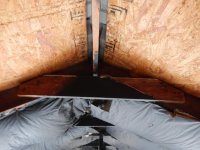
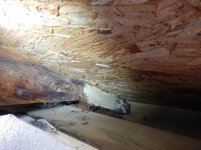
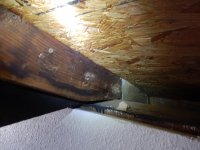
The rafters are 2x4's. They are notched to fit the top plate. They are not nailed to the plate, but to the ceiling joists, then the joists are nailed to the plate.

The ridge beam, if you can call it that is a 1x4. The decking doesn't even come to the beam, it's about 1" or so short. I can see the metal roof through the gap.

Here are some pics:
 

Attachments

  • DSCN2051.jpg
    DSCN2051.jpg
    134.5 KB · Views: 71
  • DSCN2052.jpg
    DSCN2052.jpg
    143.5 KB · Views: 70
  • DSCN2059.jpg
    DSCN2059.jpg
    149 KB · Views: 72
  • DSCN2055.jpg
    DSCN2055.jpg
    134.2 KB · Views: 66
  • DSCN2056.jpg
    DSCN2056.jpg
    146.5 KB · Views: 65
  • DSCN2057.jpg
    DSCN2057.jpg
    149.6 KB · Views: 69

mike93lx

ALLIANCE MEMBER
Joined
Dec 9, 2013
Messages
37,681
Location
Richmond, VA
I got over there today and has a little deeper look. Didn't get a chance to check the plumb on the walls, going to try to do that tomorrow. But I did pull back the insulation and looked at how the rafters are attached and the ridge beam.

The rafters are 2x4's. They are notched to fit the top plate. They are not nailed to the plate, but to the ceiling joists, then the joists are nailed to the plate.

The ridge beam, if you can call it that is a 1x4. The decking doesn't even come to the beam, it's about 1" or so short. I can see the metal roof through the gap.

Here are some pics:

That's not a beam, its a board and can be fine.

The gap isn't surprising and ia likely for venting. My house is the same, just with asphalt shingles and a ridge vent
 

Bruce 993 SEA

Well-known member
Joined
Oct 22, 2016
Messages
1,033
Location
La Conner, WA
Yup, the gap is for venting. I usually like to see screening for keeping bugs out...

I bet this bowing happened before this current roof. The osb is sort of new compared to the roof rafters. They might have just let the bowing be and re-roofed.

Cheers!
 
OP
D

DWinTX

Well-known member
Joined
Mar 20, 2006
Messages
81
Location
Woodland Park, CO
I have some updates. First, I checked the plumb on the walls at their worst point. They are both 4.5" out (going the same direction).

The foundation is not level either. It's got a pretty severe drop. I decided to have an engineer look at it. This is their report:


The structure was recently remodeled and was noticeably leaning to the left side (racked). Multiple deficiencies were observed with this structure. It is this engineers opinion that the Current Homeowner has one of two options:

OPTION 1:
1. Repair the structure and make improvements to bring the structure to a more stable position. It is assumed the building framing is not adequately braced to resist racking. This will require at least the following items:

Remove the brick/stone, sheetrock and siding to expose the framing of the structure. It is assumed this structure was not constructed with proper (or adequate) shear lateral bracing. It is recommended to install bracing, strapping and hold-downs at required uplift locations. The garage doors require PFH (Portal Frame with hold-downs) lateral bracing along the front. The report includes the requirements of the 2015 International Residential Code (IRC) for braced wall construction. See PFH Bracing Details. The Building Owner desires to raise the interior ceiling height of the garage. Install new roof rafters and ridge beam that is large enough to accommodate cross rafter ties. The ceiling joists of the structure are spaced at 24" o.c. and spanned 24'. These joists are over spanned. It is recommended to remove all ceiling joists and install ceiling joists at the appropriate spacing for the desired garage ceiling height. The foundation of the structure has an elevation differential (unlevelness) of approximately 5.0" (see Drawing 1001). It is recommended to use foundation supporting piers to lift the foundation to a more level position before performing the recommended improvements listed above. The exact configuration of the garage concrete foundation is not known. It is assumed there is a center deepened grade beam with (2) interior deepened cross grade beams (needs to be confirmed). We estimate (20) steel pressed pilings to help level the building. Additional engineering is required.

OPTION 2:
1. Tear down the structure and rebuild another building. Because the foundation is off level by 5.0" we believe it would be required (desirable) to demolish the existing foundation. It may not have been constructed adequately.


I also had a foundation company come out and look at it. He recommended 8 piers along the low side. He measured the worst part of the drop at 4.5".

Man, what a mess. I cannot afford to totally demolish the building, including the slab, and rebuild. Probably can't afford to do the extensive repairs the way the engineer describes (tearing the rock facing off the front, all sheetrock and siding off the walls, etc.).

I'm thinking of doing the foundation repairs first, then maybe tear the roof off, straighten the walls as best as can be done w/o stripping them, then rebuild the roof structure to lock the walls in. They will not be perfectly plumb, but they will be better than they are. Plus, when I replace the rafters and joists, I can use cross-ties instead of joists in part of the garage to raise the ceiling height for a four post lift. The walls at the front (where the rock facing was added) and back of the garage are only 1 to 1 1/2" out of plumb. I'd be trying to get the entire length of the walls that straight, and lock them in.

What do you think?
 

jask

Well-known member
Joined
Jul 4, 2009
Messages
314
Location
Gods Country, B.C.
I think you are off to a good start! you have solid information to work with, and you know what you would rather not do and what your financial limits are. If I were to look at a job like this I would break it down this way: you have four major areas of concern- a poorly designed roof system with over spanned trusses,bowed walls of unknown construction that require lateral shear bracing (as well as an upgraded door framing ),
applied stonework that you would like to preserve if possible, and an out of level slab.
I would have a good look at the stonework and assess if the wall and corners are out of plumb, it looks like it is only your sidewalls that are bowed..? if the end wall is good and can be stabilized while the rest of the structure (side walls) is twisted back where it belongs you can probably preserve the stonework. I do not agree with the use of posts- it is a poorly built garage, not a primary residence and that is an overkill approach that fails to address the issue of the remaining void under the slab and the bigger question of slab quality... I would suggest you get a rotary hammer and drill some test holes to verify slab thickness and consistency, get a few quotes for slab jacking and make sure they understand that the job will be dependent on the slab being good enough to carry on with the job... they will need to drill holes to inject for jacking and I would talk to them about marking out where and what size holes they will need, or pay them to bring the drill and punch the holes when they come out to quote if they are willing. Hopefully whatever subsidence issue caused the slab drop has now stabilized and slab jacking will get you leveled out with the lowest impact to the exterior and landscaping/hardscaping.
the roof system- should be stabilized before you attempt to straighten the walls, but ideally I would try to tighten up the end walls before you start. The interior of the garage is relatively empty and accessible so I empty it out, remove the door and tracks, roll my demolition waste trailer in and pull all the sheetrock to reveal the interior framing and allow upgrading without tearing up the exterior finish. this will allow installation of anchor bolts, hold downs etc. and access to the garage door frame for removal and upgrade, this is a good time to look at your electrical and any upgrades .... I would suggest sheathing the interior face of the end walls with plywood to create a solid wall, the forces you are going to put on the building are basically a slow moving earthquake ( in reverse :) ) nailing the ply correctly is critical https://www.bayarearetrofit.com/shear-walls-2/ make sure the end walls are straight and plumb before sheathing.
the roof system sounds like it is not in your budget right now so if you can beef up those over spanned trusses I would do it before you push the walls. I worked with an old engineer on a job where he had us fab 1/8" steel plate "straps" that were match punched to allow them to be placed on either side of an overspan truss and through bolt the three pieces to create a laminated truss "sandwich" that was rock solid... I did not see the final bill so sistering in engineered timber might be a cheaper alternative for you.
straightening the walls- I would use wall aligners or plumb jacks anchored to the garage slab, pushing on one wall and pulling on the other to pull the wall back plumb. I would set three or four plumb bobs hanging from the trusses along each wall about a foot into the garage and mark the starting position and final location on the slab under each line and then start bringing it plumb a turn at a time over 2 or 3 jacks per wall. keeping the top of the wall straight when you get there is going to be a half assed solution until you replace the roof and beef up the top plate of the wall... I would fasten a 2x10 horizontally to the bottom of the rafter ties ( truss )secured up tight against the wall top plate full length both sides to resist bowing until you get to replace the roof system, add your shear bracing and structural anchors etc. to the long walls and call a drywall guy in.
remember to loosen off all the fasteners on your rain gutters a good 3/4 inch, before you start pushing the walls or you risk damaging them as things shift.
if you are going to add an engineered truss have your engineer verify the wall construction is adequate before you close in.

......
 
To avoid these ads, REGISTER NOW!
Top Bottom