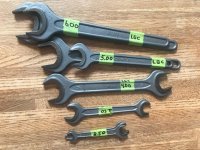
I love the look of those DIN spec wrenches, have a few from parted out German machine OEM tool kits.Picked up some massive German metric wrenches. 56mm on down. $20 for the 8.
Sent from my SAMSUNG-SM-G930A using The Garage Journal mobile app

I love the look of those DIN spec wrenches, have a few from parted out German machine OEM tool kits.Picked up some massive German metric wrenches. 56mm on down. $20 for the 8.
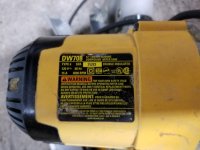
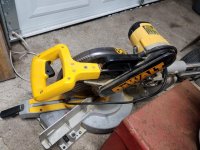
Picked up a Dewalt DW708 Compound Sliding Miter Saw off the curb this morning heading to work (was only 2 minutes from my house). Just got home and tried it out. Works Great and looks like it was only used a couple of times. Can't beat FREE Stuff!!!
Picture is just a stock one - Too Hot to go get an actual picture
I swore I wouldn't buy any more flaring kits, but this one is a hammer type, not a screw type which I don't have, and it's AN marked. I don't recognize the maker. Parker. With an "A" and a "P" melded together like a monogram for a logo. Can anybody save me time looking it up?
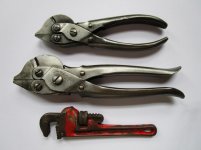
A few things today: A Blue Point #1020 screw extractor kit, a couple Bernard pliers and a cute little 6" Rigid pipe wrench. The larger Bernard pliers is an oldie, it has a patent date of 1890.


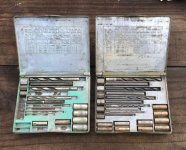
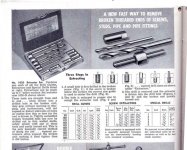
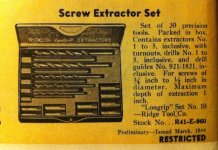
I have that extractor set in my WW2 Navy NAF toolbox. Snap-on sourced those sets from Ridgid and some of the components have Ridgid markings. I had to find a second partial set to complete mine.
-Don


 Barcalo, SO and.. (Drum Roll) Handy Andy!
  )
)

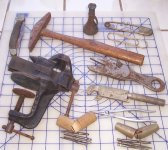
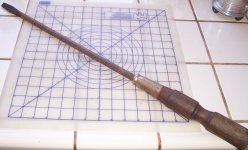
Picked up a Dewalt DW708 Compound Sliding Miter Saw off the curb this morning heading to work (was only 2 minutes from my house). Just got home and tried it out. Works Great and looks like it was only used a couple of times. Can't beat FREE Stuff!!!
Went out and got some actual pics of it.
Thanks, Stuart. The monogram looks like otvincludes an L too. A L Parker. History on Parker Hannafin is sparse unfortunately.I would guess it's from a previous incarnation of Parker Hannifin
The adjustable alligator is a C.S. Bonney patent, from after he sold the company and moved away from Philly. He licensed the design to Kraeuter and another mfgr I can't recall. Kraeuter called theirs "The Victor." I have one. I'm out, on my phone, but I will post it later. Or you could search the Bonney thread. I've posted it there before. I'm curious about the other one.A couple of odd adjustable I need to clean up!
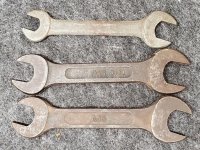


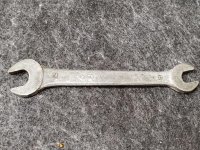
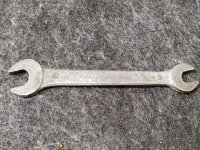
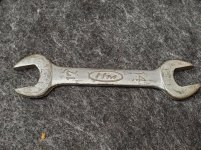
These two DOE I don't recognize the brand mark, they both seem kind of odd, one is 17/14mm and the other is 12/8mm
Is that normal or some specialty?
The DOEs I’m pretty sure are Honda tool kit , maybe came with a gas stationary engine when bought new .
Ah thanks! Honda Motors would explain the HM on both wrenches. I was searching alloy-artifacts.org for manufactures with HM in the name.
Could they be motorcycle wrenches?


The adjustable alligator is a C.S. Bonney patent, from after he sold the company and moved away from Philly. He licensed the design to Kraeuter and another mfgr I can't recall. Kraeuter called theirs "The Victor." I have one. I'm out, on my phone, but I will post it later. Or you could search the Bonney thread. I've posted it there before. I'm curious about the other one.
EDIT: I take that back. That is probably an Elgin. The Bonney's adjusting nut was central to the housing.
The other is a BOOS... :dunno
I cannot make out the date codes on those DBEs from the group photo. Usually for that pattern, the specific alloy would be forged-in on the opposite side. That pattern was produced in Chrome Vanadium, Zenel, and Bonaloy, with significant overlap (even contemporaneously) over a period of maybe two decades, after which some tools continued to be produced from the dies, but with no specific alloy shown. Also, during WWII, alloy restrictions required some alterations, so they may not mention a proprietary alloy for that reason.Bonney (but NOT marked "Zenel"?
OUTLAW - the odd hammer is a "creasing" or "border" hammer. I have one I use for silversmithing.Odd Hammer


Picked up some massive German metric wrenches. 55mm on down. $20 for the 8.
55mm - WGB
46mm - WGB
46mm - Dowidat
32mm - Dowidat
19mm - WGB
41mm-36mm WGB
27mm-22mm - W. Germany
17mm-13mm Dowidat
Nice wrench .. looks like you had a good day!
AA has some info http://alloy-artifacts.org/other-makers.html#boos
Here is the 1941 patent information on that BOOS wrench http://www.datamp.org/patents/displayPatent.php?pn=D130015&id=34712
I cannot make out the date codes on those DBEs from the group photo. Usually for that pattern, the specific alloy would be forged-in on the opposite side. That pattern was produced in Chrome Vanadium, Zenel, and Bonaloy, with significant overlap (even contemporaneously) over a period of maybe two decades, after which some tools continued to be produced from the dies, but with no specific alloy shown. Also, during WWII, alloy restrictions required some alterations, so they may not mention a proprietary alloy for that reason.
The streamlined DOEs came out after the “unique” alloy craze had largely faded into the past, so they won’t have their specific alloy on them.
I have two of those Elgins. One was my grandfather’s, broken, like many of his things. I bought the second one because I could’t figure the geometry of the internal spring (what was broken) in the first one. I have had them both apart in a box for a couple years; I can’t remember what stopped me. Could be small design changes - I think they may have been produced by different manufacturers over a period of time.
OUTLAW - the odd hammer is a "creasing" or "border" hammer. I have one I use for silvesmithing (clean it up and surprise the daughter who does jewelry making. Just de-rust; smooth any imperfections in the faces, lightly soften the face edges and mirror polish).
-jeff
I cannot make out the date codes on those DBEs from the group photo. Usually for that pattern, the specific alloy would be forged-in on the opposite side. That pattern was produced in Chrome Vanadium, Zenel, and Bonaloy, with significant overlap (even contemporaneously) over a period of maybe two decades, after which some tools continued to be produced from the dies, but with no specific alloy shown. Also, during WWII, alloy restrictions required some alterations, so they may not mention a proprietary alloy for that reason.
The streamlined DOEs came out after the “unique” alloy craze had largely faded into the past, so they won’t have their specific alloy on them.
I have two of those Elgins. One was my grandfather’s, broken, like many of his things. I bought the second one because I could’t figure the geometry of the internal spring (what was broken) in the first one. I have had them both apart in a box for a couple years; I can’t remember what stopped me. Could be small design changes - I think they may have been produced by different manufacturers over a period of time.
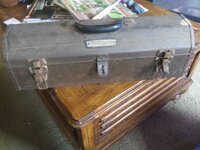

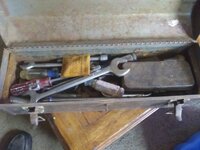

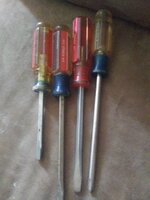





The other is a BOOS...
Indeed! Those aren't easy to find in the wild!Nice wrench .. looks like you had a good day!

Jeff, the key says: "FortLock Chicago Illinois" on one side and the code number on the other.


We use on them at work to pull pallets out of a semi truck if you don't have a loading dock where you can drive into the truck with a forklift.
Marketplace find. New in box Mitutoyo micrometer. 30.-
Thrift store find. No idea what it's used for but I like the looks of it. Forged and well made. Jaws grip tighter when you pull the chain.
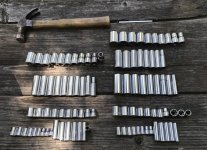
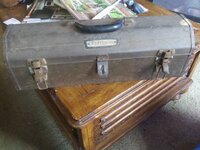
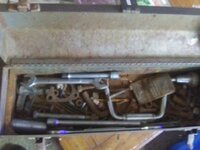
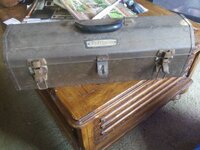
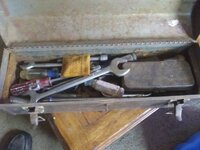
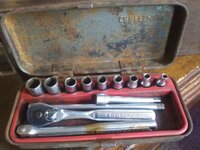
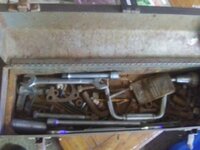
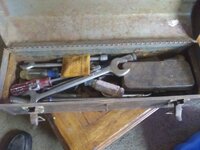
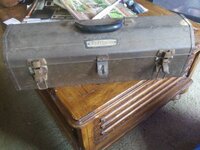
Got this box full as seen for free from an estate I was cleaning out. Another taller box but was full of bolts.
Sent from my LML212VL using Tapatalk



CV had the longest run, about three decades, so dating the year can be ambiguous.OK on further review they are both CR Vanadium:
Here is one date code - one seems missing? or they changed systems?

d42jeep : Nice score on the screw extractor set !