
You are using an out of date browser. It may not display this or other websites correctly.
You should upgrade or use an alternative browser.
You should upgrade or use an alternative browser.
Between 485 & 705 SQ/FT Mid-Century Moto Mecca Makeover
- Thread starter sakurama
- Start date
Workspaces between 485 and 705 squarefeet.
driftpin
Well-known member
Were you in the Hudson River valley? And that appears to be a Maico. I once spent a couple vacations in the vicinity of Highland NY 9W, on the banks of the Hudson River, it was a winery, and probably almost a sq. mile of property. I was there in the fall, and the scenery was spectacular.
Good for the kids to fix the electronics. The other day, my 6 y.o. grandson took my photo on my Android I'd taken of him, and he gave-himself a pilgrim's hat, and put a red buckle on it. Watching him do the drawing and coloring, and the speed at-which he did it, was a lot of fun. It's now one of my favorite pictures of him. Kids are amazing, they're sponges, learning so-quickly.
Good for the kids to fix the electronics. The other day, my 6 y.o. grandson took my photo on my Android I'd taken of him, and he gave-himself a pilgrim's hat, and put a red buckle on it. Watching him do the drawing and coloring, and the speed at-which he did it, was a lot of fun. It's now one of my favorite pictures of him. Kids are amazing, they're sponges, learning so-quickly.
With holidays and work I haven't started on the garage door and hence the Bridgeport move. It's been making me stir crazy to not have the shop or be able to work on bikes. Just sitting in the shop is therapeutic for me so I decided to find a smaller rabbit hole, er project.

Much smaller.
For the past few months I've found myself watching watch making and rebuilding videos. You'll remember that I have a thing for Seiko's and used to make some bezels for the SKX007 series. Those weeks I was in NYC or traveling I discovered the channel My Retro Watches and I found Mike to be very genuine and fun to watch and he did an entire series on one of my favorite vintage watches the 6309.

Truly my favorite Seiko is the 6105 but they've now become incredibly collectible and prices have climbed to the $2000-5000 range. Splitting time between YouTube and Ebay is a dangerous thing and I ended up finding a 6105 project watch for $600. I'm not ready to dive in on the 6105 but the next chronological variant of the Seiko divers is the 6309 and they're still pretty cheap but climbing. I love this watch as well and when I see them for less than $100 I'll pick them up so I have a couple at this point. The one above leaked (you can maybe see the condensation on the dial) and didn't keep time very well, stopped often and generally ran poorly. It needed to be serviced.
I decided that a watch is just a very small motor and if I could rebuild a motorcycle motor how hard could a watch movement be? I started collecting the tools - one of my favorite parts of any project. One of the first was this - a timegrapher.
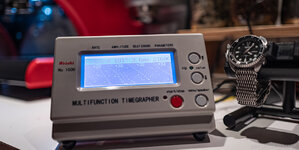
This is essentially a graphing microphone that tells you the health of a watch by listening to it and it's pretty much the first thing you do. Here's how you read this screen. The first number on the top from left to right is how fast or slow the watch is running - in this case it's only gaining 32 seconds a day (+32s/d) but the next one is more important. That one is the energy of the movement expressed as a degree.

The movement get's it's power from the mainspring (more later) and the thing that actually keeps time is the hairspring or balance - it's the little brass wheel on the left side of the movement above. It is essentially a tiny flywheel that winds and unwinds. That 180° is how far the balance wheel is rotating back and forth and modern watches will be 280-300 or more degrees. Old Seiko's like the 6309 should be 200-220. 180 is low and means the watch is dirty as the wheel isn't spinning like it should.
The third number is the balance of the rotation called beat error - how many milliseconds difference between the winding and unwinding of the balance wheel. Mike explains it as the "tick and tock" of the watch which I liked as it made sense. That number should be as close to zero as possible indicating equal rotation back and forth. The next number is the watches beat. Seiko's are 21600 beats an hour - the back and forth of that little flywheel. More expensive watches are "high beat movements" and can be as high as 36000 bps. When you see the second hand move on a watch it can take tiny steps or in expensive high beat watches it will seem to move seamlessly with many, smaller, steps. The balance is the heart of the watch.

The first thing to do is open the watch up and take out the movement. Servicing a watch is essentially just taking it completely apart, cleaning it, oiling it and then putting it together. Seems simple. Just like your car you have to change the oil on a watch because oil degrades and then so the does the watch. Most people don't service their watches. We have phones and before that we had cheap quartz watches and so the mechanical automatic watch is sort of from a bygone era when things were kept and maintained.
Right up my alley - another really well made thing from the 60's or 70's that needs to be brought back to life.
The tool I'm using above is one I made for Seiko's since that's all I have. The funky tool third from the left is a traditional case back wrench - that I never use because I made a better tool.

In order to get the movement out of the case you have to remove the stem. Generally there's always a tiny little lever or button that you push that releases the stem.
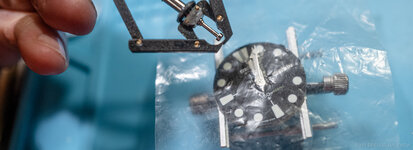
Next you take off the hands with this little plunger/squeezer thing. A small piece of plastic protects the dial.

With the dial off the movement is placed in a movement holder which is just a small clamp. I'm using an "Optivisor" which is just a magnifying visor thing. Very helpful in seeing the tiny screws but it has it's limits.

Another great thing about Seiko's is that they're common and there's a lot of information about them. Service manuals are easy to come by and I printed one out and referred to it often along with watching Mikes very methodical videos.

I bought one of these electronic repair mats off Amazon when we did the laptop repair and it is a good base for doing the watches as well. It has tiny numbered places for screws which at first I did sequentially but subsequently matched the number of the drawing to the spot on the mat - much better.

This is to give you an idea of scale here. That's a phillips head screw. If you drop this it's gone - forever. Don't bother looking. And I did lose a screw or jewel along the way. Fortunately I anticipated my incompetence and learning curve and bought a couple extra movements off ebay for $10-15 so that I'd have spares. Another benefit of the very prolific 6309 movement is that it was used in almost everything in the 70's and 80's and you can find watches with it all day long under $20. Zero risk here.
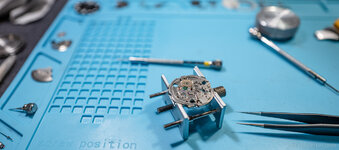
There are two sides to the watch movement and they often have different purposes but interrelate obviously. On the Seiko 6309 there's the calendar side and the gear train side. You will just keep removing parts and placing them on your mat until the movement has no more parts on it.

At this point, with the watch fully stripped, you're ready to inspect it and then clean it. Now you can use the optivisor to look at things but to really see the detail, the jewels of the watch and their condition you need to get closer. Much closer. Microscope close. Seeing Mike's videos, often shot through his microscope, and the detail he could see, it seemed like this would be a good thing to get. Plus, I knew the kids would love a microscope to play with. That's how you justify these sort of things.
I found a good deal on a used Bausch & Lomb SZ-6 for $150 with stand. It's a lab grade stereo microscope that weighs about 50lbs and is made by Leica but without the name printed on the side is a bit cheaper. As a stereo microscope when you look through it you see things in three dimensions which is incredibly helpful when you're trying to work under it. It has a zoom and essentially can zoom from about 6x to 40x but 10-20 is the range you need for watches.

This is one of the jewels of the watch - the jewels are the bearings of the important rotating spots. Generally speaking more jewels are better as they have less friction than steel on steel. If you look closely you can see some dirt on that jewel and since we're dealing with tiny tolerances and tiny amounts of friction tiny amounts of dirt make a difference. You could do this without a microscope for sure but it wouldn't be as much fun. Trust me, looking through a stereo microscope and working at an incredibly small scale is a lot of fun and super relaxing. Ben, you won't be surprised to learn, has also done a fair bit of horology on his watches and remarked about how relaxing it is. Very true. I was having a really great time in the garage again.

The last part of stripping the watch is to remove the crystal. For this you need a special press - again a very inexpensive tool compared to a normal shop press. I made many of the small pucks I needed on the lathe but the press comes with most that you'd need.

And that is a fully stripped down watch ready to be cleaned.
As you've no doubt learned about me rarely do my projects make sense in a practical way but always they're about learning something new and the discoveries along the way. This is sort of an intermission for me to keep my sanity as I prepare for the next step with the garage.
Anyway, cleaning the watch is almost as interesting as taking it apart - that's the next post!
Gregor
Much smaller.
For the past few months I've found myself watching watch making and rebuilding videos. You'll remember that I have a thing for Seiko's and used to make some bezels for the SKX007 series. Those weeks I was in NYC or traveling I discovered the channel My Retro Watches and I found Mike to be very genuine and fun to watch and he did an entire series on one of my favorite vintage watches the 6309.
Truly my favorite Seiko is the 6105 but they've now become incredibly collectible and prices have climbed to the $2000-5000 range. Splitting time between YouTube and Ebay is a dangerous thing and I ended up finding a 6105 project watch for $600. I'm not ready to dive in on the 6105 but the next chronological variant of the Seiko divers is the 6309 and they're still pretty cheap but climbing. I love this watch as well and when I see them for less than $100 I'll pick them up so I have a couple at this point. The one above leaked (you can maybe see the condensation on the dial) and didn't keep time very well, stopped often and generally ran poorly. It needed to be serviced.
I decided that a watch is just a very small motor and if I could rebuild a motorcycle motor how hard could a watch movement be? I started collecting the tools - one of my favorite parts of any project. One of the first was this - a timegrapher.
This is essentially a graphing microphone that tells you the health of a watch by listening to it and it's pretty much the first thing you do. Here's how you read this screen. The first number on the top from left to right is how fast or slow the watch is running - in this case it's only gaining 32 seconds a day (+32s/d) but the next one is more important. That one is the energy of the movement expressed as a degree.
The movement get's it's power from the mainspring (more later) and the thing that actually keeps time is the hairspring or balance - it's the little brass wheel on the left side of the movement above. It is essentially a tiny flywheel that winds and unwinds. That 180° is how far the balance wheel is rotating back and forth and modern watches will be 280-300 or more degrees. Old Seiko's like the 6309 should be 200-220. 180 is low and means the watch is dirty as the wheel isn't spinning like it should.
The third number is the balance of the rotation called beat error - how many milliseconds difference between the winding and unwinding of the balance wheel. Mike explains it as the "tick and tock" of the watch which I liked as it made sense. That number should be as close to zero as possible indicating equal rotation back and forth. The next number is the watches beat. Seiko's are 21600 beats an hour - the back and forth of that little flywheel. More expensive watches are "high beat movements" and can be as high as 36000 bps. When you see the second hand move on a watch it can take tiny steps or in expensive high beat watches it will seem to move seamlessly with many, smaller, steps. The balance is the heart of the watch.
The first thing to do is open the watch up and take out the movement. Servicing a watch is essentially just taking it completely apart, cleaning it, oiling it and then putting it together. Seems simple. Just like your car you have to change the oil on a watch because oil degrades and then so the does the watch. Most people don't service their watches. We have phones and before that we had cheap quartz watches and so the mechanical automatic watch is sort of from a bygone era when things were kept and maintained.
Right up my alley - another really well made thing from the 60's or 70's that needs to be brought back to life.
The tool I'm using above is one I made for Seiko's since that's all I have. The funky tool third from the left is a traditional case back wrench - that I never use because I made a better tool.
In order to get the movement out of the case you have to remove the stem. Generally there's always a tiny little lever or button that you push that releases the stem.
Next you take off the hands with this little plunger/squeezer thing. A small piece of plastic protects the dial.
With the dial off the movement is placed in a movement holder which is just a small clamp. I'm using an "Optivisor" which is just a magnifying visor thing. Very helpful in seeing the tiny screws but it has it's limits.
Another great thing about Seiko's is that they're common and there's a lot of information about them. Service manuals are easy to come by and I printed one out and referred to it often along with watching Mikes very methodical videos.
I bought one of these electronic repair mats off Amazon when we did the laptop repair and it is a good base for doing the watches as well. It has tiny numbered places for screws which at first I did sequentially but subsequently matched the number of the drawing to the spot on the mat - much better.
This is to give you an idea of scale here. That's a phillips head screw. If you drop this it's gone - forever. Don't bother looking. And I did lose a screw or jewel along the way. Fortunately I anticipated my incompetence and learning curve and bought a couple extra movements off ebay for $10-15 so that I'd have spares. Another benefit of the very prolific 6309 movement is that it was used in almost everything in the 70's and 80's and you can find watches with it all day long under $20. Zero risk here.
There are two sides to the watch movement and they often have different purposes but interrelate obviously. On the Seiko 6309 there's the calendar side and the gear train side. You will just keep removing parts and placing them on your mat until the movement has no more parts on it.
At this point, with the watch fully stripped, you're ready to inspect it and then clean it. Now you can use the optivisor to look at things but to really see the detail, the jewels of the watch and their condition you need to get closer. Much closer. Microscope close. Seeing Mike's videos, often shot through his microscope, and the detail he could see, it seemed like this would be a good thing to get. Plus, I knew the kids would love a microscope to play with. That's how you justify these sort of things.
I found a good deal on a used Bausch & Lomb SZ-6 for $150 with stand. It's a lab grade stereo microscope that weighs about 50lbs and is made by Leica but without the name printed on the side is a bit cheaper. As a stereo microscope when you look through it you see things in three dimensions which is incredibly helpful when you're trying to work under it. It has a zoom and essentially can zoom from about 6x to 40x but 10-20 is the range you need for watches.
This is one of the jewels of the watch - the jewels are the bearings of the important rotating spots. Generally speaking more jewels are better as they have less friction than steel on steel. If you look closely you can see some dirt on that jewel and since we're dealing with tiny tolerances and tiny amounts of friction tiny amounts of dirt make a difference. You could do this without a microscope for sure but it wouldn't be as much fun. Trust me, looking through a stereo microscope and working at an incredibly small scale is a lot of fun and super relaxing. Ben, you won't be surprised to learn, has also done a fair bit of horology on his watches and remarked about how relaxing it is. Very true. I was having a really great time in the garage again.
The last part of stripping the watch is to remove the crystal. For this you need a special press - again a very inexpensive tool compared to a normal shop press. I made many of the small pucks I needed on the lathe but the press comes with most that you'd need.
And that is a fully stripped down watch ready to be cleaned.
As you've no doubt learned about me rarely do my projects make sense in a practical way but always they're about learning something new and the discoveries along the way. This is sort of an intermission for me to keep my sanity as I prepare for the next step with the garage.
Anyway, cleaning the watch is almost as interesting as taking it apart - that's the next post!
Gregor
My mother's family ran a small town jewelry store for a few generations before the great depression killed it. It was resurrected by my great uncle in the 1950s and my mother and uncle still have memories of the store and the watch servicing bench. I believe my uncle still has the bench and many of the tools.
My grandfather said that, for certain types of watches, it was simplest to use a special extremely refined solvent and remove the watch mechanism from the case, wind it and simply let the watch run submerged in the solvent overnight. Then you could oil it and reinstall.
I think the store did the fine adjustments on all the local railroad engineer's watches on the Rock Island Line in the early 20th century.
I have no memory of these things but heard the stories often enough that I almost can imagine I was there.
My grandfather said that, for certain types of watches, it was simplest to use a special extremely refined solvent and remove the watch mechanism from the case, wind it and simply let the watch run submerged in the solvent overnight. Then you could oil it and reinstall.
I think the store did the fine adjustments on all the local railroad engineer's watches on the Rock Island Line in the early 20th century.
I have no memory of these things but heard the stories often enough that I almost can imagine I was there.
SW50th
Active member
Dude.

CecilTheTurtle
Well-known member
OMG, Gregor. Once again you have introduced me to a tool I have never heard of but MUST acquire. Always been a time geek. Used to sync my Macintosh to the NIST time servers via modem back in the 80s.
Off to google timegraphers! God, I hope they are cheap....
Off to google timegraphers! God, I hope they are cheap....
gearhead1960
ALLIANCE MEMBER
Gregor, welcome back to GJ. It's been too long between your excellent project posts. Hope to see them more frequently..... Ride On!
Arclitgold
Well-known member
- Joined
- Dec 20, 2017
- Messages
- 317
I adore this thread
Sent from my iPhone using Tapatalk
Sent from my iPhone using Tapatalk
Boosted1
Well-known member
Wow. That is a very detailed watch breakdown writeup.
Thanks
Thanks
old-air-performance
Well-known member
A reader of this thread since the first post, but first time replying in this thread.
Great builds on the house, van, trailer, bikes, shop, ...
Those seiko's are great watches, used to own a couple (skx, samurai, ...) , untill last year i sold them all to get my personal über watch and never regretted it!
...... untill now
Thanks for all those beautiful pictures.
Toon
Great builds on the house, van, trailer, bikes, shop, ...
Those seiko's are great watches, used to own a couple (skx, samurai, ...) , untill last year i sold them all to get my personal über watch and never regretted it!
...... untill now
Thanks for all those beautiful pictures.
Toon
tjpavlov
Well-known member
Until reading your post, I had no idea how much I needed a lab-grade stereo microscope. Can you share any advice on where to purchase one and what to look for?
Trapps
ALLIANCE MEMBER
Gregor, you never disappoint! 
Also a watch fan here with a bend for Divers, Pilot and sport styles. Here is my 007 'Pepsi' on a Super Oyster solid endlink bracelet:


Also a watch fan here with a bend for Divers, Pilot and sport styles. Here is my 007 'Pepsi' on a Super Oyster solid endlink bracelet:
Hawk136439
Well-known member
We need to collect all of your posts from this thread and make a digital book out of it! Glad to see you keeping sharp in the shop.
fartymarty
Well-known member
I think most here are aware of the differences between microscopes with binocular viewers and true stereo microscopes, but I offer this link anyway fyi.
https://www.amscope.com/blog/compound-vs-stereo-microscopes/
Greg, you said you purchased your microscope with a stand, but in this photo it appears to be hovering in the air, any chance for a wider shot of that set up?

I'm fairly certain that a stereo microscope and electronic work pad will be in my post Christmas future. However, I imagine I'll be able to proceed through life without a timegrapher, despite how cool the geek in me thinks it is.
https://www.amscope.com/blog/compound-vs-stereo-microscopes/
Greg, you said you purchased your microscope with a stand, but in this photo it appears to be hovering in the air, any chance for a wider shot of that set up?
I'm fairly certain that a stereo microscope and electronic work pad will be in my post Christmas future. However, I imagine I'll be able to proceed through life without a timegrapher, despite how cool the geek in me thinks it is.
I knew you weren’t slacking off. Epic post to an epic thread. Thanks again for the in-depth information on another tangent in your life. You could set up a Patreon account for entertainment value in this thread alone. I’m subscribed to your YouTube channel and patiently waiting for content there. Kudos to your wife and yourself raising your children to investigate things and not be intimidated.
Man, you guys are funny. No matter how far over the shark this thread jumps you all seem game. Nice.
So cleaning a watch seems to be some kind of dark art and there's really no consensus on how to do it. It's seems a lot like oil discussions on car or bike forums - everyone has a method and no one agrees. And don't even get started with homemade solutions.

To start with you need to separate the parts so the extremely tiny are separated from the really tiny. You can do this in a few ways but small stainless baskets seem to be a popular way. On the left side in those shallow depressions are the pallet fork and escape wheel - you can barely see them. Those and the balance are the most delicate parts so they're separated.

Naphtha seems to have a fair bit of consensus for an initial cleaning. I put the basket of parts into a small jar of naphtha and load the case and larger parts in the side.

Next the jar of parts goes into a hot water bath in an ultrasonic. This was sort of an epiphany for me because when I wash gun or motorcycle parts in the ultrasonic I generally mix up a gallon or more of degreasing cleaner or whatnot and then put the parts into a basket. The ultrasonics waves travel through the jars obviously so the method of using tiny jars for tiny parts makes perfect sense as you're not wasting gallons of solution. 20-30 minutes in the ultrasonic with Naphtha can do the job and some people will stop with that.
Some people.

Other people, who live like rabbits, like me, will have a second machine that is a dedicated watch cleaning machine. Okay, I'm not going into business here and maybe I only have 10-12 old Seiko's so this is silly but there is a method to my madness here.
Let me explain. No, there is too much. Let me sum up.
Judiaann has a Rolex. She bought it when we started dating and it has stopped working. So last year she asked if I'd get her watch serviced as her Christmas/birthday gift.
Ben sent me to the local Rolex repair place and I was sort of expecting them to get the watch running and have it set me back $3-400 or so but honestly I had no real idea. Two months later the watch is ready and the bill is $1100 and it looks brand new. It was a great gift and she was thrilled.
Less than a year later and the watch is not keeping time again.
So a watch cleaning machine on ebay for $80 really isn't out of line here. Okay, a stereo microscope and a Timegrapher and watch cleaning machine... maybe the line is getting blurry. But I can promise you I'm still less than half the cost of a Rolex service. And I now have this crazy cool new skill set and one of the coolest little machines you've ever seen.
I digress. Or rather I justify...

Sorry I don't have a shot of the whole stereo microscope but it's that horizontal bar and base behind the L&R. But this is actually a shot of the vintage L&R Precision Cleaning Machine right after it was unpacked. I got a good deal because the person selling it took horrible photos, didn't describe the included things and didn't bother to clean the machine before taking the horrible photos. I love those people.

Those little baskets that I loaded parts into have levels and a bayonet sort of mount on the top. The machine is essentially a speed controlled blender with a little fan like blade that holds the baskets tightly and the head rotates around and up and down so that the basket can be dipped into the cleaning solution.


You raise the motor/basket up and use the head space of the jar to centrifugally spin off the excess solution and then move on to two rinses.

The small black button on the front of the machine is an instant reverse and the big knob is a rheostat for the speed.

Finally the large black tube to the left of the cleaning solution jar is a heated element where you spin the parts dry in the heat so there's no chance of rust. Each solution is about 10-20 minutes and for these solutions I'm using actual watch cleaning and watch rinsing solution that is actually made by L&R - the same company that made this machine.

And back to the thing that actually powers the watch - the mainspring. This small disk houses a long and powerful spring that is wound by the automatic winding mechanism. The case can go in with the rest of the parts but the spring can't.

Mike of My Retro Watches has a video that shows how to take this apart and then clean the spring. Not too difficult but you have to be careful as the spring can explode out of that tiny disk if you aren't careful. Once it's out you simply wipe it down with naphtha and then reassemble by winding it back in. Carefully.

And then, of course, assembly is the reverse of disassembly.
Okay, it's a bit more complicated than that because the next part is perhaps as important as cleaning.

I found that placing the screws was easiest under the microscope. The style of microscope, if you followed the link by Marty above, is sometimes called a dissection microscope but it's also used a lot by tech people who do micro soldering and electronic repair.

It has a pretty decent working space below the element so there's room under it to be able to use tools and your hands so you're pretty much assembling the watch under the microscope. Generally you're working at 6-12x but for some things it's much greater. I found it remarkable how much my hands would fumble when using the optivisor but when looking through the 'scope my brain somehow understood the scale and my movement was damped to match the magnification. I could be super precise with my movement when looking at 20x or 30x and that was really fascinating.

Which brings us to the thing you actually need to see super close. Oiling. One of the biggest mistakes of novice watch builders is actually over oiling. I'm probably doing it. That needle like thing I'm holding is an oiler. It's a tiny, tiny wire with an itty bitty flat spoon like tip that holds a minute spec of oil. You touch that tip to a jewel or a pivot and let the oil wick off. To give you an idea of how little oil is used a single drop, like a water drop sized amount let's say, would be enough oil to service a few hundred watches. That bottle, which is synthetic and will extend the number of years a watch can go between services will expire long before I begin to make a dent in it and if it didn't it would last forever.

At this point, with the movement rebuilt, I put it in the timegrapher and made a few adjustments and it was much improved but the amplitude was still pretty weak. I then realized that I hadn't taken apart the diashock jewels that hold the balance spring on the top and bottom. They're the most important jewels as the balance is what keeps the time.
I don't have any shots of that because it was frustrating as all hell and I actually lost part of one of the jewels and had to pirate parts from my spare movement. It's a learning curve and I'm glad the movements are cheap and plentiful.

Those particular jewels are two part affairs with a tiny little spring clip that holds them together in place so they need to be taken apart to be oiled. Anyway after they were oiled the watch's amplitude jumped up to a much improved 208 and depending on the position it would either gain or lose a few seconds a day. The beat error was very close and I think I got it down to .1 or zero in some positions. You can rotate the holder as it measures and it will change the reading so you're aiming for an average.

I put in all new seals and then decided to ruin the value of the watch (it wasn't a very original example) by bead blasting the case and band. I love the look and figured this is the watch I like to wear right now so I'll make it how I'd like to wear it. It has kept remarkable time, staying pretty much exactly on time over the last week and it's been completely waterproof now.
It's a very cool feeling to have taken it apart, fixed it and put it back together. I've now done three watches and while Judiaann has explicitly forbade me from touching her Rolex (for now) I am now searching out rough examples of nice watches and preparing myself to tackle my 6105.
Lucas, in fact, has taken an interest in my watches. I keep them with my pocket knives and glasses in a cabinet and he loves to open the cabinet and look at them all. Actually both Nadia and Lucas but Lucas has been asking for his own watch for a while.

And it just so happens that this showed up on ebay this week. It's a Seiko 2205-7069 and it's a ladies diver from the 70's and it is barely an inch across. It uses a 28800 bps movement that is more complicated and precise than the men's divers of the era and is just amazingly cool. I picked it up for $100 and in good shape they go for $7-900 or up so I'm going to take my time and try to have this one restored by his birthday in April. Maybe he'll get a starter watch to see how he does taking care of it before he gets this one.
So there you go. One of my latest rabbit holes. It's been fun to learn and I have a lot more practice before it's something natural or easy but it's not terribly difficult and if you pick a simple, common movement like the 6309 you really don't have much to lose. Except maybe a few tiny screws.
Gregor
So cleaning a watch seems to be some kind of dark art and there's really no consensus on how to do it. It's seems a lot like oil discussions on car or bike forums - everyone has a method and no one agrees. And don't even get started with homemade solutions.
To start with you need to separate the parts so the extremely tiny are separated from the really tiny. You can do this in a few ways but small stainless baskets seem to be a popular way. On the left side in those shallow depressions are the pallet fork and escape wheel - you can barely see them. Those and the balance are the most delicate parts so they're separated.
Naphtha seems to have a fair bit of consensus for an initial cleaning. I put the basket of parts into a small jar of naphtha and load the case and larger parts in the side.
Next the jar of parts goes into a hot water bath in an ultrasonic. This was sort of an epiphany for me because when I wash gun or motorcycle parts in the ultrasonic I generally mix up a gallon or more of degreasing cleaner or whatnot and then put the parts into a basket. The ultrasonics waves travel through the jars obviously so the method of using tiny jars for tiny parts makes perfect sense as you're not wasting gallons of solution. 20-30 minutes in the ultrasonic with Naphtha can do the job and some people will stop with that.
Some people.
Other people, who live like rabbits, like me, will have a second machine that is a dedicated watch cleaning machine. Okay, I'm not going into business here and maybe I only have 10-12 old Seiko's so this is silly but there is a method to my madness here.
Let me explain. No, there is too much. Let me sum up.
Judiaann has a Rolex. She bought it when we started dating and it has stopped working. So last year she asked if I'd get her watch serviced as her Christmas/birthday gift.
Ben sent me to the local Rolex repair place and I was sort of expecting them to get the watch running and have it set me back $3-400 or so but honestly I had no real idea. Two months later the watch is ready and the bill is $1100 and it looks brand new. It was a great gift and she was thrilled.
Less than a year later and the watch is not keeping time again.
So a watch cleaning machine on ebay for $80 really isn't out of line here. Okay, a stereo microscope and a Timegrapher and watch cleaning machine... maybe the line is getting blurry. But I can promise you I'm still less than half the cost of a Rolex service. And I now have this crazy cool new skill set and one of the coolest little machines you've ever seen.
I digress. Or rather I justify...
Sorry I don't have a shot of the whole stereo microscope but it's that horizontal bar and base behind the L&R. But this is actually a shot of the vintage L&R Precision Cleaning Machine right after it was unpacked. I got a good deal because the person selling it took horrible photos, didn't describe the included things and didn't bother to clean the machine before taking the horrible photos. I love those people.
Those little baskets that I loaded parts into have levels and a bayonet sort of mount on the top. The machine is essentially a speed controlled blender with a little fan like blade that holds the baskets tightly and the head rotates around and up and down so that the basket can be dipped into the cleaning solution.
You raise the motor/basket up and use the head space of the jar to centrifugally spin off the excess solution and then move on to two rinses.
The small black button on the front of the machine is an instant reverse and the big knob is a rheostat for the speed.
Finally the large black tube to the left of the cleaning solution jar is a heated element where you spin the parts dry in the heat so there's no chance of rust. Each solution is about 10-20 minutes and for these solutions I'm using actual watch cleaning and watch rinsing solution that is actually made by L&R - the same company that made this machine.
And back to the thing that actually powers the watch - the mainspring. This small disk houses a long and powerful spring that is wound by the automatic winding mechanism. The case can go in with the rest of the parts but the spring can't.
Mike of My Retro Watches has a video that shows how to take this apart and then clean the spring. Not too difficult but you have to be careful as the spring can explode out of that tiny disk if you aren't careful. Once it's out you simply wipe it down with naphtha and then reassemble by winding it back in. Carefully.
And then, of course, assembly is the reverse of disassembly.
Okay, it's a bit more complicated than that because the next part is perhaps as important as cleaning.
I found that placing the screws was easiest under the microscope. The style of microscope, if you followed the link by Marty above, is sometimes called a dissection microscope but it's also used a lot by tech people who do micro soldering and electronic repair.
It has a pretty decent working space below the element so there's room under it to be able to use tools and your hands so you're pretty much assembling the watch under the microscope. Generally you're working at 6-12x but for some things it's much greater. I found it remarkable how much my hands would fumble when using the optivisor but when looking through the 'scope my brain somehow understood the scale and my movement was damped to match the magnification. I could be super precise with my movement when looking at 20x or 30x and that was really fascinating.
Which brings us to the thing you actually need to see super close. Oiling. One of the biggest mistakes of novice watch builders is actually over oiling. I'm probably doing it. That needle like thing I'm holding is an oiler. It's a tiny, tiny wire with an itty bitty flat spoon like tip that holds a minute spec of oil. You touch that tip to a jewel or a pivot and let the oil wick off. To give you an idea of how little oil is used a single drop, like a water drop sized amount let's say, would be enough oil to service a few hundred watches. That bottle, which is synthetic and will extend the number of years a watch can go between services will expire long before I begin to make a dent in it and if it didn't it would last forever.
At this point, with the movement rebuilt, I put it in the timegrapher and made a few adjustments and it was much improved but the amplitude was still pretty weak. I then realized that I hadn't taken apart the diashock jewels that hold the balance spring on the top and bottom. They're the most important jewels as the balance is what keeps the time.
I don't have any shots of that because it was frustrating as all hell and I actually lost part of one of the jewels and had to pirate parts from my spare movement. It's a learning curve and I'm glad the movements are cheap and plentiful.
Those particular jewels are two part affairs with a tiny little spring clip that holds them together in place so they need to be taken apart to be oiled. Anyway after they were oiled the watch's amplitude jumped up to a much improved 208 and depending on the position it would either gain or lose a few seconds a day. The beat error was very close and I think I got it down to .1 or zero in some positions. You can rotate the holder as it measures and it will change the reading so you're aiming for an average.
I put in all new seals and then decided to ruin the value of the watch (it wasn't a very original example) by bead blasting the case and band. I love the look and figured this is the watch I like to wear right now so I'll make it how I'd like to wear it. It has kept remarkable time, staying pretty much exactly on time over the last week and it's been completely waterproof now.
It's a very cool feeling to have taken it apart, fixed it and put it back together. I've now done three watches and while Judiaann has explicitly forbade me from touching her Rolex (for now) I am now searching out rough examples of nice watches and preparing myself to tackle my 6105.
Lucas, in fact, has taken an interest in my watches. I keep them with my pocket knives and glasses in a cabinet and he loves to open the cabinet and look at them all. Actually both Nadia and Lucas but Lucas has been asking for his own watch for a while.
And it just so happens that this showed up on ebay this week. It's a Seiko 2205-7069 and it's a ladies diver from the 70's and it is barely an inch across. It uses a 28800 bps movement that is more complicated and precise than the men's divers of the era and is just amazingly cool. I picked it up for $100 and in good shape they go for $7-900 or up so I'm going to take my time and try to have this one restored by his birthday in April. Maybe he'll get a starter watch to see how he does taking care of it before he gets this one.
So there you go. One of my latest rabbit holes. It's been fun to learn and I have a lot more practice before it's something natural or easy but it's not terribly difficult and if you pick a simple, common movement like the 6309 you really don't have much to lose. Except maybe a few tiny screws.
Gregor
Stuart in MN
Well-known member
I'm reminded of Timothy Wilmots, a fellow in Switzerland who builds custom watchmaker's workbenches. He posted here a few times a year or so ago. I think you need one of these. https://benchworks.be/en/

https://benchworks.be/en/I knew you weren’t slacking off. Epic post to an epic thread. Thanks again for the in-depth information on another tangent in your life. You could set up a Patreon account for entertainment value in this thread alone. I’m subscribed to your YouTube channel and patiently waiting for content there. Kudos to your wife and yourself raising your children to investigate things and not be intimidated.
MacTexas
Well-known member
What an impressive write up on watch repair. I need to follow this thread.
I'm reminded of Timothy Wilmots, a fellow in Switzerland who builds custom watchmaker's workbenches. He posted here a few times a year or so ago. I think you need one of these.
Unfortunately, he no longer makes workbenches. He has taken over the farm.
Sent from my iPad using Tapatalk
dhubbard422
Well-known member
Man, you guys are funny. No matter how far over the shark this thread jumps you all seem game. Nice.
.....
So there you go. One of my latest rabbit holes. It's been fun to learn and I have a lot more practice before it's something natural or easy but it's not terribly difficult and if you pick a simple, common movement like the 6309 you really don't have much to lose. Except maybe a few tiny screws.
Gregor
Awesome post/thread. I have an Heuer chronograph that I've had for 4+ decades and my experience has been somewhat like your wife's Rolex in that subsequent repairs/cleanings were increasing frequent and necessary. Not sure I'm ready to go down this particular rabbit hole at this time, but maybe someday... I expect I'd lose some screws. Kudos. Always enjoy your posts.
CecilTheTurtle
Well-known member
All that and a Princess Bride quote too.

mtm_motors
Well-known member
Yet another rabbit hole for us all to enjoy... I have a stack of old '60s Bulovas and Omegas I need to get started on.
Unfortunately, he no longer makes workbenches. He has taken over the farm.
Sent from my iPad using Tapatalk
As in "bought the farm"??
fartymarty
Well-known member
Lots of cool tools here for sure, I had no idea specialized cleaning tools like the dedicated watch cleaning machine even existed.
Just curious, how does dirt get into a watch anyway, all through the stem hole? What, no mini "O" ring there?
Just curious, how does dirt get into a watch anyway, all through the stem hole? What, no mini "O" ring there?
Growlertdi
Well-known member
All that and a Princess Bride quote too.
I like how his sum up was still a well documented and beautifully displayed slice of his life. Who knew that watch maintenance would be so fascinating.
nicholam77
Well-known member
Very cool, Gregor. Those older Seikos are undeniably charming. I'm a mechanical watch "enthusiast" as well, but it must be a whole different level of appreciation to take apart and clean a movement, no matter the complexity or price point. Very interesting pics and process, thanks for sharing! I believe a few seconds a day is excellent on a movement like that, so it looks like your work paid off. Your son would be very lucky to receive a gift like that, those are the type of objects that can be treasured for a lifetime and even on to the next generation...
As in "bought the farm"??
Sorry, I should be clearer. His father retired so he took over the family farm. He announced the change on his YouTube channel. I don’t have enough posts to post a link.
Sent from my iPad using Tapatalk
964haus
Well-known member
Great...the only thing that kept me from total defeat as a man was a smug knowledge that Gregor couldn't do intricate watchwork.
Where do I hand in my man card?
M.
Where do I hand in my man card?
M.
fartymarty
Well-known member
Greg, you said you purchased your microscope with a stand, but in this photo it appears to be hovering in the air, any chance for a wider shot of that set up?
Thanks, from that angle it's quite clear, the scope was just blocking the view of the stand, but I asked the question to see if you had somehow incorporated the light stands into the scope stand. I see now that everything is separate.
Sorry I don't have a shot of the whole stereo microscope but it's that horizontal bar and base behind the L&R. But this is actually a shot of the vintage L&R Precision Cleaning Machine right after it was unpacked.
Could I ask where you got your watch repair tools from?
I would like some information on the tools myself.
I know I'm gonna sound like an ****** here, especially after I asked the question about the stand, but it really is just a friendly nudge so Greg doesn't have to do all the work for us.
(In case you can't tell, this is the ****** part---->) You guys have the Google where you live, right?
https://www.google.com/search?sxsrf=ACYBGNR8KuA2EkIWCiS9hROb6lZkAhnICg%3A1575996102129&source=hp&ei=xsrvXa_tBIrysQX75baoAQ&q=watchmaker+tools&oq=&gs_l=psy-ab.1.0.35i362i39l10.0.0..4884...2.0..0.0.0.......0......gws-wiz.....10.TrlppNjwelE
https://www.google.com/search?sxsrf=ACYBGNSZdCKjUgQ_t-vYIs3lnzOgxriLuw%3A1575996107759&ei=y8rvXbfgLYnaswWdiqG4BA&q=watch+repair+tools&oq=watch+repair+tools&gs_l=psy-ab.12..0l6j0i7i30j0j0i7i30l2.33979.41531..43343...0.2..0.378.2428.0j10j3j1......0....1..gws-wiz.......0i71j35i304i39j0i13j0i13i30j0i10.6L2qS4_9TsU&ved=0ahUKEwj38a2Bw6vmAhUJ7awKHR1FCEcQ4dUDCAo
https://www.google.com/search?sxsrf...0i67j0i273j35i305i39j0i10j0i13i30.g1VnbKkrBPk
(****** part ends here, but maybe continued elsewhere, however it too will just be a friendly nudge, not a real serious attempt to be an ******)

Thanks Greg, a great thread, your varied interests enrich us all.
Lots of cool tools here for sure, I had no idea specialized cleaning tools like the dedicated watch cleaning machine even existed.
Just curious, how does dirt get into a watch anyway, all through the stem hole? What, no mini "O" ring there?
Sorry, I've been on the road for a quick trip.
Yeah, I've been sort of curious about that myself. The number one place would be if a seal fails like on the 6309 diver I just serviced. You can see in a few photos that one of the o-rings was broken but also the crown seal is notorious for drying up and being difficult to replace. Once any water gets in it can rust the steel, corrode other metals and then, worst of all, interact with the lume which, in old Seiko's, is actually salt based. That will speed up degradation and is one of the reasons to be cautious about watches from the Philippines.
If the seals are good and water doesn't get it in then it's oil break down. If you think of your watch like a car that needs regular oil changes it makes sense. Most people actually never change the oil in a watch or get it serviced and that oil breaks down and starts to form a grinding paste of metal particles. Here's a really good example.

I recently bought this watch as "serviced" all original example. You can see it's not losing any time but the amplitude tells you a very different story of it's health - it has very little energy. The balance wheel isn't turning very far and that's most likely due to friction which could be no oil or too much oil. More than likely when I open this one up it will be soaked in oil which is how unscruplous sellers "service" their watches. It will now make me look very carefully at the hands and dial to see if they're original. If they are it's worth keeping and if not it's going back.
Could I ask where you got your watch repair tools from?
Very interested in trying this....
Hi David,
Sorry, I did respond earlier but it seems my response was lost to the ether. There's not too much you need and obviously many places you can find things but because Mike of My Retro Watches set up a page where he collected most of the tools I used his links so he'd get a kick back from Amazon.
https://myretrowatches.com/tool-sale-links/
I figured it didn't cost me anything to use his links and if it helps him keep going I'm happy to help.
As for the older tools I just searched on ebay. My method there is to do the research (I figured out I wanted a Leica stereo microscope because... Leica!) and then set up a search with a low price and alert. When I find one I either make an offer or eSnipe it which keeps me from getting sucked into bidding on an auction.
The L&R machine auction was my favorite sort - bad, blurry photos, next to no description and they didn't bother to clean the machine so it looked awful. I emailed to ask some questions like if it came with the mesh baskets (hard to find and can really run up the price otherwise) and they had them but neglected to photograph them - oh, bless their incompetent hearts. So I took a chance and scored a very good deal.

Also, Judiaann finally found her Rolex. It isn't running at all and I was very disappointed as I wanted to put it on the Timegrapher with the new 6309 to just get a picture of it's health. So, it will be going in for another service and after that I'm going to start to care for it. I figure a few more Seiko 6309 rebuilds and then the 6105 and by then I'll feel comfortable tackling the Rolex.
Gregor
tjpavlov
Well-known member
I have more of a life/philosophical question for you. This thread started with a home purchase and a major renovation. You learned carpentry and a lot of other skills long the way. Then we moved into motorcycles, bread making, antique fan collecting, model building, and now watch repair. Sprinkle in some photography tutorials along the way. I feel like I'm probably missing something in this list.
My question is how do you maintain so many hobbies? Does your mind just take you down a new rabbit hole every year or so? Do you lose interest in the old hobbies when you find something new to occupy yourself with?
Personally, I've found that I find a new interest every five years or so and tend to lose interest in older hobbies.
Oh and I do owe you a thank you for the model making posts earlier this year. My third grader in Massachusetts had to build a native american longhouse recently and I used your referral to a youtuber to give us a huge leg up on the project.
My question is how do you maintain so many hobbies? Does your mind just take you down a new rabbit hole every year or so? Do you lose interest in the old hobbies when you find something new to occupy yourself with?
Personally, I've found that I find a new interest every five years or so and tend to lose interest in older hobbies.
Oh and I do owe you a thank you for the model making posts earlier this year. My third grader in Massachusetts had to build a native american longhouse recently and I used your referral to a youtuber to give us a huge leg up on the project.
bunks-tj
Well-known member
Its a shame that the Tune Up on the Rolex didnt last. I have a Bucherer, and stand to inherit a Rolex and Omega (although I hope not too soon). I know a tune up should be done periodically but I feel like it should have lasted longer than it did, in your case.