To avoid these ads, REGISTER NOW!

The VISES of Garage Journal

Private Lugnutz

Well-known member
Joined
Mar 30, 2012
Messages
30,527
Location
The Authentic Jersey Shore
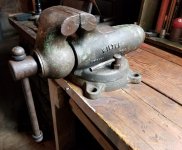
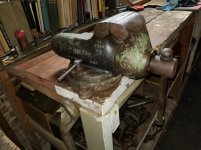
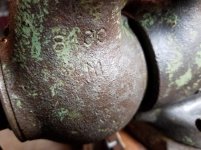
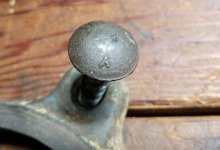
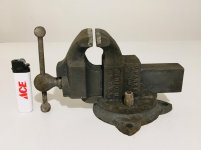
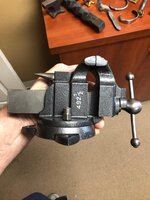
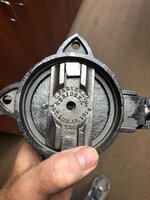
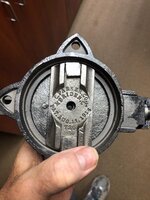
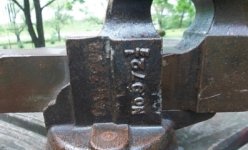
I finally stripped all the baby **** brown paint off my Feb 1949 Wilton HD 8400. When I say it was everywhere, I mean everywhere. It was in the threads on the swivel base bolts and there was overspray in the slide bore. Now that I've got it back to a state of honest wear and tear of the original hospital green, I noticed a foundry mark (an "I M" or "M I" monograph just under the "8400" on the dynamic jaw) I never saw before. What's interesting about that is that the swivel base was forged by a different foundry (that used an "HF" monograph). So Wilton was using at least two different foundries. Has anyone ever tracked down these foundry marks to their respective foundries? I'm assuming the forged-on data plate ("135") is some of kind or order or stock number peculiar to the swivel base foundry.
 

Attachments

  • 20200429_165300.jpg
    20200429_165300.jpg
    148.9 KB · Views: 57
  • 20200429_165331.jpg
    20200429_165331.jpg
    151.9 KB · Views: 51
  • 20200429_165406.jpg
    20200429_165406.jpg
    151.2 KB · Views: 43
  • 20200428_124748.jpg
    20200428_124748.jpg
    155.1 KB · Views: 43
  • 20200428_125147.jpg
    20200428_125147.jpg
    120 KB · Views: 41
  • 20200428_125627.jpg
    20200428_125627.jpg
    153.7 KB · Views: 45
To avoid these ads, REGISTER NOW!

Smitty

Well-known member
Joined
Sep 4, 2018
Messages
2,409
Location
USA
I heard Autopts talking about the front cylinder stamp and thats where I got it from. I’ll ask him for a clarification tomorrow. I find it odd that the dates don’t match up.
 

va.grouseman

Well-known member
Joined
Mar 26, 2011
Messages
4,965
Location
Southern-Central VA.
I heard Autopts talking about the front cylinder stamp and thats where I got it from. I’ll ask him for a clarification tomorrow. I find it odd that the dates don’t match up.


If they were hand stamped, it was probably early Monday morning.---Head splitting, everything's a blur and spinning, and you just want it to STOP.---Accuracy don't kick in till Tuesday.;)
 

Smitty

Well-known member
Joined
Sep 4, 2018
Messages
2,409
Location
USA
VA: lol, I hear what you’re saying. I have some Russian friends that joke that if you bought a product that was made on a Monday you’re screwed.
They party pretty hard back in the USSR
 
Last edited:

Shiftless

Well-known member
Joined
Mar 9, 2014
Messages
14,529
Location
East Bay SFO
Here’s a little one I just finished stripping off the ugly red paint. Parker 2000. 2 1/4 inch jaws. It has an unusually delicate thin little handle and the spring over the spindle system.
Check out the patent date on the underside of the swivel lockdown plate in the first picture. Aug. 11, 1914. Anybody know the date range of manufacture? I do know this vise is otherwise identical to the Parker 20.

va.: I saw the green one you posted 4 years ago. How old are our model 2000’s?


.
 

Attachments

  • 6DE5006C-38A7-40C2-B061-8A48718EC1B9.jpg
    6DE5006C-38A7-40C2-B061-8A48718EC1B9.jpg
    95.8 KB · Views: 64
  • 6D06CB92-D4CF-482F-A96A-E5F3C3AF5F18.jpg
    6D06CB92-D4CF-482F-A96A-E5F3C3AF5F18.jpg
    85.6 KB · Views: 71
  • E0FF7855-CB87-4D38-A9BA-2D8D133907F6.jpg
    E0FF7855-CB87-4D38-A9BA-2D8D133907F6.jpg
    94.4 KB · Views: 63
Last edited:

1NRO

Well-known member
Joined
Aug 5, 2010
Messages
101
Location
oop North
Recent tidy up has seen me bolt a vice down! I've a few to choose from and this isn't the most exotic but it came to me with nylon jaws and has been grabbed often enough to qualify for bench status. 4" jaws opens to just shy of 7". Is missing it's quick release and someone in the past welded the two nut halves together but that aside it works nice.
 

Attachments

  • image.jpg
    image.jpg
    129.3 KB · Views: 52

1NRO

Well-known member
Joined
Aug 5, 2010
Messages
101
Location
oop North
Managed to get a lot of my vises off the floor, floor space is good now!
 

Attachments

  • image.jpg
    image.jpg
    152.5 KB · Views: 150

Eric827

Well-known member
Joined
Sep 19, 2019
Messages
46
Location
Avon Lake, Ohio
Private Lugnutz, my 1951 Wilton 9450WE has the same "IM" marking on the dynamic you pointed out. For the swivel base, I don't believe the "HF" is there, but the raised "135" nameplate is there, along with a raised "No. 4" nameplate on the bottom.
 

Old Radar

Well-known member
Joined
Apr 17, 2019
Messages
2,754
Location
San Antonio, TX
Managed to get a lot of my vises off the floor, floor space is good now!

I do like that you have managed to put many of the heaviest vices up the highest.
Thats a really nice old stone building you have as well.

I remember lessons from my physics class on "Potential Energy". Your display wall is a living example of some serious potential energy. :thumbup:

Be careful working underneath it!!
 

1NRO

Well-known member
Joined
Aug 5, 2010
Messages
101
Location
oop North
I do like that you have managed to put many of the heaviest vices up the highest.
Thats a really nice old stone building you have as well.

😀 I tried to get some logical groups/families rather than aim them high but I can see what you mean looking at the picture.

The building is a gin case, early mechanisation of farming. The stones sat at the bottom of the picture on what is the first floor, donkeys turned them from below along with a power take off that I'm told ran a thresher. There's two big beams below, 20" x 10" and over 8 meters long, strong enough for the recent load methinks.
 

Smitty

Well-known member
Joined
Sep 4, 2018
Messages
2,409
Location
USA
Shift: Nice find on that little Parker 2000, I’m happy to hear you stripped the red paint off. That little Parker that I got last week has the same stamp on the bottom.4cab6bffa8141d32cbe4f9e89f94360c.jpgbd054b125b7ae03724fb34712a24a367.jpg


Sent from my iPad using The Garage Journal mobile app
 

Attachments

  • bd054b125b7ae03724fb34712a24a367.jpg
    bd054b125b7ae03724fb34712a24a367.jpg
    114.8 KB · Views: 2
  • 4cab6bffa8141d32cbe4f9e89f94360c.jpg
    4cab6bffa8141d32cbe4f9e89f94360c.jpg
    99.3 KB · Views: 0
To avoid these ads, REGISTER NOW!

Shiftless

Well-known member
Joined
Mar 9, 2014
Messages
14,529
Location
East Bay SFO
Smitty:
Your old Parker looks WAY nicer than mine. That’ll make a nice addition to the “smalls” section of your collection. :beer:

Mine needs BLO, or paint, or something. I didn’t see any hint of Parker Green on that vise. I am under the impression that all the old Parkers like that were originally green.

Does anybody know whether the front horseshoe retainer style is older or newer than the other Parker system with the spring over the spindle?

Did you find it like that or did you apply some black metal oil to that one?
 
Last edited:

Smitty

Well-known member
Joined
Sep 4, 2018
Messages
2,409
Location
USA
Shift
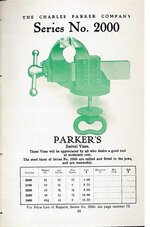
I actually traded a Rock Island vise for that little Parker. The guy who restored it did a great job. The vise it painted in a hammered dark gray. I’ve got a feeling these vises are from the late teens to early 20’s. I found your 2000 in a 1915 catalog but it was a through the bench mount. I think yours should have a collar as well.
Edit: I just looked in the spreadsheet and VA’s don’t have collars either.

05da7be76e4135732811f2497bd5b80a.jpg
 

Attachments

  • 05da7be76e4135732811f2497bd5b80a.jpg
    05da7be76e4135732811f2497bd5b80a.jpg
    40.5 KB · Views: 2
Last edited:

Shiftless

Well-known member
Joined
Mar 9, 2014
Messages
14,529
Location
East Bay SFO
Thanks for posting that catalog page Smitty.

The unusual screw down nuts to lock the swivel are in much better shape on yours. I’ve never seen those exact pieces before. Reminds me though of one of the nuts on certain Wilton bullets but those had through handles as well as hex flats.

Seeing the through the bench top mount and the front collar, it seems to me that indicates that the collar retention system pre-dates the spring over the spindle system.

Does anybody know more about this and can shed light on my assumption?
 
Last edited:

va.grouseman

Well-known member
Joined
Mar 26, 2011
Messages
4,965
Location
Southern-Central VA.
Mine say the same on the lock down plate to Shift.---I had some picks of the bottom plate but Photobucket thought it in my best intrest to delete them.

The 972 1/2 is just for size reference.
 

Attachments

  • b689aed9-af2c-4d37-8055-a67cb3d67e46.jpg
    b689aed9-af2c-4d37-8055-a67cb3d67e46.jpg
    122 KB · Views: 43
  • 9ae851eb-53da-461d-8b96-a28633b97cea.jpg
    9ae851eb-53da-461d-8b96-a28633b97cea.jpg
    120.3 KB · Views: 48
  • 2b44a6a6-d655-4b75-941b-2ef1d757339d.jpg
    2b44a6a6-d655-4b75-941b-2ef1d757339d.jpg
    121.7 KB · Views: 52
  • 572f7c08-f640-4e30-8ca3-e9058418809d.jpg
    572f7c08-f640-4e30-8ca3-e9058418809d.jpg
    125.6 KB · Views: 45
  • 1ba674f0-4490-4afe-9d1b-e49f9b7012b3.jpg
    1ba674f0-4490-4afe-9d1b-e49f9b7012b3.jpg
    116.5 KB · Views: 42
  • 9105b383-79fe-4c5f-a65a-cae16b341624.jpg
    9105b383-79fe-4c5f-a65a-cae16b341624.jpg
    117.8 KB · Views: 47
  • d32f1fff-8c88-4af5-bce9-5e6c50e02ec6.jpg
    d32f1fff-8c88-4af5-bce9-5e6c50e02ec6.jpg
    121.9 KB · Views: 53

Smitty

Well-known member
Joined
Sep 4, 2018
Messages
2,409
Location
USA
Wrench guy
I don’t, I found that pic on the internet. I’m thinking it would have came with the vise so it might say Parker on it. The little vises have lockdowns on both sides so it wouldn’t have had the retaining washer on it. Nice small wrench collection btw.
 

Vise

Well-known member
Joined
Apr 16, 2019
Messages
575
Location
NE
Managed to get a lot of my vises off the floor, floor space is good now!

Beautiful space. I agree with the “potential energy” comment, especially if you’re near any fault lines. :beer:


Smitty, Shift, VA - I really love those little Parkers. There’s one on eBay now with a chipped jaw that tempted me. Nice stuff.
 

Dan8906

Well-known member
Joined
Feb 21, 2020
Messages
91
Location
Concord, Ca
I decided to tap the CO with some 1/4-20 to make this thing serviceable in the future. These are the only bolts that I had that were long enough and will be replaced with set screws. But until then, it’s frankenwilton
IMG_1059.jpg
 

Shiftless

Well-known member
Joined
Mar 9, 2014
Messages
14,529
Location
East Bay SFO
Perfect place to hook up the power to those electrodes Dan!
 

Attachments

  • 9DB629E6-AFC2-41C1-A429-210A10D95ACB.jpeg
    9DB629E6-AFC2-41C1-A429-210A10D95ACB.jpeg
    99.2 KB · Views: 31
Last edited:

mikeswrenches

Well-known member
Joined
Apr 20, 2015
Messages
170
Smitty:
Your old Parker looks WAY nicer than mine. That’ll make a nice addition to the “smalls” section of your collection. :beer:

Mine needs BLO, or paint, or something. I didn’t see any hint of Parker Green on that vise. I am under the impression that all the old Parkers like that were originally green.

Does anybody know whether the front horseshoe retainer style is older or newer than the other Parker system with the spring over the spindle?

Did you find it like that or did you apply some black metal oil to that one?

The front retaining collar was patented November 26, 1867 by Charles Kingsley,
shortly before the December 17, 1867 patent by H K & T W Porter for the spring and screw setup in the meatball that restricted the handle movement.

I have never seen a Parker patent for the spring over rhe spindle. What does it look like?
I’ve had a spring over spindle set up on some of my Athol's, and on the Record's, and Woden's.

My 492 1/2 does not have the screw and spring set up in the meatball. Do any of yours?
 
Last edited:

Smitty

Well-known member
Joined
Sep 4, 2018
Messages
2,409
Location
USA
zkling
Thanks for solving the mystery regarding the wrench, I appreciate the pics. Your vise cleaned up great BTW.. I’m impressed with how well made these little vises are and look forward to finding more in the future.
 

PghJKB

Well-known member
Joined
Oct 13, 2012
Messages
487
Location
Industrial Heartland
I have two patents for springs that act on the main screw (spindle). Undoubtedly there are more.

The first is #74025, granted to Linus Yale, Junior, 4 Feb 1868. His uses the spring to apply tension to the spindle to preload the tension of the jaws.

Partial text of his patent: - excuse the errors, this is Google OCR at work.

4 The nature of my invention consists in so combining a spring with the jaws of a vise, and the screw and nut thereof, that an article may be clasped between the jaws either by the force of a spring or by the whole power of the screw, substantially as hereafter described.

In the drawings, the stationary jaw of the vise is represented at a the moving jaw at 6, the screw at e, and the nut at CZ. Around the stem or shank of the screw of gs. l and 2 is coiled a. spiral spring, e, and this spring bears against the moving jaw and the collar secured to the screw. When the vise has no 'article clamped between its jaws, the moving jaw will bear the relation or occupy the relative position in relation to the screw and collar shown in fig. l, and will move towards and away from the stationary jaw as the screw is turned, with the spring always expanded. When one or more articles are placed between the `jaws, and the screw is turned in the direction to clamp them, then, as soon as both jaws bear upon the articles lying between them, the screw begins to compress the spring, and the articles are held by a greater or-less spring pressure, depending upon the strength of the spring, and the number of revolutions of the screw made after the jaws have come in contact with the articles grasped between them. A continued turning of the screw in the same direction will cause the spring to be so compressed that the collar attached to the screw will bear against the moving jaw, (see fig. 2,) and then the article is clamped, as in an ordinary vise, by the whole power of the screw.


attachment.php


The second is #156066, granted to Erhard Schlenker, 20 Oct 1874. This uses a spring to compensate for wear and keep the handle tight.


attachment.php


I believe that the earliest Parkers used a heavy spring wrapped around the main screw to push out the front jaw.

Patent #71498 (issued to Chas Kingsley 26 Nov 1867) is for the adjustable nature of the Parker collar design.

If you look closely at Chas Parker's patent #11137, (20 Jun 1854 -this pre-dates Kingleys' patent by 13 years) it has a collar on the nose of the front jaw. The collar is screwed in from the top, rather than the front as is Kingsleys. 11137 is for the steel slide strengthener.

attachment.php


Who has some old brass balls Parkers out there with a spring and no main screw collar?

JKB
 

Attachments

  • Parker11137.jpg
    Parker11137.jpg
    44.1 KB · Views: 294
  • Schlenker156066.jpg
    Schlenker156066.jpg
    54.2 KB · Views: 292
  • Yale74025.jpg
    Yale74025.jpg
    58.6 KB · Views: 305

Private Lugnutz

Well-known member
Joined
Mar 30, 2012
Messages
30,527
Location
The Authentic Jersey Shore
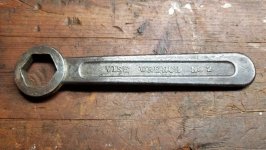
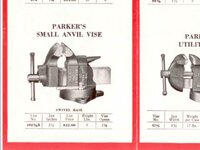
I found a photo of what the stock wrench might have looked like.
Here is mine with the wrench.
GJ member and vise researcher PghJKB and I had an informative exchange on this subject (Parker swivel base lock-down bolts and their concomitant wrenches) last year on this thread. See posts #73329 and #73332 on page 3667 for more, including links to the patents.

In summary, Parker patented one type of lock-down (1,763,021; 10 June 1930) that retained the wrench on the lock-down. The user had to pull the wrench up to a free-spinning neck area to get a new grip on the nut at the bottom and there was a flange forged-in at the very top preventing its removal.

Before that captive type patent could even be granted, they had applied for a patent for a second type of lock-down (1,778,576; 14 October 1930) that replaced the flange with a retaining ring that could be removed to remove the wrench.

The same wrench would work on either type of lock-down nut.

EDIT: Neither of the Parker vises posted just upthread appear to be either of those type lock-downs. va.grouseman's has the nut at the top. Smitty's has the nut at the bottom. But in both cases the wrench can easily be removed.

As wrenchguy has noted, and as everyone has no doubt observed, any single open end hex wrench with the correct hex opening would work.

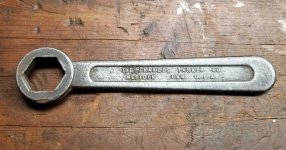
Parker did mark theirs, though, at least at some point (and perhaps always) in their production.

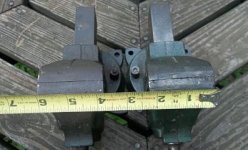
Here are some photos of my Parker Vise Wrench No. 2. I don't have the Parker vise it fits, and I don't know which Parker vise(s) that would be. I can tell you it has a 13/16" hex opening AF.
 

Attachments

  • Parker No 2 vise wrench.jpg
    Parker No 2 vise wrench.jpg
    151.8 KB · Views: 27
  • Parker No 2 vise wrench 2.jpg
    Parker No 2 vise wrench 2.jpg
    151.5 KB · Views: 31
Last edited:

Private Lugnutz

Well-known member
Joined
Mar 30, 2012
Messages
30,527
Location
The Authentic Jersey Shore
As always, the information may raise more question than it answers. Such as...

- Is the wrench on zkling's Parker vise original and factory and merely unmarked? Are those lock-down nuts original and factory or replacements? If factory, when was that vise made relative to 1930 (and those two lock-down nut patents PghJKB and I discussed)?

- Similarly, were the Parker vises you and va.grouseman posted (neither of which exhibit the 1930 patented lock-down nut designs) made well after the 1930's? And if so, did Parker even patent those simpler lock-down nut designs?

- Do we have any empirical proof that Parker ever made and sold vises with lock-down nuts like those in the 1930 patents?
 

Smitty

Well-known member
Joined
Sep 4, 2018
Messages
2,409
Location
USA
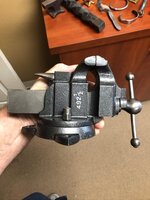
I’ve found a bit of info on my specific vise the 492 1/2. A few years ago mark posted a page from a locomotive supply company from 1948 that showed my vise with the smaller arched handle. The ad also references the model number change from no. 20 to no. 492 1/2.
I found another pic from a Parker brochure that was posted a while back here. This shows that the model no. changed to 492 1/2x. You can also see that they switched to a cylindrical meatball and the straight Parker wrench with the retaining collar. The swivel base also changed from pointed feet to a more rounded outside edge.
da5c74baaafeb93106d58c0ef4fcf0ae.jpg92d2372ec242f34432e24a85cf2184de.jpga82ffd736627845cc827fb822cfa604f.jpg


Sent from my iPad using The Garage Journal mobile app
 

Attachments

  • a82ffd736627845cc827fb822cfa604f.jpg
    a82ffd736627845cc827fb822cfa604f.jpg
    61.2 KB · Views: 3
  • 92d2372ec242f34432e24a85cf2184de.jpg
    92d2372ec242f34432e24a85cf2184de.jpg
    74.1 KB · Views: 2
  • da5c74baaafeb93106d58c0ef4fcf0ae.jpg
    da5c74baaafeb93106d58c0ef4fcf0ae.jpg
    77.7 KB · Views: 1
Last edited:

Fierljeppen

Well-known member
Joined
Jan 26, 2018
Messages
1,159
Smitty:
Your old Parker looks WAY nicer than mine. That’ll make a nice addition to the “smalls” section of your collection. :beer:

Mine needs BLO, or paint, or something. I didn’t see any hint of Parker Green on that vise. I am under the impression that all the old Parkers like that were originally green.

Does anybody know whether the front horseshoe retainer style is older or newer than the other Parker system with the spring over the spindle?

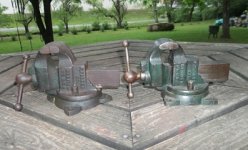
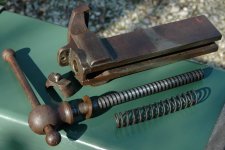
Go figure, I have a spring and a collar on my pre-1867 Parker?

I have two patents for springs that act on the main screw (spindle). Undoubtedly there are more.

The first is #74025, granted to Linus Yale, Junior, 4 Feb 1868. His uses the spring to apply tension to the spindle to preload the tension of the jaws.

Partial text of his patent: - excuse the errors, this is Google OCR at work.

4 The nature of my invention consists in so combining a spring with the jaws of a vise, and the screw and nut thereof, that an article may be clasped between the jaws either by the force of a spring or by the whole power of the screw, substantially as hereafter described.

In the drawings, the stationary jaw of the vise is represented at a the moving jaw at 6, the screw at e, and the nut at CZ. Around the stem or shank of the screw of gs. l and 2 is coiled a. spiral spring, e, and this spring bears against the moving jaw and the collar secured to the screw. When the vise has no 'article clamped between its jaws, the moving jaw will bear the relation or occupy the relative position in relation to the screw and collar shown in fig. l, and will move towards and away from the stationary jaw as the screw is turned, with the spring always expanded. When one or more articles are placed between the `jaws, and the screw is turned in the direction to clamp them, then, as soon as both jaws bear upon the articles lying between them, the screw begins to compress the spring, and the articles are held by a greater or-less spring pressure, depending upon the strength of the spring, and the number of revolutions of the screw made after the jaws have come in contact with the articles grasped between them. A continued turning of the screw in the same direction will cause the spring to be so compressed that the collar attached to the screw will bear against the moving jaw, (see fig. 2,) and then the article is clamped, as in an ordinary vise, by the whole power of the screw.

The second is #156066, granted to Erhard Schlenker, 20 Oct 1874. This uses a spring to compensate for wear and keep the handle tight.

Who has some old brass balls Parkers out there with a spring and no main screw collar?

JKB

My Parker vise has "balls of steel".

attachment.php
attachment.php
attachment.php
 

Attachments

  • 1854_parker_patent_vise.jpg
    1854_parker_patent_vise.jpg
    113.3 KB · Views: 443
  • pre-1867_parker_no.1a.jpg
    pre-1867_parker_no.1a.jpg
    67.4 KB · Views: 436
  • pre-1867_parker_no.1b.jpg
    pre-1867_parker_no.1b.jpg
    78.6 KB · Views: 440
To avoid these ads, REGISTER NOW!
Top Bottom