Like any museum, the goal in the Lugzsonian is preservation first, restoration as a last resort, and only when absolutely necessary. Not only do we not polish patina off of our tools, followers familiar with the “Barn Find Look” toolbox restoration thread, linked
here, will know that even when a box is so far gone that the Curator has to restore it, he uses techniques to re-create patina, simulating age and wear on the finish.
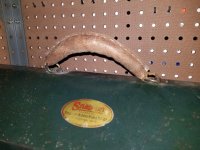
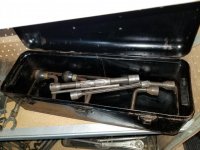
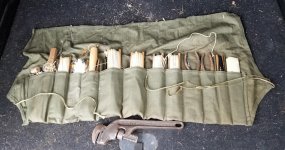
Completeness is also a goal, of course. When a kit is not complete, like most collectors, we try to find the missing pieces. With wrench sets, that usually means a missing socket, typically one of those pesky /32nds, or an extension or two, and the almost always missing tommy-/cross-bars. Occasionally, it’s something a little more difficult to find. Such as a leather handle, just to name a common, handy example. The Curator generally likes to keep some, cannibalized from scrap boxes, in stock...
...and when they are in poor shape, he is not opposed to re-cladding them by hand with period leather salvaged from something else.
In
'The Case of the Missing Socket Holder’, first introduced as a project in post #218 on page 11,
here, and followed up with a mini-progress report in post #262 on page 14,
here, he recently had to make a replacement.
This project started with intuition, got informed by research, and ended with inference.
The Curator will elaborate.
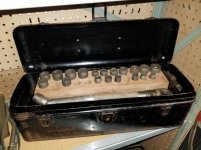
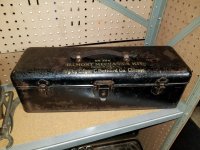
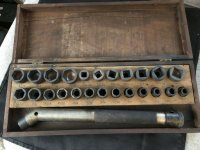
Inspection of the tray in a recently acquire mechanics kit box revealed that the little compartments on each side were not nearly large enough to contain the twenty-four (24) sockets in the set. The Curator found that odd.
Further inspection revealed screw holes, evenly spaced, in the bottom of the tray.
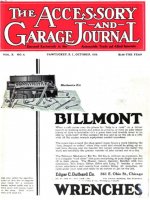
Research revealed period trade journal ads for the mechanic kit that this tray belongs to showing a socket holder in the tray.
It being considerably lighter in color than the rest of the box, the Curator didn’t think it was likely to be black or metallic. Given the number of socket sets in the Lugzsonian with steel boxes and wooden inserts for holding various pieces, he made an inference he feels pretty confident about. (As a side not, those “dividers” in the tray are for lifting it out of the box.)
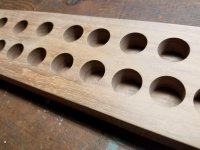
Using the ad as a guide, the Curator eyeballed the size, shape, and configuration, cut a 2x4 into a model chosen for trial and error, and made a pattern for the holes, which he completely f&^%ed up with a vintage B&D drill stand, a vintage B&D 3/8 drill, and a spade bit. So the Curator did the sensible thing: he outsourced the final steps of the project to someone much more capable of woodworking: his brother. The Curator's brother transferred the Curator's pattern to a final work piece (black walnut, at least 30 years old, from their father's secret stash) and used a drill press and a Forstner bit to drill the holes (7/8” diam., 3/4” deep – which is the width and the length of the male drive tangs in the set).
Two USPS Priority Mail days later, the Curator had the beautiful replica in hand and on the bench for inspection and fit testing...