mercifiknow
Well-known member
You were right about the cost!


Very cool! I've heard good things about the lobster wrenches.
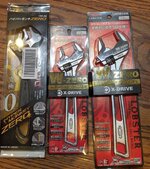
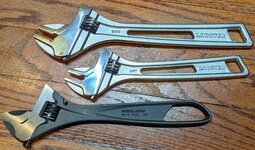
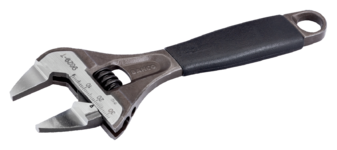
new adjustable wrenches. first impressions are very good. will write more soon.
TOP Hyper Adjustable Wrench Zero (Hyper Monkey Zero) HM-32
Lobtex Lobster W-ZERO Hybrid adjustable angle wrench UM30XGB
Lobtex Lobster W-ZERO Hybrid adjustable angle wrenchUM36XGB
Personally, I would get the regular deep sockets.Koken question:
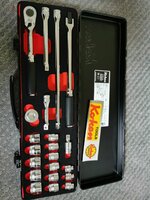
I have the regular chrome ratchets in 1/4”-1/2” sizes and love them. Also have the standard sockets. I have not bought Zeal’s yet but need to get deep sockets now. Should I get the zeal’s this time or just standard? I do have a need for the thin/shallow socket walls as I’m working on German vehicles and Japanese. I normally have to use a set of 3/8” SnapOn deep sockets in the tight spaces but am seeing I need a full ratchet size range.
Thanks!
Secondly, you already have regular handles. The Z Series / Zeal sockets are designed to be used with handles from the same range, as the tolerances are reduced. A Z Series ratchet will work with a regular socket, but could be tight the other way.

 www.garagejournal.com
Same here. I've experienced no incompatibility between Zeal, regular Ko-ken, and US-made 1/4 and 3/8 sockets and ratchets. None.do you say that from experience? curious which ratchets zeal stuff doesn't fit well on so i can avoid them.
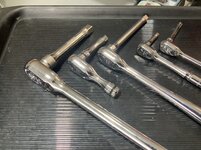
my deep (and other length) zeal sockets fit fine on my regular koken ratchet (3776N). not hard to get them on or off. i have not had issues with them on any other ratchet either (random cn/tw ****, nepros).
No, that was just what I read in KoKen’s literature.do you say that from experience? curious which ratchets zeal stuff doesn't fit well on so i can avoid them.
my deep (and other length) zeal sockets fit fine on my regular koken ratchet (3776N). not hard to get them on or off. i have not had issues with them on any other ratchet either (random cn/tw ****, nepros).
the only compatibility issue i've discovered with the zeal series so far is between the koken wobble-fix extensions and the standard (short) zeal sockets, but i'd say that's more the wobble-fix's fault if anything because the anvil insertion depth is nonstandard.
documented in detail here:
Tools of Japan
Koken adapter and ktc socket but needs the plastic.... Nice. One of the Japanese tool review youtubers I saw had wrapped plastic tape on the end of his impact socket in lieu of the plastic sleeve from the manufacturer.
if there is a reason to avoid zeal deep sockets, i would not guess that tolerance (ratchet compatibility) is it.
i would consider other issues that Dave mentioned though like:
the only koken sockets i own so far are zeal and nutgrip, but i want to try some of their regular line for fun next time i need a different set.
- which you think looks cooler (i think the scalloped look of the zeal sockets is sweet)
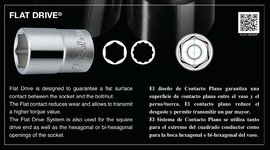
- how thin-walled they are... look in the catalog. the dimensions are well documented. for example, 10mm deep wall zeal is 14mm wide, 10mm 6pt deep (both flat drive and surface drive variants) is 14.5mm wide. less of a difference than i thought.
- what matches the look of your other tools more
- and finally what kind of stuff you work on. i can't say this from experience because i don't work on super rusty stuff, but i remember some people saying that the zeal fit on rusty fasteners might be a little tight.
would you recommend flat or surface drive for general purpose? is surface drive wobbly/sloppy on fasteners?
I have tested Zeal extensions and sockets on nepros ratchets in all sizes and will say the 3/8 cross compatibility fitment is much better than 1/4 and 1/2. The picture below shows it well.
1/2 ratchet with Zeal extension causes the quick release to stick down. 3/8 fitment is perfect on the extensions and Nepros socket fitment is just as good as Zeals. 1/4 with Zeal extension also has quick release stuck down but not really an issue because the button is still easily accessible
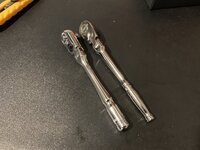
I can go and try one if you like. I can’t see there being any problem. Both are essentially “regular” tools, but the Nepros have a higher standard of finish.has anyone tried the regular koken extensions (e.g. 3760 series for 3/8") on nepros ratchets? that's what i'm leaning towards. i do like the knurling.
aside from QR button stick, do the zeal extensions lock reliably in 1/2" and 1/4" nepros ratchets, or is it borderline (or just fiddly to get it to lock)?
i bought nepros wobble-fix extensions and kind of regret it now, and so i'll be buying others to try.
I do not recommend 1/2 zeal extensions on Nepros, it’s not a good fit. The 1/4 size do lock and I actually prefer the almost flush QR but let’s be honest we all run quick spinners on 1/4 and 3/8 so it’s a non issue.i'm looking for recommendations for 1/4" and 3/8" extensions for koken zeal, koken regular, and nepros ratchets.
i have....3/8 zeal sockets on a Snap On stubby 3/8 nonflex dual80 ratchet. Really tight, unmistakably. And on an SK 45170, really tight. Certainly not a deal breaker, but I do have to work at getting them off.If someone has actually, personally, encountered "stuck" Zeal sockets on a standard ratchet of decent make, I'd like to hear about it.
Hmmm, by design and standards, all mating tools SHOULD have slop as "male" ends are to be slightly smaller and "female" ends be slightly larger. So the best quality tools should have a well defined amount of slop as opposed to being "tight", and should be compatible with all tools that meet standard dimensional specs.I also do not recommend surface drive sockets for general use. They work as advertised. How ever they fit loosely by design. This gives them some slop and a socket will not stay on a nut by itself. Or a nut will not stay in a socket easily.




4 of them are slip joint. When I took the picture, I was trying to show the "Japan" logos. I now see two of them don't show the slip joint in the picture. I guess my camera details aren't that good, but my word play is OK, huh? Only the Lineman on the left isn't a slip joint.well, only 2 are slip joint, so you haven't slipped too far
not yet
But one can tell by the offset rivet4 of them are slip joint. When I took the picture, I was trying to show the "Japan" logos. I now see two of them don't show the slip joint in the picture. I guess my camera details aren't that good, but my word play is OK, huh? Only the Lineman on the left isn't a slip joint.
That's true, but I guess Ralf11 missed that in the few seconds he looked at the picture. I know slip joint pliers are not the most exciting of tools to scrutinize. These are however my only Japanese tools to contribute to this thread.But one can tell by the offset rivet
4 of them are slip joint. When I took the picture, I was trying to show the "Japan" logos. I now see two of them don't show the slip joint in the picture. I guess my camera details aren't that good, but my word play is OK, huh? Only the Lineman on the left isn't a slip joint.
I like your sense of humor, thanks for the laugh as I imagine you looking on the back side of the monitorIt is me who slipped up by not checking the back of my monitor to see the other side - offset rivets are indeed suspicious but not determinant
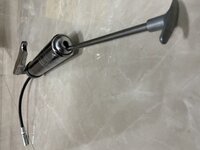
Hey, Metric Tech — looks like it's been two years since you got the KTC grease gun. I find myself in the market for a lever grease gun, and remembered this. Are you still liking it? Any issues? Do you miss cartridges?And a really nice KTC grease gun from Franks.
Hey, Metric Tech — looks like it's been two years since you got the KTC grease gun. I find myself in the market for a lever grease gun, and remembered this. Are you still liking it? Any issues? Do you miss cartridges?
Anyone else have one of these?
Good to hear! Perhaps you could help me understand how it works:I have the smaller (200cc capacity ?) ones and initially i had a hard time filling grease and bleeding air out of the gun. In one instance, i filled grease into the gun and used a plastic mallet to get the air out using light taps BAD IDEA !!! the piston rod which was retracted and held in place by the notch slipped (due to the tapping) and all the grease that i had filled, shot out in ablob and landed on my living room floor !!
I have now learnt to fill grease efficiently (least air) using hands (gloves worm obviously) and purge air occassionally during use without de-coupling the can from the pump handle completely. Now that i'm able to use it without getting half the grease on myself instead of my car, i'm very happy with it. It came with a flex hose and rigid tube attachment and i only use the flex hose which is of very high quality. I grease the U-joints on my Y61 Patrol (GU Patrol for the Ozzies) regularly and find it a joy to use since just a few pumps are sufficient. The inbuilt locking jaws of the delivery tube (flex and rigid) are better than the manual locking mechanisms found on other designs due to being slimmer and able to get into narrow spots. Some times the locking mechanism does not seal fully and a little bit of grease does escape but wiggling / adjusting the delivery tube position wrt to the grease ******/zerk will solve that problem.
Hope this helps.
What is behind the polymer rings on the Nepros sockets?
I have almost figured out what brands of sockets to buy to replace lost tools. I am OCD enough to want uniformity for each drive size and type (shallow, standard or deep) but I will probably purchase different brands for 1/4. 3/8, and 1/2 inch drive. I've about decided to get the Nepros in 1/2 inch drive. However I am curious about what they look like behind the polymer rings. Are they as polished behind the ring as they are everywhere else? If I remove the ring, or perhaps don't replace them when they wear out, what will the socket look like?
Good to hear! Perhaps you could help me understand how it works:
I gather from your description that to load it, you pull the side knob back and latch it into the notch. When it's filled, you move the knob out of the notch to allow the spring to push the grease into the head, correct? Big question: does the knob move to the front as grease is used, to give you a visual indication of how much is left?
And I also wrote "Because I have overcome my obsession that all my wrenches and sockets must be made by the same manufacturer, I am interested in sampling different tools in order to choose."How do you all choose and shop for new hand tools???
Many of the great tools that I have recently learned about are not available locally.
 www.garagejournal.com
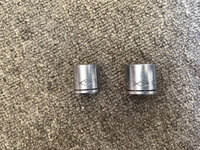
The Ko-ken sockets I have are extremely smooth, with a very slightly "brushed" finish to them — not mirror polished like U.S. sockets tend to be. It can't be felt, but it can be seen under just the right lighting.For example, I can't wait to actually hold some Ko-ken sockets, It's hard to tell from photos, but although they are highly esteemed by many GJ members, they look like they are not machined to a close external "smooth" specification?