Metallitubby
Well-known member
It's really coming together nicely. 

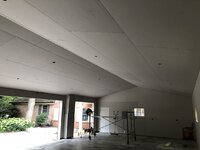

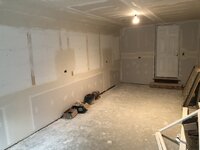

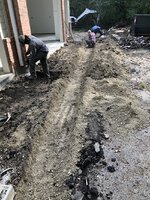


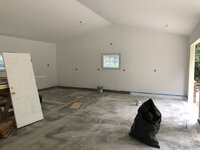
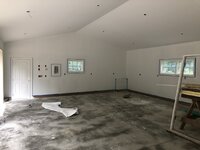
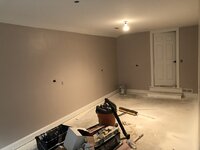

Well done sir! You should be set for whatever you want to do in there.The electrical in the garage consists of the following:
In addition, the electricians put in an additional duplex receptacle near the floor between two of the garage doors. I never asked for this but it's installation may have been required by code.
- 4 outlet boxes on exterior for coach lights.
- 1 outlet box in eaves for motion sensor light.
- 4 weather proof duplex receptacles on exterior walls.
- 3 duplex receptacles for the door openers.
- 1 duplex receptacle over the east window.
- 15 quad receptacles approx. 50" above floor. Each quad to consist of a two duplex receptacles each on separate breakers.
- 1 240v outlet box in NE corner for air compressor.
- 16 outlet boxes in ceiling for 48" LED light fixtures. These are split between two switches.
- 1 240v outlet box in ceiling for future car lift.
- 1 empty junction box in south wall with conduit back to panel for future use. Potential electric car charging.
The number of quad receptacles always seemed like it was too much. But, based on past experience, there are always receptacles that get used a lot and others that are almost never used. The layout was designed to give me the greatest flexibility to place benches and workspaces around the perimeter. The trade-off was knowing that some receptacles will rarely be used.
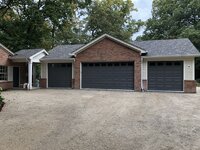


Question: How is the opener going to fit on the middle door with that bumpout and little to no room to the side?
Glad you saw the issue before sheet rock went up. I don't think it looks odd at all.Good question. During framing, it was noticed that the space between the edge of the door opening and the "wall" of the bumpout was not enough to fit the opener. So the framing was notched to allow enough gap for the unit to be installed later.
You can see this notching if you look at the drywall on either side of the middle door. About 5' above the floor you can see a small horizontal section of drywall that forms the bottom of this "notch". Not the ideal solution as it looks a bit odd but maybe the best solution at the time.


Hi I’m late to the party. It this burns my a$$. I’d build the garage push for the CO, if they push back tell them you need it to refinance to be able to afford the living space conversion. Make it up. Then once CO’d I’d tell them where to stick it!!!! These sons of bi****es work for you!!! Ahhhh I’m fired up!!The title is based on all the years that I've spent wanting to start this project.
Background
After 18 years of living on a small suburban lot with an impractical garage, in 2019 my wife and I bought a house in a very unique area of Chicagoland. Large lots, mature trees, and a small town feel. Most lots are also zoned for horses and there are lots of them around. Our house is a 2800 sq. ft. brick ranch that's perfect for a couple of middle-aged, soon-to-be empty nesters.
The Troubles Start…
Since we are on 4 acres I thought I had plenty of space to put up the garage that I always wanted. But the village has an ordinance that limits total garage space to no more than 20% of the dwelling space. Do that math on your own house and see what kind of garage that would get you.
To build the garage we had to apply for a zoning variance from the village. I won't derail this post by documenting that draining experience. But it took 6 months, several board meetings, attorney fees, high stress, and making a case for a garage to non-garage people before I finally prevailed. The whole process left me a bit bitter regarding over-regulating government bodies.
The village granted the variance but, to build the garage to the size I wanted, we had to convert our existing attached garage into living space. Sure, no problem. We just have to spend more of our money. Why should anyone at the village care about that?
The Project
My wife and I worked with an architect to design both spaces (garage and interior) so that we were happy with them. We chose to not finish the new garage interior as part of the current scope. That can be done later on as I better understand how I will use it.
My original thought was a simple rectangle with interior dimensions of 24' x 44'. My architect wanted a better looking front face so he added a bump out with gable that gave me 25' of depth in the middle of the space.
I wanted scissor trusses to provide more headroom and give the feel of a larger space. In-floor heat was also on the menu. I didn't know how much time I would spend out there in the winter, but I did know that I never want to stand around on a cold slab ever again. That in-floor heat also migrated into the refurbished existing garage as well.
Plan view of the new garage.
Front view of the new garage.
Side view of the new garage on the right with the old garage doors closed off in the background.
The new garage is going in that gap between the existing garage and the wood fence.

I've come to terms with my frustration at this point. It was an unpleasant process and one of the most frustrating experiences of my life. But that was last year and now I just want to finish the garage and start enjoying it.Hi I’m late to the party. It this burns my a$$. I’d build the garage push for the CO, if they push back tell them you need it to refinance to be able to afford the living space conversion. Make it up. Then once CO’d I’d tell them where to stick it!!!! These sons of bi****es work for you!!! Ahhhh I’m fired up!!
But awesome garage!!
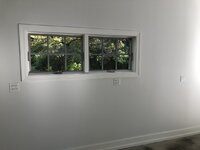
The first receptacle in the series is GFCI. The downstream ones are protected after that. All these receptacles are split up amongst six 20A circuits.Are those all gfci receptacles? Why not just do gfci breaker?


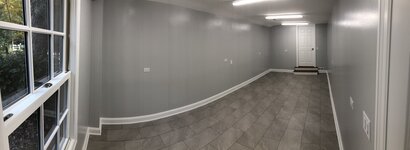


I wish I had a good answer for you. The total concrete cost on this project was $40,000. But, of course, that includes not only tearing out and replacing the slab in the old garage. But also the foundation and slab of the new garage.I'm another late joiner here. Great build!!!
I'm particularly interested in the replacement of the existing garage floor. I have a similar issue in that my floor is heaved, cracked and lower than my driveway. The PO capped the original driveway with asphalt so when it rains it drains INTO my garage. Could you ballpark a cost on just that element?
| Category | Cost |
|---|---|
| Government Costs (Zoning variance & permits): | $ 4,800.00 |
| Architecture and Engineering: | $ 7,000.00 |
| Excavation: | $ 8,600.00 |
| Concrete (foundation and slabs): | $ 40,300.00 |
| Framing Labor: | $ 12,400.00 |
| Framing Material: | $ 23,300.00 |
| In-Floor Heat (new garage and old garage conversion): | $ 11,100.00 |
| Electrical: | $ 15,500.00 |
| Interior Trim: | $ 13,200.00 |
| Roofing: | $ 5,700.00 |
| Gutters: | $ 1,700.00 |
| Insulation: | $ 5,700.00 |
| Drywall: | $ 8,100.00 |
| Painting: | $ 5,000.00 |
| Masonry: | $ 7,700.00 |
| Exterior: | $ 12,300.00 |
| Windows/Doors: | $ 7,800.00 |
| Garage Doors (including openers): | $ 8,900.00 |
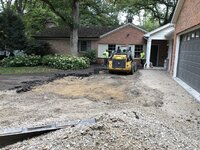
| Driveway: | $ 9,000.00 |


