To avoid these ads, REGISTER NOW!

ZMotorsports Shop Projects 2.0

SilverJimmy

Well-known member
Joined
Apr 14, 2012
Messages
1,632
Location
Prescott/Flagstaff, AZ
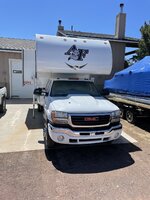
Mike, you inspired me to give my 06 LLY GMC CrewCab Dually the love it deserves. Picked it up from a friends mom after his dad passed. It only had 66k on it, now has 93k. When I got it the paint was doing the typical GM peel, so I had the roof repainted and because the strip and prep was almost a wash I replaced the hood with a cowl induction one. Then got the bed Line-X’d because it was peeling too. Just serviced both axles and the transfer case. Luckily no shiny stuff in any of them. Did a LOF and fuel filter too. Then to really make it nice polished the headlights. Wow, what a difference that makes! I think I prefer this old truck over a new one, and I know you know what I mean. Loaded up our Arctic Fox camper and heading out for our first trip of the season.
DE582032-756B-41B2-9463-667C12279C1F.jpeg130D917B-26FF-41A7-B821-C9D0FECBD7CF.jpeg
 
To avoid these ads, REGISTER NOW!

csp

Well-known member
Joined
Mar 23, 2010
Messages
5,719
Location
Franktown, CO
Mike,

do you have any favorite spots in moab that you would say are worth the expense for four five night stay?
I'll second Mike's recommendation for the OK RV park. We have been staying there since about 2005, 1-2 times per year.

A group of us stayed at the KOA in '03 and the gestapo manager didn't like us sitting outside having a conversation at normal conversation volume levels at 9pm. Haven't been back.
 

LXCam

ALLIANCE MEMBER
Joined
Apr 23, 2013
Messages
19,142
Location
AZ
the gestapo manager didn't like us sitting outside having a conversation at normal conversation volume levels at 9pm. Haven't been back.
When I first moved out to az I was at a mid level nicerrrrr RV “resort” 🤔

During the summer they shutdown the pool and the clubhouse at 9pm but in the winter those were open till 11 :rolleyes2
 

Bigblue&Goldie

Well-known member
Joined
Mar 12, 2009
Messages
10,680
Location
AZ
We usually stay at Portal in Moab, but what's been said is true. The way I understand it is the sites in the back are actually privately owned and are rented out when the owners aren't staying there. When we have a bunch of people we'll rent one of those spaces as they have big patios and casitas. It's also nice having the large bathroom/shower facility so a bunch of people aren't using the RV bathroom. Granted, it was ~$85 night, but we usually split the expense. Unfortunately, everything in Moab is rather expensive these days. We splurge on our RV space and hit the grocery store in town for food and beer. Prior to us having RV's we would stay at the Gonzo Inn.
 

WoodsTruck

Well-known member
Joined
Jan 12, 2013
Messages
1,024
Mike,

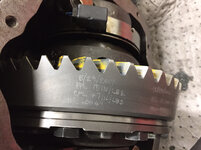
I decided to upgrade the front drums to discs on my old Bronco (Dana 44). Brainy idea on my part, I decided to pull the front cover and change out the fluid while I was at it. Come to find out, a PO had done some damage to the R&P, scraped most of the large **** out and sealed it back up. New R&P going in now.

Is there a way to account for the sideload pressure on the side bearings when reinstalling? I have the spreader to help get the carrier back in but didn't want to wedge too many shims in. My manuals don't specify this very well.

Thanks
 

Monza Harry

Well-known member
Joined
Dec 29, 2018
Messages
1,433
Location
Windsor ON
Mike, Good idea to use the shock remounting kits as your limiting straps age a more severe axle drop off will see additional sag out/droop and that scratch would have become a dent. (y) I personally would put a bolt through to the second OEM shock mounting hole with a spacer in the OEM shock eye position that would then put the bolt (redundant I know but I think we approach problem solving in a similar fashion to each other I'll suggest this any way) into double shear and reduce the torsion loading of the single ear OEM mount. As for your camping place reviews all we can ask for is your experience, and thoughts from such, not likely I'll get that far from home anytime soon but one can hope. Thanx for sharing! Harry
 
OP
Z

zmotorsports

ALLIANCE MEMBER
Joined
Oct 20, 2009
Messages
21,405
Location
Northern Utah
Mike, you inspired me to give my 06 LLY GMC CrewCab Dually the love it deserves. Picked it up from a friends mom after his dad passed. It only had 66k on it, now has 93k. When I got it the paint was doing the typical GM peel, so I had the roof repainted and because the strip and prep was almost a wash I replaced the hood with a cowl induction one. Then got the bed Line-X’d because it was peeling too. Just serviced both axles and the transfer case. Luckily no shiny stuff in any of them. Did a LOF and fuel filter too. Then to really make it nice polished the headlights. Wow, what a difference that makes! I think I prefer this old truck over a new one, and I know you know what I mean. Loaded up our Arctic Fox camper and heading out for our first trip of the season.
DE582032-756B-41B2-9463-667C12279C1F.jpeg130D917B-26FF-41A7-B821-C9D0FECBD7CF.jpeg

Beautiful looking truck. Glad you were inspired to get her polished up. She's a beauty. I agree about the older trucks vs. anything new and don't see myself getting rid of mine anytime in the foreseeable future. Thanks for sharing and posting the picture. Glad you were able to get out and enjoy it this season.
 
OP
Z

zmotorsports

ALLIANCE MEMBER
Joined
Oct 20, 2009
Messages
21,405
Location
Northern Utah
Mike,


Is there a way to account for the sideload pressure on the side bearings when reinstalling? I have the spreader to help get the carrier back in but didn't want to wedge too many shims in. My manuals don't specify this very well.

Thanks

Yes, there is a way to account for the carrier bearing preload. Many of the FSM's that I have read over the years specify to add .010"-.012" of shims to account for carrier preload but this can be difficult to measure at times, especially on a used case that may vary slightly from OEM spec's. I have found that by adding about 4-7 inch pounds of total preload when setting up rear end, compensates for this approx. .010"-.012" of shims, IF the rear end has been altered at some point before it came into my shop. That being said however, on most OEM assemblies that I have worked on I have found that by keeping the same overall shim pack thicknesses nets me the proper combined carrier preload that I am after. I can usually get a good "feel" for if I'll need to add shims or not when disassembling the axle assembly. If the carrier falls out or comes out with little to no effort after removing the bearing caps this is a very good indication that the it did not have the correct carrier preload and shims will need to be added when reassembling.

When I am setting up new gears for example I will measure the shim thickness stacks from each side, document those spec's and then move shims from side to side exactly keeping the total shim pack thickness the same. If I removed .005" from one side, I add that same .005" to the other side to keep the total shim stack thickness the same. IF, and only IF, I don't have enough carrier preload once I get everything else set up then I will add a few thou in shims to get my total combined preload where it needs to be. I have found that about the only time I have to add additional shims is on a rear end that someone else has been in and not kept the shim stacks at the correct thicknesses.

If you look at nearly all of my gear posts, you will see my notebook somewhere in the photographs depicting my notes.
documentation.jpg


An example of carrier preload is, if the pinion bearing preload is set to say 25 in/lbs. of rotating torque with the new bearing and shims/or crush sleeve, then when installing the carrier and setting up backlash I will add enough shims to account for an additional 4-7 inch/pounds of rotating torque to the pinion. So that would be roughly 29-32 in/lbs of rotating torque with the carrier installed. This is just the pinion and carrier, NOT the axle shafts.

I then mark the final spec's on my gearsets when complete such as in the pictures below. You can see my PPL (Pinion Pre-Load) and then the CPL (Combined Pre-Load). Sometimes I mark the total PPL or other times I will indicate this as a "+". Such as +7 in/lbs. which will be 7 inch/pounds more than the PPL.
gearmarkings.jpg

gearmarkings1.jpg

gearmarkings2.jpg

You can see why I am so adamant about using a case spreader, because it is next to impossible to cram the extra .010-.012" of shims into the case in order to get the proper carrier preload without one. By the design of a hypoid gear assembly, the pinion is always trying to force the carrier away from the pinion and if there isn't enough carrier preload then under stress it can actually move the carrier away a small amount which will result in the contact point being further up the tooth where it is the weakest, potentially resulting in failure.

I hope that answers your question.

Thanks for following along.
 
Last edited:
OP
Z

zmotorsports

ALLIANCE MEMBER
Joined
Oct 20, 2009
Messages
21,405
Location
Northern Utah
Mike, Good idea to use the shock remounting kits as your limiting straps age a more severe axle drop off will see additional sag out/droop and that scratch would have become a dent. (y) I personally would put a bolt through to the second OEM shock mounting hole with a spacer in the OEM shock eye position that would then put the bolt (redundant I know but I think we approach problem solving in a similar fashion to each other I'll suggest this any way) into double shear and reduce the torsion loading of the single ear OEM mount. As for your camping place reviews all we can ask for is your experience, and thoughts from such, not likely I'll get that far from home anytime soon but one can hope. Thanx for sharing! Harry

Thanks Harry. I have had very good results with the Kartek limiting straps over the years as far as stretching. Once they take an initial stretch which is about 1/2" over new static length, they generally don't stretch any more. These were the first Teraflex limiting straps I have used and they seem to be holding up well also but I have nowhere near the experience with Teraflex's straps as I do the Kartek straps.

As for the bracket, I bolted to one side as well as welded around the full perimeter of the bracket. Had this been an OEM axle I may have used a spacer and both sides of the bracket as you suggested because the OEM tab thickness is only about 11-gauge steel but this is the Dynatrac ProRock 44 front axle and the brackets are 3/16" thick and welded on very solid. Plus I tied these Nemesis brackets on to the Dynatrac bracket on one side and the axle tube at the other end for a solid connection and no chance of ripping one of the anemic OEM brackets off, which I have seen in the past.

Thanks for following along and for the comments Harry.
 
OP
Z

zmotorsports

ALLIANCE MEMBER
Joined
Oct 20, 2009
Messages
21,405
Location
Northern Utah
The wife and I took off for our first outing of the 2022 RV season last week and went to the San Rafael Swell for another trip. It was great to get away for a few days and the weather was fan-freakin-tastic to boot. This was our third trip to the Swell and I still don't think we've really even scratched the surface of all the miles of trails. We racked up about 350 off-road miles in 4 days.

Our campsite for the latter part of the week. With it being the week before the week before EJS, crowds had spilled over from Moab to the Green River area as the campground was nearly full. Despite how full the campgrounds were, we barely saw anyone on the trails until Saturday, which was a mad-house.
sr1.jpg

Airing down on day one.
sr2.jpg

I used my new Rotopax fuel jugs for the first time and took some extra fuel with us although we ended up not needing it. It did however, add peace of mind while we were exploring off-road in this remote area of Utah.
sr3.jpg

Taking a tunnel under Interstate 70 heading towards Devil's Racetrack. We hadn't done Devil's Racetrack in the several trips we've been to the Swell because we've been alone and being one of the more difficult trails in the area I would have preferred to have another Jeep with us. However, we threw caution into the wind and figured we'd give it a try on the first day.
sr4.jpg

Shortly after heading north under I-70 we came upon Dutchman Arch. Then headed to Devil's Racetrack. Devil's Racetrack turned out to be uneventful although there were about three technical spots but nothing too bad. It gave me a good opportunity to teach my wife how to spot and she did a great job. We saw nobody on the trail until we were looking for a spot to stop for lunch when we turned off Devil's Racetrack and on to Eva Conover trail. We just pulled off at an overlook and I was getting the lawn chairs out for lunch when a group of about 6-8 dirt bikes rode past us. That was the only other people we saw on the trail all day long and this is supposed to be one of the more common and busier trails in the area.
sr5.jpg

On day two, we headed down my favorite canyon, Black Dragon Wash. I love this trail as it winds through a very narrow canyon where at times it is only about 20' wide but the canyon walls are probably 150+ feet high. We were able to flip the top back and enjoy the views. We also stopped and walked around the pictograph wall.
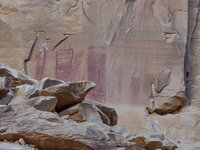
sr6.jpg

And found why it is called Black Dragon Wash.
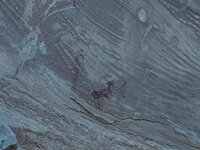
sr7.jpg

After airing up for the day we jumped on Interstate 70 and headed back east the 30-miles back to camp. Being able to drive the Jeep to the trail head, air down, wheel all day long, air back up and then drive all the way back to camp with the Jeep running flawlessly makes me grin like an idiot. Even after 8 hours of wheeling, cruising back on the interstate the engine temperature sat right on the thermostat, transmission temperature sat right around 150-degrees (only hit about 190* at the hottest on the trail) and the long term fuel trims (LTFT) sat at nearly perfect with the cruise control engaged @ 70 MPH. I can't ask for a much better running Jeep.
sr8.jpg

Our lunch spot overlooking just one of the many canyons in the area.
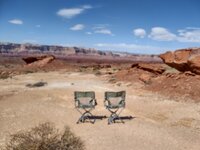
sr9.jpg

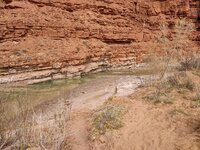
Dropping down off of Red's Canyon trail into a canyon called Muddy Creek. Red's Canyon trail was busier than hell with a dust trail of vehicles in front of us and behind us. We took an off-chute to get off the main trail and stumbled across this one. I hit record on the tablet and we continued our exploring never seeing another person the rest of the day until we came back to the main trail to air up.
sr10.jpg


More pictures to follow.....
 
Last edited:
OP
Z

zmotorsports

ALLIANCE MEMBER
Joined
Oct 20, 2009
Messages
21,405
Location
Northern Utah
Continuing of with pictures from last week's trip.

As we were dropping down towards the canyon floor we could see this concrete floor from above. When we got nearer we were surprised at what we found.
sr11.jpg

An air sock just around the last turn and the wife and I both turned and looked at each other in amazement. We were in the middle of nowhere at the bottom of a canyon with barely a level spot to be found yet a wind sock was standing erect. I had to get a picture of it.
sr12.jpg

Sure enough, there was a placard stating that this was an airstrip. Holy ****, who would have thought.
sr13.jpg

My wife rolled her eyes at me when I just had to get a couple pictures of the welds. As she was amazed by the sign I said "well, we know there are pigeons in the area". She looked puzzled but I pointed to the welds and she understood. :ROFLMAO:
weld1.jpg

Surprisingly, the wind sock was still standing will all of the lack of fusion.
weld2.jpg

And as we continued on past the air strip we dropped down the last small decent and found why it was called Muddy Creek. This is where the trail ended.
sr14.jpg

After back-tracking back up towards Red's Canyon and making sure I saved the track on our tablet we saw another turn that wasn't on my map so we thought we'd see where it went. It kept going towards a slot canyon or alcove back in the canyon when we stumbled across the Lucky Strike Mine.
sr15.jpg

Cars, refrigerators and stoves littered the wash at the mine.
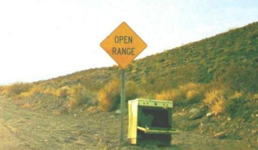
sr16.jpg

A beautiful view of the canyon walls at the mine though. Looking like storm clouds were forming we high-tailed it out of the canyon not wanting to get trapped down there if the heavy rains came.
sr17.jpg

Before leaving the mine, I had to get a shot of the mansion.
sr18.jpg


Thanks for looking.
 
OP
Z

zmotorsports

ALLIANCE MEMBER
Joined
Oct 20, 2009
Messages
21,405
Location
Northern Utah
Before leaving for vacation last week, I had mowed my lawn for the first time of the season. Then the Saturday before last I rented an aerator and aerated our yard and our son's/DIL's yard in preparation for the spring weather.

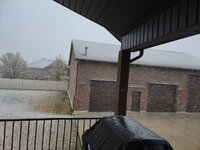
Last night after returning home from work, I pulled the Jeep in the shop to clean the interior and engine bay as well as cleaned my air cleaner again from the dusty conditions last week when I stepped outside to close up for the night we had a full blown winter storm.
snow1.jpg

snow2.jpg

I guess mother nature didn't get the message that it's spring.:unsure: Oh well, at least it dumped a couple feet of snow in the mountains where we desperately need it this year.
 

Mr.zippy

Well-known member
Joined
Apr 27, 2020
Messages
2,219
Location
Wyoming
Thank you for the pics of the trip Mike............many folks in the country have no idea of the wide open, and beautiful places we have in our area! Their world is buildings, concrete and blacktop, (with lots of green vegetation), different world for sure.
 
To avoid these ads, REGISTER NOW!
OP
Z

zmotorsports

ALLIANCE MEMBER
Joined
Oct 20, 2009
Messages
21,405
Location
Northern Utah
Thanks for the comments guys.

Skippy, I completely agree. Most people don't know what this wide open space is like, whereas I don't think I would do well in a high-rise city environment where some prefer.

Jay, yeah, the weather was absolutely beautiful for the entire trip other than the last day when the wind blew a little and stirred up some dust back at camp. Other than that mid-60's to mid-70's and sunshine.

Boosted, when I pointed to the welds and said there must be seagulls in the area my wife just rolled her eyes. We have a restaurant that we go to locally that I can't sit outside because of the welds. They make my head hurt and the food taste bad. When we sit inside the food is much better. :bounce:

JB, I completely agree about the trash. In this area for some reason the refrigerator and stove were at least era correct and added to the history. At first I thought why would they have an electrical refrigerator in a mining operation?:unsure: Then while walking around I saw a smaller dugout and wondered what it was for. Upon doing some reading and more snooping around I could see it was the electrical supply "building". I could actually see where some form of generator once resided. Then it make much more sense.

Overall it was a great opening trip to the 2022 RV'ing/Jeeping season. Both the coach and Jeep ran well and looking forward to the next.

Thanks for following along guys.
 

lilscorpion

Well-known member
Joined
Mar 15, 2010
Messages
3,600
Location
Colorado
Trans temp sat at 150*? How do you accomplish that? Andrew's LJ seems to stay right where the engine temp is - ~210*. I always thought that was the likely temp for the to need to operate at given the radiator serves as dual cooling but also helps the trans get to temp on cold days. We have a cooler on the front of the radiator (granted it's likely smaller than it needs to be)...

How is your trans cooling setup on your JK? Guess I would think it would have been warmer, like 190's at least especially in the desert.
 
OP
Z

zmotorsports

ALLIANCE MEMBER
Joined
Oct 20, 2009
Messages
21,405
Location
Northern Utah
Trans temp sat at 150*? How do you accomplish that? Andrew's LJ seems to stay right where the engine temp is - ~210*. I always thought that was the likely temp for the to need to operate at given the radiator serves as dual cooling but also helps the trans get to temp on cold days. We have a cooler on the front of the radiator (granted it's likely smaller than it needs to be)...

How is your trans cooling setup on your JK? Guess I would think it would have been warmer, like 190's at least especially in the desert.

Matt, I've been able to keep my transmission temps way down due to separating them in the cooling stack. My transmission cooling is now in no way shape or form tied to my radiator other than it is first in the airflow path.

When I did my LS swap I put the manual A/C condenser in the cooling stack which allowed me to completely cool my transmission independent of the radiator and/or A/C system. I mounted my large B&M stacked plate transmission cooler directly behind the grille.

Normal transmission temperatures for my Jeep now are in the 130-160 degree range, winter to summer highway driving. When off-road and now having more than double the HP and torque available I have found that I am not in 4-low nearly as often as I was with the V6 engine. I keep a close eye on my transmission temps and when just out driving around off-road with small grades it will easily stay in the 160-180 degree range but when it starts getting to that 180~ish degree range and I know I will still be climbing or approaching a more technical section I will then change down to 4-low to allow better fluid coupling in the transmission and less slippage through the converter and clutches which will generate much less heat and therefore seldom creep up any further than around 190-degrees.

Most of the time off-roading in areas such as the Swell, Moab, South Dakota, Texas where the elevations are moderate I am able to drive in 2-HI and easily maintain both engine and transmission temps. When I need to shift down into low range for slow crawling my engine temps will sit around 204-215 degrees with the fan on idle speed at only about 15% duty cycle and my transmission will be around the 180-195 degrees when crawling.

SW Colorado is the exception. You know as well as I do that those elevations are cooling system killers due to the altitudes and the thin air having less affect removing heat. Each August in Ouray/Silverton area torture tests my Jeep from a cooling system standpoint. On a normal year climbing very long and steep passes such as Engineer Pass, Cinnamon Pass, Hurricane Pass and California Pass I can keep my engine temps around 220-230 degrees with the cooling fan around the 35-50% duty cycle and my transmission temps right around 190~ish. However, two years ago when we were there and the ambient temps were 90+ degrees my engine and transmission got the warmest they have been which was 233-degrees engine and 200-degrees transmission.

By today's standards those still are not what is considered hot but those are where I try to set at my limits and thus far I've been able to control them. Last year with the ambient temps in Ouray in August being much more normal seasonally I easily kept my engine temps under 230 degrees and transmission temps at or under 190 degrees.

Sorry for the long answer but my with seeing so many V8 swaps in Jeeps having cooling issues one of my main goals was to NOT have cooling issues and I am quite proud of what I've been able to accomplish in cooling with still using the standard 7-slot grille.

I actually did an entire YouTube video a couple of years ago discussing how to go about keeping Jeeps cool with topics like not blocking the cooling stack with winches or big lights and keeping the rubber side flaps in place around the grill mounting.

Hope that answers your questions Matt.
 
Last edited:

lilscorpion

Well-known member
Joined
Mar 15, 2010
Messages
3,600
Location
Colorado
Matt, I've been able to keep my transmission temps way down due to separating them in the cooling stack. My transmission cooling is now in no way shape or form tied to my radiator other than it is first in the airflow path.

When I did my LS swap I put the manual A/C condenser in the cooling stack which allowed me to completely cool my transmission independent of the radiator and/or A/C system. I mounted my large B&M stacked plate transmission cooler directly behind the grille.

Normal transmission temperatures for my Jeep now are in the 130-160 degree range, winter to summer highway driving. When off-road and now having more than double the HP and torque available I have found that I am not in 4-low nearly as often as I was with the V6 engine. I keep a close eye on my transmission temps and when just out driving around off-road with small grades it will easily stay in the 160-180 degree range but when it starts getting to that 180~ish degree range and I know I will still be climbing or approaching a more technical section I will then change down to 4-low to allow better fluid coupling in the transmission and less slippage through the converter and clutches which will generate much less heat and therefore seldom creep up any further than around 190-degrees.

Most of the time off-roading in areas such as the Swell, Moab, South Dakota, Texas where the elevations are moderate I am able to drive in 2-HI and easily maintain both engine and transmission temps. When I need to shift down into low range for slow crawling my engine temps will sit around 204-215 degrees with the fan on idle speed at only about 15% duty cycle and my transmission will be around the 180-195 degrees when crawling.

SW Colorado is the exception. You know as well as I do that those elevations are cooling system killers due to the altitudes and the thin air having less affect removing heat. Each August in Ouray/Silverton area torture tests my Jeep from a cooling system standpoint. On a normal year climbing very long and steep passes such as Engineer Pass, Cinnamon Pass, Hurricane Pass and California Pass I can keep my engine temps around 220-230 degrees with the cooling fan around the 35-50% duty cycle and my transmission temps right around 190~ish. However, two years ago when we were there and the ambient temps were 90+ degrees my engine and transmission got the warmest they have been which was 233-degrees engine and 200-degrees transmission.

By today's standards those still are not what is considered hot but those are where I try to set at my limits and thus far I've been able to control them. Last year with the ambient temps in Ouray in August being much more normal seasonally I easily kept my engine temps under 230 degrees and transmission temps at or under 190 degrees.

Sorry for the long answer but my with seeing so many V8 swaps in Jeeps having cooling issues one of my main goals was to NOT have cooling issues and I am quite proud of what I've been able to accomplish in cooling with still using the standard 7-slot grille.

I actually did an entire YouTube video a couple of years ago discussing how to go about keeping Jeeps cool with topics like not blocking the cooling stack with winches or big lights and keeping the rubber side flaps in place around the grill mounting.

Hope that answers your questions Matt.
Thanks Mike, it did and I got a few good things to try out of it. My son's LJ is pushing 40" tires on a stock trans with the now boosted 4.0L running on those 5.13 stuffed Dana 60's. For all intents and purposes, it's not nearly enough motor for the drivetrain combo but it does move OK. That said, the trans is working more than is probably ideal. If we chill on the road, the trans always gets up to about 220 (according to the ECU) eventually. There's a gradual increase in temp from cold to that equally to engine time but it does always end up climbing and matching engine temp no matter how you drive. We are running the trans fluid out of the trans, into the radiator, and then into the external cooler but the cooler probably is too small to overcome the radiator's heating effect. Should I get a little happy on the skinny pedal, the heat does climb and will continue to beyond 230. Not tough I guess, 220 -> 230 isn't really a challenging feat, it's only 10 degrees.

No you point out 2 very interesting factors - first, thin air. We're not in Ouray but we are at 5200 feet which likely isn't helping. Weather should make a difference but I've noticed that the only time we don't really see cooling challenges is when it's below 40 out. I'm assuming at that point the external cooler is aided by the environment just enough to sufficiently cool what comes out of the radiator enough to keep the trans cool. Second factor is that we're not running the cooler alone. Maybe I need to try to. I was originally considering the other end of the spectrum of issues - if we just ran it through the cooler then the trans might not heat up enough in the winter months AND I was also concerned that the external cooler wouldn't be enough to cool the trans during hot months...

I don't think the grill in the LJ is overly blocked airflow-wise. We're running a M8000 winch with external solenoid. It does block the lower 1/4-ish of the grill...suppose it may be too much still.

How big of a external trans cooler are you running on your JK? Do you think I should switch over to bypassing the radiator cooler and just run the external trans cooler?
 
Last edited:
OP
Z

zmotorsports

ALLIANCE MEMBER
Joined
Oct 20, 2009
Messages
21,405
Location
Northern Utah
Matt, personally I think the fact that having the transmission fluid run through the radiator is preventing it from obtaining the Delta T that you are wanting as it will match the engine temperature and then only have a short time to cool any additional before being re-introduced back into the transmission.

By taking the radiator completely out of the equation this should allow for more efficient and thorough cooling. I have not had any issues with my transmissions running too cool even here in Northern Utah with temps in the single digits at times.

For example, this morning we are experiencing a cold spell and temps for the past few days have been at or slightly below freezing with snow. On my morning drive my engine temps were sitting right at 190-195 degrees with no fan input at all. With not having any air flow obstructions my fan was not having to work at all. This is usually the case until ambient temps get to around 65-70 degrees then at speeds lower than about 40 MPH, the fan may be required to kick on at idle speed, which is about 15% duty cycle. My transmission temps this morning were around 109-112 degrees.

I know many people think transmissions cannot operate properly when too cool but that has not been my experience in any of the vehicles over the past 30+ years. When I started building transmissions for racing and heavy duty towing back in the early 90's I did a lot of research about fluids and what is considered acceptable operating ranges of transmission fluids and when they start degrading clutch materials and seals (software). I know they say trans. fluid temps can hit 300-315 degrees for short periods but my personal cutoff is about 225-230 degrees. My thinking is because at 240-degrees the fluid can start damaging/hardening the soft lip seals and much more than that clutch discs can be damaged (around 250~ish). Either of which will result in a transmission more than likely needing to be overhauled after experiencing anything over about 240+ degrees for any length of time. I could be wrong but that has been my experience and my personal opinions only.

As for which cooler I am running, I am using a much larger cooler than specified by weight when researching. My cooler measures about 11" x 11" by 1.5" thick and is the stacked plate style of cooler. If memory serves it is the one linked below.

We also installed that same cooler on my son's WJ a couple of years ago when we built his Jeep and his temps. somewhat mirror mine.

I hope that information is helpful Matt. I would definitely try to get those transmission temps down on Andrew's LJ to prolong the life of that 42RLE.
 

Mark_17

Well-known member
Joined
Jun 27, 2018
Messages
746
Location
NJ
If you go with something like the Tru Cool 40k, you can get it with a built in cold weather bypass. That'll help it stay in the right operating range regardless of how cold it is outside.
 
OP
Z

zmotorsports

ALLIANCE MEMBER
Joined
Oct 20, 2009
Messages
21,405
Location
Northern Utah
If you go with something like the Tru Cool 40k, you can get it with a built in cold weather bypass. That'll help it stay in the right operating range regardless of how cold it is outside.

Personally I am not a fan of any of the thermal bypasses. They are a restriction and impede proper flow when you need it the most. I have been pulling the thermal blocks out of many of the GM transmissions from the past 7-8 years for this reason.

I have never had any transmission issues with transmission temperatures in the 110-130 degree range and the fact that for every 20 degree drop in temp from the higher levels doubles the life of the fluid, I am in the keep it as cool as possible camp myself. When I service my transmission at 20k mile intervals the oil is still pristine because I have been able to control the temps so well. Granted 20k is probably a bit premature but in most service manuals they recommend for extreme duty they be serviced at around 25k and I would call pushing 37" tires down the highway and up mountain passes and crawling on the rocks in 90+ degree ambient temperature "extreme" so I err on the side of caution as to not cut a vacation short due to a failure.
 

WoodsTruck

Well-known member
Joined
Jan 12, 2013
Messages
1,024
For the daily driver type vehicle, is there an advantage to have the fluid above 212°F to help boil off any accumulated moisture?
 
OP
Z

zmotorsports

ALLIANCE MEMBER
Joined
Oct 20, 2009
Messages
21,405
Location
Northern Utah
For the daily driver type vehicle, is there an advantage to have the fluid above 212°F to help boil off any accumulated moisture?

Personally, again this is my personal opinion and not anything to go off of other than past experiences with rebuilding engines and transmissions but maybe in a more humid environment it would be beneficial to keep temps slightly above normal for a daily driver that will not see "extreme" conditions, but I see absolutely no reason to intentionally keep fluid temps over 200 degrees.

As a side note, has anyone really looked and read through a FSM where it talks about maintenance schedules? Many that I have read over the recent years show something like a "Schedule A", meaning normal driving, such as highway driving at normal posted speeds for more than 10-miles at a time, fully getting the vehicle up to operating temperatures, driving in ambient temps between 32* and 95* which will show a normal engine oil change somewhere around 7500-10k mile range and transmission/differential fluid changes around 50k miles. Then there is the "Schedule B" which indicates "severe-duty" or "extreme" driving conditions such as: stop & go driving, towing or hauling heavy loads, temperatures below 32* or above 100*, driving less than 5-miles in mild weather or less than 10-miles in extreme cold or heat or driving in dirty environments. These severe-duty maintenance intervals are usually something in the range of engine oil changes around 5k-7500 or even as low as 3750 miles that I have read in one service manual and transmission/differential fluid changes at 25k miles. Now I don't know about anyone else, but the "severe-duty" description is a normal drive to work for me.

That being said, I do agree with the philosophy or theory of engine temps being slightly elevated in the modern vehicle for two purposes. First, yes, to get rid of the moisture, if any, but more importantly and secondly, the emissions can be better controlled with slightly higher engine temps compared to a couple of decades ago. General Motors for example doesn't even start to ramp up the duty cycle on their electric fans until 220-degrees in many of the model vehicles.

Coolant ranges have definitely been elevated over the past several decades. I remember in the mid-80's we were all about keeping engine temps around 180-190 degrees and if we hit 200 degrees we panicked. Many radiators had a 5 or 7 pound radiator cap at the time. For each pound of pressure you can raise the boiling point of an equally mixed water/glycol mixture about 2 PSI per pound of pressure. This meant for a 50/50 mixture of water/glycol would have about a 223-226 degree boiling point with another 10-14 degrees on top of that being pressurized for a boilover range of around 230* to 240" and you were spewing coolant everywhere. In the modern engines with 13+ pound radiator caps that has been pushed to 250-260 degrees before boiling over and spewing coolant. For example, the 2012 Denali 6.2 liter (L94) engine in my Jeep goes into hot protection mode at 262 and sends a P1258 code as well as going into limp mode and starting to pull back cylinders.

The way I drive my Jeep when off-road in Colorado, which is really the only place I have temperature concerns, is I will continue to drive at any engine temps in the 220~ish range and transmission in the 160-180 range, but I am looking ahead to know what is coming. If I am nearly at a crest or peak of a pass then continue on as normal. If these temps are during a steep climb then I will gauge how hard to push it based on if there is any oncoming traffic down the hill or not and determine if I should push hard to get up and over it OR, use a pull out and wait for downhill traffic to pass me giving the engine and transmission time to cool to around 218*/180 respectively before proceeding. So far the hottest my temps have gotten are around 233*degrees engine coolant temp and around 200* by following this protocol without pulling off to let cool. I keep telling myself that if my engine temps ever see 240-degrees then I will back out of it a bit and if they hit 245-degrees then I will pull off and let cool but so far I have not seen any of those temperatures in the past 46k miles on this powertrain and with my particular cooling stack setup. I should also mention that I am using a 2016 Camaro SS cooling fan. This is a 19" PMW (Pulse Modulated Width) cooling fan and does a fantastic job of moving a lot of cfm if/when needed and is relatively quiet due to its cyclone style design. I had not seen it over 60% on the duty cycle yet in my configuration. The Jeep JK's with the Pentastar engines however (2012+), have a PWM fan that sounds like a jet taking off. I can hear them coming up the trail behind me over my Jeep's exhaust and any background noises.

Also, off the original topic but related to temperatures, I am also a fan of the reverse flow cooling systems which accomplish a couple of things. First they get the engine up to operating temperature sooner getting them into closed loop quicker and bringing emissions in line much sooner than their predecessors and secondly they seem to keep the engine temps more consistent throughout the duty cycle.

Sorry for the lengthy response Woods Truck.
 

Bob Heine

ALLIANCE MEMBER
Joined
Oct 24, 2009
Messages
10,706
Location
Boca Raton, Florida
has anyone really looked and read through a FSM where it talks about maintenance schedules?
Mike, since 1968, I've purchased and read the Factory Service Manuals for all my cars. They used to be cheap but the last set I bought was just under $300 (Cadillac CTS-V). I've always followed the "severe service" intervals and often exceeded them. These days I have a serious problem because none of my vehicles get used much.

I changed the oil on the Corvette and Cadillac on March 3, 2020 and I'm thinking about changing the oil on the Cadillac. I've driven it 982 miles in those two years and about half those miles have been trips of 10 miles or less. The car gets driven two, maybe thee times a month. The Corvette is worse. I've driven it 79 miles in the same two years and I'm only going to change the transmission fluid and differential gear oil (It's 35 years old and about to turn 88,000 miles). I probably changed the transmission fluid 5,000 miles ago but after I pulled the tail housing off to replace the seal and gasket, the speedometer sometimes doesn't work. I also want to replace the stock pan with a deeper cast aluminum one that has a drain plug.

The PT Cruiser had its oil changed on April 9, 2020 and it has 1,424 miles on the oil. It's a turbo 4-cylinder and the FSM recommends an oil change every 5,000 miles or 6 months. Even that car only gets driven once or twice a week. Once a week would be 100 days of driving and twice would be 200 so 180 days is about 6 months of daily driving. I hope I remember how to do an oil change....
 

OutlawDrifter

Well-known member
Joined
Jan 20, 2015
Messages
3,876
Location
KS
Mike, since 1968, I've purchased and read the Factory Service Manuals for all my cars. They used to be cheap but the last set I bought was just under $300 (Cadillac CTS-V). I've always followed the "severe service" intervals and often exceeded them. These days I have a serious problem because none of my vehicles get used much.

I changed the oil on the Corvette and Cadillac on March 3, 2020 and I'm thinking about changing the oil on the Cadillac. I've driven it 982 miles in those two years and about half those miles have been trips of 10 miles or less. The car gets driven two, maybe thee times a month. The Corvette is worse. I've driven it 79 miles in the same two years and I'm only going to change the transmission fluid and differential gear oil (It's 35 years old and about to turn 88,000 miles). I probably changed the transmission fluid 5,000 miles ago but after I pulled the tail housing off to replace the seal and gasket, the speedometer sometimes doesn't work. I also want to replace the stock pan with a deeper cast aluminum one that has a drain plug.

The PT Cruiser had its oil changed on April 9, 2020 and it has 1,424 miles on the oil. It's a turbo 4-cylinder and the FSM recommends an oil change every 5,000 miles or 6 months. Even that car only gets driven once or twice a week. Once a week would be 100 days of driving and twice would be 200 so 180 days is about 6 months of daily driving. I hope I remember how to do an oil change....

Bob I think my typical daily driver gets more miles in 2mo than your PT Cruiser does in 2 years!
 

gearhead1960

ALLIANCE MEMBER
Joined
Mar 21, 2019
Messages
1,838
Location
Manassas, VA, a small blot in history
@zmotorsports Mike, I’ve always maintained most people are driving normally under a severe schedule. Especially in the congested east coast area I live. Conventional oil always every 3,000 miles between changes. Synthetic changes are done every 5,000.
@Bob Heine Bob, at your low mileage I would be worried about dilution of the oil with condensate from the humidity and temperature changes.
 

humpty

Well-known member
Joined
Dec 4, 2008
Messages
547
Location
Minneapolis, MN
Mike, since 1968, I've purchased and read the Factory Service Manuals for all my cars. They used to be cheap but the last set I bought was just under $300 (Cadillac CTS-V). I've always followed the "severe service" intervals and often exceeded them. These days I have a serious problem because none of my vehicles get used much.

I changed the oil on the Corvette and Cadillac on March 3, 2020 and I'm thinking about changing the oil on the Cadillac. I've driven it 982 miles in those two years and about half those miles have been trips of 10 miles or less. The car gets driven two, maybe thee times a month. The Corvette is worse. I've driven it 79 miles in the same two years and I'm only going to change the transmission fluid and differential gear oil (It's 35 years old and about to turn 88,000 miles). I probably changed the transmission fluid 5,000 miles ago but after I pulled the tail housing off to replace the seal and gasket, the speedometer sometimes doesn't work. I also want to replace the stock pan with a deeper cast aluminum one that has a drain plug.

The PT Cruiser had its oil changed on April 9, 2020 and it has 1,424 miles on the oil. It's a turbo 4-cylinder and the FSM recommends an oil change every 5,000 miles or 6 months. Even that car only gets driven once or twice a week. Once a week would be 100 days of driving and twice would be 200 so 180 days is about 6 months of daily driving. I hope I remember how to do an oil change....
Hey Bob,

I wanted to change my transmission sump pan to a deeper one on my 82 as well. When I looked at it and measured it out it would have been one of the lowest parts of the car. That made me nervous so I put a standard sump one in but with a drain plug. YMMV of course. Just throwing it out there.
 

Bob Heine

ALLIANCE MEMBER
Joined
Oct 24, 2009
Messages
10,706
Location
Boca Raton, Florida
@Bob Heine Bob, at your low mileage I would be worried about dilution of the oil with condensate from the humidity and temperature changes.
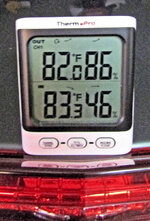
Mark, the only one that sees much humidity is the PT Cruiser because it sits outside but being a turbo, it reaches operating temperature after a mile of driving. The Corvette and Caddilac live in the garage, which isn't all that humid. It was raining outside so a degree cooler but a whole lot dryer in the garage today (trunk of Caddy).
2022-4-15 Garage - Outside Temp.jpg
Hey Bob,

I wanted to change my transmission sump pan to a deeper one on my 82 as well. When I looked at it and measured it out it would have been one of the lowest parts of the car. That made me nervous so I put a standard sump one in but with a drain plug. YMMV of course. Just throwing it out there.
@humpty, I do appreciate the heads-up and will certainly do a little measuring.

I put headers on my '87 so the oil and transmission pans are not the lowest part of the car. With the headers I have almost 4-inches of clearance.
Brand New Header PS Below.jpg
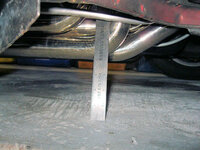
Because its a convertible, there's a big X-brace that hangs even lower than the headers. The x-brace gets quite a few scrapes but so far it is holding up.
Clearance Inches.jpg
I don't think 3 inches is enough clearance for me to follow Mike on his off-road adventures. Maybe not even on-road adventures.

Mike, sorry for the hijack but I really appreciate you showing us how to take care of our rides.
 
OP
Z

zmotorsports

ALLIANCE MEMBER
Joined
Oct 20, 2009
Messages
21,405
Location
Northern Utah
Haven't had anything interesting going on in the shop lately, just tidying up some loose ends on a few things and have had a few in-depth conversations with my son over the past week about life and making choices based on priorities as things change.

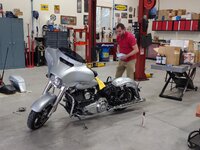
My son has decided to sell his motorcycle so last night he stopped by on his way home from work to get it cleaned up and ready to post up for sale.

The battery in his bike was dead so he pulled the battery from mine to get it sold. He is detailing it and getting it all cleaned up.
HD1.jpg

HD2.jpg

He wanted to take it for one last ride. Not exactly wearing the proper riding gear but just a quick cruise around the neighborhood.
HD3.jpg

As a parent you want to do everything for your children, regardless of their age. However, I have come to the realization that our choices, experiences and decisions in life are what eventually define us and shape our character as well as our future. By depriving our children of the opportunity to make those hard choices in life we are in fact, shaping them, but not necessarily in a good way. They will not be able to make the hard choices and decisions on their own when the time comes if we do it for them and therefore crippling their development and transformation into the people we know they can become.

Watching my son in the first few years of his marriage makes me so proud as a father as I watch and listen to how he and my daughter in law talk to one another and make choices together. He is very methodical in all that he does and weighs his decisions very carefully looking at all aspects and I couldn't be more proud as a father.

Things can be replaced at some point in time but the opportunities and choices that we make eventually define us which is invaluable.

If anyone is looking for a clean 2014 Harley Davidson Street Glide, let me know.

Thanks.
 

OutlawDrifter

Well-known member
Joined
Jan 20, 2015
Messages
3,876
Location
KS
Glad you're having those conversations and he's seeing the light on his own. I'm currently in that stage with both of my girls that are now moved out. One is getting old enough that the Mrs. and I are becoming more intelligent, the other one only comes around when she needs something...and we are dumber than post in her eyes :ROFLMAO: .

I 100% agree that if you don't let them make some hard decisions early on in life, fail a few times, and take ownership in mistakes, they will have a hard time as adults.

That's one area where I think farm kids get a leg up. On the farm, if dad isn't around, you have to make a decision and live with it, right wrong or indifferent. Make a choice and keep working the problem.

Both bikes are looking great, Mike. Thanks for checking in.

PS - I see some resemblence to you in your boy!
 
OP
Z

zmotorsports

ALLIANCE MEMBER
Joined
Oct 20, 2009
Messages
21,405
Location
Northern Utah
Glad you're having those conversations and he's seeing the light on his own. I'm currently in that stage with both of my girls that are now moved out. One is getting old enough that the Mrs. and I are becoming more intelligent, the other one only comes around when she needs something...and we are dumber than post in her eyes :ROFLMAO: .

I 100% agree that if you don't let them make some hard decisions early on in life, fail a few times, and take ownership in mistakes, they will have a hard time as adults.

That's one area where I think farm kids get a leg up. On the farm, if dad isn't around, you have to make a decision and live with it, right wrong or indifferent. Make a choice and keep working the problem.

Both bikes are looking great, Mike. Thanks for checking in.

PS - I see some resemblence to you in your boy!

Thanks Marc.

What's funny is those things that we didn't think they were paying attention to when they were younger are the things they start repeating to us like they just discovered a new planet and have to tell you all about it. :unsure:

I found when I was younger and the things I argued the most with my father about were not necessarily the things I disagreed with, I just thought I would change the outcome and prove him wrong. I was stubborn and wanted my own thoughts and beliefs to turn out to be true. Turns out he was right all along and I couldn't defy certain things no matter how badly I wanted my way to be right. Once I started working with things in the universe and accepting some basic fundamentals about things like hard work, money and career I found out I was wrong and my dad was right all along, it just took me having to experience that for myself. I see a lot of that in my son over the past few years as he has been out on his own.

One thing I am so grateful for however, is that my wife and I were able to be able to pay for his college and allow him to get a much better start in life than we had. I don't think he appreciates that aspect yet, but one day I think the light bulb will come on and he will realize just how fortunate he was to start his career debt free.

I also don't think he truly appreciates the opportunity he has to bring his stuff to our shop and have me help keep things maintained and in proper working condition. He never has had to experience taking anything to a shop and having work performed nor having to incur that expense. I keep telling my wife I wish I could help my son and DIL more financially but then she reminds me that by helping them with repairs and maintenance I am saving them a **** ton of money in itself that they would otherwise have to spend.
 
OP
Z

zmotorsports

ALLIANCE MEMBER
Joined
Oct 20, 2009
Messages
21,405
Location
Northern Utah
Selling the bike eh, redefining priorities he’s says eh??


Sounds to me like Mike might becoming a granddaddy in the not so distant future 😉

Something along those lines Cam. They've not been having the best luck trying to start their family.

Why is it that so many people who probably shouldn't have kids continue to pop them out like Pez candy, yet those who really want children and have set themselves up for providing for them and can offer them a solid and stable environment seam to struggle the most. :cry: It breaks my heart watching what they have been having to go through over the past couple of years and there's nothing I can do to help. I hate feeling helpless and all of the emotions that go along with it.

That's about all I have to say about the matter.

If anyone is looking for a clean Harley, I know where there's one for sale and the money is going towards a good cause.

Thank you.
 
To avoid these ads, REGISTER NOW!
Top Bottom