To avoid these ads, REGISTER NOW!

ZMotorsports Shop Projects 2.0

OP
Z

zmotorsports

ALLIANCE MEMBER
Joined
Oct 20, 2009
Messages
21,394
Location
Northern Utah
I forgot to show the socket that I had made to remove/install turbo pressure sensors on Duramax's. You could possibly use an open end wrench but where the sensor is mounted in the turbo housing there is not much room for the width of an open end wrench nor much room to swing the end if you can get on it. I took a 1/2" drive Carlyle 1" deep chrome socket and cut a .250" slit down the side for the wiring. I didn't want to cut an expensive socket and the Carlyle sockets are full depth broached which work well.

socket1.jpg

socket2.jpg
 
To avoid these ads, REGISTER NOW!
OP
Z

zmotorsports

ALLIANCE MEMBER
Joined
Oct 20, 2009
Messages
21,394
Location
Northern Utah
Last trip out we had a few small items that needed to be addressed on our coach so I took a couple of hours last night to complete them.

About 8-10 years ago we had the powered sun visors over the driver and passenger windshield area come crashing down. I had heard this was a common issue on early 2000 Monaco coaches that had the heavier powered sun visors vs. the manual style so I thought I would correct them once and for all. Originally the powered sun visors were merely screwed up into the trim above the windshield but there is only a screw at each end and the grabber style screws the manufacturer used were less than sufficient.

I chose to use a 1" wide by 3/16" thick aluminum strip just a little longer than the powered shade. I drilled and countersunk about 5 screws into each of these strips, one for the driver's side and one for the passenger's side. Then I drill and tapped a machine thread (10-32) into each end of the aluminum strip in which the powered shade would fasten to. This has held up exceptionally well but last trip as we were driving from Dubois, WY over the Togwotee Pass the road was horrific with chunks of asphalt missing from winter damage and I started to detect a bit of rattle or chatter from the passenger's side sun shade. While stopped at Afton, WY I took a look and noticed that one of the screws securing the aluminum strip to the overhead area had backed out a little. Last night I removed the sun shade, tightened the loose screw as well as went through the remaining fasteners to ensure they were all tight and then reinstalled the powered sun shade in place. That should now address that rattle.

Next I had two compartment/basement doors that I detected on the last trip that had some play in them. I decided to address them as well. It turned out one had to have the strike plate moved inward about a quarter of an inch to pull the storage bay door in tighter and the other was not fully engaging with the strike plate so it required a little tweaking to get everything to secure properly.


Last item of the night was to machine several small spacers for the load locks in our refrigerator. Back in 2015 when I had removed the absorption refrigerator and added the residential refrigerator to our coach I had to come up with a way of securing food, drinks, etc. in the refrigerator as residential refrigerators do not have the same type of ledges to secure items in the fridge like an RV style (absorption) refrigerator that is meant to bounce down the road.

At the time I had machined some aluminum strips with equally spaced holes in which to accept some cross bars in that would be used for securing items during travel. These load locks or bars have worked exceptional and up until last trip have never popped out of place. Last trip the wife opened the refrigerator during one of our stops and several drinks fell out due to the load bar coming out of the corresponding hole. The load bars are a length of .5" diameter aluminum rod that has a fixed bushing of Delrin on one end to engage into the aluminum strips and on the other end was a floating or collapsible piece of Delrin with a spring under it for quick insertion and removal. I was not sure if the spring had lost tension or what exactly changed but rather than back the small stainless steel socket head cap screw out any further and chance even less spring tension, I opted to machine a few small spacers measuring between .125" and .200" to ensure proper engagement with the side strips to ensure they don't pop out of place again.

Small spacer being machined for one of the load bars. Facing off the end to the exact length needed after parting off. Then dressing the OD with a small chamfer and adding a chamfer to the 3/16" diameter center hole.
rv1.jpg

All three spacers completed and ready to install under the fixed end of the load bar.
rv2.jpg

Load bars snapped nice and firmly into place. That should resolve any bars popping out in the future.
rv3.jpg

It seems there is always something that needs to be addressed on these rolling homes as they bounce down our interstate and highway system. Even more so as our country's infrastructure deteriorates more and more.

Staying up on things ensures these small items don't turn into an overwhelming repair or lengthy list. I wonder if that is why some of these RV's when sold have sooooo many things that need attention. Maybe the owners didn't stay current on the small things and they just became too monumental of a chore to tackle.
 

Bob Heine

ALLIANCE MEMBER
Joined
Oct 24, 2009
Messages
10,706
Location
Boca Raton, Florida
Mike, as usual you find the most elegant solutions. Some of us have to settle for the Homer Simpson, or Harbor Freight solutions. Us Homers would try cutting a slot in a Chinesium socket with an angle grinder, destroying everything in sight and coating everything in stinky brown dust.

Then again, there's a $45 Oxygen Sensor and Diesel Injection Socket Set at HF.
Line Sockets.jpg
It includes:
  • Vacuum Switch Sockets:
    • 7/8 in.x3/8" (x2)
    • 29mmx1/2"
    • 7/8 in.x1/2"
  • Oil Pressure Sending Unit Sockets:
    • 1 in.x3/8"
    • 1-1/16 in.x3/8"
  • Oxygen Sensor Sockets:
    • 7/8 in.x3/8"
    • 7/8 in.x1/2"
  • Injector Sockets
    • 7/8 in. x1/2"
    • 27mmx1/2"
    • 28mmx1/2"
 

LXCam

ALLIANCE MEMBER
Joined
Apr 23, 2013
Messages
19,124
Location
AZ
That's all well and cool Mike, but I'm a bit disappointed in ya my friend. I know those water bottles rolling around on the shelf must drive you nuts. I know I couldn't live with it :spit:


Sooo when will you be making the Custom By Mike Super Deluxe Water Bottle Securement Bracket...........soon to be in stores near you! :)
 
OP
Z

zmotorsports

ALLIANCE MEMBER
Joined
Oct 20, 2009
Messages
21,394
Location
Northern Utah
Bob, you know the old saying that if the only tool you have is a hammer, then everything looks like a nail. Having machining capabilities really opens up one's work envelope. Hell, somedays I look for reasons to use either the mill or lathe. :unsure: That being said, I've had my fair share of days using a die grinder to do the exact same thing and have many tools from those days but I try to keep those out of sight.:bounce: As I was digging through my socket drawer I had several injector and O2 sockets that I was certain at least one would work. Surprisingly, I didn't and I couldn't bring myself to cut up a Snap-on or other high dollar socket so a quick trip to my local NAPA netted me a 1/2" drive 6-point deep 1" socket fully broached for about $9. That was much easier to mill a slot in.


Cam, I'm sorry to disappoint ya my friend. The bottles fell over when the wife was unloading the fridge before backing the coach into the shop after washing and they must have fallen over. I thought about standing them all upright before snapping the picture but didn't think it would matter. I guess I was wrong.:ROFLMAO:
 
OP
Z

zmotorsports

ALLIANCE MEMBER
Joined
Oct 20, 2009
Messages
21,394
Location
Northern Utah
Yesterday when I arrived home I had found my Macnaught couplers had arrived that I ordered last week.

I really like the LockNLube coupler that I have been using for the past few years with one exception, it is too large of diameter to fit down inside some of the zerk ports that I have. I looked at Macnaught's couplers when I purchased the Macnaught grease guns last month but didn't order one. Well after doing some service on mine and my son's Jeeps this past couple of weeks I realized I needed a coupler with smaller diameter so I purchased a couple of the Macnaught quick couplers and will give them a try.

I purchased a standard KY+ as well as an extended reach KY+ (XL) for deeper recessed zerks.
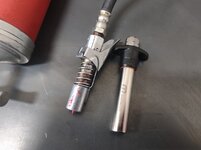
grease1.jpg

LockNLube vs. Macnaught Load & Lube. Both have similar fit, finish and feel although two completely different designs and diameters at the end.
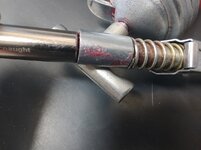
grease1a.jpg

The Macnaught is not much larger than a standard coupler measuring in at .575" diameter.
grease2.jpg

The LockNLube coupler measures about 1/16" larger in diameter at about .635".
grease3.jpg

End to end for comparison.
grease4.jpg

I moved the LockNLube over to one of my Macnaught guns using my standard Multiplex EP2 chassis grease. I added the standard Macnaught Load & Lube on my Macnaught gun that contains my Valvoline lithium with moly grease that I use on ball joints and tie rods. Lastly I added the extended tip Macnaught Load & Lube to my main grease gun which is my Proto.
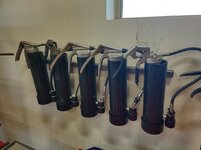
grease5.jpg

Grease guns in their respective holders.
grease6.jpg

Just after finishing up the grease gun coupler swap-a-roo my nephew came by to ask if I could swap the upper bearing around on his wife's strut for her Cadillac. He came by last week and asked me to take a look at her car as it was making a weird noise when she turned. He had inspected tie rods and replaced lower ball joints but still had the noise and was at a loss. I immediately inquired about the upper strut bearing and he didn't realize it had a bearing above the strut spring. When I looked at the mileage the car only had 58k miles on it and being a 2018 I doubted that would be an issue but then he told me the car was a rebuild buy back and that was the corner of the car that was impacted. That made much, much more sense as to the year and mileage. A quick investigation and it revealed the upper bearing was suspect.

He said he could replace the bearing and would rent a spring compressor. I insisted he bring it over and let me swap the bearing out as I don't trust those clamshell style compressors, even though I have used one for years. I told him I had a nice professional grade strut compressor and would rather do it than see him get hurt. He called to see if I had a few minutes to replace the bearing last night so I helped him out.

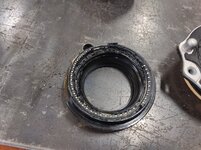
Bingo, the bearing was toast as it fell out in pieces.
cad1.jpg

cad2.jpg


Thanks for looking.
 

4 FN 27

ALLIANCE MEMBER
Joined
Oct 19, 2015
Messages
4,635
Location
Minnesnowta
Mike I am really interested in how the new Coupler works. Just got in the Lock & Lube too and found it is too big.

BTW I hope that is the "Back-up" Caliper!!! Yesterday I dug 2 of them out of my Desk Drawer to measure a Spanner Wrench and neither Dial was on Zero...LOL...then I got home and found I had 2 more like it in my Shop.

I use to have a little Laser Cut Shim Stock thingy I could put in between the Rack and Pinion Gear and get it to skip back to zero??? I guess I'll need to make another one. We made a bunch of them for the guys in the shop so we could keep their Calipers in Calibration and not make the "Ref Only".

IMG_3136.JPG
 
OP
Z

zmotorsports

ALLIANCE MEMBER
Joined
Oct 20, 2009
Messages
21,394
Location
Northern Utah
Pat, it isn't my "back-up" caliper, just one of several. It measures accurately even though the dial face has rotated over the years from being straight up. Not quite sure what you mean by not being on zero. When the caliper is closed it reads right on zero even though the dial may be orientated in a manner other than straight up. I've gotten in the habit of fully closing my calipers before each use to ensure the needle stops directly on zero regardless of how the actual dial is orientated. I also use .5", 1" and 2" gauge blocks routinely to ensure that they measure accurately as they move throughout their range.
 

SilverJimmy

Well-known member
Joined
Apr 14, 2012
Messages
1,630
Location
Prescott/Flagstaff, AZ
Mike, I seem to remember being taught by the old machinists at the power plant that I should always leave my calipers and 0-1” micrometers open about .015 so that when they contract or expand from temperature the gears and mechanism isn’t subjected to those forces. So that is what I’ve always done. YMMV! Not saying you’re incorrect, just a different take on it. I do need to start my own thread here though so I can get your input on my two latest additions to my shop. I’m going to need LOTS of input! Thanks again and keep up the incredible work.
 
OP
Z

zmotorsports

ALLIANCE MEMBER
Joined
Oct 20, 2009
Messages
21,394
Location
Northern Utah
Mike those round bars used in your RV fridge are slick! Even if the water bottles were on their side. 😂

Jay

Thank you Jay, I appreciate that.

Mike, I seem to remember being taught by the old machinists at the power plant that I should always leave my calipers and 0-1” micrometers open about .015 so that when they contract or expand from temperature the gears and mechanism isn’t subjected to those forces. So that is what I’ve always done. YMMV! Not saying you’re incorrect, just a different take on it. I do need to start my own thread here though so I can get your input on my two latest additions to my shop. I’m going to need LOTS of input! Thanks again and keep up the incredible work.

I have not heard of that Jimmy, but it makes sense. The good part is that my shop is somewhat climate controlled and I don't have large temperature swings. I honestly don't know how I store them. You know how things are when you do things out of habit, you rarely think through the process. Thinking off the top of my head I don't think I close them tightly but when I'm done I lay them back in their foam case that is open in the metrology drawer. When I reach for them I open them slightly, run my fingers over the inside jaws to ensure they are clean and free of debris then close the jaws to ensure the needle rests directly on zero. Every few times I will grab one of my gage blocks and confirm the accuracy before continuing.

I am willing to learn as I've mentioned before, I am not a machinist, merely a mechanic who has learned how to machine and fabricate so I definitely don't know everything.
 

4 FN 27

ALLIANCE MEMBER
Joined
Oct 19, 2015
Messages
4,635
Location
Minnesnowta
Pat, it isn't my "back-up" caliper, just one of several. It measures accurately even though the dial face has rotated over the years from being straight up. Not quite sure what you mean by not being on zero. When the caliper is closed it reads right on zero even though the dial may be orientated in a manner other than straight up. I've gotten in the habit of fully closing my calipers before each use to ensure the needle stops directly on zero regardless of how the actual dial is orientated. I also use .5", 1" and 2" gauge blocks routinely to ensure that they measure accurately as they move throughout their range.
Just razzing you a bit Mike. I get it. Mine are the same way. If you a making chips this is bound to happen at one point.

Our Quality System and Calibration System requires all Calipers to read Zero at the top and they are check on a schedule to a Master Gauge Block which goes out for certification every year. Then the Caliper or inspection devise is tagged with a date and a signature. If they are not in Calibration you can still use them only they are marked "For Reference Only". All Inspection Equipment, personal or company gets certified to standard. Most is done in house, some sent out and the big stuff we bring somebody in.

I need to make more of those Shims so I can get mine back to the top.

IMG_3137.JPG
 

bugnut

ALLIANCE MEMBER
Joined
Jul 14, 2012
Messages
3,891
Location
Central Ohio
WOW I thought I might be the only one who's OCD went crazy with the calipers not being at high noon! Much relief now. Go digital and it doesn't matter!!
 

Attachments

  • caliper.jpg
    caliper.jpg
    17.8 KB · Views: 16
OP
Z

zmotorsports

ALLIANCE MEMBER
Joined
Oct 20, 2009
Messages
21,394
Location
Northern Utah
Just razzing you a bit Mike. I get it. Mine are the same way. If you a making chips this is bound to happen at one point.

Our Quality System and Calibration System requires all Calipers to read Zero at the top and they are check on a schedule to a Master Gauge Block which goes out for certification every year. Then the Caliper or inspection devise is tagged with a date and a signature. If they are not in Calibration you can still use them only they are marked "For Reference Only". All Inspection Equipment, personal or company gets certified to standard. Most is done in house, some sent out and the big stuff we bring somebody in.

I need to make more of those Shims so I can get mine back to the top.

That makes me feel a bit better Pat. I was scratching my head trying to figure out what I was missing. :headscrat I would like my needle to point north (in more ways than not :lol:) but it isn't a deal breaker in my little back yard shop as I'm doing certified work for space ships.

I even went home yesterday and as soon as I stepped into the shop grabbed my gage blocks to confirm because I wasn't sure what I was missing. Everything measured correctly so I guess I'll just continue onward.


WOW I thought I might be the only one who's OCD went crazy with the calipers not being at high noon! Much relief now. Go digital and it doesn't matter!!

I have a nice Starrett digital caliper also but for some reason I keep reaching for my dial 90% of the time. I do however, like the digital when working towards a size as I can offset it and work towards zero.


Until the battery goes dead. I ended up having to pull the battery out of mine after each project. Mine follows the same rule as welding gas, runs out on the weekend.

^^This is the main reason I don't like battery powered anything. I have some battery tools but for the most part I prefer to not use things that require batteries. I still use my old fixed shade welding helmets even though I have a nice auto-darkening. For the most part I just don't care for them.
 
OP
Z

zmotorsports

ALLIANCE MEMBER
Joined
Oct 20, 2009
Messages
21,394
Location
Northern Utah
Mike I am really interested in how the new Coupler works. Just got in the Lock & Lube too and found it is too big.


Okay Pat, here is my "official" review. Keep in mind this is only my opinion and I'm a bit "quirky" when it comes to tools.

My son brought his WJ by the shop last night for a full LOF service. We checked all of the suspension joints on the ground then racked the Jeep and began the service and more detailed inspection of the chassis.
jeep1.jpg

jeep2.jpg


Now for the review or better yet comparison between the LockNLube and Macnaught Load & Lube grease couplers.


I thought this would be a good time to compare the two seeing as how I have had the LockNLube coupler on my main Proto grease gun for a couple of years now and I very much like the coupler with really only one drawback. The end of the LockNLube is just large enough that it will not fit into some of the recessed zerks such in the Teraflex tie rod/ball joints. These are actually the only recessed zerks that I have come across that the LockNLube will not fit into. Other than that I really like the LockNLube coupler as it grabs the zerk firmly and the spring has more than adequate tension to pull the outer sleeve over the splined coupler tight enough to prevent grease from oozing out. The lever on the LockNLube is easy to operate and then very quickly releases without any drama.

Now for the Macnaught Load & Lube. This is a decent coupler and especially nice that it will in fact, fit into the tight recessed zerk bores in the Teraflex tie rod/ball joints. It goes on with a push of the coupler however, I don't feel the spring tension is anywhere near as good as the LockNLube because you have to actually exert a little pressure onto the coupler and keep that pressure there to prevent grease from oozing out around the coupler and the zerk. If left to its own pressure there is a steady release of grease from around the zerk. Its not a lot but enough that it is wasteful of the grease and requires some cleanup.

The other thing I noticed about the Macnaught is that when you go to release it you will still find yourself having to either pull with a decent amount of force OR rock it to the side a bit to remove from the zerk. This had me scratching my head because it seemed to have enough spring pressure to require having to rock it to the side to remove yet on its own it would allow grease to flow from around the zerk and coupler connection.:headscrat It did fit nicely into the Teraflex joint's recessed zerk but took some force to remove it when releasing the "T" style coupler. Much better than a standard coupler mind you, but more than I thought it would.

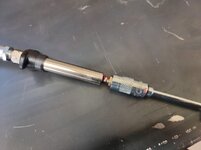
In a couple of the zerks on the double cardan joints in the driveshafts of both mine and my son's Jeeps there is a flush grease zerk that requires a needle style of adapter to reach in when the driveshaft is at a specific angle, otherwise you find yourself dropping one end of the driveshaft to grease. While greasing the center ball of these double cardan joints I also noted that the Macnaught Load & Lube would in fact fit into these adapters with the sleeve and allow the retention sleeve to actually pull up over the coupler for a little extra rigidity when working the business end of the grease gun with one hand. The LockNLube coupler is just barely too large to allow the retention sleeve to pull up over the coupler so therefore when using these adapter and my LockNLube I have found that the coupler will grab onto the zerk nice and tight but you have to be careful how to apply pressure when going onto the zerk or the couple can become disconnected from the adapter. Hope that part makes sense. See pictures below for reference.


Macnaught Load & Lube mating up to the needle adapter.
grease1.jpg

Sleeve on the needle adapter pulls completely up over the coupler allowing a nice rigid connection.
grease2.jpg

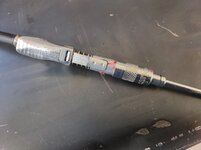
Here is the LockNLube couple mating with the same needle adapter.
grease3.jpg

With the LockNLube coupler the sleeve on the needle adapter will not slide over the coupler, only **** up to it. This requires a bit more maneuvering to get the setup in position for greasing to prevent the coupler from becoming disconnected from the zerk as you apply non linear pressure (angle) to the setup. Again, I hope I am explaining that well enough.
grease4.jpg


So after about an hour and a half of greasing and using both style of couplers, both me and my son we had a conversation about the two couplers. I really didn't preface our service job with anything specific to my son other than to tell him I got a new style of coupler and to let me know what he thought. We both had a chance to use the new Macnaught coupler in multiple situations/joints and under a nice variety of angles and situations. After completing the work I asked him for his opinion and they pretty much mirrored my own with no coercing or pre-given conclusions so I feel this was very good review of the product. He said he "much preferred the LockNLube coupler and felt like it gripped the zerk better and with minimal to no waste of grease and minimal cleanup after decoupling". I thought that was an accurate statement.

The consensus was that we both prefer the LockNLube much more than the Macnaught Load & Lube grease coupler.

That being said I moved the couplers on my grease guns back around so that the LockNLube was back on my Proto grease gun which is my preferred grease gun. I moved the Macnaught Load & Lube back to my backup gun which is also one of the new Macnaught guns that I purchased a couple of months ago. Now speaking about the Macnaught grease gun, while I do like the rigidity and build quality of the pump housing and handle assembly, I feel it leaks more than ANY of my other grease guns, even more than my inexpensive Lincoln 1134's. My son grabbed the Macnaught gun from the holder and as he was walking towards his Jeep it left a very noticeable trail across the 5 or 6 feet between the wall rack and his Jeep all across my shop floor. When he noticed he asked me "hey, are you foregoing grease now and just dumping oil straight into the guns?":ROFLMAO:

Needless to say I am less than impressed with the Macnaught grease gun as well.

I apologize for the lengthy response to Pat's question and I also don't necessarily like to dog on products or tools but I feel I am honest in my observations. I guess I could have just said "keep the LockNLube and don't waste your money on the Macnaught coupler."

Thanks for reading and I apologize if I have offended any Macnaught fans.
 
Last edited:

Swanny1953

ALLIANCE MEMBER
Joined
Jul 28, 2010
Messages
1,061
Location
Lucas, TX
Mike, thanks for the comparison. I, too, have both couplers and prefer the LockNLube to the Macnaught. As you mentioned, I found the Macnaught difficult to remove from the zerk. In fact, I broke one zerk off getting it removed and is is now attached to a zerk on my 4-post lift (without a grease gun attached) because I can't get it to release!!
Always appreciate your detailed explanations of what you have going on - admire the skill and tenacity you approach your projects with.
 

signcrafter

Well-known member
Joined
May 9, 2012
Messages
12,359
Thank you for the detailed write up of the grease guns. I have a lumax quick coupler I got from napa on one of my guns and it works pretty good. I will have to try a lock n lube sometime. My grease guns are older and pretty sure I bought them all second hand back when I was starting out. They are all the lever pump type and I see you have the pistol grip. Do you prefer the pistol grip over the lever type? I can definitely see the pistol grip being handy since you can use it one handed but I've never used one before. If you were starting fresh which gun/guns would you get? How many and what type of grease would you put in each one? I've been trying to pick different things around the shop as funds allow and upgrade them. Things that have been getting by but a little upgrade would be nice, and my grease guns fit that area. I don't do a ton of greasing anymore, most factory parts on vehicles don't have grease zerks anymore. But wouldn't mind picking up a few new guns and couplers and getting them organized like your guns.
 

SilverJimmy

Well-known member
Joined
Apr 14, 2012
Messages
1,630
Location
Prescott/Flagstaff, AZ
The most hated tool on my tool truck was the grease gun! When I sold one I was very specific in asking the purchaser what kind of use was he looking for, was he going to use cartridges or bulk, did he understand that he needed to setup the gun for whichever style he was using and also how to bleed air and prime the pump mechanism in his new grease gun. All this was done while said grease gun was grease free. Invariably about two weeks later that same guy would bring his slimy, leaking, greasy, non-functioning tool onto my truck and either want to return it cuz it was “junk” or want me to make it “work”! I wore white work shirts most of the time, so I was never happy about greasy gun repairs! 90% of the time he hadn’t read the instructions and setup the gun correctly for his supply of grease. But they always made sure it was completely full of grease! I’m willing to bet that every bad fuel pump you’ve ever changed came with a full tank of gas!
 
OP
Z

zmotorsports

ALLIANCE MEMBER
Joined
Oct 20, 2009
Messages
21,394
Location
Northern Utah
Mike, thanks for the comparison. I, too, have both couplers and prefer the LockNLube to the Macnaught. As you mentioned, I found the Macnaught difficult to remove from the zerk. In fact, I broke one zerk off getting it removed and is is now attached to a zerk on my 4-post lift (without a grease gun attached) because I can't get it to release!!
Always appreciate your detailed explanations of what you have going on - admire the skill and tenacity you approach your projects with.

Gary, thank you very much for following along and for you kind words. Glad to hear that my observations of the Macnaught are shared and not something unique to my pee brain.


Thank you for the detailed write up of the grease guns. I have a lumax quick coupler I got from napa on one of my guns and it works pretty good. I will have to try a lock n lube sometime. My grease guns are older and pretty sure I bought them all second hand back when I was starting out. They are all the lever pump type and I see you have the pistol grip. Do you prefer the pistol grip over the lever type? I can definitely see the pistol grip being handy since you can use it one handed but I've never used one before. If you were starting fresh which gun/guns would you get? How many and what type of grease would you put in each one? I've been trying to pick different things around the shop as funds allow and upgrade them. Things that have been getting by but a little upgrade would be nice, and my grease guns fit that area. I don't do a ton of greasing anymore, most factory parts on vehicles don't have grease zerks anymore. But wouldn't mind picking up a few new guns and couplers and getting them organized like your guns.

Scott, I grew up using the lever style of grease guns on the farm and that was all I knew until I started in the Industrial Maintenance Field when I was 19 years old. Most of my fellow mechanics when I started all preferred the pistol grip so I opted to give one a try. I felt like I had been hiding under a rock all my previous years as it was that big of a difference.

I will say that there are times, although rare, that the lever style would have been preferred just to have a little more leverage to push grease into a less than cooperative zerk as the pistol grip doesn't quite provide enough leverage. That being said, it is very rare as most of the time I don't have that hard of a time getting zerks to take grease.

While we are on the subject of zerks not taking grease, I will have to post up a picture of my "Grease Zerk Rejuvenator" that I purchased from Snap-on about 34 years ago. When I first started in the Industrial Maintenance Field back in 1988, which is funny because as I type this I looked at the calendar and it was EXACTLY 34 years ago today that I started my career as an Industrial Maintenance Mechanic. How time flies. :unsure:

Anyway, when I started my career the main focus for the first year or two was Preventive Maintenance because the graveyard shift I was on was the shift when PM's were performed. It was a love/hate relationship with the shift and the work. It sucked for the fact that we didn't actually do many repairs on that shift so I was not getting to do the things I really wanted to when I decided to become a mechanci but I realized I needed to do my time in the trench sort of speak and get obtain the basic knowledge. It was good in the fact that it really provided a solid base in which to familiarize myself with the various pieces of equipment but it also allowed me to observe patterns and anomalies when it came to performing preventive maintenance and really set the stage for my OCD about proper preventive maintenance on my own assets as I've grown and aged. On various pieces of equipment there were anywhere from 20-40 grease zerks per asset and I would PM between 3 and 5 units a night on average. That equates to anywhere from 80-200 zerks per night that I was cleaning the zerk, pumping grease through the zerk and then wiping the excess from the zerk and around the joint. We had an Alemite pneumatic grease gun that was on a cart and took the 35 pound pails of grease and then each mechanic had their own personal grease gun for those odd ball zerks that the pneumatic gun wouldn't fit on or we had to do outside of the shop such as on dock equipment. Let's put it this way, I got really, really good and pumping grease no matter the tool used.:lol: Nearly every night I had anywhere from 5-10 zerks that would't take grease for some reason or another. Some were due to the ball seized in the end of the zerk or the joint had corrosion that the grease couldn't force past but this was an all too common scenario so within a very short time of being on the Maintenance team I purchased one of those Grease Rejuvenators that you would put a rust penetrant into, insert onto a zerk and then strike with a hammer to forcefully push the penetrant into the joint and create a path for the grease to follow afterwards.

Last night my son had one that was not accepting grease very well so I grabbed my Snap-on grease rejuvenator and handed it to him to use. He was funny because he made such a bit deal out of it seeing as how he had never seen it before in my toolbox. It was actually kind of fun explaining to him about how my evenings would go when I would get to work to begin my shift. I told him that most nights once I pulled the rejuvenator our to my toolbox and put some penetrant in it that I would keep it on the bench all night and not clean it up or put away until the end of my shift. Looking at the tool sitting there on my bench last night it became obvious just how much I must have used it because it is quite worn.

Sorry about the detour down memory lane but back to your question, I prefer the pistol grip grease guns because you can operate them one-handed while the other hand connects/disconnects the coupler and it is much more efficient when you have a lot of zerks to hit. As for pistol grip style grease guns, I have tried quite a few and feel there is a huge difference in them. Over the past 34+ years of my career now and I much prefer my old Proto JFC33HD grease gun. It just works, each time I grab it I know as long as there's grease in it that it will pump. Some of the others I've used over the years seem to be more prone to air pockets that interrupt grease flow and can be problematic to burp the air out of whereas the Proto easily continues to force grease up to the hand pump. I have also found that it is next to impossible to find a grease gun that doesn't leak. As the temperatures rise, the lubricant separates from the carrier and can begin to work its way down around the plunger threads or the plunger seals. I've even seen some leak up at the pump at the bleed port from poor threads or design as the pressures inside the gun rise with temperature. The Proto grease gun seems to leak the least of any of the various guns I've owned so that is why I use it for the majority of my needs.

As for types of grease loaded in guns, I am sure I have more than needed as most people can get away with one or two at most. I use a Multiplex EP-2 grease for my general purpose chassis grease for things like u-joints, suspension joints, shafts and just general use. My next most used grease is the Valvoline EP with Moly. I started using this years ago after attending a lubrication class/seminar as it was a Ford (said with tongue in cheek) preferred grease for things like tie rods and ball joints. The moly is good for high stress/high load applications such as farm, industrial and ball joint/tie rod applications in the automotive world which is why Ford recommended it in their ball joints.

I then have another gun that has the RCV synthetic grease with Moly for use in RCV axle shafts which are of the Birfield design and another gun with Red & Tacky which I used in steering neck bearings on motorcycles.
 
To avoid these ads, REGISTER NOW!
OP
Z

zmotorsports

ALLIANCE MEMBER
Joined
Oct 20, 2009
Messages
21,394
Location
Northern Utah
The most hated tool on my tool truck was the grease gun! When I sold one I was very specific in asking the purchaser what kind of use was he looking for, was he going to use cartridges or bulk, did he understand that he needed to setup the gun for whichever style he was using and also how to bleed air and prime the pump mechanism in his new grease gun. All this was done while said grease gun was grease free. Invariably about two weeks later that same guy would bring his slimy, leaking, greasy, non-functioning tool onto my truck and either want to return it cuz it was “junk” or want me to make it “work”! I wore white work shirts most of the time, so I was never happy about greasy gun repairs! 90% of the time he hadn’t read the instructions and setup the gun correctly for his supply of grease. But they always made sure it was completely full of grease! I’m willing to bet that every bad fuel pump you’ve ever changed came with a full tank of gas!

I can say I was one of those guys that didn't read the instructions early on in my career Jimmy. However, after my first couple of less than stellar experiences with grease guns I feel I quickly became a connoisseur of grease guns and even up to include the term grease gun snob. :bounce:
 

SilverJimmy

Well-known member
Joined
Apr 14, 2012
Messages
1,630
Location
Prescott/Flagstaff, AZ
OP
Z

zmotorsports

ALLIANCE MEMBER
Joined
Oct 20, 2009
Messages
21,394
Location
Northern Utah
I’ve seen you on here from time to time and I really am interested in your opinion.
This is all new to me and I’m trying to not have my arm ripped off and then get beaten to death by it. Not trying to hijack, just looking for your input. When I’m not embarrassed by my ****-show I do need to start my own thread. Soon I hope!

Looks like a nice score Jimmy. Both the lathe and mill appear to be well used but well cared for and you made a haul in the accessories. The tooling and accessories for the machines can easily be worth more than the actual machines.

You will definitely have to start yourself a thread here as it appears you have a nice place to work in and would love to see more of it.
 

4 FN 27

ALLIANCE MEMBER
Joined
Oct 19, 2015
Messages
4,635
Location
Minnesnowta
Okay Pat, here is my "official" review. Keep in mind this is only my opinion and I'm a bit "quirky" when it comes to tools.

I apologize for the lengthy response to Pat's question and I also don't necessarily like to dog on products or tools but I feel I am honest in my observations. I guess I could have just said "keep the LockNLube and don't waste your money on the Macnaught coupler."

Thanks for reading and I apologize if I have offended any Macnaught fans.
Thank you Mike for the in-depth review.

Grease is like Anti-Seize. It covers everything.

I am going to do a little more playing with the L&L and look at more options. I don't mind experimenting and trying new things.

PS Mike you might have a second career option as a Tech Writer. Nice work!!!
 
OP
Z

zmotorsports

ALLIANCE MEMBER
Joined
Oct 20, 2009
Messages
21,394
Location
Northern Utah
Thank you Mike for the in-depth review.

Grease is like Anti-Seize. It covers everything.

I am going to do a little more playing with the L&L and look at more options. I don't mind experimenting and trying new things.

PS Mike you might have a second career option as a Tech Writer. Nice work!!!

Agreed Pat. Grease and anti-seize can get away from a person and before you know it everything is covered. I appreciate and am flattered by your kind words. I've tried to work on my communication skills over the life of my career as that was something I very much struggled with early on so it is nice to hear positive feedback about them.

I have noticed that in all of his threads! He just doesn't quite fit the part of an old "English School Marm" though:geek:

I "think" I appreciate your comment. Not quite sure about the "school marm" comment though. :unsure: Had to look that one up and found out it pertains to a woman school teacher. :wtf: You may have to expand on that. :lol:
 

Mr.zippy

Well-known member
Joined
Apr 27, 2020
Messages
2,219
Location
Wyoming
LOL sorry Mike..........I had an english teacher in school that made my life a living hell.....she had great writing skills, but her method of trying to get me to absorb those skills was a lost cause. All kidding aside, you have some mad technical writing skills!
 
OP
Z

zmotorsports

ALLIANCE MEMBER
Joined
Oct 20, 2009
Messages
21,394
Location
Northern Utah
LOL sorry Mike..........I had an english teacher in school that made my life a living hell.....she had great writing skills, but her method of trying to get me to absorb those skills was a lost cause. All kidding aside, you have some mad technical writing skills!

Maybe we had the same teacher. I had one in high school that tried to work her magic but just couldn't get through to me. Proper paragraphs, commas, semi-colons, quotations marks and punctuation eluded me to no end. The ONLY way I passed English in high school was because I worked on her cars in the auto shop. IF she could only see the praises I'm getting now.... :lol:
 

Bodj Built

Well-known member
Joined
Feb 3, 2016
Messages
1,165
Location
Moorpark, CA
Those that follow my thread regularly probably remember several months ago when my old Snap-on bronze dead blow hammer came apart while I was rebuilding a rear end. My Snap-on rep said he would warranty it and ordered a replacement.

It has been on backorder ever since so there's been a disturbance in the toolbox. :lol: Last night I received a text from him saying that my hammer had arrived in his stock order so this morning he swapped it out for me.
hammer1.jpg

hammer2.jpg

I know I'm a bit weird when it comes to tools, at least that's what my wife and DIL tell me, but it was kind of a bittersweet moment when I handed him the old hammer and he handed me the new one. The new hammer is nice and has the newly designed handle but there was so much history in the old hammer, it just doesn't "feel" right. I feel that over time tools, as well as vehicles, can take on their own personality and are more of an extension of the owner. This bronze dead blow hammer was one of the first, if not the first, Snap-on tool I ever purchased when I started my career as an Industrial Maintenance Mechanic nearly 35-years ago.

When I was joking with my Snap-on rep I told him I didn't know if I had another 35-years left in me to train the new hammer.:unsure:

I recall my dad having the same Snap On hammer while growing up. I remember being a punk kid, sneaking into his toolbox and grabbing it to drive nails into random 2x4s while he was remodeling our home 😂. The sight of your hammer brought back quite a lot of nostalgia. His handle suffered the same fate as yours a few years back, unfortunately
 

sweet victory

Well-known member
Joined
Jun 9, 2016
Messages
1,263
Location
USA
I started backwards and went into your Wyoming trip. Just got to say...your attention to detail, attitude about equipment, and thoroughness are awesome. Thanks for sharing everything, it's been a joy to read along!
 

lilscorpion

Well-known member
Joined
Mar 15, 2010
Messages
3,600
Location
Colorado
Lots to unpack Mike…

The grease gun rack. Did you make them? The main tubes look like pvc tube with what’s the thingy at the bottom that the tips go into?

50D87696-FC10-47BB-969B-6443A0F065F1.jpeg

Grease Guns - I ordered a couple of macnaught grease guns, thought I’d replace my lever style. I’ve not played with them yet but on your review, they’re going back in exchange for the protos. I’m not a grease fanatic, in fact I hate the mess but I typically hate it the most because the guns **** and the tips are usually really hard to get off the fittings….so you’re review on the lock and lines are very timely. Thank you.

Grease - I’ve been using Lucas oil’s marine grease on everything. Gonna switch to the Valvoline Moly Gray. After your sharing I did some reading and realized that I may be reducing the life of my joints (like my Johnny Joints) because the marine lacks additives that help in friction/pressure situations. Man, sometimes I feel like I don’t know ****. What do you use for the slip splines on driveshafts? Seems like Marine is correct for them. What about u-joints? Are u-joints considered high-speed/high heat bearings like wheel bearing where Red-n-tacky is a good choice?

Grease Joint Rejuvinator - had to look that one up. innovatine little tool. Seems like flushing and then regressing flex joints (Johnny Joints and Summint Machines Flex Joints) with a thin oil every so often would be a really good idea. Lower links tend to pick up dust and rotate it into the grease when the suspension cycles. I usually wait too long to disassemble them and clean them out. Flushing them may be the solution.. Not sure this tool is the way to do it but the idea is interesting.
 
OP
Z

zmotorsports

ALLIANCE MEMBER
Joined
Oct 20, 2009
Messages
21,394
Location
Northern Utah
I recall my dad having the same Snap On hammer while growing up. I remember being a punk kid, sneaking into his toolbox and grabbing it to drive nails into random 2x4s while he was remodeling our home 😂. The sight of your hammer brought back quite a lot of nostalgia. His handle suffered the same fate as yours a few years back, unfortunately

That's odd the handle broke in the same manner. Must be a flaw in the design or material specific to that hammer. :unsure: Thanks for sharing.

I started backwards and went into your Wyoming trip. Just got to say...your attention to detail, attitude about equipment, and thoroughness are awesome. Thanks for sharing everything, it's been a joy to read along!

Thank you very much for your comments and thanks for taking the time to read through my thread.


Nice!
I immediately looked over at the Snap-on site and they’re still available. I’m definitely ordering one the next time my rep stops by the shop.

Anders, yes, I believe they are still available, however, I think the new ones are in blow molded cases rather than the wood case. Don't quote me on that however, I am not 100% certain on the packaging.
 
OP
Z

zmotorsports

ALLIANCE MEMBER
Joined
Oct 20, 2009
Messages
21,394
Location
Northern Utah
Lots to unpack Mike…

The grease gun rack. Did you make them? The main tubes look like pvc tube with what’s the thingy at the bottom that the tips go into?

50D87696-FC10-47BB-969B-6443A0F065F1.jpeg

Grease Guns - I ordered a couple of macnaught grease guns, thought I’d replace my lever style. I’ve not played with them yet but on your review, they’re going back in exchange for the protos. I’m not a grease fanatic, in fact I hate the mess but I typically hate it the most because the guns **** and the tips are usually really hard to get off the fittings….so you’re review on the lock and lines are very timely. Thank you.

Grease - I’ve been using Lucas oil’s marine grease on everything. Gonna switch to the Valvoline Moly Gray. After your sharing I did some reading and realized that I may be reducing the life of my joints (like my Johnny Joints) because the marine lacks additives that help in friction/pressure situations. Man, sometimes I feel like I don’t know ****. What do you use for the slip splines on driveshafts? Seems like Marine is correct for them. What about u-joints? Are u-joints considered high-speed/high heat bearings like wheel bearing where Red-n-tacky is a good choice?

Grease Joint Rejuvinator - had to look that one up. innovatine little tool. Seems like flushing and then regressing flex joints (Johnny Joints and Summint Machines Flex Joints) with a thin oil every so often would be a really good idea. Lower links tend to pick up dust and rotate it into the grease when the suspension cycles. I usually wait too long to disassemble them and clean them out. Flushing them may be the solution.. Not sure this tool is the way to do it but the idea is interesting.

Matt, thanks for the comments.

The grease gun rack is made of PVC and some steel tubing that I used to mount the PVC to and secure to the wall. I have a full build of the grease gun rack back on page 76 (Post 3003) if you want to check it out.

As for grease, I use Phillips 66 Multiplex EP2 as my general chassis grease. It is a red extreme pressure grease with a NLGI rating of 2. This works great for things like u-joints, driveshafts, wheel bearings and general greasing duties. For the ball and socket style of components such as ball joints, tie rod ends, etc. I use the Valvoline EP Grease with Moly. I have refrained from using the moly in the U-joints because we had some issues many years ago and upon disassembly and exchanging information with our lubrication rep. at work we came to the conclusion that the moly can be a bit too heavy of a grease and actually cause the rollers in ball bearings as well as the small needle bearings from properly rolling and as they "skip" through the races and/or cups they will induce wear and actually do more to promote a failure than reduce it.

Hope that makes sense as I typed it.
 
OP
Z

zmotorsports

ALLIANCE MEMBER
Joined
Oct 20, 2009
Messages
21,394
Location
Northern Utah
So here is a weird one.

Last night my wife and I were just sitting down to dinner after I through a couple burgers on the grill. My son called to tell me he had an issue with his truck and was at his in-laws for dinner. He said as he and my DIL were driving there just before the exit he heard a hissing sound and could see a smoky haze in the mirror. He immediately noticed that it was in front of the rear tires so therefore NOT coming out of the exhaust. He turned A/C off, radio, etc. to focus on the issue and noticed that as he let his foot off the throttle, the haze or smoke cleared slightly but then as he got back on the throttle it increased.

Upon arriving at his mother-in-laws home, he popped the hood and began looking around. He said there were no odd noises other than the hiss he heard at speed but he could not hear that at idle with the hood open. He said it appeared that there was a heavy fuel vapor coming from the PCV breather port in the driver's valve cover. I asked if he was making oil and he said the oil level was at full and no more. This made no sense to me.:headscrat IF it was fueling bad enough for a vapor to be coming from the PCV port it SHOULD have been dumping directly back in to the oil pan and gaining oil level. I told him to sit tight and I would be right there. As my wife and I were driving to his MIL's home I kept rolling over in my mind what could be causing fueling AND hissing sounds yet not making oil. I started thinking maybe a boost tube or hose came off but that wouldn't necessarily make it smoke or haze, but possibly could as it wouldn't be adding enough air for complete combustion BUT it would be coming out of the exhaust, not from under the truck.

Upon arriving I could tell he was frustrated as well as hot, as it was over 100 degrees yesterday here in northern Utah, but he had done a good job of doing preliminary testing and diagnosing. He showed me a piece of paper that he had wiped the engine dipstick on and the oil was present but nothing showing a halo, such as if there had been fuel in the oil. I was actually quite impressed as I was thinking to myself that he must have been paying attention all those years and a wave of pride came over me. He then stated it appeared to be coming from under the small diaphragm of the PCV block on the driver's head. He mentioned that he had removed the dipstick with it running and saw nothing being emitted from the dipstick tube, then removed the oil fill cap and noticed there was a very, very small amount of oil vapor coming from the oil fill cap. He said that appeared to be normal and whatever was taking place must be above the oil level. Again, I was very impressed with his methodical process of thinking through the issue at hand.

I had him fire up the engine and noticed a heavy mist but it appeared to be straight diesel fuel. It was coated on the bale connectors as well as the small resonator on top of the engine. I reached around the boost tube and could feel it wet as well but I knew it should not have any fuel in the boost tube. I removed the boost tube from the intake and noted the inside was dry as a bone. I then removed the small PCV hose from the driver's rocker cover and inside it was relatively dry, no fuel.

In this picture you can see the pooled fuel around all the areas circled in YELLOW. Fuel puddled around the rocker cover bolts, high pressure fuel line connectors and bale connectors where it had been spraying.
Inkedinj1_LI.jpg

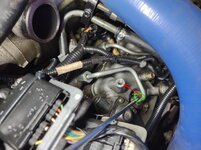
While I had the intercooler to intake boost tube removed and the PCV hose disconnected I had him start the engine. At idle I really couldn't see much but I had him raise the RPM slightly and I immediately saw the issue. If you look at where the screwdriver is pointed (GREEN circle), there was a small crack or fracture in the high pressure line and fuel above idle was spraying out in the direction of the RED arrow. It was hitting the aluminum boss on the rocker cover and dispersing all around in the form of a heavy mist of fuel. This could not be seen without removing the boost to intake ductwork and getting a clear view.
Inkedinj2_LI.jpg

I remembered I had some old high pressure lines back at the shop so my son and I headed back to the shop to grab a good line and a few tools. Here is the replaced high pressure line and after some cleaning with brake cleaner to remove the pooled fuel around the intake and top of engine.
inj3.jpg


I have not seen nor even heard of a failing high pressure line until now. I have heard and seen people have a hard time getting old lines to seat into new injectors but I have not seen an actual high pressure line fail on a Duramax. What really bothers me is that when we replaced his injectors back in April of 2019, we installed all new high pressure lines even though his OEM lines looked good. Now we have a failure in one of those high pressure lines with less than 3 years of age and less than 20k miles.

Upon returning back home and putting tools away, I took the failed line, capped one end and used compressed air to blow in the other to see if I could get air out of the crack, I could not. It was such a small failure point that it could hold approx. 125 PSI of air pressure but when above idle fuel pressures of around 5k PSI and up it would allow fuel to pass through.

That was one for the books but at least it was a relatively easy repair and I had the spare parts at the shop to get him and my DIL back on the road without more inconvenience.
 
OP
Z

zmotorsports

ALLIANCE MEMBER
Joined
Oct 20, 2009
Messages
21,394
Location
Northern Utah
After much deliberation over the past couple of months followed by a lot of soul searching and waffling over the past week or so finally led me to a long and in-depth conversations with the wife over the weekend, I have decided to sell our bike.

If anyone knows of someone who is looking for a meticulously maintained and clean 2010 Harley Davidson Ultra Classic CVO, I know someone who has one for sale.... ;)

CVO3.jpg

bike1.jpg

bike2.jpg


Thanks for looking.
 
To avoid these ads, REGISTER NOW!
Top Bottom