To avoid these ads, REGISTER NOW!

Winchester Tools

Private Lugnutz

Well-known member
Joined
Mar 30, 2012
Messages
30,520
Location
The Authentic Jersey Shore
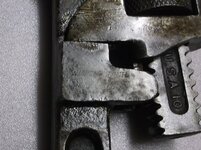
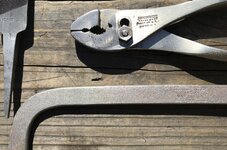
I picked up these slip-joint pliers at the flea this morning. Very similar to the Model 2496-6 pliers that Don found last May. Except these have no model number and are branded "OCTOBER SPECIAL." Which is kind of funny. I guess you can only use them one month out of the year! Or were they on sale? :)
 

Attachments

  • 20220217_124436.jpg
    20220217_124436.jpg
    298.3 KB · Views: 26
  • 20220217_124447.jpg
    20220217_124447.jpg
    303.3 KB · Views: 19
  • 20220217_125048.jpg
    20220217_125048.jpg
    185.8 KB · Views: 21
To avoid these ads, REGISTER NOW!

leg17

Well-known member
Joined
Aug 11, 2011
Messages
1,369
Location
Kentucky
Probably 40 or 50 years ago, I had been told that a guy had made a Winchester stamp and would buy up unmarked wrenches and, presto,.... a collectible. They got premium prices at gun shows. Have shied away from Winchester ever since.
 

four.cycle

Well-known member
Joined
Oct 19, 2015
Messages
28,625
Location
Tacoma, Washington
^ yeah... but.... if you were going to go to the trouble of doing that, wouldn't you think you'd make a better effort to replicate the odd "lightning" type font that Winchester used as Private Lugnutz notes, on every item they were known to have made?
 

Private Lugnutz

Well-known member
Joined
Mar 30, 2012
Messages
30,520
Location
The Authentic Jersey Shore
Agree with 4.c on this one, Leg. I've heard the stories about Winchester repops, too, the subject has come up before on this thread IIRC, and the crux is the branding was very well done. Apparently really hard to distinguish the original.
 

d42jeep

Well-known member
Joined
Oct 22, 2014
Messages
16,518
Location
Northern California
Me too, especially because it's not the trademark. I have never seen a Winchester tool that did not have the 'fancy' (for wont of a better term) font. I wonder what the story is there.
My wife and I did the math, and the absolute minimum amount of time the Winchester marked file was lost in the basement was 50 years. It well could have been quite a bit longer. I’m not sure that the market existed for Winchester tools as collectibles 50 plus years ago.
-Don
 

Private Lugnutz

Well-known member
Joined
Mar 30, 2012
Messages
30,520
Location
The Authentic Jersey Shore
I don't understand your reply, Don. It seems like you're replying to someone who said or implied it was a counterfeit made for a conterfiet market. I did not do that. In fact, in the ensuing discussion, prompted by leg17 and 4.c, I am pretty much saying the opposite. If it's a counterfeit, it's the worse counterfeit I have ever seen, capable of fooling only the most ill-informed or gullible collector, because it looks nothing like the Winchester TM! That is precisely what makes it so baffling, which leads back to my original question. Since it seems so unlikely to be a counterfeit, what is it? Was there another company that branded their files Winchester in the 1950's? Is it an Asian import? Is it indeed an E.C. Simmons 'Winchester' and the files (and perhaps even other tools!) were marked with a version of the name that did not look like the TM?

Don't misread, "I have never seen a Winchester tool that did not have the fancy (for wont of a better term) font" to mean "It's not a Winchester tool." I meant only what I said. I have never seen that mark before. I am far from being a Winchester expert. I have collected some tools - all of which have the very reocgnizable TM, and I have delved into the interesting history. That's it. There could be a very easy explanation that a true Winchester aficionado might know.
 

d42jeep

Well-known member
Joined
Oct 22, 2014
Messages
16,518
Location
Northern California
Your question was “ I wonder what the story was there?” I was just adding some details regarding the timeline that I hadn’t mentioned before. I thought that the marking was rather simple but I suspect that may have been how they marked the tools that long ago. I didn’t mean to imply anything but other members had mentioned forgeries.
-Don
 

Private Lugnutz

Well-known member
Joined
Mar 30, 2012
Messages
30,520
Location
The Authentic Jersey Shore
Thanks. Sorry for misreading you, in that case. I just wanted to make sure you weren't thinking I was making any conclusions about it being a forgery. Maybe it is? I have no idea. Maybe it's exactly what leg17 is suggesting. Maybe someone unscrupulous succeeding in selling them to people despite the fact that it looks nothing like the Winchester TM.
 

RTM

Well-known member
Joined
May 13, 2019
Messages
13,106
Location
SF Bay Area
Just to get back on track, here are my Winchesters. I had no idea if mine had fancy or plain font any more, since I bought them years ago. Need to poke through the file pile, see if I have any Winchesters in there.

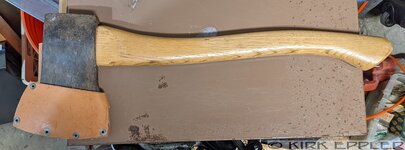
First up is a hatchet as found sometime before 2007 (bottom), and the poor state of the handle at the eye.

DSC08352-X2.jpg


DSC08355-X2.jpg

Here it is now, rehandled and a home made sheath to protect the edge. And a shot of the logo.

PXL_20220219_011121570-XL.jpg
PXL_20220219_011151744-XL.jpg
 
Last edited:

RTM

Well-known member
Joined
May 13, 2019
Messages
13,106
Location
SF Bay Area
Next up a couple of chisels, both fairly recent acquisitions.

The pair, the shiny is a 4981 1/4", the dull one is a 4703 - 1/2"
PXL_20220219_010830933-XL.jpg

The logos are the same, except the number. The dull one was hard to shoot
PXL_20220219_011356927-XL.jpg

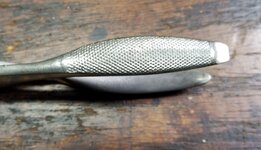
Posted in other threads I have a Winchester screwdriver.

See the screwdriver here lower left

IMG_20200719_174217-X2.jpg

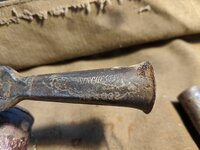
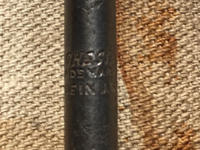
And the Ferrule and logo here.
pxl_20211117_203958274-x2-jpg.1554431
 
Last edited:

piehammer

Well-known member
Joined
Mar 20, 2021
Messages
245
Location
Georgia
Sorry for the poor photos. This was in my Grandfather's tool chest, the one that started me collecting tools. Winchester No. 4032 chisel. No idea if those handles are original to the chisel itself.

IMG_20191209_194044.jpgIMG_20191209_194054.jpg
 

toolmiser

Well-known member
Joined
Sep 1, 2009
Messages
1,656
Location
La Crosse, WI
I think I have a couple of Winchester auger bits for a hand brace. I found them in a bunch of other assorted auger bits, I pulled them out and put them in my safe along with the other namesakes.

I would like to get one of their wood planes some day.
 

RTM

Well-known member
Joined
May 13, 2019
Messages
13,106
Location
SF Bay Area
I think I have a couple of Winchester auger bits for a hand brace. I found them in a bunch of other assorted auger bits, I pulled them out and put them in my safe along with the other namesakes.

I would like to get one of their wood planes some day.
I don’t think leaving those two items alone in a dark place will lead to wood planes. I think that only works with clothes hangers and ugly shirts.
 
To avoid these ads, REGISTER NOW!

LesserSon

Well-known member
Joined
Feb 7, 2016
Messages
5,053
Location
PA USA
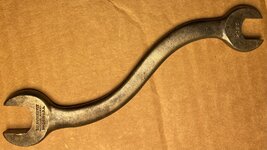
Having a Mandela Effect moment here… E180E816-3FFE-4AD2-BC79-0BEFE42DAA4C.jpegD23D293D-7624-4968-912C-925C04D117EF.jpegI was going to post this S-wrench, but this thread was nowhere on my WATCHED threads list. After I added it, I thought I’d glance at my previous posts…but I don’t have any.
Hmm…I know I’ve posted Champion pattern screwdrivers on the Show Our Wood thread, but I realyy thought I’d posted other W tools, here.
Not finding the posts, I figured, hey, I’ll just make a new family portrait and post that. Now I can’t find the actual tools, either. Maybe in a different timeline? Parallel universe?
Well, someday, when I get my head out of my *** and straighten up my hoard, I may have more to share.
 

Private Lugnutz

Well-known member
Joined
Mar 30, 2012
Messages
30,520
Location
The Authentic Jersey Shore
LS,

I'm trying to figure out what ISN your wrench is. As I remarked in post #34, Winchester's model numbering system appears to be unique. It's not Williams or B&S or anyone else's. My No. 1522 is an ISN 27, for example, but it has "U.S.S." size markings, which helped more easily confirm that. Your No. 1514 size markings are more vague, to say the least, with just the "STD". (Great, but which standard?)

1/4 x 5/16 U.S.S. would be 1/2" x 19/32" AF, and ISN 25
1/4 x 5/16 S.A.E. would be 7/16" x 1/2" AF, and ISN 725
1/4 x 5/16 Am. Std. would be 7/16"x 9/16" AF, and ISN 725A

The 19/32" AF is very close to your measured 5/8". So I'm guessing the "STD" on your is also a reference to "U.S.S." and it's probably an ISN 25.

Would you agree?
 

LesserSon

Well-known member
Joined
Feb 7, 2016
Messages
5,053
Location
PA USA
Apologies for the tape rule; I can’t lay hands on an inside caliper at present.675EFEDE-846C-4E7D-9450-D1A15EBBE841.jpeg1314D9BE-BF7B-40C9-8344-E3D94A677A37.jpeg
It’s just… that it’s not 19/32” across flats - it’s 5/8”, and I don’t see evidence of stretching or additional grinding. Seems it should be ISN 726.
I wonder if the intention was to mark the two end by different standards: the smaller opening “1/4 USS” & the larger opening “7/16 hex head cap screw” or “7/16 SAE standard screw & nut.” Maybe it is just an error?
 

Farmer J.

Well-known member
Joined
Sep 18, 2016
Messages
1,995
Location
UK, Cornwall/Hertfordshire.
Maybe it's this? :

1/4" STANDARD Whitworth is 0.525" across flats (Just over 1/2")
5/16" STANDARD Whitworth is 0.600" across flats (a little under 5/8")

Not 'British Standard Whitworth' or 'British Standard Fine', both of which have different dimensions..

Or, I could be muddled. It's difficult to keep track of the different Whitworths.


LesserSon

Well-known member
Joined
Feb 7, 2016
Messages
5,053
Location
PA USA
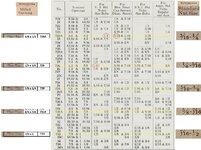
It appears that to Winchester, 1/2” & 5/8” are just the milled openings needed for fitting standard nuts of 1/4” and 5/16” bolts. AF457230-70A2-4F16-934A-122BE2D7465F.jpeg(p32 of the 1923 catalog)
 

Private Lugnutz

Well-known member
Joined
Mar 30, 2012
Messages
30,520
Location
The Authentic Jersey Shore
It appears that to Winchester, 1/2” & 5/8” are just the milled openings needed for fitting standard nuts of 1/4” and 5/16” bolts.
Saying "Milled to fit Standard bolts and nuts" still begs the same question. Which standard?! A wrench with a 5/8" (or 20/32", if they want to be cute) milled opening does not match the across-the-flats diameter of the head of a 5/16" bolt or a nut in U.S.S. (it is 19/32" A.F.), S.A.E. (it is 1/2" A.F.), Am. St. (it is 9/16" A.F.), or Hex Cap (it is 1/2" A.F.).

So what 5/16" nuts and bolts do they think their wrenches are going to standardly fit?

If they mean Whitworth, as Farmer J. suggested, I would suggest they needed to be a lot more explicit than assuming users would consider Whitworth to be one of the primary standards.

I think "STD" does in fact refer to U.S.S. (again, "U.S.S." is how they expressed it on my wrench), and for whatever reason, they believe they need to mill the 19/32" opening that fits a U.S.S. 5/16" nut or bolt with an extra 1/32" slop up to 20/32" or 5/8".

Note they apparently don't believe it's necessary to mill the 1/2" opening (or 16/32", as they expressed it in the catalog) on the other side of the wrench with an extra 1/32" slop, because 1/2" is indeed the correct opening for the A.F. diameter of a 1/4" bolt head or nut in U.S.S.!!

Winchester's folly.jpg
 

LesserSon

Well-known member
Joined
Feb 7, 2016
Messages
5,053
Location
PA USA
The question is not what milled openings fit what nuts, but why did Winchester stamp/advertise this wrench (possibly others) the way it did? There’s no chart for that.
I think this may come down to the semantics of the word fit. Certainly, this opening will fit over a standard 5/16 nut, though not as snug as a 19/32”AF opening. I am reminded of the BHMCo inch/mm DOEs. Or the semantics of standard, as you have already suggested; japanned, plated, or corroded 5/16” nuts would need that extra 1/32”.
Not charts, but actual nuts and actual practices of mechanics a century ago might tell us how satisfactory Winchester’s specs were. Rounded-over 5/16” nuts, or correspondingly splayed openings on 726 wrenches (including other brands) would provide suggestive physical evidence that 5/8” AF openings were used by mechanics on 5/16” nuts.
Beyond that, unless a mass of correspondance from irrate, slop-hating mechanics turns up, what are we left with but a dubious a priori runaround? Would it be any more fruitful than that lavished on that other Winchester mystery, 525 S Winchester Blvd?
Sallie Winchester died earlier this month (September 5) one century ago, not long before the 1923 catalog would have been finalized. Without documentation, we may as well be using a ouija board to seek an authoritative explanation.
 
Last edited:

Private Lugnutz

Well-known member
Joined
Mar 30, 2012
Messages
30,520
Location
The Authentic Jersey Shore
From my perspective, Machinery's Handbook is not filled with semantics, and more importantly, not subject to them, either. Nobody needs to look any further for documentation or find any more authoritative than that. Hardware manufacturing quality was imperfect, but using wrenches that were "not as snug" is precisely what contributed to nuts being rounded off in the first place.

But, that catalog excerpt has more and much bigger problems than the "5/16STD" opening on your wrench being 1/32" larger than the specified 19/32" for U.S.S. that cannot be explained away by the 'practical vs book' argument. It's not just one size that's a little over. Some are way beyond the idea of deliberate overage. But others, inconceivably, and conversely, seem too small! In fact, I have to retract my previous statement. I no longer think the "STD" on your wrench is referring to U.S.S. The problem is that we don't know what it refers to. The figures on the left, under "Standard Nut Size", do not map with any one standard - U.S.S., Hex Cap, S.A.E., or Am. Std., anyway!

We know without any need for any explanation or other documentation (or a ouija board!) that Winchester's milled openings were deliberate. We may not know why, but given the source, I'm not overly interested in that, anyway. Especially because it defies a logical pattern. It's awfully random. As I said, it's a mess.

If we were talking about a legitimate, primary manufacturer here, this would all be more shocking, of course. But you won't find an excerpt like Winchester's - DOE "S" wrenches with these specific milled openings correlated to these specific "Standard Nut Sizes" - in any other 1920's catalogs (i.e., Williams, Bonney, et al) or the Machinery's Handbook.

That it's a legendary arms maker who used their name to try too hard to expand into home goods and other sectors, and failed, producing a bevy of tools with cool Americana logos that collectors love to find, is more than enough explanation for me for why we are seeing such a bizarre correlation of openings and sizes.

But that's also part of why it's so intriguing. Did they consult with their OEM? Did their OEM just shake their heads and take their money? The idea that Winchester had their own dedicated engineering department that designed these peculiar milled openings is highly implausible.

To go back to you scenario, if you really want to go there and look at it from an actual practices of actual mechanics perspective, it's important to recognize that the wrenches do not have the milled openings marked on them. They have nut sizes marked on them with a vague "STD". If we don't know what nuts those openings were meant to fit, neither would the mechanics! If they didn't throw these "STD" Winchester wrenches through a window in total frustration I'd be very surprised.
 

Private Lugnutz

Well-known member
Joined
Mar 30, 2012
Messages
30,520
Location
The Authentic Jersey Shore
Here are some charts to illustrate the problem...

In this one, I am converting the milled opening sizes of Winchester's wrenches expressed in /32nds to more recognizable fractions and correlating those much more common and recognizable combinations to ISN.

Winchester's folly 2.jpg
 

Private Lugnutz

Well-known member
Joined
Mar 30, 2012
Messages
30,520
Location
The Authentic Jersey Shore
In this chart, I am plotting those Winchester wrenches on a standard wrench chart. You can see the problem. It's not the openings. There's nothing wrong with their openings. The confusion would be in their "Standard Nut Sizes" as wrench markings! The first wrench maps to two different standards (not that unusual, but they're usually helpfully marked as U.S.S., Hex Cap, S.A.E., or A.S. on either jaw face), and the second wrench happens to match one standard, but in the rest of the cases the "STD" markings would not match any standards.

Just take their 28/32 x 32/32 (7/8 x 1) wrench for example. Imagine you're a mechanic in 1923 with that wrench in your hand. Remember, it's not marked with the milled openings. According to Winchester's catalog, they think it fits "Standard Nut Size" 7/16 x 1/2, and therefore, it would be marked, like yours, with "7/16STD" and "1/2STD". The mechanic will soon find that it doesn't fit those size nuts IN ANY STANDARD. The end marked "7/16STD" is milled for 7/8", which fits 1/2 U.S.S., 5/8 Hex Cap, and 9/16 Am Std. The end marked "1/2STD" is milled for 1", which fits 3/4 Hex Cap and 5/8 Am Std.

Something is badly amiss.


Winchester folly 3.jpg
 
Last edited:

LesserSon

Well-known member
Joined
Feb 7, 2016
Messages
5,053
Location
PA USA
Theaded fasteners had been in regular use for centuries prior to the first edition of Machinery’s Handbook (1914). You mentioned previously (which I would expand upon) that multiple proposed standards were competing to provide reliable interchangeability of fasteners - a demand created by mass production, and complicated by the differing requirements of unrelated industries. Thus, that struggle had not ended, even by the end of WWII, which from what I know of your collecting preferences, I guess would also guide your selection of MH editions?
Machinery’s Handbook underwent a significant expansion and revision for the 6th edition (1924). Since the Winchester catalog of 1923 predates that revision, I searched, but did not locate a pdf of earlier editions, so instead consulted the 2nd edition (1914) of American Machinists’ Handbook and Dictionary of Shop Terms.
In addition to a table presenting the expected “U.S.Standard“ dimensions B68C7F1E-F6D3-4BD4-96C3-4F536B38E663.jpeg
it includes two tables of “Manufacturers Standard” conforming to the Winchester milled openings.D41F1974-0AA5-48DC-9EEF-236874675E04.jpegEB6EEFC8-D326-4ABC-A710-F0628A16B36E.jpeg
I’d add that wrenches sold for “general purpose” do suggest a standard not associated with the automotive industry, and that by contrast, the “engineers’ wrenches” advertised above them do align with the ALAM SAE USS ISN openings. (At least, to my screen-exhausted eyes, they appear to. Perhaps someone else could fact-check.)
 
Last edited:

Private Lugnutz

Well-known member
Joined
Mar 30, 2012
Messages
30,520
Location
The Authentic Jersey Shore
...which from what I know of your collecting preferences, I guess would also guide your selection of MH editions?
Yes, but full admission, I didn't even look. I was making a generic reference. I DID check early 1920's catalogs (Bonney, Williams, and Walden), though, which don't include anything remotely close to what Winchester is calling a "standard".
Machinery’s Handbook underwent a significant expansion and revision for the 6th edition (1924). Since the Winchester catalog of 1923 predates that revision, I searched, but did not locate a pdf of earlier editions, so instead consulted the 2nd edition (1914) of American Machinists’ Handbook and Dictionary of Shop Terms.
Good idea.
it includes two tables of “Manufacturers Standard” conforming to the Winchester milled openings.
Excellent. Much better than thinking their OEM's let them screw the pooch so badly! Thanks.
 

d42jeep

Well-known member
Joined
Oct 22, 2014
Messages
16,518
Location
Northern California
I added the hacksaw I missed in the above picture. 4B7DD4E0-6213-4D12-9465-61DAA04E8623.jpegEDD57882-B698-4F27-A262-6A229E80ACA5.jpegRight after I took those pictures, I found a Winchester auger bit I had missed.
-Don4FA982E5-5893-4999-9A5B-47F7F0614A74.jpeg0AADF161-6AE6-4B10-92BE-C71548C22099.png
 

park city flyer

Active member
Joined
Jul 26, 2014
Messages
37
Location
southern Indiana, U.S.A.
Hi Tom. Not to cast any aspersions on your father or uncle, but note that Remington Cutlery was established in 1920. Before WWI, two countries dominated the knife market: England (Sheffield) and Germany (Solingen). In WWI, England lost its expertise - quite literally in action, and Germany lost its export customer base to resentment. Remington, fat with WWI cash, cleverly stepped into the abyss with Remington Cutlery. Their investment and truly innovative manufacturing processes allowed them to produce up to 10,000 high quality knives per day throughout the Roaring 20's, a full decade before the Great Depression struck. Perhaps it helped them somewhat with retention, but the economic effects were fairly widespread across products, so it was kind of hard for any company to avoid it in a zero sum game. They sold the division to PAL Cutlery just before WWII, as you mentioned.

Winchester is a much different story. They did not make knives, per se. In 1919, also fat with WWI cash, also well before the Great Depression, they bought out the Eagle Pocket Knife Company, which was also located in New Haven, including the plant, and all the employees. Winchester did not make most of the tools, housewares, and sporting goods that they sold through their mail order catalog and in a few of their retail stores, either. Essentially, Winchester attempted to 'Sears & Roebuck' themselves into a nationwide general store, literally banking on their name ("As Good As The Gun" was the slogan), and failed miserably. They went so far "all in" on this plan that they merged, in 1922, with one of Sears, Roebuck, & Co's competitors, E.C. Simmons. When everything crashed in 1929, they crashed with it. The partnership was dissolved in 1931, Winchester was sold, and the buyers re-concentrated on guns only. The popularity of the tools as collectibles, now in its second, very waning wave, is almost strictly a byproduct of the near-mythic "red-blooded" popularity of the firearms and the name and its legacy.
Hi,Lug.

My uncle worked in Remington's cutlery division from its beginning to to its end. As you say, knives saved some jobs in the thirties.
Olin bought Winchester Repeating Arms in 1931. I started at Olin in New Haven in 1971. I was told that Winchester-labelled hand planes and some other woodworking tools were made by Sargent, also of New Haven. Oldtimers said that some non-gun stuff was made at Winchester in the thirties, but I don't know what.

To my knowledge, the only non-firearm items produced on the Olin New Haven property in the seventies were the Ramset line of construction fasteners and applicator guns.
 
  • Like
Reactions: RTM
To avoid these ads, REGISTER NOW!
Top Bottom