Bob - yes, it's interesting how Europe pretty much shuts down in July and August because everyone is away "on holiday." I have gotten spoiled with the Army - 30 days of paid vacation per year. Of course, I have also spent up to 15 months at a time deployed to a combat zone, working 14 hour days x 7 days a week with periodic rocket and mortar attacks, so it all evens out.
Your mother sounds like she was an amazing and extremely independent woman. Must have been nice to have you living nearby as she got older.
Scott
Scott, Australia has a similar phenomenon. Summer arrives in December along with the Christmas and New Year holidays so the children have a lot of time off from school. Perfect time to take vacation! My drive to work the rest of the year took at least an hour but in January it was under a half hour. When I worked for IBM we got two weeks vacation the first full year, three weeks after five years, four weeks after ten years and five weeks after 20. My final years didn't allow for much time off so they paid me for the fifteen weeks I hadn't taken when I retired. The CEO of IBM had to sign off on my carried vacation because they instituted a 'take it or lose it' policy in those final years.
Military service has its perks but it's sad the best we can do is 'thank you for your service.' No one ever shot at me while I worked for IBM or AOL but I did put in some crazy hours. In my final years at IBM they catered meals so we didn't have to leave the building. For much of that time I lived on four hours sleep a night and the other 20 in the office seven days a week. An alarm clock wouldn't wake me so I drank a quart of water just before going to bed. Four hours later I was guaranteed to be up and awake.
Because she and my father were teachers, they had summers off. The book dad co-authored brought in a decent third income (more than their combined salaries in some years) so they were able to travel, primitively dragging a travel trailer or just a station wagon, across North America. Eventually they explored the world together until my father passed in 1968. They didn't get to Africa, South America or much of the Pacific so mom fulfilled that dream alone (with friends). She did the safari thing and visited China in 1982.
My mother almost lost her life before she was born. My grandfather sailed from England for Canada in March 1912 to get a place to live in Montreal, with my grandmother and year old son to follow soon after. She arranged for passage in April aboard the Titanic. She cancelled the trip when she realized she was pregnant. No way was she spending six days risking seasickness on top of morning sickness, caring for a toddler in a tiny cabin. My mother was born in November 1912 and made the crossing safely in 2013. Grandpa got a job with the Canadian government to teach failed goldminers how to raise and care for livestock in in the Yukon Territory, from his home base in Grande Prairie, Alberta. Those years taught my mother how to live in rough conditions.
Good for you being able to retire so young Bob. My wife and I were on track to retire at 56-58 but then we went and did a stupid thing six years ago and bought our new home. We waffled for quite a bit (like 3 years) before pulling the trigger as we didn't want it to affect our retirement plans but figured it would delay them by about 8 years or so due to having to go back to having a mortgage. Once we made up our minds that being out of our old neighborhood would be a good thing and accepted the fact that we wouldn't be able to retire until around 65 years of age, we rolled up our sleeves and got busy completing our shop and yard and figured we would just enjoy it. However, after getting everything completed, paying extra on the mortgage and now being able to put more into investments, we have been able to push ahead and now it's looking like our retirement was only delayed a couple of years if we can stick to the plan compared to the 8 or so years we initially calculated when we moved. We are currently on track to retire at about 60-62 year old range which is only 6-8 years away and I think it will be here before we know it. Paying for health insurance will be our biggest concern until we are at age to qualify for Medicare but my main goal is to have the mortgage paid off within the next 5-6 years so we enter retirement completely debt free as that is our only debt.
I have been waffling lately on changing jobs as I've been approached a couple of times over the past year but the vacation you spoke of has been the deciding factor. Most companies in my line of work start at either one or two weeks and then after about 5 or 8 years will bump you up to 3 weeks where you max. out. I am currently grandfathered in at my current job and have 6 weeks vacation which is hard to walk away from, even for a bit more money. The wife also has the same amount of vacation and we feel we have a nice balance of work and time to travel which make it easier to work a few more years before retirement.
Many (most) of our RV'ing friends went full-time when they retired and seeing as how my wife and I are the youngest couple in the group we travel with we are unfortunately having to watch many of them hang up the keys to their RV's as age is catching up to them. We have been traveling with this group for nearly 15 years now and although we feel very blessed to be able to do so, it is hard to watch them leave the RV lifestyle and some of them actually passing away. My wife and I have talked at length about what our retirement will look like and as much as I thoroughly love and live to travel in our RV I don't think I could ever go "full-time". I need my stick and brick to come home to and enjoy between RV'ing trips. I can easily see my wife and I take more extended RV trips when we retire but no way could I go full time. I can also see myself spending more time in my shop when we're not traveling and my wife thinks she would like to volunteer at our county library a few days a week.
I enjoy reading and listening to others who are at retirement age to see what they do with their time but I also am a bit frightened as I watched my father go down hill rapidly once he "semi-retired" and had to come to the realization that he couldn't do the things he did when he was younger. All he ever did was work and really had no other interests so when he started selling off pieces of the farm and doing less farming, ie. semi-retire, he really went down hill fast and ended up passing at only 73 years old. I don't want to be that way and want to be around for my wife, son, DIL and eventually grandchildren. More importantly, my wife and I have many dreams that haven't become reality yet so we need as much time between now and through retirement as we can get so we can to fulfill those dreams.
Mike, you are doing all the right things for retirement. We paid off the mortgage when I was in my 40s and never took loans out for cars, boats or other expensive toys. Never carried a credit card balance and lived well below our means (I have no idea who these "Jones's" are).
I was motivated to retire as early as possible because my father died when he was 55, two months after he retired. Nothing I lusted for or 'had to have' was worth missing out on my children and grandchildren (and now great-grandchildren) growing up. You have enough hobbies and interests to fill your hours in retirement so I wouldn't worry about a rapid decline.
I do go against the majority of financial advisors when it comes to Social Security. The conventional wisdom is to wait to collect as long as possible so the check is bigger. I disagree because a check today in the bank is worth more than a check someday in the mail. If you start collecting Social Security when you are 62, that money could fund the outrageous cost of health insurance for the three to five years from age 62 to Medicare. If you live a long time, waiting could pay off but I wasn't willing to gamble living past 80. I suspect, like me, the Social Security check is a bonus but not the ball game. Without using your actual numbers or accounting for cost of living increases, a simple spreadsheet of a 30% reduction for taking early withdrawal ($30,000 full annual benefit taken at 67), shows break-even if you live to 80:
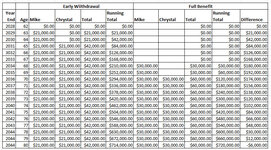
I'm sure I'm missing something so take this as the ramblings of an old man but this falls into the "buying green bananas" realm/
@Squankum, sorry, I was editing with cut and paste and left that dangling. I was making the point that the years between 50 and 59,5 were lean because I couldn't touch the IRA and 401k plans without a 10% penalty. Pretty sure there are ways around it but all it meant for us was living normally, as in below our income. Now the surpluses go to our kids and grandkids.
Did they end the pension plan for people who had been working there for years? Or just new hires?
"Changing career goals of the workforce" meaning "kids today don't expect to stick with an employer for decades, because we sure as hell aren't going to give them the chance"?
After the 1999 announcement triggered a bunch of lawsuits, IBM allowed 65,000 employees who were nearing retirement to choose either the pension plan or a 401k. In 2006 IBM stopped contributing to the pension fund. A complication of defined benefit plans is the required payments to the
Pension Benefit Guarantee Corp., a federal entity established to protect pensions. IBM expected to pay $500 million to the PBGC in 2005, but because of low short-term interest rates, the company had to pay $1.2 billion for the year, the company said. When IBM turned the pension plan over to Prudential, effective January 2023, it became an annuity plan and is no longer protected by the PBGC. Another "We upped our income, now up yours!"
Back in the 1980s, IBM noticed Microsoft and all the other Silicon Valley tech companies had no retirement plans. Most of those companies gave employees stock options, which made them rich so no one cared. IBM tried the same thing in the mid-1990s, giving employees stock options if they met their goals.