

You are using an out of date browser. It may not display this or other websites correctly.
You should upgrade or use an alternative browser.
You should upgrade or use an alternative browser.
Alternate uses for a rotary hammer drill?
- Thread starter autobon7
- Start date
acer66
Well-known member
I have one in a jig attached so it hits my metal bed frame for a cheap vibrating bed and the noise is an added bonus acting as white noise for a good night sleep.Just curious what other uses you all have found for a rotary hammer drill besides the obvious. Have seen them used to dig through clay with a spade bit, drive a ground rod. Any other uses?
nadogail
Well-known member
I have seen a large drill used to crank open and closed a Roll Up door. They used the drill to replace the manually operated chain.
Like an SDS based one? I use mine mostly for drilling holes, though have once used it as a chipping hammer for going through some brick, it worked ok. I have one of those TR Industrial jack hammers, so for clay and ground rod driving and such I use that.
bcradio
Well-known member
A rotary hammer drill is a versatile power tool commonly used in construction, woodworking, and DIY projects. It is designed to drill through hard materials such as concrete, brick, stone, and metal. Here is a list of common uses for a rotary hammer drill:
- Drilling in concrete: Rotary hammer drills excel at drilling holes in concrete, whether it's for anchor bolts, electrical conduit, or plumbing.
- Masonry work: You can use a rotary hammer drill for various masonry applications, such as drilling holes in brick, block, or stone for mounting fixtures, creating openings, or installing pipes.
- Chiseling and demolition: Many rotary hammer drills have a chiseling function that allows you to chip away at concrete, remove old tiles, or break up small areas of masonry.
- Installing fasteners: Rotary hammer drills are ideal for drilling holes and installing fasteners like screws or anchors in tough materials like concrete or stone.
- Woodworking: While primarily designed for masonry work, some rotary hammer drills have a switch that enables them to function as regular drills. This versatility allows for drilling holes in wood, plastic, or metal.
- Creating channels and grooves: With appropriate drill bits or chisels, you can use a rotary hammer drill to create channels or grooves in concrete or masonry for running cables or pipes.
- Tile removal: The chiseling function of a rotary hammer drill makes it useful for removing old tiles or breaking through tile mortar.
- Core drilling: Some rotary hammer drills can be used with core drill bits to create large diameter holes for plumbing, electrical, or HVAC installations.
- Concrete surface preparation: Rotary hammer drills with specialized attachments can be used for light concrete surface preparation, such as removing paint, rust, or coatings.
- General construction: Rotary hammer drills are valuable tools for construction professionals, as they can tackle a wide range of tasks, including drilling, chiseling, and demolition work.
Way off the mark for what it's supposed to be used for, but I used a cordless Milwaukee hammer drill to create texture on copper.
Mrs. Imagineer asked me to make a small concrete plant box*, and if possible, add a metal (copper) accent band. The 040" thick copper band looked too plain, so the Mrs. asked if I could create some texture on it. Using an air hammer caused too much of a dent, so I added texture to it using the hammer drill. I cut the head off a 1/4" bolt, then using a belt sander, rounded over the threaded end. With the shank of the bolt chucked in the drill, and with a smearing of grease on the copper, I used the hammer drill to make small dimples on the copper.
It took a while to complete, and having to lean into it for the effect, I would not recommend it.
* I used 1/2 gallon paper milk cartons, cut to about 6" tall, for the forms and created the inner part with a piece of wood. I pushed a nail through the bottom of the milk carton to stand the wood off the bottom and also create a small drain hole. For the concrete I used countertop mix (https://www.menards.com/main/buildi...-9fe7-4fe5-823e-31edd1757fa1&ipos=1&exp=false).
Mrs. Imagineer asked me to make a small concrete plant box*, and if possible, add a metal (copper) accent band. The 040" thick copper band looked too plain, so the Mrs. asked if I could create some texture on it. Using an air hammer caused too much of a dent, so I added texture to it using the hammer drill. I cut the head off a 1/4" bolt, then using a belt sander, rounded over the threaded end. With the shank of the bolt chucked in the drill, and with a smearing of grease on the copper, I used the hammer drill to make small dimples on the copper.
It took a while to complete, and having to lean into it for the effect, I would not recommend it.
* I used 1/2 gallon paper milk cartons, cut to about 6" tall, for the forms and created the inner part with a piece of wood. I pushed a nail through the bottom of the milk carton to stand the wood off the bottom and also create a small drain hole. For the concrete I used countertop mix (https://www.menards.com/main/buildi...-9fe7-4fe5-823e-31edd1757fa1&ipos=1&exp=false).
RTM
Well-known member
I have the clay spade, a bull point, a cold chisel, and a 3" sharper chisel for vinyl tile peeling, and the ground rod driver, which was used most recently, as well as some 3/4" drill bits. Original purchase was to use as a shovel under the house so I wanted the low profile of the roto hammer.
Nothing more exotic so far.
Edit, mine is a Bosch 11202, a straight spline drive roto hammer.
Nothing more exotic so far.
Edit, mine is a Bosch 11202, a straight spline drive roto hammer.
Last edited:
I have two (aside from cordless impact drivers/drills) a smaller Hilti and larger Bosch. I believe the Hilti is SDS Plus and Bosch is SDS Max. I use the Hilti most often and mostly for setting metal connectors in concrete pads and footings for decks, etc. I've also used it to attach conduit and electrical boxes to cinderblock and run CAT cables through concrete foundations. The Bosch is a much heavier unit. I've used it from everything such as demo ceramic tiles, curbs, walls, sidewalk/walkways to scraping vinyl tiles off concrete floors. I've also used it to drive ground rods and loosen up soil/remove rocks while digging deck footings or mailboxes, etc. I have a full set of long concrete bits for it that I don't think I ever used lol.
dnschmidt
Well-known member
What are you calling a rotary hammer drill? Is this a run of the mill hammer drill or an SDS rotary hammer, which is a different category of tool. A rotary hammer can be set to hammer, hammer with rotation or set to straight rotation like a normal drill.
Walkers
Well-known member
Remember to always follow the manufacturer's instructions...
Yeah, thats not happening! I took apart my older Hilti TE 14 and removed an idler gear so that it would hammer only so I could use it for tile removal. I dont think that was in the manual
428PI
Well-known member
I've used my Bauer max sds for busting up concrete around a fence pole and as an impact hammer trying to get wheels off of my rotor tiller as well as drilling holes in concrete.
tyyost
Well-known member
I’ve done the typical and also used the ground rod driver attachment to drive in hammer set (readhead) type anchors after drilling the holes with the drill to set up pallet racks in a warehouse project at work. The anchors were in tough to reach locations and the ground rod driver worked perfectly in-situ.
isb cornbinder
Well-known member
We used to use one of our rotary hammers to drive "C" cleats onto connecting duct-work flanges.
There used to be a neighborhoods cat hanging around. When the cat thought it was not being watched, the cat would poop on our patio table. I rigged the hammer drill up against the underside of the metal table. The last time the cat looked like it was about to do something, I plugged the tool in from inside the house. There was an instant hammering on the table top and it sounded like summer thunder. The cat went straight up and came down under full power. When traction was regained the cat accelerated like John Force.
There used to be a neighborhoods cat hanging around. When the cat thought it was not being watched, the cat would poop on our patio table. I rigged the hammer drill up against the underside of the metal table. The last time the cat looked like it was about to do something, I plugged the tool in from inside the house. There was an instant hammering on the table top and it sounded like summer thunder. The cat went straight up and came down under full power. When traction was regained the cat accelerated like John Force.
Al Borland
Well-known member
- Joined
- Jan 20, 2016
- Messages
- 1,602
Put a Bullpoint in it and run joints for repointing, offset chisel for popping ceramic tiles, bushing tool bit for levelling lumps in concrete or making recesses. Not sure what the right name is, but there's a blade holder that takes what appears to be a block-plane blade for scraping or pulling up carpet or linoleum.
signcrafter
Well-known member
- Joined
- May 9, 2012
- Messages
- 12,632
I have a couple of the 6" scraper blades I use for removing thinset and other duties. In the winter I use these blades as ice chopper when the snow starts to melt during the day and freezes on the driveway at night. Works great in a big cordless sds.
KnurledNut
Well-known member
I have a hammer face bit similar to those used on air hammers.
I have a large Bosch that I used to break out some bedrock in my driveway. Local guys wanted a big bucks to take out a 4' by 10' area. Plus, as is common these days, it seems, no solid prediction when they could get to it, etc.
I spent three or four hundred bucks on the drill, don't remember, and it took me two days, but I got it done and now I have the tool. By the way, I went to Home Depot to rent one, and they wanted almost a hundred bucks for a chisel bit and I decided to just give up and buy one myself.
I spent three or four hundred bucks on the drill, don't remember, and it took me two days, but I got it done and now I have the tool. By the way, I went to Home Depot to rent one, and they wanted almost a hundred bucks for a chisel bit and I decided to just give up and buy one myself.
Have both SDS plus and max.What are you calling a rotary hammer drill? Is this a run of the mill hammer drill or an SDS rotary hammer, which is a different category of tool. A rotary hammer can be set to hammer, hammer with rotation or set to straight rotation like a normal drill.
driftpin
Well-known member
Not an uncommon use, just a thoroughly satisfying use: getting rid of a sub-contractor hired to do a job, who didn't have the tools necessary to do it properly.
I had a 10' X 20' steel-framed, 3/4" plywood/Tyvek/Hardi-Board/standing seam metal roof premanufactured building set onto a slab poured for it. I hired the itinerant who was recommended by the building sales people to anchor the PT 2" X 8" floor plate to the slab. He showed up with a ragged-*** Dewalt hammer drill which quickly ran-through every, like him, lame-*** battery he had, w/o drilling a single hole to depth. I was using 1/2 or 5/8' hilti threaded concrete anchors for the job (can't recall which).
When he started trying to set the $$ hilti pins, and wasn't even setting them to a depth in the half-drilled holes, where they would 1] be of sufficient set-depth to allow the threads to put the flat washers/nuts into contact with the PT floor plate when tightened, and 2] then left that one sticking-out, as-if it was 'good-enough(!), and he grabbed another and began to attempt to set a second hilti pin in the same way, I told him to pick-up his tools, and to not come-back.
My HFT Chicago Electric SDS-MAX demo impact hammer drill made every one of the roughly two dozen concrete holes I needed, using the HFT carbide drill bit set I bought w/the tool, awhile before.
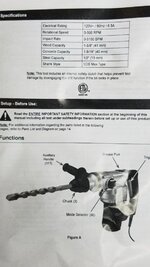
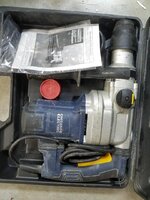
I was able to remove one of the two poorly half-set holes not deep-enough hilti fasteners the sub-contractor made, the other wasn't coming out. I A.I.P.'ed (abandoned in place) it, and quickly drilled another concrete hole near if, full-depth, and all the others.
Seeing the look on that half-assed sub-contractor's face when I told him to clear-out was a source of satisfaction, bigly.
I had a 10' X 20' steel-framed, 3/4" plywood/Tyvek/Hardi-Board/standing seam metal roof premanufactured building set onto a slab poured for it. I hired the itinerant who was recommended by the building sales people to anchor the PT 2" X 8" floor plate to the slab. He showed up with a ragged-*** Dewalt hammer drill which quickly ran-through every, like him, lame-*** battery he had, w/o drilling a single hole to depth. I was using 1/2 or 5/8' hilti threaded concrete anchors for the job (can't recall which).
When he started trying to set the $$ hilti pins, and wasn't even setting them to a depth in the half-drilled holes, where they would 1] be of sufficient set-depth to allow the threads to put the flat washers/nuts into contact with the PT floor plate when tightened, and 2] then left that one sticking-out, as-if it was 'good-enough(!), and he grabbed another and began to attempt to set a second hilti pin in the same way, I told him to pick-up his tools, and to not come-back.
My HFT Chicago Electric SDS-MAX demo impact hammer drill made every one of the roughly two dozen concrete holes I needed, using the HFT carbide drill bit set I bought w/the tool, awhile before.
I was able to remove one of the two poorly half-set holes not deep-enough hilti fasteners the sub-contractor made, the other wasn't coming out. I A.I.P.'ed (abandoned in place) it, and quickly drilled another concrete hole near if, full-depth, and all the others.
Seeing the look on that half-assed sub-contractor's face when I told him to clear-out was a source of satisfaction, bigly.
mike93lx
ALLIANCE MEMBER
If you ever have a project like that again, I'd highly recommend renting a real jackhammer. It will go a lot faster and you stand while running it instead of crawling aroundI have a large Bosch that I used to break out some bedrock in my driveway. Local guys wanted a big bucks to take out a 4' by 10' area. Plus, as is common these days, it seems, no solid prediction when they could get to it, etc.
I spent three or four hundred bucks on the drill, don't remember, and it took me two days, but I got it done and now I have the tool. By the way, I went to Home Depot to rent one, and they wanted almost a hundred bucks for a chisel bit and I decided to just give up and buy one myself.
oldschoolcraft
Well-known member
I bet you’re the kind of guy who leaves his car running when pumping gas.Yeah, thats not happening! I took apart my older Hilti TE 14 and removed an idler gear so that it would hammer only so I could use it for tile removal. I dont think that was in the manual

oldschoolcraft
Well-known member
I need this in my life! Is it SDS or SDS max? Can you please share a link or at least the brand who makes it?I have a hammer face bit similar to those used on air hammers.
KnurledNut
Well-known member
SDS+.I need this in my life! Is it SDS or SDS max? Can you please share a link or at least the brand who makes it?
Like so much of my junk, made it myself. I cut the drill portion off of a stop bit.
Also made my own 1/2 drill chuck adaptor and rod/stake driver.
Last edited:
Thats awesomeSDS+.
Like so much of my junk, made it myself. I cut the drill portion off of a stop bit.
Also made my own 1/2 drill chuck adaptor and rod/stake driver.
View attachment 1908448
Milton Shaw
Well-known member
- Joined
- Feb 11, 2011
- Messages
- 4,868
Nobody else has mentioned the tamper head, but it is handy also. I have the Dewalt that takes the 3/4" hex shaft. I also have the SDS Pluss that I use for a lot of smaller stuff, concrete drilling etc.
CoronadoBruin
Well-known member
Longtime lurker, first-time poster as this is a subject I have a leg up on you indoor guys: I have nothing but Hilti, and will buy nothing but Hilti in this tool class. I've used Bosch and they make fine tools but nothing comes close to Hilti, and every thing else other than Bosch I've tried is **** (old Milwaukees had some moments). I've drilled tens of thousands of holes from 3/8" to 6" core, busted and chipped untold yards of concrete, and my Hiltis go through the concrete (with many USA bits) like the proverbial sh!t through a Christmas goose. I still have my first Hilti, a TE52 SDS max (the Hilti guys no longer get their ******* in a bunch when you use the SDS max or plus designation) that must be around 35 years old, or even older, and starting to show it, but is still a great concrete driller (it's lost a lot of its straight hammering ability).
I've used the rotary hammers for much of what others have already mentioned, but also in gardening: Digging holes in compacted or rocky soil for tree planting, used to drill bulb holes in the same tough soil, and to sink underground drip-watering sleeves for both existing trees (pines and oaks) and newly-planted ones. I bought some drill extensions just for gardening. Yeah, you go from 45 years of construction to gardening pretty quickly when you retire; it's nice.
Next project with one of the Hiltis is breaking the asphalt driveway at the mountain house in order to pour a concrete drive.
Even though I'm recently retired, I'm going to buy one last (expensive) Hilti. Yes, I belong here....
One last note: There are rotary hammers and there are hammer drills, but no rotary hammer drills, unless there has been a new tool invention recently of which I'm not aware.
I've used the rotary hammers for much of what others have already mentioned, but also in gardening: Digging holes in compacted or rocky soil for tree planting, used to drill bulb holes in the same tough soil, and to sink underground drip-watering sleeves for both existing trees (pines and oaks) and newly-planted ones. I bought some drill extensions just for gardening. Yeah, you go from 45 years of construction to gardening pretty quickly when you retire; it's nice.
Next project with one of the Hiltis is breaking the asphalt driveway at the mountain house in order to pour a concrete drive.
Even though I'm recently retired, I'm going to buy one last (expensive) Hilti. Yes, I belong here....
One last note: There are rotary hammers and there are hammer drills, but no rotary hammer drills, unless there has been a new tool invention recently of which I'm not aware.
jonesg
Well-known member
hilti is overkill for home users like me.
I just bought an $85 rotary from amazon, with a decent bit its going through concrete very quickly.
I broke up and removed my garage floor with a $185 elec jackhammer.
Hilti is made for all day long all week long heavy use, great for trademen, not so bright for me to spend my money there.
I just bought an $85 rotary from amazon, with a decent bit its going through concrete very quickly.
I broke up and removed my garage floor with a $185 elec jackhammer.
Hilti is made for all day long all week long heavy use, great for trademen, not so bright for me to spend my money there.
jonesg
Well-known member
When I'm finished drilling concrete with mine I plan to just sell it on craigslist, I have no use for a drill this heavy.
It has the power of a great drill but the weight penalty is too much, I prefer my milwaukee M18 any day.
It has the power of a great drill but the weight penalty is too much, I prefer my milwaukee M18 any day.
bcradio
Well-known member
welcome to the forum!Longtime lurker, first-time poster as this is a subject I have a leg up on you indoor guys: I have nothing but Hilti, and will buy nothing but Hilti in this tool class. I've used Bosch and they make fine tools but nothing comes close to Hilti, and every thing else other than Bosch I've tried is **** (old Milwaukees had some moments). I've drilled tens of thousands of holes from 3/8" to 6" core, busted and chipped untold yards of concrete, and my Hiltis go through the concrete (with many USA bits) like the proverbial sh!t through a Christmas goose. I still have my first Hilti, a TE52 SDS max (the Hilti guys no longer get their ******* in a bunch when you use the SDS max or plus designation) that must be around 35 years old, or even older, and starting to show it, but is still a great concrete driller (it's lost a lot of its straight hammering ability).
I've used the rotary hammers for much of what others have already mentioned, but also in gardening: Digging holes in compacted or rocky soil for tree planting, used to drill bulb holes in the same tough soil, and to sink underground drip-watering sleeves for both existing trees (pines and oaks) and newly-planted ones. I bought some drill extensions just for gardening. Yeah, you go from 45 years of construction to gardening pretty quickly when you retire; it's nice.
Next project with one of the Hiltis is breaking the asphalt driveway at the mountain house in order to pour a concrete drive.
Even though I'm recently retired, I'm going to buy one last (expensive) Hilti. Yes, I belong here....
One last note: There are rotary hammers and there are hammer drills, but no rotary hammer drills, unless there has been a new tool invention recently of which I'm not aware.
twagler
Well-known member
I've used my ancient Black & Decker (back when B&D meant American-made and industrial quality) rotary hammer in its non-rotary, hammer only mode to: (a) remove rusted in place trailer hitches from the receiver tube, by knocking it from the backside, and (b) remove rusted in place brake rotors from my car. It's amazing how a powerful electric hammer can persuade things to move when a sledge hammer and tons of force from a hydraulic cylinder applied to my trailer hitch and jack bolt applied to my brake rotor failed to do the job.
californiamilleghia
Well-known member
Anyone use a Rotary hammer in hammer only mode to make a planishing hammer for sheet metal ?
Normally people use an air chisel but I do not want to have a compressor ,
something like this but with a new rotary hammer , and probably a steel frame
Normally people use an air chisel but I do not want to have a compressor ,
something like this but with a new rotary hammer , and probably a steel frame
jonesg
Well-known member
shock is better than force, heat is even better.!I've used my ancient Black & Decker (back when B&D meant American-made and industrial quality) rotary hammer in its non-rotary, hammer only mode to: (a) remove rusted in place trailer hitches from the receiver tube, by knocking it from the backside, and (b) remove rusted in place brake rotors from my car. It's amazing how a powerful electric hammer can persuade things to move when a sledge hammer and tons of force from a hydraulic cylinder applied to my trailer hitch and jack bolt applied to my brake rotor failed to do the job.
CoronadoBruin
Well-known member
Yeah, it's a tool that doesn't get much use by the average homeowner. I've known guys who didn't want to spend the cash on a Hilti or similar so they bought an unknown Chinese drill, thinking if it makes it through one or two jobs then it's paid for itself. Surprisingly, it would sometimes make it to 6, 7, or 8 jobs, but I've known other guys who literally got 5 minutes out of the tool. Happy it worked out for you.When I'm finished drilling concrete with mine I plan to just sell it on craigslist, I have no use for a drill this heavy.
It has the power of a great drill but the weight penalty is too much, I prefer my milwaukee M18 any day.