To avoid these ads, REGISTER NOW!

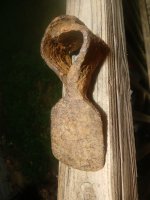
Odd hoe/adze thing: Anybody have any guesses what it is?

Jacobs976

Well-known member
Joined
Sep 11, 2020
Messages
830
Location
Indiana
PXL_20240221_005924494.jpg
PXL_20240221_005939541.jpg
PXL_20240221_005950175.jpg
Got this at an estate sale along with some blacksmithing and woodworking tools. It was on a 24 inch tree branch handle that had seen better days and a few generations of termites but the socket looks similar to a small viking pattern hatchet in size and shape.

It's forged, a bit roughly, like a hatchet as well but the blade(obviously in the opposite orientation to a hatchet) doesn't appear to have been sharpened but does show signs of wear(mushrooming) expected with hammering motion.

Thought it might've been for breaking up carbon in something like a burnt log canoe since it looks kinda like a spoon and the shape would make some sense in that situation but that's just speculation.

The hoe idea was from its shape and it being dull as well but it looks too small for a hoe.

Anybody know what it might've actually been for?
 
To avoid these ads, REGISTER NOW!
OP
J

Jacobs976

Well-known member
Joined
Sep 11, 2020
Messages
830
Location
Indiana
I bet it is a tree hoe for chopping roots.
It's not sharp at all so I don't think it'd do much for roots but I am leaning more towards a hoe.

Maybe for foraging given it's size. It wouldn't do much overall but it's small enough it'd work pretty well for exposing the base of mushrooms or plant roots.

It was in the workshop which was just woodworking and blacksmithing stuff but it was sitting with a bunch of wood block planes and some odds and ends that were all probably late 1800s in a display so it could've just been put in the shop because of it's age.
 

RTM

Well-known member
Joined
May 13, 2019
Messages
13,114
Location
SF Bay Area
Almost certain not an adze. 99% I’ve seen have square eyes. Some home made ones might, which that might be, the blacksmith may have forged it for himself.
 
OP
J

Jacobs976

Well-known member
Joined
Sep 11, 2020
Messages
830
Location
Indiana
Almost certain not an adze. 99% I’ve seen have square eyes. Some home made ones might, which that might be, the blacksmith may have forged it for himself.
I was originally thinking of a spoon for carving out the carbon left over after burning for canoes when I was stuck on it being a woodworking tool. Not quite a traditional adze but not exactly not an adze either.

Couldn't find any actual tool like it though regardless of prompt(socket doesn't line up with any adze, size doesn't line up with any hoe since it's built more like a mattock style hoe than the ones that would be in the same weight class which have longer blades for reach, neither category had the blade shape either) but I do know there's adzes the same size and they're all traditional square sockets so if it was forged by the family that had it(multi generational woodworkers and blacksmiths with all the equipment and facilities for both trades) then it'd have the traditional square socket.


Short of it, adze was unlikely from the start but it didn't look particularly like a hoe either since it's small enough to sit in your hand. Initial thought was just based on it's location and it reminding me of a hatchet I have that has the same forging method.
 

AreBeeBee

Well-known member
Joined
Sep 17, 2020
Messages
415
Location
Wisconsin
Could be a grub hoe although they usually have straight-across blade edges, at least when new. To me the curvature of the blade edge suggests that it's a gutter adze. These were used to chop out a round-bottom channel in a small log for use as a gutter on a house, or any other channel for water. (But clearly if you're faced with digging up a garden, this'll get the job done!)

Check out Eric Sloane's Museum of Early American Tools (a great book for any tool fan) or some of Mike "Windsor chair" Dunbar's books. There are many old tools that were carefully designed for specific jobs that have vanished (or nearly so) from use today. Sloane's books in particular will amaze and probably delight you.
 
Last edited:

Farmer J.

Well-known member
Joined
Sep 18, 2016
Messages
1,995
Location
UK, Cornwall/Hertfordshire.
Could be a grub hoe although they usually have straight blade edges. The curvature suggests to me that it's a gutter adze, used to chop out a round-bottom channel through a small log that can used as a gutter on a house or any other channel for water.

Check out Eric Sloane's Museum of Early American Tools (a great book on old tools) or some of Mike "Windsor chair" Dunbar's books.
That's interesting, it could be. I have only seen wooden gutters made from planks fastened together to make the trough. Old gutters tend to rot so don't last long, and period designs are difficult to research.
 

AreBeeBee

Well-known member
Joined
Sep 17, 2020
Messages
415
Location
Wisconsin
The fact that it was found with a 24-inch handle points to it being used close up on the work piece — not a length that would be convenient for digging up roots and breaking up soil. I agree that the eye looks hand-forged.

My understanding is that the preferred wood for gutters was elm, being relatively rot-resistent. Cedar, too, perhaps. But hunting examples that have survived over timescales of decades or a century is asking a lot!
 

RTM

Well-known member
Joined
May 13, 2019
Messages
13,114
Location
SF Bay Area
That's interesting, it could be. I have only seen wooden gutters made from planks fastened together to make the trough. Old gutters tend to rot so don't last long, and period designs are difficult to research.
There were gutter planes made, for making wooden gutters, typically redwood around here.


I was in a lumber yard (Empire, Belmont, CA, RIP) about 22 years ago, and they had an odd shape up high. Looked like about 4x4, but with a groove in it, and curved edges. Redwood Gutters for the many vintage house people are always trying to bring back. Machine made, for certain.
 
Last edited:

AreBeeBee

Well-known member
Joined
Sep 17, 2020
Messages
415
Location
Wisconsin
I was in a lumber yard (Empire, Belmont, CA, RIP) about 22 years ago, and they had an odd shape up high. Looked like about 4x4, but with a groove in it, and curved edges. Redwood Gutters for the many vintage house people are always trying to bring back. Machine made, for certain.
Growing up in the Boston area in the 1950s, we had a 1920s house with a slate roof and wood gutters. I recall seeing a foot-long piece of wooden gutter in the basement cubby of leftover construction lumber.

Given the era when the house was built, its wood gutters were surely machine made as you note. Don't know what the wood was, but it did have a reddish color if I'm remembering correctly, suggesting cedar or maybe even redwood.
 

Cleave

Well-known member
Joined
Jul 11, 2018
Messages
353
Location
Back Porch
Grub hoe. Looks hand forged.
Nowadays they generally come with a pick on the other side, a very important tool for dirt work and gardening.
 
To avoid these ads, REGISTER NOW!

AreBeeBee

Well-known member
Joined
Sep 17, 2020
Messages
415
Location
Wisconsin
Yeah, that size of head, plus the shortish handle, suggests gutter adze to me — but happy to be corrected.
 
OP
J

Jacobs976

Well-known member
Joined
Sep 11, 2020
Messages
830
Location
Indiana
Gutter adze seems like a good candidate but the examples I could find were more curved like a kitchen spoon. That said they were all modern examples so they're not good examples of a tool that most likely is from the early 1900s.

I'll do a carbon test and check for wear/abrasion to see if it has just seen excessive wear or if it's close to original design since I'll have to do it anyways to get it cleaned up.
 

Wolley

Well-known member
Joined
Jun 24, 2022
Messages
420
Location
Maine
Doesn't look like it was ever sharpened enough to be effective in wood. I'd say somebody's great granny weeding tool.
 

Mintgrun

Well-known member
Joined
Oct 7, 2015
Messages
2,112
Location
Kingston, Wa.
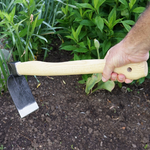
They call this one a short handled half hoe.
1708824620052.png

I have similar sized hoes with a fork on the back end. The little ones are handy.
 
OP
J

Jacobs976

Well-known member
Joined
Sep 11, 2020
Messages
830
Location
Indiana
They call this one a short handled half hoe.
1708824620052.png

I have similar sized hoes with a fork on the back end. The little ones are handy.
I figured it might be something similar. Blade is shorter though which made me think foraging where you might need to be more precise to avoid roots and wouldn't need to dig too deep.
 
OP
J

Jacobs976

Well-known member
Joined
Sep 11, 2020
Messages
830
Location
Indiana
Did a carbon test and the piece is pure low carbon steel. In other words it wasn't meant to strike anything harder than dirt.

The blade appears to be original condition minus a few bites and mushrooming, most likely from rocks. No true edge but the blade is rounded over.

Basically with the current info the piece is a hoe. Not a particularly good one since a piece of gravel would destroy the blade but still a hoe.
 

Gmonkee

Well-known member
Joined
May 9, 2010
Messages
2,759
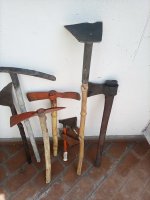
These are mine, they still hand forge truck springs into agricultural tools in Mexico.

I bought the Pulaski new 20 years ago. The pick hoe is probably older.
We use these around here for whatever digging that has to be done.
IMG_20260614_145742.jpg
 
Last edited:

Gmonkee

Well-known member
Joined
May 9, 2010
Messages
2,759
I think they chose the round eye on primitive tools as it's a form found easily in nature. I use bamboo and branches from trees on mine. I may get 5 years on hardwood or three on bamboo.
But it's right here around me just growing on trees if it fails on a job. As it was a century ago to grandma out on the homestead.


Sure, the kiln dried hardwoods at Ace Hardware last much longer. But these were not made to fit a standard tool handle.

A commercial garden hoe might be 10 or 20 dollars in a store. I made six like the one in the picture from scraps on the shop floor for a few welding rods. All are different, all are solid and kinda ugly.
Everyone in my family now has one to lose in the tall grass for months on end.

An enterprising felĺow here makes garden rakes of angle iron and bits of rebar too. Just a retiree making a living on his own schedule.

That trailer spring pick I found at a resale shop, cheap. I had to try it. It works well strangely.
Don't know who made it but kudos for trying. That should take three generations to wear out.
 
Last edited:

Bobthewrench

Well-known member
Joined
May 30, 2026
Messages
63
I vote small worn grub hoe. A lot of common tools were made in smaller sizes for lighter duty, such as the boy's or "house" axe for use next to a wood stove, smaller mattocks etc. for flower gardening by women etc. that were easier to handle for small jobs. Right now in a flower bed on front of my house I have an invasive species spreading that spreads underground and pops up, and I am going to get an old but small-size mattock-like tool out of the garage and go to town on it.
 
To avoid these ads, REGISTER NOW!
Top Bottom