To avoid these ads, REGISTER NOW!

Thinking of buying a Powerprobe

tak1313

Well-known member
Joined
Feb 4, 2018
Messages
651
I just re-watched his video. he didn't say it didn't do what it was supposed to do. What it boiled down to is that it didn't fit into his process. There are multiple ways to arrive at an answer. What's important is to find a tool that aligns with your preference and level of diagnostic knowledge. If you aren't comfortable with ohms law or Kirchhoff's laws you need something that aligns with your knowledge to use, but there's super super smart guys that just use test lights most of the time, but they know how to apply it properly and what they are telling them.

What I appreciated about PHAD's approach is that he articulated the electrical theory and was smart and learned enough to understand the limitations of the loadpro. things like intermittent fault requiring more amperage to reproduce, like a relay that fails when heat-soaked or duty cycle controlled circuits may require a different approach. His other concern was the size, but if you aren't getting a loadpro in you aren't getting a power probe in either.

At the end of the day each issue requires a choice of what tool to use, and you may not use the same one each time. LoadPro and Power Probe don't do the same things. They are different tools and require different methodologies to use. If your thought process makes more sense to use one or the other, more power to you. I advocate knowing why you are choosing what you are chosing. It can be really easy to mess things up with a power probe. LoadPro not so much. I find a lot of people don't know how to properly use a power probe, but also don't understand what a loadpro is telling them. Whatever you use, take some time to understand why things are doing what they are doing and some basic theory behind it.

I was going to **** it up and watch both vids (each about 50 minutes long), but found that part 2 is gone. Even searched his video stash, and no Part 2 that I could find.

IIRC part 2 was about how the inventor responded with bashing his video and how wrong he was in his part 1, and going about showing how/why his review was right.
 
To avoid these ads, REGISTER NOW!

signcrafter

Well-known member
Joined
May 9, 2012
Messages
12,359
I was going to **** it up and watch both vids (each about 50 minutes long), but found that part 2 is gone. Even searched his video stash, and no Part 2 that I could find.

IIRC part 2 was about how the inventor responded with bashing his video and how wrong he was in his part 1, and going about showing how/why his review was right.
I think I remember watching that video now that you say that. I liked Dan and his approach to testing circuits but then snap on came out with their own tester that had a loading feature built in to the tool. Think PP did also with the hook or PP4 around the same time if I remember right. Dan had a patent on his loadpro and he got pissed at these companies and sued them I believe, it's been a while. He kind of went of the rails at that point releasing a few videos of him ranting. Kind of stopped following Dan at that point. He used to post a lot of videos on youtube and I always watched them. I get him being upset but the way he aired it publicly and how he stopped posting educational videos and just rant videos I kind of wrote him off. He would argue with anyone who didn't agree his way was the best and there was no other way.
 
OP
H

Hakeem

Well-known member
Joined
Jan 22, 2024
Messages
1,253
Location
Chicago
Ok after reading your feedback here and doing some more research on YouTube, it seems like a “nice to have” not “need to have”. I often have to work out in the yard, so having a tool that combines flashlight+voltmeter+no-load test light+power/ground source, all with a very long cable, is appealing. It would be much less valuable if I was strictly working in the shop

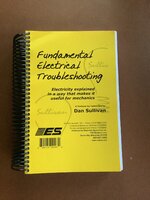
On the other hand, $120+ is a chunk of change to spend on what is essentially a convenience item so I think I’ll hold off a month or two. I did buy this book on the recommendation of someone here (@signcrafter perhaps?) and have been finding it very informative.

image.jpg

Thanks to all for the excellent discussion! :beer:
 
To avoid these ads, REGISTER NOW!

richfinn

Well-known member
Joined
Jan 29, 2011
Messages
4,814
Location
Leeds, Yorkshire, England
I work as fleet mechanic for a heavy duty tow and transport shop, so I spend a lot of time dealing with simple wiring issues. These trucks all have dozens of lights, so it seems like there’s always some lighting that isn’t working, 15ft+ away from the battery.

I do ok with a DMM and a test light but I’ve kinda had my eye on a power probe. Being able to check a fixture for power/ground and then to test the component itself by applying power/ground, seems like it could really speed diagnostics up. The long jumpers + omnipresent ground would be nice, too.

On the other hand, I know that you can easily fry some of the sensitive electronics (CAN BUS, ECM, etc) by sending power in the wrong place. If I steer clear of the engine bay and stick to applying power/ground to things like lights and isolated components that I removed like blower motors, is there really much risk of damage?

Any thoughts on investing in one of these?

If you were confident in your testing you wouldn't really even need to power up isolated "suspect" components with a Power Probe, think of all the extra steps and time you are adding to your diagnosis!!!

this is why most experienced techs load test the wiring as they check the supply/ground, when you see a red/green LED on a power probe it doesn't necessarily mean you have good power or ground, those LEDs only need a few thousands of an amp to light up where you might need anything from 300ma to 5 amps on a typical lighting circuit.

If a component in the circuit is open circuit you can't do a conventional loaded "volt drop" test, that's where the test lamp comes in (it becomes the load) and then you can accurately measure the available voltage with a multimeter.

You might get lucky and fix a few blown bulbs using a power probe, if you are looking for corrosion in wiring harnesses it will be a struggle.

The best thing you can do now is study "volt drop" testing/ohms law and practice with a few experiments.

If I had a spare hundred bucks to blow on electrical tools I would buy a good DC current clamp and a test lamp over a power probe all day long.
 
To avoid these ads, REGISTER NOW!
Top Bottom