To avoid these ads, REGISTER NOW!

Fasten sanded Birch plywood to walls with the least visible fastener?

Tracs

Well-known member
Joined
Feb 1, 2015
Messages
566
Location
Manitoba, Canada
I have some nice sanded Birch plywood that I am installing on the walls of my 40x60x12 shop. I am doing a 4' row all the way around the bottom of the walls and the entire end gable wall with the overhead door/man door.

I am looking for the best way to screw/nail it on that will be the least visible. I'd rather not fill 20+ holes per sheet if I can avoid it.

After installation I will be staining the wood a color of my choosing. Not exactly sure what color as of yet.

What are your thoughts?
 
To avoid these ads, REGISTER NOW!
OP
T

Tracs

Well-known member
Joined
Feb 1, 2015
Messages
566
Location
Manitoba, Canada
I'd test a piece with 23 gauge pin nails. I was impressed with the holding power when I pulled some flooring that I used them on steps.
Edit; and some adhesive wouldn't hurt...

I was thinking of a finishing nailer type fastener. Not sure how big the hole is.

Spray foam adhesive. No fasteners.

I don't think adhesive would work, the studs are covered with poly.
 

JerseyBoatBuilder

Well-known member
Joined
Mar 3, 2012
Messages
1,585
Location
Florida
Some people might laugh. But I would say Velcro. Glue or staple "depending on thickness" to the back of the panels and you can glue it or staple it to studs.
Built many, many Multi Million dollar sport fish and yachts that way. Birch, Maple, Cedar and custom Upholstered panels.
The holding strength is enough to break the panel if you are not careful removing them.
 

loganb

ALLIANCE MEMBER
Joined
Dec 29, 2011
Messages
5,504
Location
Omaha, NE
Trim screws around the perimeter, then to conceal those you can use a moulding/chair rail/baseboard to provide an accent and hide the screws. That trim can easily be attached with pin nails and will be hard to find

You may need a screw in the middle(field) to keep it from bowing...short of a concealed solution like Velcro on the backside as mentioned above I would just fill that hole
 
OP
T

Tracs

Well-known member
Joined
Feb 1, 2015
Messages
566
Location
Manitoba, Canada
Some good ideas here. The fasteners don't have to be invisible, it is a shop after all.

I will have to check out a brad nailer and or the grk trim screws.
 

Hank11

Well-known member
Joined
Aug 19, 2019
Messages
1,139
Location
Tennessee
You might also think about using Phillips head screws with finish washers. You can buy both in different materials and color finishes. If you lay out a nice uniform grid, it could look pretty nice.
 

Jackfre

Well-known member
Joined
Dec 26, 2010
Messages
4,406
Location
N CA
Either the pin nails or screws work well. I’d use the GRK’s myself. Yes they make about an eighth inch home but will care in setting them you can make them flush with the surface. Carefully mark the ply for each screw and its spacing with a small pilot hole while on the ground. It will be uniform and look good, imho. What I like about the screws is that if you need to get into the wall you can simply back the screws out remove the ply. You may have thought of everything, but things and needs change. You can be as **** about the screw holes as you like, but it is a shop and it being the lower course will largely be covered.
 

pembol

Well-known member
Joined
Feb 13, 2014
Messages
268
I am in the process of installing ply on my walls at the moment and went with GRK trim head screws. They are pretty discrete, but still retain the huge advantage that you can easily remove any wall panel you may need to. Unless your ply is absolutely flat (which mine is not) then you will end up overdriving some to pull the ply tight to the studs - they don't have as much holding power as 'normal' screws, but the screw holes are small enough that you really can't tell.
 

mm08822

Well-known member
Joined
Jan 13, 2012
Messages
5,866
Location
NJ
May want to stain/seal the panels first while laying flat before installation.

Doing so, can help reduce the deeper stain absorbsion of the broken wood fibers around each fastener if stained after installation.
 
To avoid these ads, REGISTER NOW!

CraigStu

Well-known member
Joined
May 22, 2014
Messages
4,013
Location
Blacksburg, Va
A brad nailer I think is your answer. The nail heads are small and you can adjust power to adjust head sink depth. It is so fast you can do a nail every 8 inches if the holding power is a bit suspect. Besides, if you don't have one already, you will be amazed how often it comes in handy.
 

Ak Jim

Well-known member
Joined
Jan 5, 2012
Messages
532
Location
Interior AK
If you use screws figure out how many and then set up a pattern so they will all be symmetrically uniformly spaced. Make it look like they were intended to be seen and look good.
 

Fav Onefour

Well-known member
Joined
Jul 14, 2022
Messages
693
Location
MN cold and hot
Again if not bothered by exposed fasteners, perhaps cabinet hanging screws? Nice looking big heads that won’t pull through.
I've gone with that route on a few projects when forced to use face fasteners.
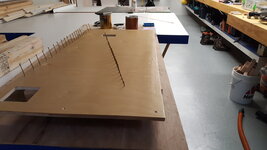
I pre drilled the holes on this piece so wood was clean around fasteners. Probably not needed.
20190529_161508.jpg
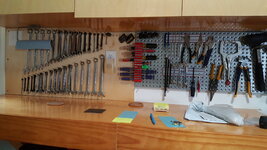
The finish screws for hanging wrenches etc. were also pre drilled.
20190624_095643.jpg
I'm a bit of a **** with these type of projects. I measure and lay out the locations before installing the fasteners. I like the clean look of straight rows and spacing if possible.
 

Kezorm

Well-known member
Joined
Aug 18, 2021
Messages
174
Location
Twin Cities, MN
Counterbore, screw it and plug the holes with Birch plugs. Or simply countersink and leave the screws visible.
This is the approach I took with baltic birch plywood. No plugs. Just countersunk black screws in regular pattern. Regular pattern is key. Need to measure and precisely place every fastener with intent.

IMG_8732.jpeg
 

BlindViper

Well-known member
Joined
Dec 1, 2009
Messages
1,304
Location
York, PA
OP
T

Tracs

Well-known member
Joined
Feb 1, 2015
Messages
566
Location
Manitoba, Canada
This is the approach I took with baltic birch plywood. No plugs. Just countersunk black screws in regular pattern. Regular pattern is key. Need to measure and precisely place every fastener with intent.

IMG_8732.jpeg

Before I selected this plywood for the walls I put up a 4x8 piece that the electrical panel is mounted to. I used drywall screws perfectly placed to secure it to the wall. I don't mind the look. And I do plan on staining all the wood a darker color, maybe a red mahogany or gunstock. The upper wall metal is stone grey.
 

4x4Pete

Well-known member
Joined
Aug 26, 2019
Messages
791
Location
Stroud
I finished a workshop with sanded fir plywood. I used a 16 ga brad nailer. Wood filler filled the small holes quiclky and easily. Almost invisible to the point that it was difficult to find one.
 

qdvuu

Well-known member
Joined
Feb 8, 2008
Messages
610
Location
Norcal
You might also think about using Phillips head screws with finish washers. You can buy both in different materials and color finishes. If you lay out a nice uniform grid, it could look pretty nice.
OP, what is your strategy for future "behind the wall" upgrades? If you want to be able to remove them, the screws w/ finish washers is easy and non-damaging.
 
OP
T

Tracs

Well-known member
Joined
Feb 1, 2015
Messages
566
Location
Manitoba, Canada
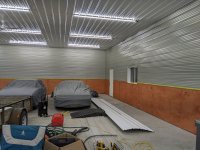
Almost a year later I finally finished putting up the last piece. I ended up using a 16g nailer and measured out where each fastener went. I put 4 nails into each stud, for a total of 16 nails per 8' section. The main walls were done last November, but I just added a closed in storage room. I have to stain the bottom 4' of wood on that section.

If I need to attach anything to the wood/metal it will go through into the studs anyways, so there will be nothing hanging off just the wood.

PXL_20251122_232523442.jpgPXL_20251122_232519190.jpgPXL_20260605_014153695.jpg
 

sizem

Active member
Joined
Jan 20, 2021
Messages
29
Location
kentucky
If you want a perfect job w/ absolutely no fasteners or mars showing, then the Hafele panel connectors would meet your needs. The system consists of three parts...a triangular mounting plate, a button, and a marker for positioning the button on the panel. You place the plate on the wall, insert button marker, place panel on wall in position and push...the marker locates where you fasten the button on the panel. Then you snap the panel to the wall. This system would great for fastening my backsplash in our kitchen. See attached details.

If the panels are strictly cosmetic and not load bearing, then a micro nailer works great!
Good luck.
 

Attachments

  • hafele Panel Connector, Button-fix™ Type 3 - Häfele.pdf
    593.5 KB · Views: 11
To avoid these ads, REGISTER NOW!
Top Bottom