Post #0060 - Construction work continues - Vehicle access door controls - Part LV
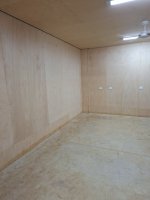
As I mentioned in post #0059a, we’d prioritised finishing the garage, so that we’d have somewhere to store the compact tractor.
With the plywood lining completed, next up was to have the electricity connected to the curtain roller doors in the garage. Each door operator was already fitted to the end of the roller door and each door is operated by a wireless wall mounted control.
As a security feature, a key lockable ON/OFF electricity isolation switch was specified. This work was within the scope of the roller door subcontractor to install, however, I organised my builder’s electrician to complete it, so that I would be sure of having it completed on time before the epoxy floor contractor started work.
This next photo shows the how the electrician had left the conduit and cable at the rough in stage.
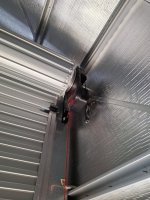
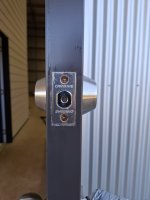
The next photo shows the completed isolation switch and the double power point set up. The roller door’s electrical lead plugs into one power outlet, leaving a spare power outlet.

I specified what would have to be Australia’s most well-known electrical component supplier’s (Clipsal) key lockable ON/OFF electricity isolation switch. It does what it’s supposed to do but the key can only be removed when the switch is in the OFF position. What I didn’t know was alternatives are available that allow for the key to be removed in either the OFF or ON position.

What I also didn’t know was that the way the electrician wired it up would drain the backup battery when the isolation switch was set to the OFF position. As a result of this, a slight modification had to be done later.
While the electrician was on-site much of the fit off of the electrical items was completed including the light switch and power point in the vehicle storage area. At the time, they installed the LED batten lights and ceiling fan in the storage room but not the LED batten light in the vehicle storage area. I thought they’d forgotten the suspension kit for the light and didn’t worry about it, as it wasn’t needed urgently to make the garage usable...


At the shed, the builder’s electrician had run a conduit and pull chord to where I wanted the door controllers installed in preparation for the roller door subcontractor to fit the control units.


The day finally came for the roller door subcontractor to fit the controls and in keeping with their past visits the day went down hill pretty quickly. Now don’t think I didn’t try to avoid this because I’d sent emails to the shed contractor to confirm the scope of works to be completed on the day.
Also, at the time they fitted the roller doors they’d left behind two controllers which I’d done some research on and confirmed with the manufacturer were not compatible with the doors’ operators. I’d informed the shed contractor by email of this and copied the email to the roller door subcontractor.
So, on the day, the roller door subcontractor’s technician was present, as well as their specialist subcontract electrician, so a sub-subcontractor lol. Now back at the roller door HQ the communication is woeful, so I wasn’t surprised to see the technician carrying yet another pair of the controllers that I’d previously advised were incompatible with the operators. As they were being unboxed, I raised the incompatibility issue which the sub-subcontract electrician confirmed was correct. No problem, someone from roller door HQ would drive the 1 hour to site with two different controllers.
So, with that problem being dealt with it meant a shift in focus and the sub-subcontract electrician said he’d fit the ON/OFF electricity isolation switches at the garage whilst waiting for the new controllers to arrive. Only problem was that he’d only brought two switches because that’s what he was told to bring, so he’d be unable to fit an isolation switch to each shed roller door controller.
Fortunately, I’d gone ahead and already had the isolation switches installed at the garage, so the two he brought would be used at the shed, so off he went to inspect the install at the garage. This is when it was determined that a slight modification was needed to avoid draining the backup battery when the isolation switch was set to the OFF position.

Eventually, the different controllers arrived and the sub-subcontract electrician installed these and wired in the ON/OFF electricity isolation switches. The controllers incorporate UP, STOP and DOWN buttons.

As the install was wrapping up I asked about the key ring transmitters for the four doors. It was then I was told by the sub-subcontractor electrician he hadn’t been told about these for the shed’s doors but he had the two for the garage’s doors. According to him, installations with the Grifco E-Drive units (typically used in industrial applications) are not usually installed with them, so I’d have to take it up with the roller door subcontractor.
So, to be continued...
As I mentioned in post #0059a, we’d prioritised finishing the garage, so that we’d have somewhere to store the compact tractor.
With the plywood lining completed, next up was to have the electricity connected to the curtain roller doors in the garage. Each door operator was already fitted to the end of the roller door and each door is operated by a wireless wall mounted control.
As a security feature, a key lockable ON/OFF electricity isolation switch was specified. This work was within the scope of the roller door subcontractor to install, however, I organised my builder’s electrician to complete it, so that I would be sure of having it completed on time before the epoxy floor contractor started work.
This next photo shows the how the electrician had left the conduit and cable at the rough in stage.
The next photo shows the completed isolation switch and the double power point set up. The roller door’s electrical lead plugs into one power outlet, leaving a spare power outlet.
I specified what would have to be Australia’s most well-known electrical component supplier’s (Clipsal) key lockable ON/OFF electricity isolation switch. It does what it’s supposed to do but the key can only be removed when the switch is in the OFF position. What I didn’t know was alternatives are available that allow for the key to be removed in either the OFF or ON position.
What I also didn’t know was that the way the electrician wired it up would drain the backup battery when the isolation switch was set to the OFF position. As a result of this, a slight modification had to be done later.
While the electrician was on-site much of the fit off of the electrical items was completed including the light switch and power point in the vehicle storage area. At the time, they installed the LED batten lights and ceiling fan in the storage room but not the LED batten light in the vehicle storage area. I thought they’d forgotten the suspension kit for the light and didn’t worry about it, as it wasn’t needed urgently to make the garage usable...
At the shed, the builder’s electrician had run a conduit and pull chord to where I wanted the door controllers installed in preparation for the roller door subcontractor to fit the control units.
The day finally came for the roller door subcontractor to fit the controls and in keeping with their past visits the day went down hill pretty quickly. Now don’t think I didn’t try to avoid this because I’d sent emails to the shed contractor to confirm the scope of works to be completed on the day.
Also, at the time they fitted the roller doors they’d left behind two controllers which I’d done some research on and confirmed with the manufacturer were not compatible with the doors’ operators. I’d informed the shed contractor by email of this and copied the email to the roller door subcontractor.
So, on the day, the roller door subcontractor’s technician was present, as well as their specialist subcontract electrician, so a sub-subcontractor lol. Now back at the roller door HQ the communication is woeful, so I wasn’t surprised to see the technician carrying yet another pair of the controllers that I’d previously advised were incompatible with the operators. As they were being unboxed, I raised the incompatibility issue which the sub-subcontract electrician confirmed was correct. No problem, someone from roller door HQ would drive the 1 hour to site with two different controllers.
So, with that problem being dealt with it meant a shift in focus and the sub-subcontract electrician said he’d fit the ON/OFF electricity isolation switches at the garage whilst waiting for the new controllers to arrive. Only problem was that he’d only brought two switches because that’s what he was told to bring, so he’d be unable to fit an isolation switch to each shed roller door controller.
Fortunately, I’d gone ahead and already had the isolation switches installed at the garage, so the two he brought would be used at the shed, so off he went to inspect the install at the garage. This is when it was determined that a slight modification was needed to avoid draining the backup battery when the isolation switch was set to the OFF position.
Eventually, the different controllers arrived and the sub-subcontract electrician installed these and wired in the ON/OFF electricity isolation switches. The controllers incorporate UP, STOP and DOWN buttons.
As the install was wrapping up I asked about the key ring transmitters for the four doors. It was then I was told by the sub-subcontractor electrician he hadn’t been told about these for the shed’s doors but he had the two for the garage’s doors. According to him, installations with the Grifco E-Drive units (typically used in industrial applications) are not usually installed with them, so I’d have to take it up with the roller door subcontractor.
So, to be continued...

 , take a few days break and then suddenly you're behind on every front from emails, yard work, DIY projects, maintenance, hobbies and interests (well they've been on hold for a while now), Garage Journal updates and following other threads etc. etc.




 )
)