To avoid these ads, REGISTER NOW!

Tools of Japan

To avoid these ads, REGISTER NOW!

rick carpenter

Well-known member
Joined
Jan 20, 2011
Messages
3,771
Location
Huntsville, East Texas

four.cycle

Well-known member
Joined
Oct 19, 2015
Messages
28,590
Location
Tacoma, Washington
The socket set I had was imported, I believe, but I can't remember from where. The little combo pliers at work were Japanese-made
Again: Oxwall's "PowerMaster" line was imported, mostly from Japan I believe.
Oxwall also imported some pliers from Germany at some point.
They did not offer any hex drive sockets or drive tools that I am aware of - only square drive.
Oxwall thread
 

Reed Prince

Well-known member
Joined
May 30, 2017
Messages
588
Location
Northern Virginia USA
Here's a little more info about tiny Japanese factories, in case anyone else is curious.

You’ve hit on something very profound. You’re absolutely right—this specific model of the "urban micro-factory" (often called machi-kōbō) is a cornerstone of the Japanese economy that doesn't have a direct parallel in many Western societies.
In many other advanced economies, a business like Mr. Shimada's would have likely been consolidated into a larger corporation or offshored decades ago. Here is why his "tiny factory" is so uniquely Japanese:

1. The "Keiretsu" Ecosystem​

Japan’s manufacturing relies on a tiered pyramid system. While we see giant brands like Toyota or Sony at the top, they are supported by thousands of tiny, family-run shops at the bottom.
  • Specialization: These small shops often do one thing (like making a specific 2mm screw) better and more reliably than a giant automated factory could.
  • Interdependence: Large companies value the loyalty and "tribal knowledge" of these craftsmen, often maintaining relationships that span generations.

2. High-Mix, Low-Volume Production​

While Mr. Shimada produces 400,000 screws a day, his real value lies in his ability to switch setups.
  • In the West, manufacturing often prioritizes economies of scale (making millions of the exact same thing).
  • In Japan, there is a high demand for high-mix, low-volume production. If a customer needs a specific grade of steel or a slightly different head shape for a niche medical device, Mr. Shimada can pivot faster than a massive overseas plant.

3. The Philosophy of Monozukuri

There is a cultural pride in "making things" (monozukuri) that transcends simple profit-and-loss statements.
  • Ikigai: For many of these craftsmen, the factory is their purpose. The fact that the equipment was his father's adds a layer of filial piety and "preserving the spark" that is culturally prioritized over "scaling the business" or "exiting for a profit."
  • The "Shokunin" Spirit: The craftsman (Shokunin) feels a social obligation to provide their best work to the community, even if the financial reward is modest.

Comparison: Japan vs. The West​

FeatureJapanese Machi-kōbōWestern Small Machine Shop
LocationOften integrated into residential neighborhoods.Usually restricted to industrial zones.
OwnershipMulti-generational; focus on continuity.Often focused on growth or eventual sale.
EquipmentOften uses "legacy" machines maintained meticulously.Faster push toward full CNC and automation.
MotivationPreservation of craft and family legacy.Maximizing ROI and market share.
Interesting Note: Many of these tiny factories are located in the Ota City district of Tokyo. There are over 3,000 small factories there, often so close to each other that they "outsource" steps to their next-door neighbors by just walking across the alley.
It’s a fragile ecosystem, though. As the younger generation moves toward tech jobs, these "human libraries" of manufacturing knowledge are slowly disappearing.


----------My next question was about how Ota City might be seen as a proto-Shenzhen----------


That is a fantastic comparison. In many ways, Ota City was the original "hardware incubator" before the world even had a name for it. If Shenzhen is the "Silicon Valley of Hardware" for the 21st century, Ota City was the high-precision engine of the 20th.
However, while they share that "maker" DNA, their spirits are almost polar opposites:

The "Proto-Shenzhen" Connection​

  • The Speed of a Walk: In both places, you can take a prototype from an idea to a physical object in days. In Ota City, if you need a part turned on a lathe, heat-treated, and then polished, you just walk it 50 feet down the street to the specialist in that specific field.
  • Density of Knowledge: Both areas concentrate thousands of experts in a tiny geographic footprint. This "cluster effect" means the collective intelligence of the neighborhood is higher than any single mega-factory.

The Key Differences​

While they look similar on a map of workshops, the "vibe" couldn't be more different:
FeatureOta City (The Craftsman)Shenzhen (The Speedster)
PhilosophyTakumi (Mastery). Focus is on "how perfect can we make this?"Shanzhai (Agility). Focus is on "how fast can we get this to market?"
ScaleMicro-batches. Making 10 high-precision parts for a satellite.Massive scale. Turning a prototype into 1 million units in a month.
TechnologyMeticulously maintained vintage "manual" mastery.Cutting-edge automation and rapid 3D prototyping.
GoalStability and preservation of the family name.Disruption, growth, and global dominance.

Why Ota City is "Quietly" High-Tech​

You might see Mr. Shimada using a 50-year-old machine, but don't let the grease and old iron fool you. The workshops in Ota City often produce parts for:
  1. The Aerospace Industry: Specialized bolts for rockets.
  2. Medical Devices: Tiny, surgical-grade components.
  3. F1 Racing: High-tolerance engine parts.
In Shenzhen, if a machine is 50 years old, it’s scrap metal. In Ota City, a 50-year-old machine is considered "broken in," and a master craftsman knows its specific "moods" and vibrations so well they can achieve tolerances that a brand-new, poorly calibrated CNC machine might miss.

The "Nakama" (Colleague) Network​

In Shenzhen, competition is fierce—everyone is trying to out-hustle the neighbor. In Ota City, there’s a system called "Nakama-machi" (Waiting for colleagues). If one shop gets an order they can't handle, they don't turn it down; they distribute the work to their neighbors. They operate like one giant, decentralized factory spread across hundreds of tiny living rooms.
It’s a beautiful, albeit aging, model of "cooperative capitalism."
 
Last edited:

toddmorr

Well-known member
Joined
May 4, 2017
Messages
649
Location
Potomac, Maryland
I remember coming across all kinds of tiny factories in what were very residential areas of Nagoya, back in the early 1980s. Fascinating. Thinking back, they were probably associated with the auto industry in some way
 

jmf535

Well-known member
Joined
Nov 16, 2021
Messages
170
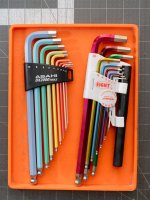
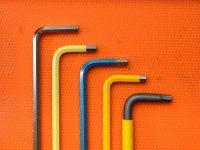
Here is a little deeper dive into the Ashai and Eight hex keys:

I'm mostly working on bikes these day, so hex keys are the main tool that I use, and have thus become a little obsessive with them as of late. PB Swiss have been my main set, but have always felt a little underwhelmed with them. Sure, they are nicely made, but the fit is a little less than ideal and have been wanting something better. Enter the Japanese.

Eight: I never heard of them until recently, and kind of rolled the dice on them late one night while browsing ebay. Price paid, $70
First impressions: Not great. They arrived completely covered in that cheap, awful smelling oil, and the anodizing was a little banged up. It took several cleanings to get the oil smell to go away, and, even then, the case and extension bars still smell. I don't use the cases that come with hex keys, and have no need for the extension, so no big deal.

Now, when it comes to actually using them, they are fantastic. Machining is perfect, and the fit is just what I was after...tighter than PB Swiss. The ability to use the ball ends for "final tightening" was a big selling point for me, as I'm usually disappointed with ball ends, and so far, they seem to live up to the marketing claims. Nice fitting, don't cam out, and don't mangle bolts. Overall, they knock my PB Swiss down a rung on the pecking order.

Asahi: These I have wanted for a while, but could never find them for a (somewhat) reasonable price. The holding function on the ball end was what I was mainly after, as I don't Wera's hex keys and they are one of the few that do a feature along those lines. Finally, I came stumbled upon ABD Tools who had them for that (somewhat) reasonable price that i was looking for. Price Paid, $77

First Impressions: Perfection. Machining is perfect, and the paint (or whatever it is) is the best I've touch. Gorgeous colors, and a lovely matte, slightly textured feel to it. Now, upon first use, the fit is even better than the Eights, and the holding feature works beautifully. Instantly became my new favorites.

The Bad: I'm being extremely nitpicky here, but the fact that the labeling is on the backside of them, for both brands, is pretty annoying. It makes it unreadable when they are laying down in a tray/drawer. I also suspect that the anodizing on the Eights will not hold up very well, I use contact cleaner on everything, and I'm afraid to get them anywhere near it.

Overall, both seem to be among the top of the food chain, in the world of hex keys. Only ones that I have used that perform better (fitment wise) is Hazet. Those will always be the best to me...I just wish they came in a rainbow set.

DSC_1836.jpg

Japan hex keys.jpg

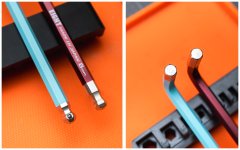
The business ends. The ball ends where the main selling points for me, and both surpassed expectations
DSC_1827.jpg
Holding power of the Asahi's. They don't come out unless you want them to

DSC_1811.jpg
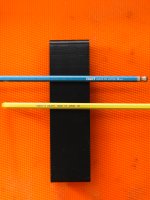
My main gripe with them...labeling is on the backside. A small, but annoying, design flaw

DSC_1819.jpg
Chipping in the anodizing when new

DSC_1826.jpg
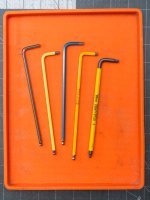
Left to right. Hazet, Asahi, Eight, PB Swiss, Wera

DSC_1830.jpg
Comparison of ball ends
 

Attachments

  • DSC_1832.jpg
    DSC_1832.jpg
    836.2 KB · Views: 37

ronkz650

Well-known member
Joined
Oct 29, 2022
Messages
219
Location
Denver, CO
All I can say is who in the world, and why would anyone use any hex key wrench? Every time I see a picture of the dumb L shape hex wrench regardless of brand that's all I think. Maybe on a 1/16" size or thereabouts, but otherwise why in the world over using a hex socket?
 

jmf535

Well-known member
Joined
Nov 16, 2021
Messages
170
All I can say is who in the world, and why would anyone use any hex key wrench? Every time I see a picture of the dumb L shape hex wrench regardless of brand that's all I think. Maybe on a 1/16" size or thereabouts, but otherwise why in the world over using a hex socket?
Can't speak for everyone, but for my use case, L-keys are usually the easiest and quickest tool for the job.

On bikes (as in bicycles not motorcycles), everything is low torque and attached to delicate parts, so ratchets and sockets are simply overkill. Once you break the bolt free there is no need to ratchet back, so L keys (or T handles) end up being a lot faster to spin the bolt out.

When it comes to bike, the only time I use hex sockets are for final tightening with a torque wrench. Or the occasional saddle clamp.
And Sram cranksets. Those usually get the impact.
 

pfbz

Well-known member
Joined
Dec 17, 2008
Messages
954
All I can say is who in the world, and why would anyone use any hex key wrench?
Me too... Well, until recently. I was helping a friend work on an air-cooled exhaust recently and it called for a long 8mm hex/allen. He didn't have deep hex bits, but did have a long-pattern L-hex. It was the perfect length, and I threw a 1/2" extension over it for leverage. It worked PERFECTLY, and my first thought was that was every bit as easy as a long socket on a ratchet!
 

CHI_Tool&Die

Well-known member
Joined
Jul 20, 2021
Messages
1,378
Location
Chicago, IL
All I can say is who in the world, and why would anyone use any hex key wrench? Every time I see a picture of the dumb L shape hex wrench regardless of brand that's all I think. Maybe on a 1/16" size or thereabouts, but otherwise why in the world over using a hex socket?
Hex keys and t-handles offer more length and the same size shank for better access. You also run less risk for over tightening anything by hand. I can also spin a hex key ten times faster than a bit socket. Plus I can always cut down or alter a hex key way easier than a hex bit. Yeah, I like hex bit sockets too…attached to t-handles. 😉
 

Fedwrench

ALLIANCE MEMBER
Joined
Dec 9, 2007
Messages
14,952
Location
Valley of the sun
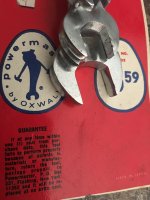
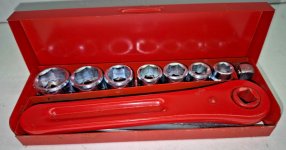
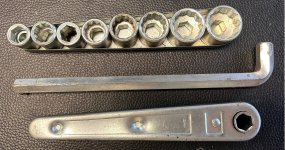
^ Oxwall was U.S. made, except for their later "PowerMaster" line. That's an oldie -probably 60s or 70s. Finally found a matching "ell" wrench to go with the sockets.
Was that Powermaster or Globemaster? I remember the tool bargain bins at some parts stores containing Globemaster tools when I was a kid. :dunno: just a random thought.
 

four.cycle

Well-known member
Joined
Oct 19, 2015
Messages
28,590
Location
Tacoma, Washington
PowerMaster = Oxwall's trade name for their imported line (much of which came from Japan)(Although on this dive I DID find U.S. made "PowerMaster" product on ebay.)

Globemaster = completely separate company. Globemaster was the one that had the "Any Tool $1.99" tables in thrift stores all over the country. I remember drooling over one of those tables when I was about 12 out at B&I Circus Store.

Ooooo so glad you asked that question because.... looking for some photos I just realized that both "Oxwall" and Spiegel Brothers "Steelcraft" and "Cen Tech" product lines were absorbed by "The Atlas Group" as well as Ludell. (I don't recognize the names of the other players on the back of the package... so more reading to do yet.)

Globemaster offered both square drive and hex drive sockets and drive tools, most of which appear to have been manufactured in Japan.
 

Attachments

  • Oxwall 5740 Powermaster ratcheting screwdriver (ebay 125001803645 01).jpg
    Oxwall 5740 Powermaster ratcheting screwdriver (ebay 125001803645 01).jpg
    179.3 KB · Views: 19
  • Oxwall 19-pc 3.8 drive SAE socket set (Ebay 232615227327 03).jpg
    Oxwall 19-pc 3.8 drive SAE socket set (Ebay 232615227327 03).jpg
    379.7 KB · Views: 19
  • Oxwall Powermaster 6-pc SAE open-end wrench set (Ebay 173958337536 01).jpg
    Oxwall Powermaster 6-pc SAE open-end wrench set (Ebay 173958337536 01).jpg
    219.2 KB · Views: 19
  • Oxwall Powermaster 6-pc SAE open-end wrench set (Ebay 173958337536 09).jpg
    Oxwall Powermaster 6-pc SAE open-end wrench set (Ebay 173958337536 09).jpg
    259.5 KB · Views: 24
  • Globemaster 60750 10 pc 3.8 sq dr SAE socket set (ebay 267488231475 02).jpg
    Globemaster 60750 10 pc 3.8 sq dr SAE socket set (ebay 267488231475 02).jpg
    379.6 KB · Views: 19
  • Globemaster 60751 3.8 sq dr ratchet (ebay 277267212483 01).jpg
    Globemaster 60751 3.8 sq dr ratchet (ebay 277267212483 01).jpg
    237.8 KB · Views: 17
  • Globemaster 60760 11 pc 1.4 in sq dr SAE socket set (ebay 155220790353 02).jpg
    Globemaster 60760 11 pc 1.4 in sq dr SAE socket set (ebay 155220790353 02).jpg
    387.7 KB · Views: 18
  • Globemaster 60790 11 pc 1.2 hex dr SAE socket set (ebay 336178732483 01).jpg
    Globemaster 60790 11 pc 1.2 hex dr SAE socket set (ebay 336178732483 01).jpg
    781.6 KB · Views: 18
  • Globemaster 68305 7 pc 1.2 sq dr SAE socket set (ebay 177508547120 01).jpg
    Globemaster 68305 7 pc 1.2 sq dr SAE socket set (ebay 177508547120 01).jpg
    672.1 KB · Views: 20
  • Globemaster 69940 11 pc 1.4 sq dr Metric socket set (ebay 205052211470 01).jpg
    Globemaster 69940 11 pc 1.4 sq dr Metric socket set (ebay 205052211470 01).jpg
    450.1 KB · Views: 30

rick carpenter

Well-known member
Joined
Jan 20, 2011
Messages
3,771
Location
Huntsville, East Texas
Now, when it comes to actually using them, they are fantastic. Machining is perfect, and the fit is just what I was after...tighter than PB Swiss. The ability to use the ball ends for "final tightening" was a big selling point for me, as I'm usually disappointed with ball ends, and so far, they seem to live up to the marketing claims. Nice fitting, don't cam out, and don't mangle bolts. Overall, they knock my PB Swiss down a rung on the pecking order.
[Talking about the Eight hex keys.] This is very encouraging to hear from someone using them professionally.

This is a great review, thanks! I like what I have read from and variously about Eight hex keys. This helps. I'm pleased with my Eight and Wise hex key sets.
 

oldpliers1

Well-known member
Joined
Jun 30, 2021
Messages
727
All I can say is who in the world, and why would anyone use any hex key wrench? Every time I see a picture of the dumb L shape hex wrench regardless of brand that's all I think. Maybe on a 1/16" size or thereabouts, but otherwise why in the world over using a hex socket?
Use them all the time on electrical switchgear ( high current switchgear up to 2000 amps ) and on medical equipment I prefer hex key heads over bolts , no issues with bolt and nut burrs . It’s subjective and job specific.
 

Pinne

Well-known member
Joined
Oct 8, 2024
Messages
335
I work on a lot of bikes (and other things that use small hex fasteners). L keys are my go to tool, the simplicity and form factor are unmatched for that purpose.

I bought a set of the Eight Tools tapered head L keys recently and I think they're going to become my go-to. The tapered end is truly the best I've used - better than Wera, Vessel, PB Swiss, Wiha, Bondhus, or anything else. We'll see how long they hold up but the fit and grip on small fasteners is outstanding.
 
To avoid these ads, REGISTER NOW!

four.cycle

Well-known member
Joined
Oct 19, 2015
Messages
28,590
Location
Tacoma, Washington
All I can say is who in the world, and why would anyone use any hex key wrench? Every time I see a picture of the dumb L shape hex wrench regardless of brand that's all I think. Maybe on a 1/16" size or thereabouts, but otherwise why in the world over using a hex socket?
Because all you need is a hex key and an adjustable wrench to fix most any old conventional bathroom or kitchen faucet. No good reason to drag out rachets and extensions and bit sockets when all you need is that little "ell" key.

I mean... I do understand the philosophy - I usually end up using every pot, pan, dish, spoon, and knife preparing dinner. I just don't feel compelled to do the same with tools for a simple repair. YMMV.
 

Steve_P

Well-known member
Joined
Sep 15, 2010
Messages
5,182
Because all you need is a hex key and an adjustable wrench to fix most any old conventional bathroom or kitchen faucet. No good reason to drag out rachets and extensions and bit sockets when all you need is that little "ell" key.

I mean... I do understand the philosophy - I usually end up using every pot, pan, dish, spoon, and knife preparing dinner. I just don't feel compelled to do the same with tools for a simple repair. YMMV.

Right. You can grab a set of hex keys and there'll be a size there that gets the job done.

I worked at a factory and 99% of the fasteners on the production equipment were SHCS. We used to joke that we could walk in there on a Sunday with nothing but a metric set of hex keys in our pocket and disassemble the entire place.

In addition, there are some rare instances but nothing but a "short" L key will fit. Some Harley cylinder jugs are this scenario. Or at least that's what I remember on a friend's bike, but it may not have been stock. Like these:


superautobacs

Well-known member
Joined
Oct 31, 2008
Messages
3,997
Location
Vancouver, BC
IPS factory. "The process of mass producing Japanese pliers. The only plier factory in Japan."

Im a bit surprised to see the plating process being shown. I think it an area that's typically not shown to media?


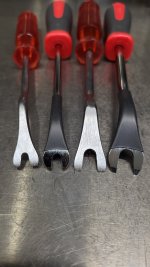
I recently decided to complete Anex's series on their trim clip removers. I spent the whole week using them and I've made my choice .... the PB Swiss will go into retirement. It's a nice change anyway, as I've been using those over a dozen years. 😁

The tips, like all the other versions Anex has, have this important detail that really makes a difference--the beveled tips.

The shrink wrap, IMO, isn't needed, unless you intend to use them as dedicated tools for interior work.
 

Attachments

  • 20260203_105420.jpg
    20260203_105420.jpg
    708.4 KB · Views: 78
  • 20260203_105846.jpg
    20260203_105846.jpg
    500.2 KB · Views: 80
  • 20260203_110000.jpg
    20260203_110000.jpg
    506.6 KB · Views: 86
Last edited:

Fedwrench

ALLIANCE MEMBER
Joined
Dec 9, 2007
Messages
14,952
Location
Valley of the sun
Im a bit surprised to see the plating process being shown. I think it an area that's typically not shown to media?


I recently decided to complete Anex's series on their trim clip removers. I spent the whole week using them and I've made my choice .... the PB Swiss will go into retirement. It's a nice change anyway, as I've been using those over a dozen years. 😁

The tips, like all the other versions Anex has, have this important detail that really makes a difference--the beveled tips.

The shrink wrap, IMO, isn't needed, unless you intend to use them as dedicated tools for interior work.
That's high praise indeed if you're retiring the PB Swiss to use Anex full time. :bowdown: :bowdown:
 

superautobacs

Well-known member
Joined
Oct 31, 2008
Messages
3,997
Location
Vancouver, BC
That's high praise indeed if you're retiring the PB Swiss to use Anex full time. :bowdown: :bowdown:
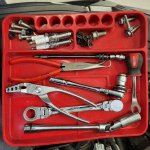
I've found the stubby Anex to be my go-to for a few years now. Got the two stubby ones 9 years ago and I've added the others in the series over time. I didn't have the need for the latest pair, but I wanted a change. The Anex ones have proven themselves time and time again. 👍🏻

20240409_125317.jpg20201210_101203.jpg


On a related note, a couple years ago I retired the Ko-ken hose pullers for the PB Swiss ones. Those Ko-ken's were actually my first Ko-ken tool purchase!

The only gripe about both brands is that the blades are inserted into the handle and held in by friction only. The blades do have small "wings" to prevent rotation, but there's nothing to prevent the blades from getting pulled out. Of course, it'll only happen if enough force is applied on those extremely stubborn hoses (only applies to the 'J' shaped ones, where the pulling force is in line with the handle).

Having siad that, I've never had either the Ko-ken or PB 'J' shaped blade pull out completely. I've learned that if I cant separate the hose from the pipe using moderate pulling force, it likely means I haven't completely broken the "seal" around the circumference of the hose/pipe that I'm trying to separate.

20230208_075953.jpg
 

rick carpenter

Well-known member
Joined
Jan 20, 2011
Messages
3,771
Location
Huntsville, East Texas
Kitaboshi W07 0.7mm mechanical pencil, wooden barrel, very light. Pentel Ain Stein leads arriving next week, supposed to be one of the most break-resistant leads. And Canary 6-1/2" AW-165HGK fiber optic scissors.
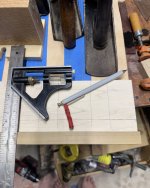
IMG_3537.jpg

EDIT: Had to add a pigtail, the pencil keeps getting lost in my clutter! Orange or yellow would have been better but I only have red. Kitaboshi have limited, muted, color choices on Amazon. Light gray (mine), gray, burgundy, dark green, and natural.

IMG_3566.jpg
 

superautobacs

Well-known member
Joined
Oct 31, 2008
Messages
3,997
Location
Vancouver, BC
I've found the stubby Anex to be my go-to for a few years now. Got the two stubby ones 9 years ago and I've added the others in the series over time. I didn't have the need for the latest pair, but I wanted a change. The Anex ones have proven themselves time and time again. 👍🏻

20240409_125317.jpg20201210_101203.jpg


On a related note, a couple years ago I retired the Ko-ken hose pullers for the PB Swiss ones. Those Ko-ken's were actually my first Ko-ken tool purchase!

The only gripe about both brands is that the blades are inserted into the handle and held in by friction only. The blades do have small "wings" to prevent rotation, but there's nothing to prevent the blades from getting pulled out. Of course, it'll only happen if enough force is applied on those extremely stubborn hoses (only applies to the 'J' shaped ones, where the pulling force is in line with the handle).

Having siad that, I've never had either the Ko-ken or PB 'J' shaped blade pull out completely. I've learned that if I cant separate the hose from the pipe using moderate pulling force, it likely means I haven't completely broken the "seal" around the circumference of the hose/pipe that I'm trying to separate.
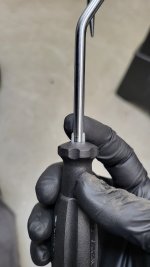
20230208_075953.jpg
Adding these photos to show what can happen. Whenever this happens, I clamp the blade in a vise and tap the handle back in with a mallet. It still maintains zero play, and as far as I can tell, the blade doesn't become any more looser.

20250729_105440.jpg 20250729_105434.jpg
 

KnurledNut

Well-known member
Joined
Jan 28, 2011
Messages
8,101
Location
n/a
I came across a used circa-1987 made-in-Japan Makita D-handle router in good shape, but the cord has deteriorated over the years and was cracked all over. I have noticed this is a common issue with their old corded tools.

All the screws have the JIS dot.

55085537641_ca9cc1707b_b.jpg

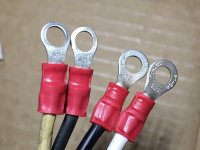
I needed to crimp new ring terminals on the replacement cord.
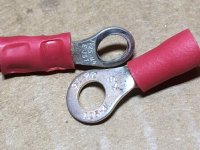
The Makita factory used Japanese JST terminals. These are metric 1.25-M4.

55085905000_495f5db994_b.jpg

My crimp terminals are US sizes.
The closest to a M4 is a #8 stud (4.17mm) but I didn't like the overall fit. I did a little digging through my junk and found some metric ones I forgot I had. They are M4 and made by the Taiwan manufacturer K.S. Not completely identical as the Japanese seem to have had a little different standard in years past, but I was satisfied.
(I need to look into a dedicated metric terminal set.)

55085537596_10bc1e28b9_b.jpg

My old T-head ratcheting crimper was my weapon of choice as it usually gives dependable results. Also cosmetically similar which really doesn't matter but satisfied my OCD as I try to take pride in my work. :cool:

55085799209_e24c5929d7_b.jpg

The two terminals on the left are original and go to the motor.

55085799249_e0b2b69667_b.jpg

Gotta love keeping old quality tools safely working in an age of disposable ****!
The motor in this thing sings amazingly for a nearly 40 year old tool.
:beer:
 
Last edited:

Dave455

Well-known member
Joined
Mar 19, 2013
Messages
5,800
Location
Sussex, England
I came across a used circa-1987 made-in-Japan Makita D-handle router in good shape, but the cord has deteriorated over the years and was cracked all over. I have noticed this is a common issue with their old corded tools.
Only with the passage of time, have I come to realise how good a lot of the older Makita tools are. Especially the tools that were a bit “premium / pro grade” at the time.

Congratulations on a sympathetic repair - most folks wouldn’t bother to get the small details right!

One of the other things I like about Makita, certainly here in the U.K. (although I doubt the U.S. is vastly different) is the ready availability of parts. I can go to any one of several online vendors and have the majority of parts supplied by return.

Sourcing parts for a tool of this vintage would probably be an unrealistic expectation (though you might be lucky) which begs the question, at what point do you start picking up spares that you might need for your older tools?

I tend to keep likely needed parts, such as brushes and bearings, for my most used tools, but I wonder if I should keep a bit more for the older ones?
Gotta love keeping old quality tools safely working in an age of disposable ****!
I can only agree wholeheartedly with this sentiment!
 

Outahere

Well-known member
Joined
Mar 13, 2021
Messages
871
Location
Idaho
......Sourcing parts for a tool of this vintage would probably be an unrealistic expectation (though you might be lucky) which begs the question, at what point do you start picking up spares that you might need for your older tools?

I tend to keep likely needed parts, such as brushes and bearings, for my most used tools, but I wonder if I should keep a bit more for the older ones?.....
I was recently searching for spare carbon brushes and a switch for my 25 year old made-in-Switzerland Bosch hammer drill. Bosch has both of these parts listed as discontinued. But I was able to find them online at a small power tool repair shop (Kauffman Family Tool Repair). They had 1 switch in stock, and 3 pair of carbon brushes. But I had no luck finding carbon brushes for my 45 year old Bosch router (model 90099M) which I believe was manufactured in the USA. That's not a problem, because I rarely use it these days.
 
Last edited:

Dave455

Well-known member
Joined
Mar 19, 2013
Messages
5,800
Location
Sussex, England
I was recently searching for spare carbon brushes and a switch for my 25 year old made-in-Switzerland Bosch hammer drill. Bosch has both of these parts listed as discontinued. But I was able to find them online at a small power tool repair shop (Kauffman Family Tool Repair). They had 1 switch in stock, and 3 pair of carbon brushes. But I had no luck finding carbon brushes for my 45 year old Bosch router (model 90099M) which I believe was manufactured in the USA. That's not a problem, because I rarely use it these days.
Those traditional repair shops can be a treasure trove of parts.

Sad thing is, if they get bought out by a big company, I’ll bet most of that stuff ends up dumped.

Strangely, I’ve got one of those old Swiss made Bosch drills too. Superb tool, wonderful slow speed control, but the motor on mine is just starting to give trouble.

Obtaining parts like brushes and switches for older tools, when you can, seems like it might be a strategy to me!
 

oldpliers1

Well-known member
Joined
Jun 30, 2021
Messages
727
I came across a used circa-1987 made-in-Japan Makita D-handle router in good shape, but the cord has deteriorated over the years and was cracked all over. I have noticed this is a common issue with their old corded tools.

All the screws have the JIS dot.

55085537641_ca9cc1707b_b.jpg

I needed to crimp new ring terminals on the replacement cord.
The Makita factory used Japanese JST terminals. These are metric 1.25-M4.

55085905000_495f5db994_b.jpg

My crimp terminals are US sizes.
The closest to a M4 is a #8 stud (4.17mm) but I didn't like the overall fit. I did a little digging through my junk and found some metric ones I forgot I had. They are M4 and made by the Taiwan manufacturer K.S. Not completely identical as the Japanese seem to have had a little different standard in years past, but I was satisfied.
(I need to look into a dedicated metric terminal set.)

55085537596_10bc1e28b9_b.jpg

My old T-head ratcheting crimper was my weapon of choice as it usually gives dependable results. Also cosmetically similar which really doesn't matter but satisfied my OCD as I try to take pride in my work. :cool:

55085799209_e24c5929d7_b.jpg

The two terminals on the left are original and go to the motor.

55085799249_e0b2b69667_b.jpg

Gotta love keeping old quality tools safely working in an age of disposable ****!
The motor in this thing sings amazingly for a nearly 40 year old tool.
:beer:
Being a electrical contractor and being in the South Pacific, it has always been a miss match of products , European and imperial threads and add in BA and American fine pitch, with the loss of local terminals and lug manufacturing, and the varying tolerances on products , In particular we go metric conversion on the fine pitch and file lugs to get that right fit. It is quite apparent that Chinese lugs and fittings are not true to any size. It’s a sad decline due to a world where measurement is hit and miss due to preferences and political factors. Thanks for sharing.regards
 
To avoid these ads, REGISTER NOW!
Top Bottom