To avoid these ads, REGISTER NOW!

Bridgeport power drawbar question

whateg01

Well-known member
Joined
Mar 13, 2006
Messages
11,187
Location
doo dah, kansas, usa
Apparently this isn't a problem, but I haven't figured out how it's not. I'm starting to think about adding a power drawbar to my mill. R8 spindle and I mostly use er25 collets. But when I need a face mill or want to use a drill chuck, I do have to pull the r8 collet out. So the power drawbar will make that a little easier.

Here's my question... When I loosen the drawbar now, I have to tap it to loosen the collet from the taper. Using an impact to loosen the drawbar, there's not enough room to do that and the videos I've seen make it apparent that it's not needed anyway. Why doesn't the collet stick in the taper?
 
To avoid these ads, REGISTER NOW!

RoninB4

Well-known member
Joined
Jul 22, 2020
Messages
3,479
Location
Under My House
When I loosen the drawbar now, I have to tap it to loosen the collet from the taper.
-Is the internal key in the spindle mashed/deformed? Many BP's have the ruined internal key because someone didn't take the time to align the collet keyway and just proceeded to draw the collet through the key. From that point on it became difficult to detect the location/clocking of the key and each collet inserted in the wrong location continued to swedge the key. A power drawbar could easily have contributed to this happening. A remnant of the key could cause the slight drag requiring a tap to loosen the taper. You'll have to insert a finger into the spindle to determine the presence/condition of the key, it should be noticeable. If not, you know what has happened in a previous life.
Why doesn't the collet stick in the taper?
-Even R8's are a type of spring collet. The collet ID in the free state determines how much "spring" remains after the initial torque is released. If the ID is very close to nominal size then it won't expand further in the free state and won't attempt to push itself free of the taper. The amount of "stiction" will depend upon the fitment and surface finish for both the collet and the spindle tapers. Why might an impact make tapping unnecessary like in the videos? There's several reasons why (in this reply) and none of them are a guarantee that it will work for your equipment. I've only had a power drawbar in a couple of shops, never found them to be a worthwhile addition but that's just personal preference.
 

loganb

ALLIANCE MEMBER
Joined
Dec 29, 2011
Messages
5,495
Location
Omaha, NE
I don’t understand power draw bars. It takes me seconds to change a collet. Is it a function of how tall the user is? Can normal sized people not reach the top of the spindle? Maybe due to leveling feet or a riser block?

Yes. I'm 5'8 and with a 4" riser block struggle to reach....taller riser and it's time for a stool lol. Power draw bar or one of the quick change tooling setups you change from the working end and never touch the draw bar are big improvements in efficiency and just general ease of operation
 

tool_scrounge

Well-known member
Joined
Jul 20, 2010
Messages
4,168
Location
Southern California
I don’t understand power draw bars. It takes me seconds to change a collet. Is it a function of how tall the user is? Can normal sized people not reach the top of the spindle? Maybe due to leveling feet or a riser block?

I found a shop fabricated 4” tall step made all the difference in making it easy to reach the draw bar and change collets.
 

b-dog

Well-known member
Joined
Apr 24, 2015
Messages
238
Location
Lakewood, CO
I don’t understand power draw bars. It takes me seconds to change a collet. Is it a function of how tall the user is? Can normal sized people not reach the top of the spindle? Maybe due to leveling feet or a riser block?

Similar concept as an impact or a powered drill. Sure, a ratchet or hand crank drill work but pulling a trigger is quicker and easier. I changed a lot of collets with a wrench and it worked fine but I love my powered drawbar and would be frustrated AF going back to using a wrench. FWIW, I'm 5'-6" and can reach the top of a regular sized knee mill, without a step.

As others have said, the impact that drives the drawbar is fixed in place so it pushes the collet out, no tapping necessary. Another small benefit is that end mills don't fall out of the collet while your left hand is holding the brake. I use my left hand to hold the tool/collet and right hand does all the drawbar work.
 
OP
W

whateg01

Well-known member
Joined
Mar 13, 2006
Messages
11,187
Location
doo dah, kansas, usa
If I recall correctly the power drawbar is fixed to the top of the mill. The down pressure of unscrewing the drawbar forces the collet/r8 holder down. The thread down pressure forces the mating parts to separate.
That helps! Thanks!

-Is the internal key in the spindle mashed/deformed?
No, it's not deformed or mashed. It's not there. It was removed before I bought the machine. No, I'm not reinstalling it.

-Even R8's are a type of spring collet. The collet ID in the free state determines how much "spring" remains after the initial torque is released. If the ID is very close to nominal size then it won't expand further in the free state and won't attempt to push itself free of the taper. The amount of "stiction" will depend upon the fitment and surface finish for both the collet and the spindle tapers. Why might an impact make tapping unnecessary like in the videos? There's several reasons why (in this reply) and none of them are a guarantee that it will work for your equipment.
That's not why things stick in tapers, particularly when there's a tool or workpiece in the collet. What about the drill chuck or facemill that also stick on the r8 taper? Even though the r8 taper is technically not a locking taper, stuff still lightly locks in them. Seems you don't actually use any r8 tooling or you would know that.

I've only had a power drawbar in a couple of shops, never found them to be a worthwhile addition but that's just personal preference.
Yes it is your personal preference. I see a lot of people also say they are great and they save time. Some people also like pickups while others like sports cars. There are even crazy people who like both! Egad!

As others have said, the impact that drives the drawbar is fixed in place so it pushes the collet out, no tapping necessary. Another small benefit is that end mills don't fall out of the collet while your left hand is holding the brake. I use my left hand to hold the tool/collet and right hand does all the drawbar work.
Thanks!
 

American Locomotive

Well-known member
Joined
Jan 8, 2017
Messages
10,928
Location
Rhode Island
I don’t understand power draw bars. It takes me seconds to change a collet. Is it a function of how tall the user is? Can normal sized people not reach the top of the spindle? Maybe due to leveling feet or a riser block?
I mean it's really only seconds in the sense that its "less than a minute" to check out an R8 collet. You gotta get the wrench, hit the brake, loosen the draw bar, spin it out (and hopefully it spins nicely), half the time the collet or accessory doesn't drop out, so you gotta tap it out. Then you gotta spin it back in, hope it spins nicely, get your wrench, crank it down, etc...

It's not a huge deal if you have 1 or 2 long operation to do. But if you have a job set up that requires 6 different tools, and you have to do that job 5 times in a row, the power drawbars make things a lot faster and more convenient.

Is it necessary? No. But it turns a ~45second-1 minute operation into a 3 second operation.
 
OP
W

whateg01

Well-known member
Joined
Mar 13, 2006
Messages
11,187
Location
doo dah, kansas, usa
In my home shop speed isn’t an issue. In a place of business it is.

I don’t have a mill at home, but if I did I think I’d prefer using a wrench.

John
I mean, in a home shop, since speed isn't an issue, I could just cut all of my stock with a hacksaw. But I don't. I use a bandsaw because it's faster and easier.
 

dr_clyde

Well-known member
Joined
Jan 7, 2009
Messages
6,423
Location
Holland, MI
I love my power draw bar. It’s significantly faster than a hand tool change and when you’re doing a lot of tool changes it adds up to real time savings.

I charge by the hour, and if I can be more efficient in the shop I’ll make more money.

There’s a reason CNC machines work on making their tool changes as fast as possible.
 

RoninB4

Well-known member
Joined
Jul 22, 2020
Messages
3,479
Location
Under My House
Seems you don't actually use any r8 tooling or you would know that.
-After 40+ years in machine shops, much of it using a BP, I guess I don't measure up to your knowledge yardstick. Estimating your skill/knowledge level by the questions you frequently ask I don't think you know as much as you like to think you do. Even stating that the internal key was "removed" by someone demonstrates that. I won't be helping you with your apprentice level questions any more and we'll both be happier for it.
 

JuncleJohn

Well-known member
Joined
Dec 27, 2025
Messages
183
Location
Omaha, Nebraska
Nothing worse than reaching up and not being able to change a tool because the power draw bar is malfunctioning, compressor not turned then waiting for the air to pump up, or just not working.

A 3/4” wrench is always ready to go.

Home-hobby shop not needed. Buy a mill that already has one? Cool.

John
 

American Locomotive

Well-known member
Joined
Jan 8, 2017
Messages
10,928
Location
Rhode Island
I love my power draw bar. It’s significantly faster than a hand tool change and when you’re doing a lot of tool changes it adds up to real time savings.

I charge by the hour, and if I can be more efficient in the shop I’ll make more money.

There’s a reason CNC machines work on making their tool changes as fast as possible.
Yup. A buddy of mine has a Brother Speedio, and that thing can change tools fast.

But even in a home shop, just playing around, a power draw bar can be useful. Let's say you're doing something simple, like making a 4 bolt square pattern on a flange, and you want the holes counter-bored and chamfered for a big cap screw. That's, what, 5 operations and tool changes per hole?
- Spot drill
- Pilot drill
- Main drill
- Counterbore
- Chamfer

20 tool changes just to do 4 holes. You'll be 10 minutes deep just in tool changes on that job doing it manually. Yeah yeah you could just do all 4 holes with each tool before changing to the next tool, but now you're exchanging tool changing for wheel spinning and increasing your odds of being off center with an operation.
 

AEAdam

Well-known member
Joined
May 27, 2023
Messages
2,703
Location
SE PA
I mean it's really only seconds in the sense that its "less than a minute" to check out an R8 collet. You gotta get the wrench, hit the brake, loosen the draw bar, spin it out (and hopefully it spins nicely), half the time the collet or accessory doesn't drop out, so you gotta tap it out. Then you gotta spin it back in, hope it spins nicely, get your wrench, crank it down, etc...

It's not a huge deal if you have 1 or 2 long operation to do. But if you have a job set up that requires 6 different tools, and you have to do that job 5 times in a row, the power drawbars make things a lot faster and more convenient.

Is it necessary? No. But it turns a ~45second-1 minute operation into a 3 second operation.
I suspect speed alone isn't the real reason these are popular.
IMG_8408.jpeg
The bolts that lock the turret have 3/4" heads, the bolts that lock the ram have 3/4" heads. The 3 bolts that secure the knuckle (ram adapter) are 3/4". The worm gear that nods the head has a 3/4" hex head (3/4" wrench is there). If I'm not mistaken every single hex head bolt you can see in this picture has a 3/4" head. The hold down kit I have for this table has 3/4" hardware.

Many times, I don't even bother with the spindle brake. I grab my wrench off of one of those bolt heads (usually the turret) and just give it a good yank. Inertia reacts the pull. Your draw bar should not be super tight. One good jerk, and I spin the bar out a little, then usually tap the top of it with the wrench to brake the collet free, then hang the wrench back up, spin the draw bar with my right hand and yank out the tool, and then the collet with the other. If it takes me 10 seconds, I'd be surprised. I never once thought about it.

I'm a little over 6'6". I don't have a riser, tho my machine is jacked up on adjustable feet maybe 8". That puts the head in a comfortable position for me. I think if I couldn't see the draw bar, or needed a step stool, I'd feel differently about power draw bars.

To be clear, I have absolutely nothing against power draw bars. I'm learning in this thread why people like em.
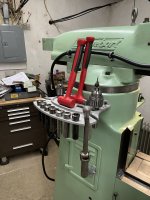
IMG_8406.jpeg

BTW, This fun collet rack was designed and manufactured in New Castle Delaware, which is about 45 minutes to my south. It has slots to hold your 3/4" wrenches in various places and also your Kurt vise handle (also 3/4" hex, or at least mine is). Not sure about the copies of this that say CHINA on the top. Sometimes when you make castings of a casting, you lose some fidelity. This one is a real beaut. Point is, for Bridgeports, 3/4" wrenches are a must have. I have a normal one and a short one that I sometimes use as a speed handle on my vise.
 
Last edited:

AEAdam

Well-known member
Joined
May 27, 2023
Messages
2,703
Location
SE PA
Yup. A buddy of mine has a Brother Speedio, and that thing can change tools fast.

But even in a home shop, just playing around, a power draw bar can be useful. Let's say you're doing something simple, like making a 4 bolt square pattern on a flange, and you want the holes counter-bored and chamfered for a big cap screw. That's, what, 5 operations and tool changes per hole?
- Spot drill
- Pilot drill
- Main drill
- Counterbore
- Chamfer

20 tool changes just to do 4 holes. You'll be 10 minutes deep just in tool changes on that job doing it manually. Yeah yeah you could just do all 4 holes with each tool before changing to the next tool, but now you're exchanging tool changing for wheel spinning and increasing your odds of being off center with an operation.
Confused. I do all these operations with a drill chuck. Why would you collet change for this?

I have an old Metabo keyless chuck that's so so. Just haven't found a cheap Albrecht in good shape yet.

Hey- never mind. There are 1000 ways to do anything in a machine shop or wood shop. No right or wrong answers.

Pretty sure the Brother Speedio is the machine FoxConn bought to make the iPhone bodies.
 

American Locomotive

Well-known member
Joined
Jan 8, 2017
Messages
10,928
Location
Rhode Island
Confused. I do all these operations with a drill chuck. Why would you collet change for this?
Depends on what size holes you're drilling, what kind of tooling you're using and what kind of accuracy you're looking for. Carbide in a drill chuck is usually bad for business, for example. Likewise making a flat-bottom counterbore with an endmill in your drill chuck is probably going to end badly.
 
To avoid these ads, REGISTER NOW!

b-dog

Well-known member
Joined
Apr 24, 2015
Messages
238
Location
Lakewood, CO
It's a "quality of life" thing and I'd like one on my mill too. I'd also like a powered knee.

An actual powered knee with the fancy lever would be nice. However, a drill chuck drive adapter was THE FIRST thing I bought for my mill. I have a dedicated drill that just sits on the knee spindle.
 

b-dog

Well-known member
Joined
Apr 24, 2015
Messages
238
Location
Lakewood, CO
I just added power feed for the knee. Maybe that'll trigger somebody, too. I've only used it a couple times so far but I like it.

I'm blown away by how many people are actually against the power draw bar :LOL:

As for the spindle key - I've never used a machine with one intact. I didn't know there was even supposed to be a key for a long time. I'd be the happy to pop one out if I had the opportunity.
 
OP
W

whateg01

Well-known member
Joined
Mar 13, 2006
Messages
11,187
Location
doo dah, kansas, usa
An actual powered knee with the fancy lever would be nice. However, a drill chuck drive adapter was THE FIRST thing I bought for my mill. I have a dedicated drill that just sits on the knee spindle.
I did that for awhile. Didn't have a dedicated drill for it though, so most times I just cranked it by hand rather than getting the drill. I did add a ratchet to make it easier to raise the knee, say, 25 thou at a time. The ratchet could be kept at the perfect position for easier cranking.
 
OP
W

whateg01

Well-known member
Joined
Mar 13, 2006
Messages
11,187
Location
doo dah, kansas, usa
Nothing worse than reaching up and not being able to change a tool because the power draw bar is malfunctioning, compressor not turned then waiting for the air to pump up, or just not working.

A 3/4” wrench is always ready to go.

Home-hobby shop not needed. Buy a mill that already has one? Cool.

John
The ones I'm looking at seem to leave the top of the drawbar exposed, so I could just use a wrench if I needed to. I do see some that are completely encased though.
 
OP
W

whateg01

Well-known member
Joined
Mar 13, 2006
Messages
11,187
Location
doo dah, kansas, usa
-After 40+ years in machine shops, much of it using a BP, I guess I don't measure up to your knowledge yardstick. Estimating your skill/knowledge level by the questions you frequently ask I don't think you know as much as you like to think you do. Even stating that the internal key was "removed" by someone demonstrates that. I won't be helping you with your apprentice level questions any more and we'll both be happier for it.
Ok, bye! You'll be sorely missed! 🙄
 

AEAdam

Well-known member
Joined
May 27, 2023
Messages
2,703
Location
SE PA
Ok, bye! You'll be sorely missed! 🙄
Come on guys, seriously. @whateg01, he's trying to HELP you.

I don't want GJ to become the inverse of PracticalMachinist. In PM, amateurs like me are discouraged from posting. Here, we insult the pros to get them to quit, then we can share misinformation without those pesky experienced people around. Perverse.

Speaking of which, PM would probably be a good place to search if you haven't already.
 

alfadan

Well-known member
Joined
Mar 9, 2007
Messages
2,102
Location
Augusta, ks
I don't have a power draw bar or the desire for one at the moment, though I suppose they can be helpful. If I were interested in speed, an ER collet holder would be my choice.

I had a drill adaptor on the knee for a while, but the drill stuck out so far, it got to be bothersome to have to walk around it, especially to see the work on the right side of the vice. It has wrench flats on it for hand feed, but the bracket I had to hold the drill in place got in the way.
 

Bigblue&Goldie

Well-known member
Joined
Mar 12, 2009
Messages
10,662
Location
AZ
Yes. I'm 5'8 and with a 4" riser block struggle to reach....taller riser and it's time for a stool lol. Power draw bar or one of the quick change tooling setups you change from the working end and never touch the draw bar are big improvements in efficiency and just general ease of operation

The struggle is real. I'm 5'8.5" (per my basketball card stats) and my Bridgeport is on leveling feet and it sits on the gas curb in my garage. It makes it super ergonomic to use as I'm not hunched over, but I definitely need a stool to change a collet.
 
OP
W

whateg01

Well-known member
Joined
Mar 13, 2006
Messages
11,187
Location
doo dah, kansas, usa
I don't have a power draw bar or the desire for one at the moment, though I suppose they can be helpful. If I were interested in speed, an ER collet holder would be my choice.

I had a drill adaptor on the knee for a while, but the drill stuck out so far, it got to be bothersome to have to walk around it, especially to see the work on the right side of the vice. It has wrench flats on it for hand feed, but the bracket I had to hold the drill in place got in the way.
Er collets was the first thing I did to help speed things up on the old round column mill drill.

Fwiw, remove the handle before running the power feed on the knee.
 

American Locomotive

Well-known member
Joined
Jan 8, 2017
Messages
10,928
Location
Rhode Island
An actual powered knee with the fancy lever would be nice. However, a drill chuck drive adapter was THE FIRST thing I bought for my mill. I have a dedicated drill that just sits on the knee spindle.
The powered knee is definitely one that should be done well before a powered draw-bar, that's for sure. Power feed on the knee makes the usability of the mill so much better.
 

Firebrick43

Well-known member
Joined
May 12, 2015
Messages
13,973
Location
West central Indiana
7 degrees and less is considered self locking taper in machine spindles, for example MT is 1.49 degrees.

10 degrees or larger taper is considered self releasing.

The majority of CNC tools except HSK are based on the original 1931 adopted NTBM taper angle of 7/24, including all the CAT tapers and BT. This is 16.59°

R8 is 16°51" or 16.85° that bridgeport/hardinge came up with in 1952 or 3? They changed the angle ever so slightly just to say they didn't copy? They are self releasing or should be for anything but collets.

But the spring forces in collets that sometimes make them stick is why drawbar wrenches are made of aluminum and have a knocker on the end of the handle to pop the drawbar after its loosened a turn. Many of the power drawbars are just butterfly impact wrenches mounted on spring loaded post although some put everything in a nice housing that hides that fact. But they have (or should have) enough vibration to loosen even a collet. A lot of spindles are damaged after years of use. I have reground a lot of tapers.

Have you considered TTS system? Many of the tools can be changed with loosening the modified 3/4 collet just a turn and the face contact makes for a much more stable tool/tool holder and length repeatability is much improved. Their superfly leaves a very nice finish for the money, although not very fast removal rates.
 
Last edited:
OP
W

whateg01

Well-known member
Joined
Mar 13, 2006
Messages
11,187
Location
doo dah, kansas, usa
7 degrees and less is considered self locking taper in machine spindles, for example MT is 1.49 degrees.

10 degrees or larger taper is considered self releasing.

The majority of CNC tools except HSK are based on the original 1931 adopted NTBM taper angle of 7/24, including all the CAT tapers and BT. This is 16.59°

R8 is 16°51" or 16.85° that bridgeport/hardinge came up with in 1952 or 3? They changed the angle ever so slightly just to say they didn't copy? They are self releasing or should be for anything but collets.

But the spring forces in collets that sometimes make them stick is why drawbar wrenches are made of aluminum and have a knocker on the end of the handle to pop the drawbar after its loosened a turn. Many of the power drawbars are just butterfly impact wrenches mounted on spring loaded post although some put everything in a nice housing that hides that fact. But they have (or should have) enough vibration to loosen even a collet. A lot of spindles are damaged after years of use. I have reground a lot of tapers.

Have you considered TTS system? Many of the tools can be changed with loosening the modified 3/4 collet just a turn and the face contact makes for a much more stable tool/tool holder and length repeatability is much improved. Their superfly leaves a very nice finish for the money, although not very fast removal rates.
on an R8 drill shank, there are no spring forces. It's a solid chunk. So, why don't drill chucks just fall out? Or my R8 shank fly cutter? Even talking about R8 collets, there is no spring force holding it in place. When drawn tight, the collet is forced between the tool and the taper, so it is essentially solid, as well. Sure you could pull an empty collet into the taper and it would stay put, but I could easily just stick my finger in it and slide it free. That's not the same thing. And gaslighting me, saying it doesn't happen, is BS, too or else there wouldn't be a need for the knocker that is so common. I use a round brass slug that lives next to the vise.
 

Firebrick43

Well-known member
Joined
May 12, 2015
Messages
13,973
Location
West central Indiana
on an R8 drill shank, there are no spring forces. It's a solid chunk. So, why don't drill chucks just fall out? Or my R8 shank fly cutter?
They should fall out. I said above?
A lot of spindles are damaged after years of use. I have reground a lot of tapers.

Even talking about R8 collets, there is no spring force holding it in place. When drawn tight, the collet is forced between the tool and the taper, so it is essentially solid, as well. Sure you could pull an empty collet into the taper and it would stay put, but I could easily just stick my finger in it and slide it free. That's not the same thing.
A collet has to have a tool placed in it so it is slightly oversized. When that collet is tightened (with a drawbar) the shape is forced to change significantly by being forced and flexed by the taper, aka spring pressure, I am not talking about being pushed in with your finger. Morse tapers dont lock either buy finger force.
And gaslighting me, saying it doesn't happen, is BS, too or else there wouldn't be a need for the knocker that is so common. I use a round brass slug that lives next to the vise.
I don't know what your are worked up about? I never said it didn't happen? I literally mentioned the knocker as well in the post above :headscrat
But the spring forces in collets that sometimes make them stick is why drawbar wrenches are made of aluminum and have a knocker on the end of the handle to pop the drawbar after its loosened a turn.
 
OP
W

whateg01

Well-known member
Joined
Mar 13, 2006
Messages
11,187
Location
doo dah, kansas, usa
They should fall out. I said above?
I've always heard that they should. I've always also heard that you usually have to knock them loose, which I do.

A collet has to have a tool placed in it so it is slightly oversized. When that collet is tightened (with a drawbar) the shape is forced to change significantly by being forced and flexed by the taper, aka spring pressure, I am not talking about being pushed in with your finger. Morse tapers dont lock either buy finger force.
I'm not talking about being slightly "stuck" in the taper. That's what I'm getting at. I mean being locked in the taper requiring a tap to get it to come free.

I don't know what your are worked up about? I never said it didn't happen? I literally mentioned the knocker as well in the post above :headscrat
Wasn't you that said it. Somebody else also said that the reason the collet gets locked in the taper is because of the key, which is also not true. Sorry, didn't mean to imply that you said it if it came across that way.
 

dutchgray

Well-known member
Joined
Sep 28, 2014
Messages
6,461
Location
Dorset. England.
Who here has the factory Bridgeport draw bar wrench with the bend in it, makes reaching by hand easier.
The open end is a smaller size and fits the smaller nuts on the table power feed trips, which are really the only thing on a Bridgeport that you need to adjust regularly that isn't 3/4"20260302_135730.jpg
 
Last edited:

jmarkwolf

Well-known member
Joined
Jan 15, 2013
Messages
1,809
Location
Southeast Michigan
I don’t understand power draw bars. It takes me seconds to change a collet. Is it a function of how tall the user is? Can normal sized people not reach the top of the spindle? Maybe due to leveling feet or a riser block?
I'm 6 foot and I had no issue reaching the drawbar on my 1967 Bridgeport, but when I replaced it with a new Acer eMill as a retirement gift to myself 9 years ago there was no way I could reach the drawbar without a step stool.

Then, fearing a misstep on/off the step stool I bought a power drawbar. Never regretted the decision.
 

dr_clyde

Well-known member
Joined
Jan 7, 2009
Messages
6,423
Location
Holland, MI
I suspect speed alone isn't the real reason these are popular.

I'm a little over 6'6". I don't have a riser, tho my machine is jacked up on adjustable feet maybe 8". That puts the head in a comfortable position for me. I think if I couldn't see the draw bar, or needed a step stool, I'd feel differently about power draw bars.

To be clear, I have absolutely nothing against power draw bars. I'm learning in this thread why people like em.
Just out of curiosity, have you ever used a machine equipped with a power draw bar?

I'm 6'3", never had any issues with reach or dexterity. Even on my machine that has a riser. I have one bridgeport set up for a specific part family and I never change tools on it, so I don't even remember the last time I used the drawbar on that machine. But my main machine that I use for general work has the power draw bar and I absolutely love having it.
 

AEAdam

Well-known member
Joined
May 27, 2023
Messages
2,703
Location
SE PA
Just out of curiosity, have you ever used a machine equipped with a power draw bar?

I'm 6'3", never had any issues with reach or dexterity. Even on my machine that has a riser. I have one bridgeport set up for a specific part family and I never change tools on it, so I don't even remember the last time I used the drawbar on that machine. But my main machine that I use for general work has the power draw bar and I absolutely love having it.

No, I haven't. That's why I'm interested in this thread.

I've used mills with power feeds before but never owned one. I really like the old school manual features of my mill, but I feel I've gotten all the authenticity I need from knee cranking!

Power draw bar is a ways off for me, but that decision is pure ignorance on my part. Again, I'm reading/listening.
 
To avoid these ads, REGISTER NOW!
Top Bottom