To avoid these ads, REGISTER NOW!

Propane monoblock air conditioners

bluedog225

Well-known member
Joined
Jan 31, 2012
Messages
3,241
Location
Texas
Why are propane (R-290) monoblock air conditioners allowed in Europe and other developed countries, but essentially unavailable in the United States?

I understand propane is flammable, but I think these systems keep the refrigerant sealed in an outdoor unit. Compared to my natural gas stove with a virtually unlimited supply of flammable gas, they seem pretty safe.

Serious question. From a technical and code perspective, what specifically prevents these from being sold widely in the U.S.? Is it just a shameless money grab by an industry that has bought off the legislators/regulators? Like car dealerships.
 
To avoid these ads, REGISTER NOW!

dscheidt

Well-known member
Joined
Apr 26, 2017
Messages
2,880
In the us, propane systems are limited to 150 gram charge, which isn’t enough for an ac unit. That’s supposed to be changing, but it hasn’t yet. Propane is in use in some self contained appliances, like vending machines and water coolers, as well as freezers.
 

fitter30

Well-known member
Joined
Jun 23, 2019
Messages
2,960
Location
Peace Valley,mo
EPA sets the spec. Refrigeration has been using lp for 25+years . For the stand alone coolers for can and bottle soda in quick shops and gas stations. Installed testing labs at a major case manufacturer in Missouri.
 

NitroGarage

Well-known member
Joined
Mar 2, 2016
Messages
203
Location
Cleveland, OH
There's been a few people on a large internet forum that have imported them from china. I reached out to a company advertising one with a nearly 7.0 COP R290 air source heat pump, $3K landed for the 18kW unit.

Definitely on my radar.
 

pcmeiners

Well-known member
Joined
Aug 13, 2009
Messages
7,826
Location
In the only town in Pennsylvania, Bloomsburg.
Ran into this after researching LP units. Sounds interesting, one test result which gives overall efficiency versus multiple data points which make it difficult to calculate overall efficiency and makes manipulation of data results easy. Now the US should adopt this with a FED government mandated testing procedure (I can dream can't I :)). The HVAC industrial lobbyists will fight this tooth and nail, as it loves to keep buyers in the dark.

Key Aspects of SCOP

  • Definition:It is the ratio of total heating output (kWh) to total energy input (electricity) over a full season
    .
    • Typical Values: Modern air-source heat pumps generally achieve a SCOP of 3.0 to 4.0, while ground-source units can reach 5.0 or higher.
    • Calculation Factors: SCOP accounts for fluctuating outdoor temperatures, standby time, and varied heating demands.
    • Climate Dependence: SCOP values are often calculated based on specific European climate standards (EN14825).
    • Importance: A higher SCOP directly correlates to lower operational costs and reduced environmental footprint.
SCOP vs. COP

  • COP (Coefficient of Performance): Measures efficiency at a specific, single point in time.
  • SCOP (Seasonal COP): Measures average efficiency over the entire, variable
 
Last edited:

danski0224

Well-known member
Joined
Jan 29, 2005
Messages
13,335
Location
Near Naperville, IL
advertising one with a nearly 7.0 COP R290 air source heat pump
Sounds fishy to me.

A quick search is showing a range of 3.0-4.0 COP for air source heat pumps, and the COP will go down as temperature goes down. A COP of 7.0 when it is 70 degrees outside, and you are trying to maintain 71 inside is probably pretty much useless. I think.
 
Last edited:

American Locomotive

Well-known member
Joined
Jan 8, 2017
Messages
10,929
Location
Rhode Island
R290 is great. Relatively low pressure, very cheap, very efficient requiring small charges, and non-ozone depleting and low GWP. Of course, it is flammable. But I think risks are minimal with the fact that HVAC systems rarely have catostrophic loss of charge failures. Risks can be further mitigated with loss of charge switches and/or combustible gas sensors on the indoor unit.

The EPA has significantly increased the R290 charge lmits to 500g for open refrigeration cabinets and 300g for closed cabinets. I don't think there's approval for air conditioning use yet, but provided this refrigeration roll out goes well without anyone blowing up, I think we should see R290 allowed in the near future.
 

danski0224

Well-known member
Joined
Jan 29, 2005
Messages
13,335
Location
Near Naperville, IL
combustible gas sensors on the indoor unit
New R454B equipment has a sensor* in the evaporator coil, and it's either wired to a board or plugged into a board that turns on the circulating fan if the sensor detects anything. The sensor does not indicate a loss of refrigerant to the user.

Given several pounds of refrigerant in a residential split system, the lack of odorant in propane used as a refrigerant, the fact that propane sinks in ambient air, and the possible ignition sources (relays, motor), it doesn't sound too appealing to me.

*: It is important to note that this sensor is NOT required for the equipment to operate. I know for a fact that at least on Bosch equipment, there is a DIP switch for "sensor" or "no sensor", and the outboard box that comes with ICP equipment does not have to be wired into the system to enable operation. If such a requirement comes about in the future, someone will figure out a way to bypass it.

I would NOT be surprised at all if the failure to install/wire these sensors/connectors can cause stuff from property damage to death.
 
Last edited:

fitter30

Well-known member
Joined
Jun 23, 2019
Messages
2,960
Location
Peace Valley,mo
New R454B equipment has a sensor* in the evaporator coil, and it's either wired to a board or plugged into a board that turns on the circulating fan if the sensor detects anything. The sensor does not indicate a loss of refrigerant to the user.

Given several pounds of refrigerant in a residential split system, the lack of odorant in propane used as a refrigerant, the fact that propane sinks in ambient air, and the possible ignition sources (relays, motor), it doesn't sound too appealing to me.

*: It is important to note that this sensor is NOT required for the equipment to operate. I know for a fact that at least on Bosch equipment, there is a DIP switch for "sensor" or "no sensor", and the outboard box that comes with ICP equipment does not have to be wired into the system to enable operation. If such a requirement comes about in the future, someone will figure out a way to bypass it.

I would NOT be surprised at all if the failure to install/wire these sensors/connectors can cause stuff from property damage to death.
All refrigerate has always been deadly. From with a open flame that turns refrigerate into phosgene gas to a high concentration depleting the air.
 

Lassen Forge

Well-known member
Joined
Apr 26, 2014
Messages
15,006
Location
The romantic hills of central Umbria, Italy,
As it was explained to me - one part "safety" - the scare is that if the system leaks in a closed space you induce a flammable atmosphere. Part of the reason they changed from H2S to CFC's are H2S is highly flammable, and CFC's aren't. 290 is (of course) flammable, so yeah... they limit the quantities of 290 to keep a potential leak from replicating the fun of a H2S leak with a source of ignition...

The other is economics - if they made using 290 li consumer quantites legal, who would buy the pricier fluorcarbon refrigerants?

Both my fridge and our split system uses 290, and I dont worry the house will blow up, because technology has moved on from brushed motors etc...


All refrigerate has always been deadly. From with a open flame that turns refrigerate into phosgene gas to a high concentration depleting the air.

Phosgene is the gift that keeps on giving - nasty ugly ****, once exposed the damage doesn't heal. We had a truck cargo fire I responded to and got a goodly whiff or 2 of Phosgene, and my lungs have never been the same.
 

danski0224

Well-known member
Joined
Jan 29, 2005
Messages
13,335
Location
Near Naperville, IL
All refrigerate has always been deadly. From with a open flame that turns refrigerate into phosgene gas to a high concentration depleting the air.
Sure, but a system that does not contain a flammable refrigerant won't ignite if there is a leak+spark.

Or, am I missing something here?
 

pcmeiners

Well-known member
Joined
Aug 13, 2009
Messages
7,826
Location
In the only town in Pennsylvania, Bloomsburg.
We live with natural gas, gasoline, lacquer thinner, propane charged aerosol cans, propane cylinder for camp cooking/soldering, phosgene producing hydrocarbons (heated), gasoline/NG pipe lines, lithium batteries....... What is the big deal with 290?
It is primarily new litigation chum for lawyers.
 

danski0224

Well-known member
Joined
Jan 29, 2005
Messages
13,335
Location
Near Naperville, IL
We live with natural gas, gasoline, lacquer thinner, propane charged aerosol cans, propane cylinder for camp cooking/soldering, phosgene producing hydrocarbons (heated), gasoline/NG pipe lines, lithium batteries....... What is the big deal with 290?
Ok, but why can't I bring a propane cylinder for a grill into a store?

Especially if the store has smaller one use propane cylinders on the shelf, and pallets of flammable paints and other solvents?
 

pcmeiners

Well-known member
Joined
Aug 13, 2009
Messages
7,826
Location
In the only town in Pennsylvania, Bloomsburg.
Ok, but why can't I bring a propane cylinder for a grill into a store?
I see no reason with the newer valves.

As to why.... because a Brooklyn hardware store blew up from massively leaking propane tanks in the 80s. I was in the hardware store when the NY Fire Department was checking it for safety, how they OKed the propane storage beats me, the propane smell was terrible, personally I was nervous being in the store . The store was a bomb waiting to happen, it killed a number of people. The NYFD knew it was dangerous, it was likely payolla .

"A propane explosion on July 21, 1987, destroyed the 18th Avenue Plumbing and Supplies store and an adjacent bakery in Borough Park, Brooklyn, killing 4 people and injuring 11
. The blast occurred when propane tanks were being moved into the basement, where they were being stored illegally."

When I would go to store I prayed no one light a match to smoke.
 
Last edited:

pcmeiners

Well-known member
Joined
Aug 13, 2009
Messages
7,826
Location
In the only town in Pennsylvania, Bloomsburg.
Heat exchanger coupled to a condenser, works like a flat-plate exchange, one side pumps heat /cooling via 290, the other side of the heat exchanger picks up the heat /cooling using a non flammable fluid/gas going to the inside condenser . The heat exhanger does not have to be a flat plate exchange, could be like a regular HP coil, but it would have two fluid circuits, one for the 290 transferring heat/cooling, the other circuit picklng up the heat/cooling given off by the 290 side (like some car radiators). All refrigerant remains outside.
 
Last edited:
To avoid these ads, REGISTER NOW!

Death Row Dave

Well-known member
Joined
May 13, 2020
Messages
484
Location
Home
I worked where we stored 27 million gallons of Propane . It spells Danger to the uneducated . It is heavy in the gas state so a leak is going to puddle up in the lowest place it possibly can , and vent out as lighter gasses do . Propane is no odorized in its natural form , ordorent is highly corrosive to copper , so how long until a leak will happen ?
 

rawen2

Well-known member
Joined
Feb 26, 2021
Messages
164
Location
High Desert of CO
Here's a link to what I found. Web page is lacking in details but if I'm reading correctly they use water to transfer heat between outdoor and indoor units. Propane refrigerant is only present in outdoor unit.

It sounds promising if they are being honest with the numbers. I'll bet the cost is astronomical but competition would help with that.
 

danski0224

Well-known member
Joined
Jan 29, 2005
Messages
13,335
Location
Near Naperville, IL
It sounds promising if they are being honest with the numbers.
The numbers can't be good.

Sounds like an air source heat pump with a plate heat exchanger for the fluid going into the house.

An internet search yields a typical COP for air source heat pumps to be 3-4 on average.

Now there's another heat transfer medium... and losses. Both for the fluid and the pumping of said fluid.

And if it's located in freezing temperatures, now you need glycol to prevent freezing, and a further reduction in heat transfer efficiency and additional pumping losses.

Sounds so optimistic that it could be called a scam.

You are starting with basically an air source heat pump and reducing efficiency from there. Unless I'm missing something, which is possible.
 

pcmeiners

Well-known member
Joined
Aug 13, 2009
Messages
7,826
Location
In the only town in Pennsylvania, Bloomsburg.
Sounds so optimistic that it could be called a scam.

With you, the numbers are high, way too high.... 290 at best is just a little better than 410, no where near 7.
COP=7, the highest number at a temperature =around 47 degrees, for a few milliseconds, or the company has aliens supplying new technology, or the company has some mighty big shovels;) I am betting on the big shovels.
As to the fluid on the home side of the 290 minisplit, it could be any fluid not prone to freezing, either liquid or hydrocarbon gas, as long as it is good at transferring heat or cold. As is water is one of the best heat transfer mediums.

"An internet search yields a typical COP for air source heat pumps to be 3-4 on average."

Agree the average cheap HP is COP 3-4, highest efficiency R 410 HPs are 4.05, high efficiency r290 HP maybe 4.5 (air to air), geothermal around 5 with the newest technology.
 
Last edited:

The Metric System

Well-known member
Joined
Apr 28, 2025
Messages
268
Ok, but why can't I bring a propane cylinder for a grill into a store?

Especially if the store has smaller one use propane cylinders on the shelf
A large part of propane safety is the question of whether a given leak in a given space can reach the lower flammability limit of ~2.1%. If it cannot, then the gas won't ignite even if there is an open flame present.

A leak from a small ~400g cylinder dissipates much more readily than one from a 9kg BBQ tank.

100x small cylinders are a less significant hazard than a single larger one, even if those 100x cylinders represent a greater total quantity of propane.
 
Last edited:

Death Row Dave

Well-known member
Joined
May 13, 2020
Messages
484
Location
Home
Propane LEL 2% UEL 10% . Anything outside of these mixtures will not burn . Specific gravity of vapor 1.5 specific gravity of liquid .5 . Boiling point -44* F . If one does get a leak chances of seeing a cloud in a confined area is very good . Everything has a hazard to use , gasoline , diesel , natural gas , propane and electric . Most issues are ignorance of the hazards , just be safe as you possibly can .
 

The Metric System

Well-known member
Joined
Apr 28, 2025
Messages
268
I design/install flammable gas refrigeration systems for a living.

Here's how the regulatory side works:
  • Regulatory agencies (in the US this is typically UL) set flammable charge limits based on equipment type and application.
  • Below this charge limit no flammability mitigation measures are necessary, you can put the device anywhere with no special restrictions or requirements.
  • You can install systems with a charge above the limit, but then you start to need things like gas leak sensors and ventilation fans and ignition source control etc.
  • The charge limit only applies to a single sealed system, because it sets a maximum on the amount of gas that can leak out through one given leak.
Charge limits are low (typically in the range of 150g - 400g) but hydrocarbon refrigerants are so efficient in terms of heat transfer that even these low charges can accomplish a lot of useful work. The systems are designed to minimize dead space that would divert otherwise useful charge, so you'll see things like smaller filter driers and accumulators compared to a conventional system.

If you need more capacity that can be accomplished within the charge limit, your options become:
  1. Run multiple systems in parallel
  2. Use a secondary heat transfer fluid and keep all the flammable stuff outdoors or in a controlled area
  3. Design for the heavier charge and plan to apply mitigation measures that will keep it safe
Option #1 is usually the most efficient choice.

I have participated in testing where they actually cause a system to leak out directly onto an ignition source to simulate the worst-case situation. The most common outcomes are:
  • Nothing
  • A brief jet/ball of fire similar to what you'd get from a propane plumbing torch
I have yet to see a system actually "explode" but it certainly can happen.

As I understand it the biggest explosion risk is if the design allows heavier-than-air flammable vapors to pool in a low area. Our equipment always has open brackets and continuously on cooling fans to reduce the chance of this type of pool developing.
 

Mr onetwo

Well-known member
Joined
Apr 6, 2011
Messages
2,002
Location
Coastal Maine
People think that a regular Mitsubishi unit is expensive. That one is probably 50% more, just as a guess.

Will not be for the typical cheapskate USA HVAC customer. That system in the video likely eclipsed $100k.
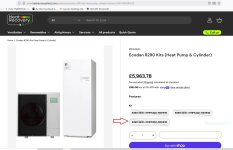
Nah......Capture.JPGlbs.JPGrepresentative pricing in the UK as of today
 

Mr onetwo

Well-known member
Joined
Apr 6, 2011
Messages
2,002
Location
Coastal Maine
I talked briefly with a contractor based south of London last year about these units.Strictly a Mitsu dealer.Total cost of install was roughly comparable to gas fired boiler install when all was said and done.Thru August of 2025 he had installed over 150 systems....very few problems.Said his guys loved them.
 
To avoid these ads, REGISTER NOW!
Top Bottom