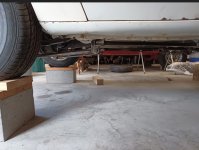
You’re only lifting it high enough to add one layer of cribbing at a time.But at some point that block is kinda tall, which seems dangerous.
Jack goes on its own pile of cribbing. that's why you use a jack with a vertical lift, because you don't want the jack moving horizontally.I’m not worried about the cribbing, I’m worried about the 6-12" block I have to put on top of my jack to get in the next level of cribbing.
Where did they place the jacks? On top of other cribbing next to the corners? Apologies if I’m being dense.


I am guessing stability.Just wondering why some guys are making the stands twice as wide as the tire?
For my tasks 16” for a 12.5” wide tire assures more stability when I torque to spec any suspension components at ride height. More height is optional and can be added later if needed.Just wondering why some guys are making the stands twice as wide as the tire?
I am guessing stability.
I'm going to hijack this thread with another question.
I want to replace the rear leaf spring bushings on my '75 GMC K25, and I've been trying to figure out how to safely lift the rear high enough to get the rear tires fully off the ground by about 5", then let the axle droop so I can remove/replace the leaf spring bushings. It worked on the front springs with a fairly short stack of cribbing under my hydraulic floor jack, but the frame and crossmember there is much lower than in the rear of the truck. I do not have a high lift (or farmer's) jack and probably wouldn't want to use one.
Removing the old bushings will require drilling out the old rubber bushings and then working under the truck beating on the bolts until they come out. Its not the kind of work you want to do under the truck unless things are very stable.
Possible choices for lifting the rear enough to have the axle hang free.
- Lift at the end of the truck with the jack under the receiver for the Class 3 trailer hitch. However, the bottom of the receiver is about 18" off the ground, and since its at the far end of the truck it takes quite a bit of vertical movement before you get the wheels off the ground. It will require a lot of cribbing to get my floor jack to lift high enough to bring the tires off the ground. It also raises both rear wheels at the same time from a single point, which is not very stable from left to right.
- Lift it under the frame, forward of the front spring eye. I have to go quite a distance forward of the axle to ensure I have space to place the jack and then remove/replace the front spring bushing. The one advantage is that it should allow me to do one side at a time, which keeps the truck more stable.
Thanks. I'm open to any input.
Lift it via the rear axle enough to remove the wheels and tires. Once they are off lower the frame onto jackstands or cribbing in front of the fixed end of the leaf springs enough so that the brake drums are almost touching the ground once you get the jack out from under the axle. Most of the weight will be on the jackstands with just the weight of the springs/axle on the jack and you can muscle that part up enough to get your jack out. You remove a lot of the height needed by removing the tires and wheels first.I'm going to hijack this thread with another question.
A little late on the reply, but had to give kudos...

Obviously, it is out of the car, but that is only step one.
On my project car I'm currently using concrete blocks (oriented in the proper direction) with a 2 x 12 on top to spread the load. Height is about 9 1/2" and is working out ok so far. It was a little tight removing the transmission, but it came out the front with the engine already removed. It probably needed on more 2 x 12 stacked to remove it from the side.
![]()
Probably OK… But I’m just not crazy about seeing CMU’s to hold up a vehicle.concrete blocks (oriented in the proper direction) with a 2 x 12 on top to spread the load
Agreed, all it takes is one crack.Probably OK… But I’m just not crazy about seeing CMU’s to hold up a vehicle.
Wife's 1976 Cobra II. She's had it since we got married in 1978 and it's time for a new engine, trans, paint and suspension refresh. Slowly getting there, about ready to paint the engine compartment and start going back together.Need more details on the car; what are you working on?
Yeah, I know. But the blocks are brand new and they haven't been tossed around or seen any kind of movement or impact since the car was set on them.Probably OK… But I’m just not crazy about seeing CMU’s to hold up a vehicle.
That's how my neighbor got killed.Probably OK… But I’m just not crazy about seeing CMU’s to hold up a vehicle.
I've done this on multiple square bodies.I'm going to hijack this thread with another question.
I want to replace the rear leaf spring bushings on my '75 GMC K25, and I've been trying to figure out how to safely lift the rear high enough to get the rear tires fully off the ground by about 5", then let the axle droop so I can remove/replace the leaf spring bushings. It worked on the front springs with a fairly short stack of cribbing under my hydraulic floor jack, but the frame and crossmember there is much lower than in the rear of the truck. I do not have a high lift (or farmer's) jack and probably wouldn't want to use one.
Removing the old bushings will require drilling out the old rubber bushings and then working under the truck beating on the bolts until they come out. Its not the kind of work you want to do under the truck unless things are very stable.
Possible choices for lifting the rear enough to have the axle hang free.
- Lift at the end of the truck with the jack under the receiver for the Class 3 trailer hitch. However, the bottom of the receiver is about 18" off the ground, and since its at the far end of the truck it takes quite a bit of vertical movement before you get the wheels off the ground. It will require a lot of cribbing to get my floor jack to lift high enough to bring the tires off the ground. It also raises both rear wheels at the same time from a single point, which is not very stable from left to right.
- Lift it under the frame, forward of the front spring eye. I have to go quite a distance forward of the axle to ensure I have space to place the jack and then remove/replace the front spring bushing. The one advantage is that it should allow me to do one side at a time, which keeps the truck more stable.
Thanks. I'm open to any input.
That’s what the neighbor said.Yeah, I know. But the blocks are brand new and they haven't been tossed around or seen any kind of movement or impact since the car was set on them.