To avoid these ads, REGISTER NOW!

What epoxy for pinhole leak in a 5 gallon steel gas can

LeeG

Well-known member
Joined
Nov 29, 2012
Messages
1,525
Location
Phoenix, AZ
Like it says. This is a 5 gal nato style can I carry in my truck. Small weeping hole in the side. Looks like it got dented and the hole is at the edge of the dent.

Lee
 
To avoid these ads, REGISTER NOW!

cgrutt

Well-known member
Joined
Mar 4, 2016
Messages
8,200
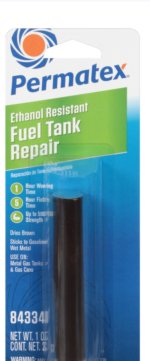
I'd probably try to solder or braise (with an SSF-6 silver rod) it but they do sell tank repair kits such as these. No experience with either.

Screenshot_20260308_152212_Chrome.jpg

Screenshot_20260308_152316_Chrome.jpg
 

WildBill

ALLIANCE MEMBER
Joined
Aug 20, 2021
Messages
1,987
Location
PNW
I used that permatex stuff on a ford truck gas tank that had a bunch of small rust holes on the bottom front corner, still holding fine about 5 years later. Just wire wheeled it and cleaned it off first. I tried chipping some off, wasn't going anywhere.
 
OP
L

LeeG

Well-known member
Joined
Nov 29, 2012
Messages
1,525
Location
Phoenix, AZ
It is a $120 Wavian can. I'd rather not just pitch it. I have patched my old Bitz steel cans in the past, but I don't remember what I used.
 

MichaelP

Well-known member
Joined
Jul 27, 2009
Messages
921
Location
IL/WI border
You can buy a metal gas tank for $50, and it'll serve much longer than the rusted and patched NATO tank. And you won't need to worry about fuel leaking inside your vehicle.

The NATO tank can become a sentimental artefact of your collection.
 

Junkman

Well-known member
Joined
Dec 18, 2006
Messages
6,617
Location
Northeastern CT
In 1959, I was introduced to a product called Metalset A4. I used it to repair a hole in my car's gas tank. It worked perfectly, and 10 years later, when the car was full of rust, the repair was still intact.
 

American Locomotive

Well-known member
Joined
Jan 8, 2017
Messages
10,935
Location
Rhode Island
You could Kreem it. Used on motorcycle gas tanks forever.

That stuff just falls off after a few years and makes a mess.
I would think you’ll need to fill it with an inert gas before you weld on it.

Agree. I would not consider a torch on a gas tank unless filled with CO2. That said I have used steel reinforced epoxy putty on gas container, no issues.
If you completely fill the tank with water (twice if you're really worried about it), it will purge all flammable vapors out. Steel doesn't absorb fuel.
 

American Locomotive

Well-known member
Joined
Jan 8, 2017
Messages
10,935
Location
Rhode Island
Don't blame the product for poor prep. I have never had an issue.
Every motorcycle I've ever seen or owned that had a "Kreem" coated tank, had the coating fail and flake off in huge chunks. Maybe it lasted 10 years? I don't know, since I bought them used. But it's unreliable enough to know that it's not a long term fix, and a waste of money.

On the other hand, soldering the pinhole will take 5 minutes of time, requires almost no prep besides some sand paper, and will be a very durable fix.
 
To avoid these ads, REGISTER NOW!

Uncle murph

Well-known member
Joined
Jan 28, 2021
Messages
1,461
Location
Harford county
None, they will all fail. You need to solder or weld it. Soldering is probably the easiest.

Drain can out, fill can to the brim with water, shake it all around to make sure no air pockets, dump water out.

Sand the paint off, use plenty of flux, and use a torch you can control the flame.
With a little luck it might not explode. I wouldn’t risk it having seen others attempts ending badly.
 

American Locomotive

Well-known member
Joined
Jan 8, 2017
Messages
10,935
Location
Rhode Island
With a little luck it might not explode. I wouldn’t risk it having seen others attempts ending badly.
I've soldered multiple steel gas tanks before, from motorcycle tanks to truck tanks. If you completely fill them with water, all flammable vapors will be gone from the tank. There just isn't any other possibility.

I can understand and appreciate the apprehension. But you just have to approach it logically: If you remove all of the fuel from the tank, and then fill it completely up with water such that there is no air at all left, then ALL of the flammable liquids and vapors would have been displaced from the tank. There is no other possibility. Gas can't permeate into steel and hide.
 
Last edited:

BurtEggley

Well-known member
Joined
Oct 8, 2024
Messages
860
steel does absorb the H2 in the fuel and outgas with heat. Water also does not remove the flammable oils. I know this for a fact because years ago I cut a tank in half while full of water. Tossed the water out and set the tank aside. Everytime i walked by it for a week I smelled fuel. Tossed a match in it and ****!

Rinse it out with hot soapy water. Rinse. Fill half to 2/3 with water and toss in some dry ice from the grocery store. Lots sell it now. The dry ice will turn to gas and when you see it spilling out the opening CO2 has replaced the air. Then do your soldering. Use a high quality solder for brazing type repairs, otherwise it may crack. Personally I would write it off to a bad choice of where to set it down, or where to park etc., and buy a new one. Can't imagine what a small pinhole spilling a gallon or two of gasoline would do to a garage when a spark comes along.
 

dcg9381

Well-known member
Joined
Jun 20, 2018
Messages
11,640
Location
Austin, TX
None, they will all fail. You need to solder or weld it. Soldering is probably the easiest.
Gonna go with not soldering on a gas tank. Grinding it off is bad enough (use sandpaper), over-patch it with fiberglass, paint for UV protection.

Hell, I patch my plastic tanks with 3M marine stuff...


(not saying any of this is real advise, but sometimes you gotta do what you gotta do)
 

lolaetype

Well-known member
Joined
Dec 11, 2019
Messages
2,080
Location
North Western Arkansas
I've bought three military style gas cans in the past few years. I de-rust them by shaking a chain and small fasteners in them, then use muriatic acid to clean the inside, followed by a thorough rinsing. Then I use Eastwood's gas tank sealer to coat the inside.

One of the cans had pinholes that I first filled and sanded with regular JB weld, the same as I'd do body filler. The Eastwood tank sealer doesn't let the gasoline get to the JB weld. I've been using that tank for about 10 years and it refuses to leak.
 

BurtEggley

Well-known member
Joined
Oct 8, 2024
Messages
860
I've been using that tank for about 10 years and it refuses to leak.

best way to ruin a good thing is to say it like that. I told some buddies one night while we were working on a race car that I'd never seen my now ex-wife angry or upset. They laughed at me, both being recently divorced, and said wait a while. She showed up a little later that day with three cups of coffee for us. Pleasant as could be handing them their coffee, she dropped mine all over me and stormed off. Turns out she didn't like to be alone and that was the first time we had been apart except for work. She was jealous of the car. Buddies were like, the dude is out of touch. So yeah, you've never seen that tank leak, eh?
 

NUTTSGT

Super Moderator
Staff member
Joined
Sep 14, 2009
Messages
50,870
Location
Northern Central Ohio
We usually have some tank sealant on the Engine. I forget the brand but it works decent enough that it was purchased and given to us by the County EMA office.
 

LopezBart

Well-known member
Joined
Oct 13, 2023
Messages
2,525
Location
Lopez Island, WA
I once fixed a actively leaking polyethylene plastic gas tank seam on a mower w/ a soldering iron while it was leaking.... I did shut off the mower, though.

The dry ice approach does work well; there's a neat trick w/ pouring CO2 from sublimating dry ice into a jar w/ a burning candle that demonstrates how the heavier gas sinks to the bottom.
 

LSU

Well-known member
Joined
Dec 4, 2011
Messages
701
My two cents worth - I think the patch works on gas tanks that you're using "all the time" but what I'm afraid of is gas tanks that you use "some of the time" - you know, the ones that you use and then shove off into the garage and you do not notice the slow drip or leak until you see the gasoline pooled on the ground.

I have a fishing camp that I go to infrequently and I'm always amazed and how "stuff" leaks - gas tanks, plastic fuel cans, etc. I think something is fine to store and when go to the camp there is always some sort of leakage around the bottom of the base of the container. Honestly = I don't know where it comes from.

My camp has a large cistern where we collect rain water to shower in, wash dishes, etc. and I've used most of the above prodcuts these products to patch PVC & PEX lines with great success but I'm not sure I'd trust them to hold long term gasoline storage in a confined space.

Just my thoughts.
 

larry4406

Well-known member
Joined
Jan 27, 2006
Messages
19,073
Location
Northern Virginia
I’ve done the water rinse out process and solder method on an old 1 gal metal gas can like @American Locomotive mentioned.

This was around 1978 time frame. Mower threw a rock into my minibike fuel can. I was in middle school and method was approved by dad and I’m still here. Was uneventful.
 

Old Man Roger

Well-known member
Joined
Apr 6, 2017
Messages
17,439
Location
Palm Coast Florida
Anytime I’ve welded a gas tank, and there have been a few, I used soap and water to wash it out. So far none have exploded, now I did have a close call on a tune pipe from my kx125, lost an eyebrow on that one.lol I didn‘t think to wash that one out before I welded it.
 

ATC

Well-known member
Joined
May 12, 2012
Messages
8,266
Location
VA
JB weld. The original cold weld. Lots of ATV tanks have been done with it. 35 years ago my brother put a hole in the bottom crankcase of his 3-wheeler with a rock on the trail. Slathered the hole with JB Weld and it is still holding just fine to this day (I owned it, and now my friend owns it)
 

KenC

Well-known member
Joined
Dec 20, 2009
Messages
2,577
I'd solder, with an old-fashioned soldering copper so no open flame. Clean well, rinse with water, clean again. Clean and prep with acid. Apply some solder to a hot copper soldering iron, apply solder to the can near the iron. when it melts it will flow and seal.

I've seen my Dad assemble galvanized guttering like that and watching the solder follow the heat is amazing.

Might have to go to an antique shop (or eBay) to find a soldering copper. Maybe even an old gas torch to heat it.
 

Jay870

Well-known member
Joined
Mar 9, 2024
Messages
121
I have no particular knowledge of the why, but lots of resources, including Wavian, say Wavian fuel cans should not be filled with water due to the lining/sealant being used.
 

Recoveryman

Well-known member
Joined
Aug 18, 2015
Messages
76
Location
Southern indiana
Another old time way to get rid of gas fumes in a can is to stick the filler pipe of the gas tank over an exhaust pipe of a running engine and let it run for some time, I'm thinking maybe an hour. I've seen it done a number of times.
Recoveryman
 

PCustoms

Well-known member
Joined
Jul 23, 2011
Messages
22,392
Location
VT
I have no particular knowledge of the why, but lots of resources, including Wavian, say Wavian fuel cans should not be filled with water due to the lining/sealant being used.

That's probably because the water would not be drinkable...
 
To avoid these ads, REGISTER NOW!
Top Bottom