To avoid these ads, REGISTER NOW!

Can anyone school me on hot water booster pumps?

evintho

Well-known member
Joined
Apr 6, 2006
Messages
1,358
Location
Santa Rosa, CA.
We're about to remodel our small master bathroom. Currently, when I turn on the shower it takes several minutes for the water to get hot. I assume a hot water booster pump plumbed into the hot water heater would alleviate that or at least get the water hot faster. Is that right? I see them listed on Amazon for $50 to $500. How do they function and what are the pros and cons? Any help is greatly appreciated!
 
To avoid these ads, REGISTER NOW!

The Cobbler

Super Moderator
Staff member
Joined
Oct 24, 2013
Messages
25,835
Location
Niagara Region, Ontario, Canada
a pump will work, you can put it on a timer to regulate the recirc period to avoid heat loss if you want
you can do it without a pump and do it with a gravity loop too . you can still time that with a solenoid to regulate the time it's operational
there is another system where the pump uses the cold water to return the cool hot water to the tank until it's hot . that's basically a manual on demand system
I would do a gravity system if you have the bathroom at a higher point than the water heater and you can get a return line to the water tank

A gravity-fed recirculating hot water system uses natural convection to provide instant hot water by circulating water through a return line, without a pump. The principle depends on hot water rising, while denser, cooler water sinks back into the bottom of the water heater, creating a self-starting loop.
 
Last edited:

DGersic

Well-known member
Joined
Mar 12, 2017
Messages
6,281
Location
DeKalb, IL
I’ve been running a passive recirculation loop for a couple of years now. Works great. Shower and bathroom faucet both get hot water in less than a couple of seconds. Cost is theoretically higher, but in practice I have not noticed a change in the gas bill.
 

kbuhagiar

Well-known member
Joined
Dec 27, 2005
Messages
1,736
Location
Escondido, CA
I’ve been running a passive recirculation loop for a couple of years now. Works great. Shower and bathroom faucet both get hot water in less than a couple of seconds. Cost is theoretically higher, but in practice I have not noticed a change in the gas bill.
Gravity loops here, too. Work really well, rarely wait more than 10 seconds for hot water.
 

Junkman

Well-known member
Joined
Dec 18, 2006
Messages
6,617
Location
Northeastern CT
The one I saw on This Old House was hooked up to the hot water line, with a reline plumbed into the cold water line. When you wanted to use it, you pushed a button under the sink, and it would circulate the water until the hot water arrived, at which point the heat turned off the circulating pump. I was going to do this, but never got around to it. We just turn on the hot water, and it comes up fairly fast, in about 30-45 seconds. Since we are on a well, we don't have to pay water bills, but it is wasteful.
 

FullRaceMerc

Well-known member
Joined
Jan 9, 2015
Messages
3,838
Location
SoCal (SGV)
A booster pump isn't really what they use for that. That's more for a low pressure situation. We use a booster pump up at the retirement place. The house is on a hill & water comes from the street below. Halfway up is the booster pump. Without it water doesn't make it to the top.

For instant hot water normally you use a recirculation pump. There are 2 types of recirculating pumps that I'm familiar with.

The first type uses a 3rd line (1 is hot. 2 is cold. 3 is recirc) back from the most distant fixture where you want hot water. The recirc line is connected to the hot line near the most distant fixture. The pump draws water from the recirc line & sends it into a tee on the cold side of the water heater.

It pumps the water in a loop so there is hot water at any point along the loop. Frequently these are on a timer, so you're only heating water at times where you are likely to use it. And on some systems the pump cycles on & off based on temperature. It can be important to use one way valves to prevent cold from backfeeding thru the recirc line when the pump is off. Some systems also need an expansion tank.

Navien brand tankless water heaters can include the pump built in.

The second type of system is a pump located under a sink far from the water heater. It pumps water from the hot line into the cold line so the hot line fills up with hot water. Some systems have the on-demand button as mentioned above. Others are temp controlled. They can also be on a timer, so you're only heating water at times when you are likely to need it. This system is usually easier to add to an existing house, since you don't have to run the 3rd line. The disadvantage is warmer water in your cold line. Not a big deal most of the time.
 
Last edited:

58Yeoman

Well-known member
Joined
Oct 1, 2010
Messages
8,999
Location
Central IL
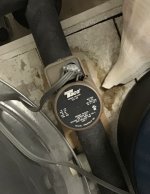
Mine works a bit differently. I have a timed pump on the water heater that will push the hot water to the kitchen sink, pushing hot water back through the cold water line. I have used this system for at least 20 years from my other house, and now this house. I time it for a couple hours for when we will need hot water to wash the dishes. Our meal times may vary. Of course, at those times, if you want cold water, you have to let it run for a bit to get the hot water out of the lines. As soon as you quit with the cold, the pump will push more hot through until that silvery thing you see beneath the sink between the lines senses the temp change and closes, which shuts off the pump.

In my other house, I used it for the bathroom which was farthest from the heater. In this house, the kitchen is farthest from the heater. We're in the country on a well, so we don't pay for our water, except for two times when our pump failed. OUCH. The second time was a short time out of warranty. Wasn't the pumps fault though, anyway.SDC10501.JPGSDC10502.JPGSDC10502.JPG
 

ADKAmateur

Active member
Joined
Feb 9, 2026
Messages
31
FullRaceMerc nailed it. My basement wasn’t finished so I was able to loop my hot water lines and add a Grundfos recirculating pump that tracks your patterns so it minimizes energy use. Highly recommend it. Instant hot water at every tap in my house. If you already have a return line into your hot water tank that is all you need - I had to loop everything and add that. Otherwise, unless you want to do a lot of surgery the under sink version is your answer. You have to install it at the sink the farthest from your hot water tank.
 

Jackfre

Well-known member
Joined
Dec 26, 2010
Messages
4,406
Location
N CA
Just a few miles S of you in Pet. As you are about to start a re-model you should analyze the lay-out of your HW piping before doing anything else. You are likely suffering from the original low-cost bidding meathead plumber syndrome. Your problem could be fixed by a re-pipe or re-circ. Are you planning on upgrading your tank to tankless or heat pump? I’ve solved a lot of HW delivery problems by adding a direct line to a fixture. The under-counter Grundfos system do wrk well.
 

Hank11

Well-known member
Joined
Aug 19, 2019
Messages
1,141
Location
Tennessee
How about a point of use heater? Plumbed in line with current hot line? You’d get near instant hot and shortly it would be drawing hot from the main tank.
 

HoosierMark

Well-known member
Joined
Jan 31, 2013
Messages
1,440
Location
Southeast IN
I have a simple setup. My hot water line is in a loop from the water heater. I have a recirculating pump and control it from the master bedroom. That is the furthest point from the WH. I flip it on and in a very short time have hot water when I open valve. For the few times we have company I just let it run. Our kitchen and other bath are right above the WH so thermal gravity provides almost immediate hot water.
 

SILVERPLATE

Well-known member
Joined
Jun 29, 2005
Messages
1,701
Location
Fort Worth, Texas
My pump is located immediately in the hot water return line throughout the house. i have immediate hot water at every sink in our home at all times. My unit pumps away from water heater.
IMG_7002.jpeg
 
Last edited:

larry4406

Well-known member
Joined
Jan 27, 2006
Messages
19,073
Location
Northern Virginia
Do these pumps:
  • "pump away" from the water heater meaning they are located on the supply side close to the water heater, or
  • "pump towards" the water heater meaning they are located on the return side prior to the water heater, or
  • makes no difference, pick one
After my master bath project is done, this will be the next project I am thinking. The master bath has been plumbed to pipe the hot water thru it to benefit all hot water fixtures and to then continue thru the hall bath, and other various fixtures. I will need to complete the remainder of the loop in the basement.
 

FullRaceMerc

Well-known member
Joined
Jan 9, 2015
Messages
3,838
Location
SoCal (SGV)
Do these pumps:
  • "pump away" from the water heater meaning they are located on the supply side close to the water heater, or
  • "pump towards" the water heater meaning they are located on the return side prior to the water heater, or
  • makes no difference, pick one
After my master bath project is done, this will be the next project I am thinking. The master bath has been plumbed to pipe the hot water thru it to benefit all hot water fixtures and to then continue thru the hall bath, and other various fixtures. I will need to complete the remainder of the loop in the basement.
If it is a temperature controlled pump, you would want it between the last fixture on the loop & the water heater. Otherwise it would turn off before hot reaches the last fixture.
 

JohnX14

Well-known member
Joined
Jun 2, 2014
Messages
550
Location
Boston 'burbs
The first type uses a 3rd line (1 is hot. 2 is cold. 3 is recirc) back from the most distant fixture where you want hot water. The recirc line is connected to the hot line near the most distant fixture. The pump draws water from the recirc line & sends it into a tee on the cold side of the water heater.

It pumps the water in a loop so there is hot water at any point along the loop. Frequently these are on a timer, so you're only heating water at times where you are likely to use it. And on some systems the pump cycles on & off based on temperature. It can be important to use one way valves to prevent cold from backfeeding thru the recirc line when the pump is off. Some systems also need an expansion tank.
This is what I've seen done in all the higher end houses I work in.
 

larry4406

Well-known member
Joined
Jan 27, 2006
Messages
19,073
Location
Northern Virginia
Do these pumps:
  • "pump away" from the water heater meaning they are located on the supply side close to the water heater, or
  • "pump towards" the water heater meaning they are located on the return side prior to the water heater, or
  • makes no difference, pick one
After my master bath project is done, this will be the next project I am thinking. The master bath has been plumbed to pipe the hot water thru it to benefit all hot water fixtures and to then continue thru the hall bath, and other various fixtures. I will need to complete the remainder of the loop in the basement.

If it is a temperature controlled pump, you would want it between the last fixture on the loop & the water heater. Otherwise it would turn off before hot reaches the last fixture.
In my case it will be a dumb pump. It will run whenever it gets power. I will install an aquastat on the return after the last fixture to measure the temp. Additionally, I will have occupancy sensors in the bathrooms and kitchen. These devices will be wired in series to enable the power to the pump.

No occupancy detected, aquastat low - no pump operation
Occupancy detected, aquastat low - pump runs till aquastat is satisfied and shuts down
Occupancy detected, aquastat satisfied - no pump operation

I am thinking pump location is not relevant with this scheme.
 

FullRaceMerc

Well-known member
Joined
Jan 9, 2015
Messages
3,838
Location
SoCal (SGV)
I will install an aquastat on the return after the last fixture to measure the temp. Additionally, I will have occupancy sensors in the bathrooms and kitchen. These devices will be wired in series to enable the power to the pump.
Are the sensors in parallel & the aquastat in series? If all devices were in series it sounds like every room would have to be occupied for the pump to run.

Other than my confused question above, it sounds like a very cool approach to be ready to meet demand, without running unnecessarily at off times. Very creative solution. I may have to "borrow" that thinking down the road. 👨‍🎓

I'm actually currently considering running a return line & pump at home. But with our varied schedules a timer would have to run too many hours. And since I'm cheap I had pretty much decided against it. I've also been considering 1/2" separate home runs to various fixtures to reduce the volume of water required to obtain hot at each. But the occupancy sensor approach might be the ticket instead.

Hmmm... Maybe double pole light switches in the rooms combined with the aquastat. One pole for the light & one for the pump. If the light's on & water's cold it pumps. Off or hot & it doesn't. We're pretty good about turning the lights off. Gives me something to think about.
 
Last edited:
To avoid these ads, REGISTER NOW!

larry4406

Well-known member
Joined
Jan 27, 2006
Messages
19,073
Location
Northern Virginia
Are the sensors in parallel & the aquastat in series? If all devices were in series it sounds like every room would have to be occupied for the pump to run.

Other than my confused question above, it sounds like a very cool approach to be ready to meet demand, without running unnecessarily at off times. Very creative solution. I may have to "borrow" that thinking down the road. 👨‍🎓

I'm actually currently considering running a return line & pump at home. But with our varied schedules a timer would have to run too many hours. And since I'm cheap I had pretty much decided against it. I've also been considering 1/2" separate home runs to various fixtures to reduce the volume of water required to obtain hot at each. But the occupancy sensor approach might be the ticket instead.

Hmmm... Maybe double pole light switches in the rooms combined with the aquastat. One pole for the light & one for the pump. If the light's on & water's cold it pumps. Off or hot & it doesn't. We're pretty good about turning the lights off. Gives me something to think about.
The Sensorworx occupancy sensors I’ve been studying connect to a power pack. The power pack controls the load (pump in my case). Their logic is “Or”.

So, I get up and go into master bath, it detects me and loop is cold. By the time I’m done with the toilet, the loop is hot and I wash my hands.

I then go to the kitchen. The sensor sees me but the aquastat is satisfied from just having the pump run.

Etc.
 

JohnX14

Well-known member
Joined
Jun 2, 2014
Messages
550
Location
Boston 'burbs
I think some here are way overthinking this. With just the standing losses of the hot water in the supply lines to the fixtures, the water heater isn't using a lot of energy to keep the water hot at the furthest fixture. Running the circulator 24/7 won't use enough energy to notice. For a water heater with a tank. A little different with an on-demand heater.
 

larry4406

Well-known member
Joined
Jan 27, 2006
Messages
19,073
Location
Northern Virginia
I think some here are way overthinking this. With just the standing losses of the hot water in the supply lines to the fixtures, the water heater isn't using a lot of energy to keep the water hot at the furthest fixture. Running the circulator 24/7 won't use enough energy to notice. For a water heater with a tank. A little different with an on-demand heater.
It’s an unintended hydronic heating loop also….
 

FullRaceMerc

Well-known member
Joined
Jan 9, 2015
Messages
3,838
Location
SoCal (SGV)
I think some here are way overthinking this. With just the standing losses of the hot water in the supply lines to the fixtures, the water heater isn't using a lot of energy to keep the water hot at the furthest fixture. Running the circulator 24/7 won't use enough energy to notice. For a water heater with a tank. A little different with an on-demand heater.
I guess I should have specified that I'm thinking about tankless situations. Yeah, an insulated loop with a pump on a tank type water heater is essentially just a bigger tank.

On new work we almost are almost always installing outdoor tankless water heaters these days. No interior space lost for a closet. No elevated platform in a garage. No outdoor enclosure. No exhaust ducting.

I would like to avoid having to repeatedly fire up a tankless unit to heat the lines when not in use.
 
Last edited:

JohnX14

Well-known member
Joined
Jun 2, 2014
Messages
550
Location
Boston 'burbs
I don't think the tankless loops/ pumps work all that well. You are heating the loop vs. a tank that is mostly circulating the loop while still dealing with the standing losses of the tank. As I said, I have a tankless. (2 actually) and I walk into the bath and turn on shower first. Brush teeth, do business, and by then I have a hot shower. And the tank is only 10-15' from the shower in "my" bathroom.
 

Mandres

Well-known member
Joined
Jun 22, 2006
Messages
1,152
I'm intrigued by the guys who've said that a 24/7 passive loop didn't make a noticeable difference in the gas/heating bill.

It seems like that would be hugely inefficient, with the water heater running a whole lot. How is that not driving the bill way up?
 

DGersic

Well-known member
Joined
Mar 12, 2017
Messages
6,281
Location
DeKalb, IL
I'm intrigued by the guys who've said that a 24/7 passive loop didn't make a noticeable difference in the gas/heating bill.

It seems like that would be hugely inefficient, with the water heater running a whole lot. How is that not driving the bill way up?

I don’t have the stats handy, but I’ve looked at my gas bill and it hasn’t dramatically changed with the passive recirc loop. I do have the pipe insulated between the water heater and the bathroom, but not on the return side.

The water returning to the tank isn’t cold, it’s just cooler than what’s in the tank.
 

DGersic

Well-known member
Joined
Mar 12, 2017
Messages
6,281
Location
DeKalb, IL
I'm intrigued by the guys who've said that a 24/7 passive loop didn't make a noticeable difference in the gas/heating bill.

It seems like that would be hugely inefficient, with the water heater running a whole lot. How is that not driving the bill way up?

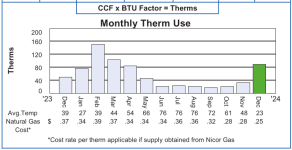
Here is the last few years of natural gas consumption.

Nicor-2022.pngNicor-2023.pngNicor-2024.pngNicor-2025.png

We have gas for heat, hot water, stove, and clothes dryer. The passive loop was installed around March of ‘23.

Naturally, gas use goes up in the winter because of the furnace. I take more showers in the summer than I do in the winter. Cooking goes down in the summer, I do a lot of dinners on the grill or the smoker, fewer on the stove. Not sure about washing clothes, that seems like it would be relatively constant year round, but summer clothes are smaller, lighter, and faster drying than winter clothes.

Still, as you can see, it’s not a huge change running the recirc loop, compare 2022 to 2023, it’s a few cubic feet per month. The few dollars a month are more than worth it.

I used my IR gun to check the pipe temperatures. It’s not losing as much heat as you might think.

108.5F at the top of the water heater
106.9F at the far end of the loop, at the sink return
94.8F at the return to the water heater

So, there you go. One set of data on a passive recirc loop.
 

dcg9381

Well-known member
Joined
Jun 20, 2018
Messages
11,640
Location
Austin, TX
I'm intrigued by the guys who've said that a 24/7 passive loop didn't make a noticeable difference in the gas/heating bill.
It seems like that would be hugely inefficient, with the water heater running a whole lot. How is that not driving the bill way up?
I'm not sure either, I guess if you insulated the return pipe well, it could hold the same value as the hot water tank itself.. But that's optimistic. I don't think I'd ever do a 24/7 recirc system, the cost to heat compared to the cost of "wasted water" verus heating cost would be easy math for most people.

I have a Navien (gas/tankless). And went back and added a recirculation loop, had to program the unit I found the right amount of "run time" - which you can schedule. Pump was built in. I also ran CAT5 to every bathroom and rigged up a "door bell" type pre-heat button in the baths. Someone here figured out how to do that wirelessly, but you still need a recirculation loop...
 

4x4Pete

Well-known member
Joined
Aug 26, 2019
Messages
791
Location
Stroud
The issue with running the recirc pump 24/7 is the recirc line can develop leaks. I had clients that wanted to or required the pump to run 24/7 and both of them had issues with leaks. The copper piping would wear out from the inside out creating pinholes. One particular place was a commercial retirement home and had 100's of feet to run the recirc. We tried limiting the flow by putting a smaller pump in and using a valve on the supply and found that certain places in the building wouldn't get hot water for exceptionally long times. We ended up replacing the leaky portions if the line with pex a and that helped. But the whole line couldn't be replaced at once so ongoing leaks happened fairly regularly.
 

ScaldedDog

Well-known member
Joined
Jan 15, 2008
Messages
1,065
Location
Sedalia, CO/NSB, FL
We're on propane, which makes it tougher to track cost, but I never noticed a difference with our 24/7 system with dedicated recirc loops running. It did take me a long time to get the valve settings and pump timing right, though. Leaving the pump running all the time caused the temperature in the HWT to vary a lot, for some reason, so you never knew how hot your shower would actually be. The final solution was to leave the long loop recirc valve full open, the shorter two loops about half open, and run the pump five minutes on and ten minutes off, 24/7. Now every shower feels the same, and hot water is just a few seconds away from any faucet in the house.

BTW, our system is plumbed with PEX, not copper.

Mark
 

kbuhagiar

Well-known member
Joined
Dec 27, 2005
Messages
1,736
Location
Escondido, CA
The issue with running the recirc pump 24/7 is the recirc line can develop leaks. I had clients that wanted to or required the pump to run 24/7 and both of them had issues with leaks. The copper piping would wear out from the inside out creating pinholes. One particular place was a commercial retirement home and had 100's of feet to run the recirc. We tried limiting the flow by putting a smaller pump in and using a valve on the supply and found that certain places in the building wouldn't get hot water for exceptionally long times. We ended up replacing the leaky portions if the line with pex a and that helped. But the whole line couldn't be replaced at once so ongoing leaks happened fairly regularly.
For those of us who are unfamiliar, could you please explain the physics involved that would make one hot water pipe (i.e. the recirculation loop) leak faster than another hot water pipe? Is it because water is moving in the pipe all the time, as opposed to intermittently?
 

LopezBart

Well-known member
Joined
Oct 13, 2023
Messages
2,526
Location
Lopez Island, WA
You may find this interesting:


I find using a flow sensor to be a clever solution to minimizing both power and water usage.

-
 

LopezBart

Well-known member
Joined
Oct 13, 2023
Messages
2,526
Location
Lopez Island, WA
For those of us who are unfamiliar, could you please explain the physics involved that would make one hot water pipe (i.e. the recirculation loop) leak faster than another hot water pipe? Is it because water is moving in the pipe all the time, as opposed to intermittently?

Copper pipe is subject to corrosion from moving water because it removes the protective film that forms. See


4x4Pete

Well-known member
Joined
Aug 26, 2019
Messages
791
Location
Stroud
For those of us who are unfamiliar, could you please explain the physics involved that would make one hot water pipe (i.e. the recirculation loop) leak faster than another hot water pipe? Is it because water is moving in the pipe all the time, as opposed to intermittently?
Bart explained it perfectly in his post above. When looking at the inside of a leaky section of recirc pipe it appears to have been scoured away, almost like it has a corossive liquid running through it.
I personally have an on demand water heater that takes longer to get hot water to any point of use vs a tanked heater. My bathroom is approx 50' away from the water heater. I brush my teeth using hot water in the morning, it gets hot just before finishing up, and then the shower is hot as well. I've considered installing a recirc pump and even went as far as installing the check valve and tee stub out when I last replaced the water heater. It just has never happened for one reason or another.
 

pima67

Well-known member
Joined
Dec 5, 2009
Messages
303
Location
Tucson, AZ
We have a recirc loop with a pump at gas water heater in garage. I plugged it into a X-10 appliance module some 20 years ago and timed how long takes to get hot water to the various outlets. Using a X-10 remote I turn the pump on for the specified times for the desired outlet then turn the pump off. X-10 was relatively inexpensive at the time but is a bit unreliable so I have to check that the pump is on or off using a small light bulb plugged into the same receptacle. Other remote control technologies are available that are probably more reliable. But at my age the extra walking needed is good for my health.
 

dcg9381

Well-known member
Joined
Jun 20, 2018
Messages
11,640
Location
Austin, TX
Copper pipe is subject to corrosion from moving water because it removes the protective film that forms. See
Basically copper has "finite life" on total flow of gallons through it? Had no idea... Probably impacted by "quality" of the water too.
I'm pretty solidly in the PEX camp these days...

We have different issues because our water supply is finite (rain water collection), so not wasting water is a thing.
 

FullRaceMerc

Well-known member
Joined
Jan 9, 2015
Messages
3,838
Location
SoCal (SGV)
The copper piping would wear out from the inside out creating pinholes.
I've read that too fast of a recirc pump can cause cavitation, which damages the pipe, but haven't seen it myself.

I've seen pinholes develop where the plumber didn't ream the copper. Several feet away it would begin to leak. I've followed this guy on 2 different jobs where it's happened multiple times. At first I thought it was the pipe, but after cutting open fittings I found the ridges. As I understand it the ridge causes cavitation, which harms the metal. Just like with an improper boat prop.
 
To avoid these ads, REGISTER NOW!
Top Bottom