To avoid these ads, REGISTER NOW!

1947 Delta 12" Disc Sander Restoration

chargedmr2

Well-known member
Joined
Sep 18, 2019
Messages
205
Location
WA
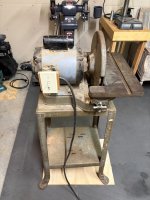
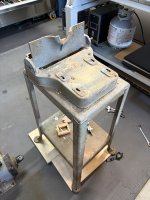
I picked up this disc sander a couple of weeks ago for $100. They rarely come up in my area and I've been wanting one of these for a couple years, so I'm excited to add it to my growing line-up of American made machines from the good ole days :) It doesn't have much of the original paint left on the stand and it does have some rust here and there but overall it seems to be in pretty good shape. That switch will definitely have to go!!:ROFLMAO::ROFLMAO:


IMG_5714.jpegIMG_5712.jpegIMG_5716.jpegIMG_5715.jpeg
 
To avoid these ads, REGISTER NOW!
OP
C

chargedmr2

Well-known member
Joined
Sep 18, 2019
Messages
205
Location
WA
One of my favorite parts of a restoration is disassembly. I just LOVE seeing how everything was made and how all of the parts go together. It's like unraveling a little mystery of sorts:ROFLMAO: In this case, the Delta disc sanders are pretty darn basic, so there isn't much mystery. But the simplicity of the design is actually pretty cool and makes for a fast disassembly. I think I had this guy apart, including the motor, in just over an hour. Not too bad!
IMG_5735.jpegIMG_5742.jpegIMG_5750.jpeg


I've disassembled and restored a few motors in the past and I usually have to desolder the wires running to the capacitor. I was pleasantly surprised to see that the contacts have screws. That saved me a little time and effort!
IMG_5754.jpegIMG_5757.jpeg


I knew this motor was not going to be clean inside, but I will say it's definitely the dirties of the ones I have opened. But this IS a disc sander, so that makes sense. I've done a couple of drill press motors and a delta triple duty grinder, which was like a time capsule on the inside. This one was not exactly a time capsule, lol! It's pretty clear that dust collection was not part of the shop where this guys resided over the past 8 decades.
IMG_5764.jpegIMG_5774.jpegIMG_5776.jpeg


I was a little disappointed to see that I was NOT the first to open this motor. I was greeted with a damaged wire that had been repaired by a prior owner. I removed that crimped on connector, soldered things back up and covered it in shrink wrap.
IMG_5783.jpegIMG_5793.jpeg
 
OP
C

chargedmr2

Well-known member
Joined
Sep 18, 2019
Messages
205
Location
WA
This 3/4 HP delta motor still had the original New Departure extended race 87504 bearings in it. Unfortunately, I was a little too careless when pulling one of them off the shaft and damage it with the puller. Otherwise, I think these would have been great candidates for cleaning up and repacking with new grease. I've never actually done that before, but I'd like to learn how to remove the shields. I may take the opportunity to learn how to do this on the damaged bearing since I won't have to worry about screwing up a good one.
IMG_5798.jpeg

I will say, I was surprised how clean the felt seals were! I wonder if they are original or were replaced in the past?
IMG_5787.jpegIMG_5796.jpeg
 
OP
C

chargedmr2

Well-known member
Joined
Sep 18, 2019
Messages
205
Location
WA
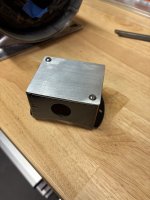
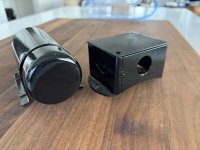
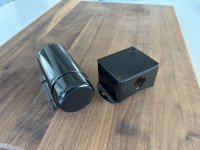
About that light switch the PO had installed...that was the first thing that absolutely had to go. I looked around for the original switch and did manage to find a Cutler Hammer switch that looked good. But the cover for the electrical box on the motor was missing, and that's a little tougher to find.

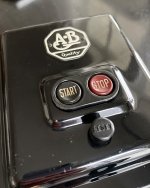
So, I decided to go a different route all together. I came across a motor starter on FB marketplace for $25 and grabbed that to use for my sander. It's an Allen Bradley 709SP with a dual voltage coil that can be easily set up for either 110v or 220v. I also found the proper heater, an N30 in this case, on eBay for a few bucks. Not too bad all in all.

The switch was in pretty good condition overall. The paint is a little rough on one side and on the back, but I decided to polish it up and keep it all original.

Now to decide where exactly on the stand I will mount this pretty little switch. I think I'll go dead center on the front, but I'll make that call once I get things back together.
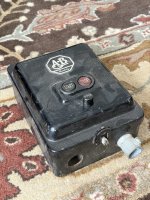
IMG_5814.jpeg

It cleaned up pretty nicely, I think.
IMG_5820.jpegIMG_5829.jpeg

And the inside is in pretty nice shape as well.
IMG_5824.jpeg

When I first got my hands on this switch, I wasn't sure how to confirm that it was really made for 110 or 220v. I had read that many of the AB 709 motor starters were set up for EITHER 110 or 220, but NOT both. However, the 709SP is in fact a dual voltage coil that can be switched between voltages by moving a simple jumper. Here's the proof I needed to feel good about what I had:
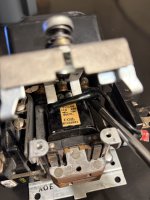
IMG_5837.jpeg
 
OP
C

chargedmr2

Well-known member
Joined
Sep 18, 2019
Messages
205
Location
WA
I also managed to strip all the paint from the motor yesterday. This was a tough call for me (and also a pain to do). I went back and forth for several days on whether or not to keep the original paint. I even polished it up to remove the oxidation and it shined beautifully. But it did have some rusted areas around the edges that really needed to be addressed.

And after I finished repainting the end bells with fresh black paint, my mind was made up. I knew I would not be okay with the rust on the motor if everything else about the disc sander was refreshed with fresh paint. And the cast iron parts, as well as the stand, all need new paint since there isn't much of the original paint remaining.

I did end up chasing down the paint color that @Snip's used. I just love the older greenish-grey from the 1930s. Napa was happy to mix some up for me based on the info I found in the larger Delta picture thread. I haven't got there yet, but I'm pretty excited to see how it looks.IMG_5919.jpegIMG_5899.jpegIMG_5920.jpeg
 
OP
C

chargedmr2

Well-known member
Joined
Sep 18, 2019
Messages
205
Location
WA
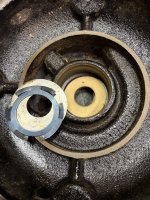
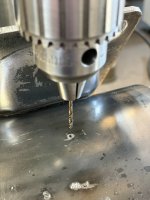
I swear, Delta must have used drive screws made of tool steel! I've had luck using a Dremel to slot drive screw heads and then back them out with a screw driver, but NOT this time. They wouldn't budge and the "screw heads" that I made just snapped off. And this was after using some Kroil to help loosen things up.

I ended up drilling them out with a carbide bit and cutting oil, but WOW they were not easy to drill. I destroyed one bit since I used my hand drill (not recommended with brittle bits like this, but I thought I'd get away with it by being careful). The second drive screw was drilled out on my Atlas drill press that I just finished restoring recently. That worked MUCH better, but the downward pressure needed to drill these guys out was surprising!

If anyone has tips, I'm all ears!

IMG_5939.jpeg
 

Beerhippie

Well-known member
Joined
Oct 13, 2023
Messages
9,696
Location
Far NE Oregon
I swear, Delta must have used drive screws made of tool steel! I've had luck using a Dremel to slot drive screw heads and then back them out with a screw driver, but NOT this time. They wouldn't budge and the "screw heads" that I made just snapped off. And this was after using some Kroil to help loosen things up.

I ended up drilling them out with a carbide bit and cutting oil, but WOW they were not easy to drill. I destroyed one bit since I used my hand drill (not recommended with brittle bits like this, but I thought I'd get away with it by being careful). The second drive screw was drilled out on my Atlas drill press that I just finished restoring recently. That worked MUCH better, but the downward pressure needed to drill these guys out was surprising!

If anyone has tips, I'm all ears!

IMG_5939.jpeg
Left-handed carbide bits?

Drive screws are usually pretty hard steel--they are driven into steel, after all. I've been pretty lucky with them so far--touch iron.
 
OP
C

chargedmr2

Well-known member
Joined
Sep 18, 2019
Messages
205
Location
WA
Left-handed carbide bits?

Drive screws are usually pretty hard steel--they are driven into steel, after all. I've been pretty lucky with them so far--touch iron.
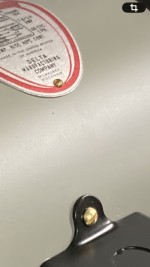
I think you just gave me good cause to add a nice vintage reversing drum switch to my drill press :) Fortunately, I was able to use a punch on some of the other drive screws to knock them out, but on the motor, of course, there's no access to the back side. I'm in the same boat on the Delta badge that was on the front edge of the table. Both of those broke as well, so more drilling to do.
 

Snip's

Well-known member
Joined
Apr 29, 2017
Messages
1,850
Location
Ohio
I swear, Delta must have used drive screws made of tool steel! I've had luck using a Dremel to slot drive screw heads and then back them out with a screw driver, but NOT this time. They wouldn't budge and the "screw heads" that I made just snapped off. And this was after using some Kroil to help loosen things up.

I ended up drilling them out with a carbide bit and cutting oil, but WOW they were not easy to drill. I destroyed one bit since I used my hand drill (not recommended with brittle bits like this, but I thought I'd get away with it by being careful). The second drive screw was drilled out on my Atlas drill press that I just finished restoring recently. That worked MUCH better, but the downward pressure needed to drill these guys out was surprising!

If anyone has tips, I'm all ears!
Mine had a RI motor, and I was able to carefully grind down the drive screw heads and then used a punch to drive the stem towards the inside... Here's a photo where you can see open areas between the stator and the motor shell that let the drive screw drop out... I then tapped the holes and used screws instead of the drive screws...
IMG_4503 2.jpg

IMG_5439.PNG
 
OP
C

chargedmr2

Well-known member
Joined
Sep 18, 2019
Messages
205
Location
WA
Mine had a RI motor, and I was able to carefully grind down the drive screw heads and then used a punch to drive the stem towards the inside... Here's a photo where you can see open areas between the stator and the motor shell that let the drive screw drop out... I then tapped the holes and used screws instead of the drive screws...
IMG_4503 2.jpg

IMG_5439.PNG
Appreciate the tips! Your restoration is the inspiration for mine. Love that color! And sure do wish I scored an earlier sander with the RI motor. Maybe next time!

I was able to drive one of the drive screws inward somewhat since it just happened to align with the small gap between the motor housing and the coils. Then I drill that one out. The other was butted up against the coils, as far as I could tell, so I didn't want to drive that one further in. That was the extra challenging one.

Any tips on getting the coils so darn clean? Yours looks like it rolled off the assembly line yesterday.
 

toolmiser

Well-known member
Joined
Sep 1, 2009
Messages
1,655
Location
La Crosse, WI
My college had one like that, instructor was very set in his ways, and liked to express his views. One rule was you were not allowed to leave a machine with it moving. Those sanders took maybe five minutes to stop rotating. Gave us a good excuse to avoid the sander.
 
OP
C

chargedmr2

Well-known member
Joined
Sep 18, 2019
Messages
205
Location
WA
My college had one like that, instructor was very set in his ways, and liked to express his views. One rule was you were not allowed to leave a machine with it moving. Those sanders took maybe five minutes to stop rotating. Gave us a good excuse to avoid the sander.
If he were nice, he’d have replaced the bearings to reduce the spin down time, 😂
 

Snip's

Well-known member
Joined
Apr 29, 2017
Messages
1,850
Location
Ohio
Appreciate the tips! Your restoration is the inspiration for mine. Love that color! And sure do wish I scored an earlier sander with the RI motor. Maybe next time!

I was able to drive one of the drive screws inward somewhat since it just happened to align with the small gap between the motor housing and the coils. Then I drill that one out. The other was butted up against the coils, as far as I could tell, so I didn't want to drive that one further in. That was the extra challenging one.

Any tips on getting the coils so darn clean? Yours looks like it rolled off the assembly line yesterday.
Mine was loaded with many years of sawdust...
I first blew all the loose sawdust particles out of the stator as best I could... There was a lot of dust that came out...
I then used a couple of cans of CRC Lectra-Motive.. Worked great and no risk of damage to the wire insulation... Got it clean and oil free...
Let it sit out in the hot sun to bake out all of the remaining CRC liquid...
IMG_4487 4.jpg


Then used Sprayon EL-600 as a way to add a bit more varnish to the old wiring "Just in case" since I had it all apart...
IMG_4488 2.jpg
I did the same proceedure to the rotor as well...
IMG_4490.jpg IMG_4491 4.jpg
 

jmarkwolf

Well-known member
Joined
Jan 15, 2013
Messages
1,812
Location
Southeast Michigan
I've got the same sander, serial number 37.360, vintage 1945, that I inherited from my dad. Still use it all the time.

Pics at:


Post #18
 
Last edited:
To avoid these ads, REGISTER NOW!
OP
C

chargedmr2

Well-known member
Joined
Sep 18, 2019
Messages
205
Location
WA
Mine was loaded with many years of sawdust...
I first blew all the loose sawdust particles out of the stator as best I could... There was a lot of dust that came out...
I then used a couple of cans of CRC Lectra-Motive.. Worked great and no risk of damage to the wire insulation... Got it clean and oil free...
Let it sit out in the hot sun to bake out all of the remaining CRC liquid...
IMG_4487 4.jpg


Then used Sprayon EL-600 as a way to add a bit more varnish to the old wiring "Just in case" since I had it all apart...
IMG_4488 2.jpg
I did the same proceedure to the rotor as well...
IMG_4490.jpg IMG_4491 4.jpg
That Lectra-Motive would have been perfect! I may have missed my opportunity though, since I just primed the motor housing, and I'm not sure I could easily avoid getting the cleaner on the exterior. I imagine that it would not play well with fresh primer.

I may get creative and see if I can still pull this off.
 
OP
C

chargedmr2

Well-known member
Joined
Sep 18, 2019
Messages
205
Location
WA
I've got the same sander, serial number 37.360, vintage 1945, that I inherited from my dad. Still use it all the time.

Pics at:


Post #18
Another beautiful RI motor, to boot! Looks amazing!
 
OP
C

chargedmr2

Well-known member
Joined
Sep 18, 2019
Messages
205
Location
WA
Little more progress. Heater element arrived this morning for the Allen Bradley starter, so it should now be good to go for providing proper thermal protection for the motor.
IMG_5954.jpeg


Also managed to get some fresh paint on various motor components after stripping everything down to are metal. Looks MUCH better now!
IMG_5957.jpegIMG_5961.jpeg


And here's the motor housing primed and ready for paint. Hoping to get that done later today.
IMG_5952.jpeg
 
OP
C

chargedmr2

Well-known member
Joined
Sep 18, 2019
Messages
205
Location
WA
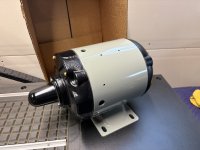
So, I painted the motor housing today, and the color came out pretty nice. Really glad I went with the 1930s green-gray color. Unfortunately, I ended up with a pretty bad orange peel effect to the paint. You can’t really see it in the picture I attached but in the right light it looks pretty bad. I’ll let this dry for a couple of days, sand the top coat smooth with some 400 grit wet dry sandpaper and try again.

It was a little cool outside for painting, and I wasn’t really getting a fine mist, but more of a heavy spatter. Also this urethane based paint that NAPA mixed for me is much less forgiving than a typical can of rust oleum. Hopefully I get it right the next time around! IMG_5967.jpeg
 
OP
C

chargedmr2

Well-known member
Joined
Sep 18, 2019
Messages
205
Location
WA
Well, sometimes restorations seem to go one step forward and two steps backwards. First, my paint job ended up less than ideal and now my replacement bearings that just arrived aren't quite what I was looking for.

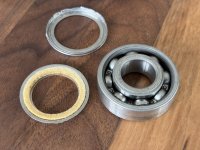
I accidentally ordered a C5 spec bearing, which has more play than it should have for this application. So, while I await the correct C3 specced bearings, I decided to disassemble one of the original New Departure 87504 bearings. As you can see by the pictures, the grease was a bit dried up, but I must say, after cleaning everything out, this bearing could probably go back into service for quite some time. But, if I'm replacing one, I think I'd rather just replace both for consistency. After all, I don't plan to open this motor again for decades (or maybe ever!).
IMG_5798.jpegIMG_5978.jpegIMG_5989.jpegIMG_6006.jpeg
 
OP
C

chargedmr2

Well-known member
Joined
Sep 18, 2019
Messages
205
Location
WA
And one step forward! I finished the repaint of the motor housing. No more orange peel and it looks fantastic! This is a urethane automotive paint, which I've not used before. It's less forgiving than the typical spray can paint, but my initial impression is that it's FAR better quality. Very happy so far.
IMG_6061.jpegIMG_6063.jpegIMG_6064.jpegIMG_6071.jpegIMG_6074.jpeg
 
OP
C

chargedmr2

Well-known member
Joined
Sep 18, 2019
Messages
205
Location
WA
Very nice!

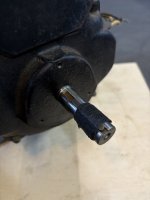
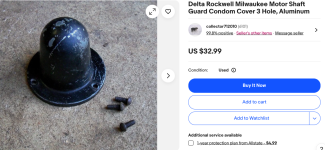
What is the bullet shaped cap on the end bell opposite the shaft? A cover for an exposed shaft on that side?
Exactly. The motor has a shaft on both sides. I believe the newer motors eventually switched to a single shaft, but not sure when that would have happened.
 

Beerhippie

Well-known member
Joined
Oct 13, 2023
Messages
9,696
Location
Far NE Oregon
Exactly. The motor has a shaft on both sides. I believe the newer motors eventually switched to a single shaft, but not sure when that would have happened.
That would be a "general purpose" motor, as Craftsman called them. Not specifically made for the tool, but made for any number of different applications.
 

Snip's

Well-known member
Joined
Apr 29, 2017
Messages
1,850
Location
Ohio
Very nice!

What is the bullet shaped cap on the end bell opposite the shaft? A cover for an exposed shaft on that side?
It's also known as a motor shaft condom... :dunno:
Screen Shot 2026-03-29 at 4.32.47 PM.png

My RI motor has the double shaft, but it's of an older vintage that doesn't have the screw holes to attach the "condom"...

Before the condom, the early designers came up with a different form of protection (Far right of the motor image)...
So their solution back then was to provide a different anatomical design...
Oh and it was made out of a species of hardwood... Perhaps known by the design team as a "Woody" :LOL:

Screen Shot 2026-03-29 at 4.21.51 PM.png
 
Last edited:
OP
C

chargedmr2

Well-known member
Joined
Sep 18, 2019
Messages
205
Location
WA
That would be a "general purpose" motor, as Craftsman called them. Not specifically made for the tool, but made for any number of different applications.
That makes sense.
It's also known as a motor shaft condom... :dunno:
Screen Shot 2026-03-29 at 4.32.47 PM.png

My RI motor has the double shaft, but it's of an older vintage that doesn't have the screw holes to attach the "condom"...

Before the condom, the early designers came up with a different form of protection (Far right of the motor image)...
So their solution back then was to provide a different anatomical design...
Oh and it was made out of a species of hardwood... Perhaps known by the design team as a "Woody" :LOL:

Screen Shot 2026-03-29 at 4.21.51 PM.png
@Snip's You're killing me here :ROFLMAO: :ROFLMAO: Serious question, though...have you ever seen one with a "woody?" I've seen the aluminum version, but never the one in the image.
 

JonahBrown

Well-known member
Joined
May 5, 2025
Messages
101
I was thinking the welded steel stands are older than that.
I picked up this disc sander a couple of weeks ago for $100. They rarely come up in my area and I've been wanting one of these for a couple years, so I'm excited to add it to my growing line-up of American made machines from the good ole days :) It doesn't have much of the original paint left on the stand and it does have some rust here and there but overall it seems to be in pretty good shape. That switch will definitely have to go!!:ROFLMAO::ROFLMAO:
 
OP
C

chargedmr2

Well-known member
Joined
Sep 18, 2019
Messages
205
Location
WA
1775234411700.jpeg
If I remember correctly this one is 1938 vintage.
I haven’t been able to find any definitive cutoff for when Delta stopped using the welded stands. Maybe they didn’t make the switch all at once? I’ve seen other sanders dated to the late 40s with the welded stands, but I believe the bolted stands were in use then as well.
 

JonahBrown

Well-known member
Joined
May 5, 2025
Messages
101
Some of the dating involves the Delta badge as well as the serial # on the sander.
 

jmarkwolf

Well-known member
Joined
Jan 15, 2013
Messages
1,812
Location
Southeast Michigan
I haven’t been able to find any definitive cutoff for when Delta stopped using the welded stands. Maybe they didn’t make the switch all at once? I’ve seen other sanders dated to the late 40s with the welded stands, but I believe the bolted stands were in use then as well.
My 1945 Delta 12in sander has a welded stand if that's any use to you.
 
To avoid these ads, REGISTER NOW!
Top Bottom