To avoid these ads, REGISTER NOW!

What’s the correct way to denote an abandoned wire in the wall?

DGersic

Well-known member
Joined
Mar 12, 2017
Messages
6,284
Location
DeKalb, IL
Short version: I have a Romex daisy chain circuit where the final leg is dead and disconnected. It runs through walls and is inaccessible, so I can’t pull the cable out. I will abandon it in place. What’s the correct way to cap off and/or label it so that someday if somebody does open the wall, they won’t be wondering where that wire came from and if it might be hot?
 
To avoid these ads, REGISTER NOW!
OP
D

DGersic

Well-known member
Joined
Mar 12, 2017
Messages
6,284
Location
DeKalb, IL
I would just cap it at both ends and leave it in the wall. It's just a chunk of wire at this point so there's no need for additional info in the off chance that a future homeowner finds it.

I can’t find / reach the far end. I removed the powered end from the source, and confirmed that everything still works.

I may have cut and capped off the far end at some time in the past ~30 years. I must have done it, though I have no memory of doing so.
 

johnre

Well-known member
Joined
Dec 1, 2016
Messages
1,045
Location
Portland, OR
I can’t find / reach the far end. I removed the powered end from the source, and confirmed that everything still works.

I may have cut and capped off the far end at some time in the past ~30 years. I must have done it, though I have no memory of doing so.
I'm not sure if you're requesting a way to find the hidden end of the wire, but most studfinders have an AC circuit detection system built in. You indicated that you can get at the source end of it; while normally I wouldn't recommend energizing something that you're not sure what is the state of it at the other end, what's another 10 minutes on top of the 30 years it sat this way?

Temporarily energize it again at the source, use the studfinder to trace the length of the wire, and just open up the wall in the stud space where it ends. If there's no J-box there, put one in, repair the sheetrock, and put on a blank cover plate so you don't have to remember the next time.
 
OP
D

DGersic

Well-known member
Joined
Mar 12, 2017
Messages
6,284
Location
DeKalb, IL
I'm not sure if you're requesting a way to find the hidden end of the wire, but most studfinders have an AC circuit detection system built in. You indicated that you can get at the source end of it; while normally I wouldn't recommend energizing something that you're not sure what is the state of it at the other end, what's another 10 minutes on top of the 30 years it sat this way?

Temporarily energize it again at the source, use the studfinder to trace the length of the wire, and just open up the wall in the stud space where it ends. If there's no J-box there, put one in, repair the sheetrock, and put on a blank cover plate so you don't have to remember the next time.

I know where the end is, or at least I’m pretty sure that I know where it is. It is inaccessible because it’s in a wall cavity that has a two-gang box in it, my hand and arm can only reach around in there to a limited degree, and it is full of blown in cellulose insulation, so my inspection camera can’t see it.

1950 house with ~1” thick plaster walls. The best stud finders don’t really work here.

Longer version, with pictures follows.
 
OP
D

DGersic

Well-known member
Joined
Mar 12, 2017
Messages
6,284
Location
DeKalb, IL
Back story, we’re remodeling the bathroom. After the demo crew tore out the walls, removed the tub, toilet, sink, and floor, we’re down to bare studs and plywood subfloor. We have found some electrical ugly, which will be fixed before the walls are closed up again.

Longer version, with pictures…

Here’s the layout, not to scale:

IMG_5738.jpeg

This is an old house, it probably only had three or four circuits when originally wired, with a fuse panel and romex. Codes have changed since 1950, and there have been many alterations. An addition was put on the back in the 1970s. The fuse panel is gone, and Square D breaker panel is installed now.

The circuit in question comes from the panel and enters this two gang box in the bathroom from below.

IMG_8842.jpeg

That’s the yellow modern romex wire. In this little box was a double switch, one for the lights, one for the exhaust fan. The circuit branches out from this box, so there’s a lot going on here.
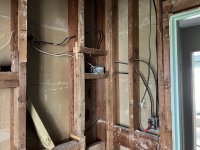
IMG_8843.jpeg

Going up to the attic, there is an old black romex, that feeds that feeds the switch and ceiling light in the hallway.

There is also a slightly newer silver/grey romex that goes to the exhaust fan. This is currently disconnected and showing bare wires hanging out, because it wasn’t “in” the box, it was wrapped around the outside of the box and held in place by the switch mounting screws.

Going up and to the left, black romex (top) goes to the lamp sconces. Yes, that’s ugly and wrong as shown.

Finally, up and to the left, black romex (bottom) goes in to the corner pocket and feeds the light switch and ceiling lights in the bedroom. From there, it then goes along the wall, behind the stack, to a burried j box in the corner

IMG_8844.jpeg

That j box has a cut off wire about 9” long that used to go in to the wall. It probably fed something that was cut off when they built the addition. Since the other end was locked in to this j box, they just taped the ends and left it. That’s coming out, and I’m planning to eliminate the j box as well.

Coming out of the j box, the circuit runs under the window and around the corner to an outlet box.

IMG_8846.jpeg

This was all behind the bathtub. The outlet box branches out some more. This outlet is in my office.

Coming out the bottom, running up behind the HVAC duct, protected by some 1970s duct tape, and heading left in to the wall, this feeds the light switch and ceiling light in my office.

Coming out the top, heading right, the (removed and capped off with yellow wire nuts) romex is the one I want to abandon.

When we first moved in, I didn’t trust my expensive computers to old ungrounded two-wire outlets and two-to-three prong adapters. I cut a two gang hole and ran a dedicated 15A circuit from the panel. That’s in the corner, under my desk, next to the box with the Ethernet plugs in it here.

IMG_8848.jpeg

To the left of that, the only other outlet box in the room is shown. This one is original.

Opening these two up, I have my new white romex feeding the source side of the GFCI outlet. And I have old black romex on the load side, feeding that other outlet.

If you’ve read this far… I’m 95% sure that the wire I want to abandon is cut somewhere around that wall corner. It used to run from one outlet in my office to the other outlet, but I cut it. I just have no memory of cutting it or connecting it to the GFCI.

Without further cutting in to plaster walls, a job I do not want to do, I can’t find the far end of this branch of romex. I have disconnected the source end in the bathroom wall, confirmed that everything still works ok, so it’s definitely not in use. A non contact tester confirms that it’s not hot from some other connection that I don’t know about. And given the way everything is daisy chained, there wouldn’t be anything else for this wire to go to.

This is a long way around asking what to do with the now abandoned and disconnected wire in the wall. Both ends are disconnected. It’s not hot. Should anything be done with it beyond wire nuts and tape?

Ideally, I’d pull it out, but some investigatory pulling on it says that it’s not going to budge.
 

Attachments

  • IMG_8845.jpeg
    IMG_8845.jpeg
    694.7 KB · Views: 3
  • IMG_8847.jpeg
    IMG_8847.jpeg
    811.1 KB · Views: 3

nh_yota

Well-known member
Joined
Mar 10, 2015
Messages
4,076
Location
Seacoast New Hampshire
As I said, as long as the other end isn't connected to a power source just cap together the wires on the end you have access to.

My old house has gradually been rewired over the years and what BX cable I couldn't remove has been de-energized, capped at whatever end(s) I have access to, and left hanging in the wall unless I keep the box for another connection.
 
To avoid these ads, REGISTER NOW!

The Cobbler

Super Moderator
Staff member
Joined
Oct 24, 2013
Messages
25,837
Location
Niagara Region, Ontario, Canada
I remember when I was a teenager a corner store I worked at had a fire inspection . there was a wire hanging in the basement, the fire guy said to the owner to cut it back short and marette the ends together .
 

Carchie

Active member
Joined
Apr 24, 2018
Messages
26
Short version: I have a Romex daisy chain circuit where the final leg is dead and disconnected. It runs through walls and is inaccessible, so I can’t pull the cable out. I will abandon it in place. What’s the correct way to cap off and/or label it so that someday if somebody does open the wall, they won’t be wondering where that wire came from and if it might be hot?
Don’t just leave it floating in the wall, that’s how future you gets surprised lol. Kill it at the source first, disconnect it from the breaker or upstream box so it’s truly dead. Then cap each conductor with proper wire nuts, not tape, and if you can access one end, leave it inside a junction box with a blank cover and a label like “abandoned, not in use, source disconnected.” If it’s fully buried and you can’t box it, at least document it on your panel schedule or house notes, otherwise someone later might assume it’s live and waste time chasing it.
 

mm08822

Well-known member
Joined
Jan 13, 2012
Messages
5,873
Location
NJ
Yup, good ole Jenny and then there was the problem solver....36-24-360
 

mm08822

Well-known member
Joined
Jan 13, 2012
Messages
5,873
Location
NJ
Both songs actually never clearly spoke/finished the last digit but it was easy enough to assume.
 

4x4Pete

Well-known member
Joined
Aug 26, 2019
Messages
791
Location
Stroud
I had a new service run to the workshop at work. The electrician cut the abandoned underground wire off flush where it came up through the sill plate. He said if the inspector questions it, he'll say that it isn't able to be used. He didn't have a problem with it. Make it as safe as reasonably possible and don't worry about it.
 

rust in the eye

Well-known member
Joined
Oct 2, 2017
Messages
2,750
Location
Chicagoland
not quite. if you wire nut them together in the panel and someone comes along to hook them back up, the other end will not cause the breaker to trip since the wires are wire nutted together
While re-connecting abandoned, unknown and shorted together wires in a panel is truly a fools errand I see your point. Same reason, I suppose, that my wife's clothes iron came with a warning stating to not iron clothes while wearing them.
 
To avoid these ads, REGISTER NOW!
Top Bottom