To avoid these ads, REGISTER NOW!

How do you store your electric extension cords?

bluedog225

Well-known member
Joined
Jan 31, 2012
Messages
3,241
Location
Texas
I’m sure I’m doing it wrong. I got this cord used and it just fell off the roll. What’s the secret?
 
To avoid these ads, REGISTER NOW!

cody1325

Well-known member
Joined
Apr 17, 2024
Messages
1,075
Location
Southwest Virginia
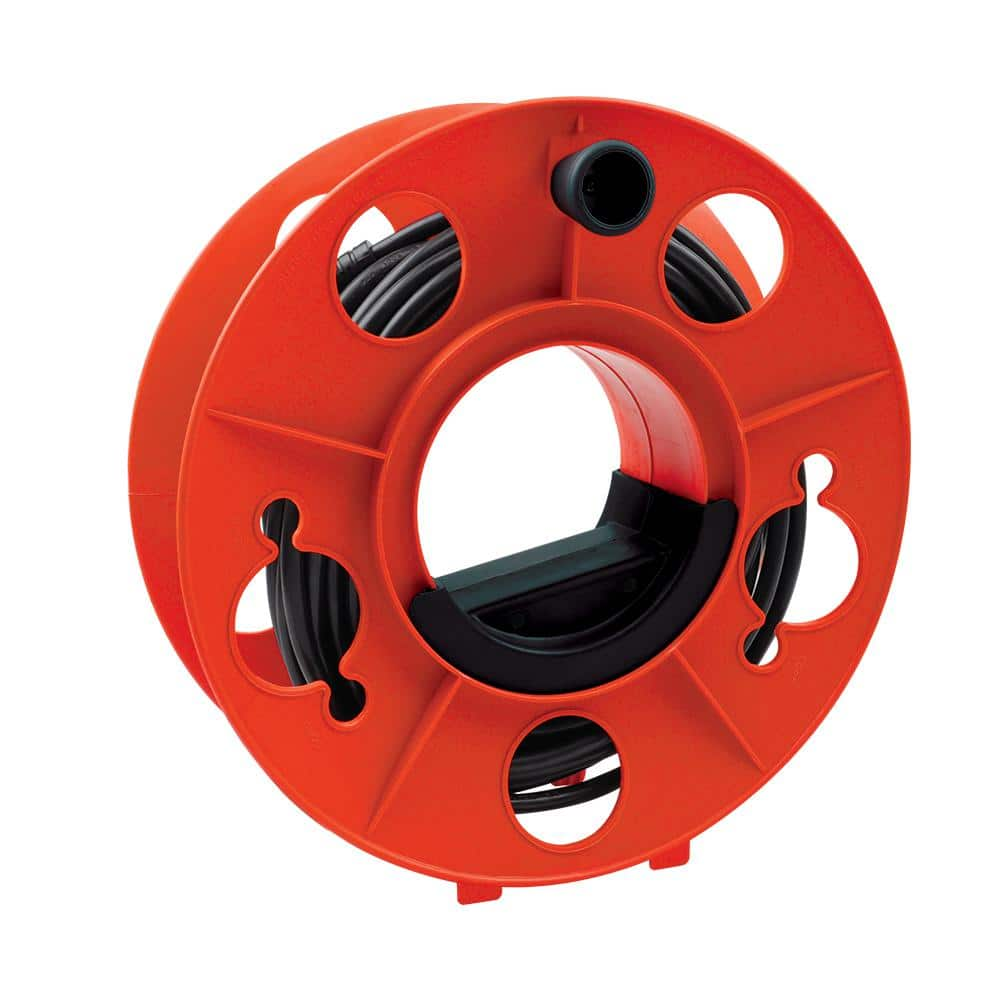
My main one is on a reel (which has the female plugs built into it), which equates to rolling it up and putting it back on the shelf.

For all the rest--I roll them up, wrap the roll with the Velcro cable tie I attached to one end, and then put it away--either on a nail or a shelf depending on whether it's my shop or the basement.


Rolling longer cables up though I struggle with.
 

C-S-H

Well-known member
Joined
Jan 18, 2024
Messages
144
I coil my electric extension cords the same as a surveyors' steel tape. So 100' tape is coiled into about 17 figure 8 coils, then hung. They pay off easily with no twist after decades of usage.
 

cgrutt

Well-known member
Joined
Mar 4, 2016
Messages
8,157
I coil them as you would a climbing rope. Then hung or thrown flat in back of my pickup.

images (35).jpeg
 
To avoid these ads, REGISTER NOW!

Stuart in MN

Well-known member
Joined
Sep 8, 2005
Messages
22,988
Location
Minneapolis
There's various ways to coil them so they don't get twists or tangles but I usually just roll mine up and deal with it. I only have one that's really long and I don't use it often, the shorter ones are easy enough to untangle.
 

Crazyjake8493

Well-known member
Joined
Sep 26, 2014
Messages
3,948
Location
Upstate NY
With all the battery tools I own now, I think I only have three extension cords. One 25' cord crammed in the storage under the rear seat in the truck, and a 25' and 50' rolled up with a velcro hanger and hanging on the garage wall just inside the door.
 

LopezBart

Well-known member
Joined
Oct 13, 2023
Messages
2,519
Location
Lopez Island, WA
I coil the extension cord (never more than a 50' cord, of course) and plug the ends together. I then take a loop of rope and hang the cord on a hook.
 

atch

Well-known member
Joined
Apr 4, 2006
Messages
842
Location
Columbia, Missouri
I do a forearm wrap, then cuff 'em with one of these. Hardest part about storing them is to get the two ends of the cord plugged together after I've refilled it and before all the angry pixies leak out. Also gets tiresome having to check level on them all (I do it once a month or so) so they're ready to use.
1774711280995.png
I coil them; plug the two ends together; and use these clips. I've never had any negative experiences doing this. There are several places and methods/hooks in my shop to hang them.
 

lund

Well-known member
Joined
Nov 2, 2019
Messages
756
Location
Michigan
I coil them as you would a climbing rope. Then hung or thrown flat in back of my pickup.

images (35).jpeg

This is the best way. I am a mountain and ice climber (though not so active at it anymore). A "mountaineers' coil" as sketched above is an excellent way to coil a cord (or rope) without kinking. It is very easy to do and fast once you get the pattern down.

But cgrutt left off a very important "step 0" before making the coil. You must first "stack" the cord and start from the midpoint. You do this as follows. You first grab one end of the cord. Work out all kinks. Then starting from one end with the end outside (or in your hand) *stack* the unkinked cord till you reach the other end. Then with both ends in your hand (cord doubled up) stack again till you reach the midpoint of the coil. Then make the Mountaineer's coil making loops back and forth with your hand from the midpoint . You can find rock climbing tutorial videos of this online or look at books on mountaineering and rock climbing (Freedom of the Hills is excellent). It is exactly the same procedure for electrical cords as with ropes. But it is critically important to start out with an unkinked cord and cords kink easier than rope. If you do and keep doing this every time, the cord will remain kink free. Also, if correctly worked and stacked, you will find with each successive coiling that it gets less kinked with each successive use as you get it properly worked.

NEVER EVER NEVER roll a cord winding loops from elbow to hand. When you do this, it puts an overall rotation each turn and generates kinks that have to be worked out.

Rock climbers and mountaineers are often super good and fast at this procedure since it can be life and death on a multi-pitch route to avoid rope snarls. Kinks can also catch on features generating all sorts of problems. Climbing partners will also murder anyone who *$%# -up the rope -- so it gets very ingrained.

Also, I strongly recommend avoiding plastic sheath cords. Those kink too easily. Rubber sheaths are much better. Also, working in low temps can exacerbate kink problems (especially with plastic sheath cords). Below freezing can be nightmarish and it can be better to take the cord inside and let it warm up first before coiling.

Be kind to your cords and your cords will be kind to you ;) Maybe your life does not depend on it in DIY and even job site applications for cords as it does for mountain climbers. But the methods mountaineers use really help. I gather some contractors are very phobic about cord handling also since poor techniques can create problems and inefficiencies on jobs.
 
Last edited:

cgrutt

Well-known member
Joined
Mar 4, 2016
Messages
8,157
This is the best way. I am a mountain and ice climber (though not so active at it anymore). A "mountaineers' coil" as sketched above is an excellent way to coil a cord (or rope) without kinking. It is very easy to do and fast once you get the pattern down.

But cgrutt left off a very important "step 0" before making the coil. You must first "stack" the cord. You do this as follows. You first grab one end of the cord. Work out all kinks. Then starting from one end with the end outside (or in your hand) *stack* the unkinked cord till you reach the other end. Then with both ends in your hand stack again till you reach the midpoint. Then make the Mountaineer's coil. I am sure you can find rock climbing tutorial videos of this online or look at books on mountaineering and rock climbing (Freedom of the Hills is excellent). It is exactly the same procedure for electrical cords as with ropes. It is critically important to start out with an unkinked cord and cords kink easier than rope. If you do and keep doing this every time, the cord will remain kink free. Also, if correctly worked and stacked you will find it gets less kinked with each successive use as you get it properly worked.

NEVER EVER NEVER roll a cord winding loops from elbow to hand. When you do this, it put an overall rotation each turn and generates kinks that have to be worked out.

Rock climbers and mountaineers are often super good at this procedure since it can be life and death on a multi-pitch route to avoid rope snarls. Kinks can also catch on features generating all sorts of problems. Climbing partners will also murder anyone who *$%# -up the rope, so it gets very ingrained.

Also, I strongly recommend avoiding plastic sheath wire. It kinks too easily. Rubber sheaths are much better. Also, working in low temps can exacerbate kink problems. Below freezing can be nightmarish and it can be better to take the cord inside and let it warm up first.

Be kind to your cords and your cords will be kind to you ;) Maybe your life does not depend on it in DIY and even job site applications with cords as it does for mountain climbers. But the methods I found really help. I gather some contractors are very phobic about cord handling also since poor techniques can create problems and inefficiencies on jobs.
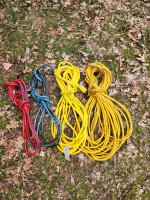
I actually coil them a little different than the picture and not sure if its how you described or not. I actually always coil starting with both ends in hand, so effectively it winds up being half the cord coiled but doubled up. I don't have any problem with wires kinking and when I use the cord I always uncoil the full length. Just rolled a 50' up about 5 min ago.

Here are four that I keep in back of my truck. 2 25s a 50 and 100...
20260330_171954.jpg
 
Last edited:

Superbowl

Active member
Joined
Feb 19, 2026
Messages
39
Location
DC area
Short ones I coil. I learned how to handle long ones 50 years ago when I was framing houses. You chain coil the long ones.

1 . Hold the both the plug and socket in one hand and walk until you pull the wire into an equal length parallel pair.

2. Walk back still holding the plug and socket until you have a four parallel wires and grab the ends with the two loops with the same hand.

3. Coil a small length of the now four wire sections and then reach through that coil and grab the four wires and pull through the loop making another loop the same size and the first one.

4. Continue reaching through each new loop and pulling the wires as you make a "chain."
 

crewchief888

Well-known member
Joined
Dec 3, 2009
Messages
13,736
Location
NW indiana
i arm wrap them and toss them into a heavy duty storage tote that measures 35"W x 22" H X 22" deep. it's nearly full to the top. and is stored downstairs with Xmas decorations.
i have 12' 25' 50' & 100' cords, literally 1000's of feet of them.
i have a couple 25' cords in the basement & a couple more in the garage
 

The Cobbler

Super Moderator
Staff member
Joined
Oct 24, 2013
Messages
25,806
Location
Niagara Region, Ontario, Canada
I've never really paid much attention to winding cords. they are consumables as far as I am concerned . having said that during most of my working life, hardly a day would go by that I wasn't using an extension cord or 2 or more . 99% of the time they were wound between my thumb & index finger, around my elbow . heavier cords just wrapped in a circle on the ground . a few winds of black tape held the winds together . the daily use ones were hung on hooks in the vans. the occasional use ones went back into the shed & hung up whenever I got around to it .
 

metalmagpie

Well-known member
Joined
Nov 1, 2011
Messages
796
Location
Seattle
Take the two ends and hold them in one hand. Pull slack until you can grab the middle with the other hand. Put the middle with the two ends. Now the cord is quartered. Repeat as necessary until you have a bundle about 4 feet long. Now tie the whole bundle in a single overhand knot loosely. Hang it up from a loop on either end. This is how they deal with cords in recording studios. To undo, just untie the simple loose overhand knot, then it all comes loose and not tangled. Been doing it for years.

If you're going to hang multiple cords on one hook tie one in a long loop and the next in a short one. Easy to separate them.
 

lund

Well-known member
Joined
Nov 2, 2019
Messages
756
Location
Michigan
I actually coil them a little different than the picture and not sure if its how you described or not. I actually always coil starting with both ends in hand, so effectively it winds up being half the cord coiled but doubled up. I don't have any problem with wires kinking and when I use the cord I always uncoil the full length. Just rolled a 50' up about 5 min ago.

Here are four that I keep in back of my truck. 2 25s a 50 and 100...

20260330_171954.jpg
It looks like the standard way: to double up from the midpoint and coil starting from the midpoint in double. Getting to the midpoint without kinking is the "stacking" is what I described to add to your diagram. Maybe I did not describe it so well. But it is easier to watch (videos) of the full procedure and study drawing sequences (like in the book "Freedom of the Hills") than to read the procedure written out. Stacking is important to avoid kinks and I suspect that is what you are doing when you get ready to coil.

Mountaineers usually leave longer tails through the coil to tie on as a backpack for rope hauling. But that would look weird for an extension cord. Ha!

The mountaineer's coil also works great for longer cords, but it can work with relatively shorter ones also (down to ~25 ft). Sorter than 25', I tend to do something else. Climbing ropes are often 60 meters or longer so that is a lot of rope and if it gets snarled you can imagine the mess. I have a 150' 12 gauge rubber sheath cord that I use for long power pulls and it works great for that heavy and bulky mass of wire.

I think it people were better at cord management they might be less negative on corded tools relative to battery ones. Cords have their place for heavy and drawn out work. Battery sanders, grinders, and portable table saws do not quite cut it relative to corded ones.

By the way, cord reels and hose reels can also work ok. But you have to be careful not to twist hand held ones while winding on them. For long and heavy power cords though, the mountaineer coil is the way to go and you do not need any reel system.
 
Last edited:
To avoid these ads, REGISTER NOW!
Top Bottom