To avoid these ads, REGISTER NOW!

Talk me out of a manual (non-electric) walkie stacker / pallet stacker

jaylude

Member
Joined
Jan 14, 2012
Messages
23
Hey all. I've spent the last couple of days kicking around the future pallet racking setup for my outbuilding. The building is about 30'x50', cement floors, 12' ceiling. Now that I've got a clear picture of what that will be (ye' ol' standard 42" depth / 8' height orange and green racks...) I'm thinking about the stacking part.

I have a Kubota M7060 with forks that does a good enough job of moving pallets around outside, where there's room to move. 2000+lb fork capacity and it can go places most forklifts can't. And I've got a nice Crown manual pallet jack for moving pallets around on the ground inside my building, and out onto asphalt for the Kubota. So those parts of the pallet moving game are all set.

The Kubota is WAYYY too cumbersome to use inside the building or for delicate one-man pallet racking and stacking indoors, so that's where I'm looking at options for lifting pallets up onto the racks, and dropping pallets to the floor. Once I get them to the floor, my pallet jack can take over, and outside the building, the Kubota can handle the rest.

I won't be moving things often - we're talking once or twice a week at most, and there will likely be weeks where I don't move anything at all up or down off racks. I fully recognize the utility of a dedicated forklift, but a lot of the functionality is redundant to my Kubota. And, I don't want to take up the floor space and have yet another vehicle to maintain and troubleshoot.

Based on the above, I've been looking at semi-electric and manual walkie stackers. The electric units either have huge multi-hundred pound, expensive lead acid batteries, or lithium batteries for up and down motion. When they fail - and they all eventually fail - the unit is a brick. They're also full of hydrualic pumps, valves, and on newer units, circuit boards and electronics that are potential failure points and headaches. Parts are hard to come by, as is service info. The benefit is easy lifting - just hit a button and viola, your forks are 8' in the air.

Manual units are similarly rated, lower profile in the rear, are dead simple AND require minimal floorspace, but on the downside require the operator to hand pump or foot pump the forks up ~1" at a time. Seems tedious, but I've never used one. It's the exact same pumping action as for a pallet floor jack. I can order one of these brand new for about $2000 and even in the case that it sits for months, never worry about a dead battery or similar.

Am I insane to think about a manual unit for this type of service? We're talking like, 100 pumps to get a pallet up in the air. Will I hate the thing in a month? Would love some feedback from folks who have used both.
 
To avoid these ads, REGISTER NOW!

no704

Well-known member
Joined
Apr 27, 2016
Messages
5,208
Had one with a two handed crank/winch at an old job. Real pita. Feet not wide enough to set a pallet on the ground and can’t have anything on the floor where you are trying to stack.
 

GrayFlattop

Well-known member
Joined
Jan 18, 2018
Messages
1,039
Location
Chicago
Hey all. I've spent the last couple of days kicking around the future pallet racking setup for my outbuilding. The building is about 30'x50', cement floors, 12' ceiling. Now that I've got a clear picture of what that will be (ye' ol' standard 42" depth / 8' height orange and green racks...) I'm thinking about the stacking part.

I have a Kubota M7060 with forks that does a good enough job of moving pallets around outside, where there's room to move. 2000+lb fork capacity and it can go places most forklifts can't. And I've got a nice Crown manual pallet jack for moving pallets around on the ground inside my building, and out onto asphalt for the Kubota. So those parts of the pallet moving game are all set.

The Kubota is WAYYY too cumbersome to use inside the building or for delicate one-man pallet racking and stacking indoors, so that's where I'm looking at options for lifting pallets up onto the racks, and dropping pallets to the floor. Once I get them to the floor, my pallet jack can take over, and outside the building, the Kubota can handle the rest.

I won't be moving things often - we're talking once or twice a week at most, and there will likely be weeks where I don't move anything at all up or down off racks. I fully recognize the utility of a dedicated forklift, but a lot of the functionality is redundant to my Kubota. And, I don't want to take up the floor space and have yet another vehicle to maintain and troubleshoot.

Based on the above, I've been looking at semi-electric and manual walkie stackers. The electric units either have huge multi-hundred pound, expensive lead acid batteries, or lithium batteries for up and down motion. When they fail - and they all eventually fail - the unit is a brick. They're also full of hydrualic pumps, valves, and on newer units, circuit boards and electronics that are potential failure points and headaches. Parts are hard to come by, as is service info. The benefit is easy lifting - just hit a button and viola, your forks are 8' in the air.

Manual units are similarly rated, lower profile in the rear, are dead simple AND require minimal floorspace, but on the downside require the operator to hand pump or foot pump the forks up ~1" at a time. Seems tedious, but I've never used one. It's the exact same pumping action as for a pallet floor jack. I can order one of these brand new for about $2000 and even in the case that it sits for months, never worry about a dead battery or similar.

Am I insane to think about a manual unit for this type of service? We're talking like, 100 pumps to get a pallet up in the air. Will I hate the thing in a month? Would love some feedback from folks who have used both.
Yep - you’re insane. Not that I’m judging…
 

carlaisle

Well-known member
Joined
May 14, 2022
Messages
368
It won't take anywhere near a month to develop a powerful hate for it and self-loathing for yourself. There are many better ways to punish yourself if you need to suffer.
 

NUTTSGT

Super Moderator
Staff member
Joined
Sep 14, 2009
Messages
50,884
Location
Northern Central Ohio
I think I would rather have a small lp gas forklift than a walk behind unit.

Serious question though, are you really stacking/unstacking stuff on the pallet racking that often ?
 

racecougar

Well-known member
Joined
Jan 26, 2021
Messages
5,008
Location
Missouri
Rather than hand/foot pumping, could it not be converted to air-over-hydraulic? Yes, you'd have an umbilical (air hose) to deal with, but I'd connect and disconnect a hose happily over having to hand/foot pump a pallet up to height.
 
OP
J

jaylude

Member
Joined
Jan 14, 2012
Messages
23
I think I would rather have a small lp gas forklift than a walk behind unit.

Serious question though, are you really stacking/unstacking stuff on the pallet racking that often ?
I would totally rather a forklift too, from a functionality standpoint. 1000%. But all the other drawbacks (cost, size, complexity, maintenance, fueling/electrical....) and redundancies to existing equipment are what has me strongly looking at alternatives.

I won't be stacking that often. Just like I mentioned - may use it once or twice a week at most, maybe a bunch one weekend if I'm rearranging things or busy on a big project, and some weeks not at all. Engines (forklift) or batteries (electric walkie stacker) don't usually like that even if well maintained.

So all of that leads one potentially to a manual pump walkie stacker solution, but I'm just looking for a sanity check before I head down that path....
 
OP
J

jaylude

Member
Joined
Jan 14, 2012
Messages
23
Rather than hand/foot pumping, could it not be converted to air-over-hydraulic? Yes, you'd have an umbilical (air hose) to deal with, but I'd connect and disconnect a hose happily over having to hand/foot pump a pallet up to height.
I have that exact same question. It seems like the PERFECT answer for my use case, but I don't see anything off the shelf. And yes, you'd have to tote around an air hose but big deal, I'd take that annoyance over dealing with batteries, charging and other electrical maintenance/complexity, plus the size of an electric walkie stacker.

If anyone here knows whether that's a feasible option, please chime in! I'm fully capable of welding, fabricating and machining...I just haven't approached a hydraulic modification like that before. Is there a solution?
 

racecougar

Well-known member
Joined
Jan 26, 2021
Messages
5,008
Location
Missouri
I have that exact same question. It seems like the PERFECT answer for my use case, but I don't see anything off the shelf. And yes, you'd have to tote around an air hose but big deal, I'd take that annoyance over dealing with batteries, charging and other electrical maintenance/complexity, plus the size of an electric walkie stacker.

If anyone here knows whether that's a feasible option, please chime in! I'm fully capable of welding, fabricating and machining...I just haven't approached a hydraulic modification like that before. Is there a solution?
Have a link/specs to the one you want to retrofit?
 
To avoid these ads, REGISTER NOW!

rocksnstumps

Well-known member
Joined
Mar 20, 2024
Messages
157
In order to be stable all those units which are more compact without a lot of counterweight in the back have legs extending forward with rollers on the front. That means as someone mentioned above you have to be concerned about free floor space under the pallet racking to be able to push the lift in far enough. I have a small 12v electric unit that runs a hydraulic pump. While the forks are 42" the legs in front stick out about 36". I have stuff on my pallet rack that was put in before a bunch of cabinets were added later underneath on the floor. Now hard to pull stuff off the shelf or put back without some prying or pushing to get more fully on or off the forks.
 

NUTTSGT

Super Moderator
Staff member
Joined
Sep 14, 2009
Messages
50,884
Location
Northern Central Ohio
I would totally rather a forklift too, from a functionality standpoint. 1000%. But all the other drawbacks (cost, size, complexity, maintenance, fueling/electrical....) and redundancies to existing equipment are what has me strongly looking at alternatives.

I won't be stacking that often. Just like I mentioned - may use it once or twice a week at most, maybe a bunch one weekend if I'm rearranging things or busy on a big project, and some weeks not at all. Engines (forklift) or batteries (electric walkie stacker) don't usually like that even if well maintained.

So all of that leads one potentially to a manual pump walkie stacker solution, but I'm just looking for a sanity check before I head down that path....
Totally understand that.

Have you searched on Govdeals for your area ?

??
 

RMERR

Well-known member
Joined
Mar 22, 2017
Messages
429
Location
Northern CA
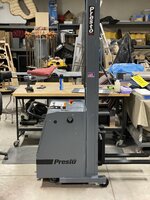
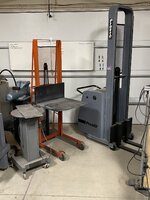
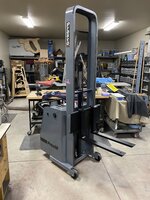
I had some of the same issues in my shop, too tight to use a full-size forklift inside. I have both types of stackers, a manual foot pump and an electric (battery) hydraulic. I use both frequently, but the foot pump one is mostly used for ground to about 40 inches high. I'd hate to have to foot pump it up to a tall shelf. My Presto electric/hydraulic stacker goes to 74" with a simple lever. There's about 600lbs of counterweight in the cabinet so it doesn't need long forward legs. It's rated for 1000lbs, I love it. They show up used in my area occasionally $800-$1500 (how I bought mine). It's a nice solution for me, small enough to maneuver in the shop, yet enough lift power for anything I'm moving. Presto and Wesco both make similiar versions of this lift.
 

Attachments

  • Lift2.JPG
    Lift2.JPG
    856.6 KB · Views: 58
  • Lift10.JPG
    Lift10.JPG
    808.5 KB · Views: 57
  • IMG_1602.JPG
    IMG_1602.JPG
    804.4 KB · Views: 55
OP
J

jaylude

Member
Joined
Jan 14, 2012
Messages
23
Ha! Looks like I wasn't the only one wondering about converting a manual unit....his stacker is the exact one I was considering:


Codyboy

Well-known member
Joined
Jan 31, 2019
Messages
1,638
Location
S.E. TEXAS
Yeah thats a good size tractor for that size space.
I have a 6065 (65 &75 hp ) cab tractor in a 40x60. It's tight but I can make it work.
Trying to figure out where to place the rack for convenient access.
 

mike93lx

ALLIANCE MEMBER
Joined
Dec 9, 2013
Messages
37,434
Location
Richmond, VA
I had some of the same issues in my shop, too tight to use a full-size forklift inside. I have both types of stackers, a manual foot pump and an electric (battery) hydraulic. I use both frequently, but the foot pump one is mostly used for ground to about 40 inches high. I'd hate to have to foot pump it up to a tall shelf. My Presto electric/hydraulic stacker goes to 74" with a simple lever. There's about 600lbs of counterweight in the cabinet so it doesn't need long forward legs. It's rated for 1000lbs, I love it. They show up used in my area occasionally $800-$1500 (how I bought mine). It's a nice solution for me, small enough to maneuver in the shop, yet enough lift power for anything I'm moving. Presto and Wesco both make similiar versions of this lift.
That presto is cool. Having short front legs must be very helpful
 

Montauket

Well-known member
Joined
Mar 25, 2023
Messages
133
Got room above for a crane trolley with a set of pallet forks? Walkie Stackers ****, been in logistics for 37 years everyone hates when they have to reach for one of them. We were given 2 of them for a half million sq ft warehouse from a vendor not long ago. We told him to come get them and get his money back through selling them to someone who would use them. Cumbersome in tight spots, wide front supports on reach trucks, battery is expensive and charging to keep it alive is a waste of money if your not really going to use it much.
 

PeterN

Well-known member
Joined
Mar 19, 2011
Messages
115
Location
FDL, WI
I've got a Hercules manual stacker like you are thinking about that I bought for a similar reason as yours. I've got a 40X45 shed that is full and the only option was to use the 12ft height for more storage. Bought pallet racking from a local liquidation store and he also had a Hercules stacker like you are thinking of getting. It supposedly can lift 2200lbs. It is fully manual (didn't want to deal with electric) and can only lift about 5ft high. Limits the height of the rack you are placing items on and you need clearance at floor level for the front stabilizer legs. It is a slow process pumping the lift (mine has a foot and hand actuation) but it is super maneuverable and has a low floor space footprint. I find it one of my most valuable tools in the shop. Actually use it more for moving stuff around, unloading the truck when there is a pallet involved, and lifting/holding super heavy items (like the rotor in my woodchipper during a rebuild). The forks can be adjusted for width if you need to. A fork lift is a better option if you are mainly stacking in the pallet racking but I am already short of floor space that a fork lift would consume a good size chunk of. I also have a utility tractor with forks that I thought I could use to put stuff in the rack at higher levels but I need to clear out half the shed in order to maneuver it and you need to keep flattening out the load as you lift, unlike a fork lift. An option but not a quick one. The manual stacker is also quiet and no exhaust fumes. Don't regret getting mine at all.
 

Attachments

  • Hercules lift.jpg
    Hercules lift.jpg
    795.1 KB · Views: 13

mikegt4

Well-known member
Joined
Sep 12, 2005
Messages
3,265
Location
sw ohio
I used Presto stackers at my last job, they worked pretty well for most of out storage needs. Our floors were smooth (sealed like a WalMart store) and perfectly level. If you are not pushing around max capacity loads they would work for a smooth floored garage environment.
 
Last edited:
To avoid these ads, REGISTER NOW!
Top Bottom