To avoid these ads, REGISTER NOW!

table saw blade hard to raise, need help diagnosing

BTL-A4

Well-known member
Joined
Feb 28, 2018
Messages
1,252
Location
Santa Clarita
I have a Craftsman 10" 1able saw (152.221140 from the early 2000's) that has a blade that is hard to raise and lower. The worm gear and the rack seem to grind against each other and the handle is very hard to turn. The angle adjustment has the same mechanism and works very smoothly with no issues.

Here are some photos:

Looking down at the mechanism thru the throat:
20260408_144226.jpg

Looking slightly up and at the side of the mechanism:
20260408_144300.jpg

Looking at the end that has the hinge. This is from the side, as above. I stuck the camera in the side door:
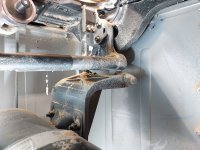
20260408_144320.jpg

The only reference in the manual I could find for this:
20260408_144537.jpg

MY THOUGHTS

1. I've tried adjusting the bolts as described but it didn't seem to do anything. It moves the worm gear eccentrically such that the distance between the teeth of both gears is increased. I can get it to mesh so there is little space, but even when there is more space, it is still hard to move.

2. I've also held the tilting assembly as I turned the wheel to see if taking any weight off helped, and it was marginal. I think something is binding, but I'm not sure where.

3. It also occurs to me the spring might be broken. You can't see it in these photos but there is a spring on the hinge that helps carry the weight of the tilting assembly.

4. I thought I might lube the gears anyway. I can see metal coming off when I turn the handle. Maybe grease and some sawdust will provide some protection.

Any help would be appreciated! Thanks!
 
To avoid these ads, REGISTER NOW!

jblnut

ALLIANCE MEMBER
Joined
Jan 17, 2015
Messages
6,972
Location
In the Middle of MN
I’d start by lubing anything that moves that isn’t the worm or driven gears. A few days back I gave my table saw a good go over and lubed the spot the blade assembly pivots on as well as the bushings that both handles run through. I also stuck a new 2hp motor on. Runs and moves like a champ now.

Basically, if it moves it should do so freely unless it isn’t supposed to. Everything under there should move freely when there is no weight in it. If it doesn’t start lubing things.
 

Gutman

Well-known member
Joined
Jan 10, 2019
Messages
292
Location
ENC
Had similar symptoms to what you're experiencing; a grizzly cabinet saw I inherited, but the mechanism was very much like an 80s model craftsman table saw I had previously, and it looks similar to yours.

What I found was that during years of use by the previous owner, there was a buildup of a hard 'crud' on the teeth of the worm gear assembly for raising and lowering the blade. That buildup had become compressed on the teeth over time and it resulted in severe binding in several spots over the range of travel while raising and lowering the blade. And like you, I was having no issue with the bevel adjustment mechanism.

I first tried using compressed air to blow out the surfaces, but that did not work. I'm speculating that the very fine sawdust, wood pitch, oils, etc, and gear compression pressure/heat created a very hard material, almost like a plastic wood.

I ended up spraying down the gear surfaces with some acetone and then used some picks to actually scrape that crud off of the gear teeth.

Mine was a cabinet saw so access to the mechanism was a ***** (enclosed cabinet and I did not want to remove the cast iron table top), so I removed the blade and throat plate and I was able to use the picks using an inspection mirror, but it took some time.

Your craftsman should be much more accessible to inspect and, if necesary, clean those teeth.

It gave me a much greater appreciation for the mechanism operation and how critical/tight the tolerances are for that worm gear assembly.
 
Last edited:

KansasArt

Well-known member
Joined
Jan 29, 2020
Messages
276
Location
Kansas
Wouldn’t lubing moving parts get all globbed up with sawdust? I have a lower grade dewalt that is difficult to raise the blade too. Haven’t applied any lube out of fearing sawdust would line all the threads.
 

imagineer

Well-known member
Joined
Dec 13, 2015
Messages
1,000
Location
Ohio
I have a Steel City table saw and it too developed a blade adjustment resistance, but in the tilt direction.

Turned out to be a crack in the cast chassis that is bolted to the saw base cabinet. The crack wasn't obvious or easy to find. I was taking the entire assembly apart with the intension of cleaning and re-greasing all moving parts. In order to access one bolt, the blade had to be tilted to about 30 degrees. In doing so, I saw the crack in the casting open up.

To fix it, I ended up machining a flat section that spanned the crack in the casting. I drilled and tapped 2 holes on either side of the crack and bolted a slice plate. After bolting I attempted to TIG weld the splice plate tot he casting using silicon bronze rod. This was several years ago and it's still holding.
 
To avoid these ads, REGISTER NOW!

rlitman

Well-known member
Joined
Oct 18, 2010
Messages
24,582
Location
Long Island
Wouldn’t lubing moving parts get all globbed up with sawdust? I have a lower grade dewalt that is difficult to raise the blade too. Haven’t applied any lube out of fearing sawdust would line all the threads.
That depends on the lube you use. But as Gutman discovered, the factory lube has that issue, so if you have this problem, step 1 is to clean out the teeth and worm (a wire toothbrush may help). Also, the curved track of the trunnion (top of the 3rd picture).

Then you want to apply a completely dry type lube. The kind that does not attract dust. I like dry bicycle chain lubricants here (they have similar issues). I would specifically recommend Pedro's X Dry Chain Lube. For the record, I personally use their predecessor product that I own a lot of (Pedro's Extra Dry Chain Lube), but that formulation has been off the market for some years since they stopped using PTFE. The newer version still gets excellent reviews.
 
Last edited:

david3921

Well-known member
Joined
Apr 22, 2014
Messages
430
Location
Wyoming, Michigan
If it was mine, I would find a way to take off the black worm gear. After it's out, rotate the carriage gear to see if the carriage rotates up like it's supposed to. If not it's where the issue is. If so, then the problem it at the worm gear.
 
OP
B

BTL-A4

Well-known member
Joined
Feb 28, 2018
Messages
1,252
Location
Santa Clarita
I took a little of everyone's advice and cleaned the saw. I had tons of metal and wood sawdust come out from everywhere. I used compressed air and a vacuum cleaner. I then inspected the worm gear and the other gear and did not find any residue of any kind on them. I lubed them with some Tri-Flow bicycle chain lubricant. I also lubed some of the other pivot points. In the owner's manual under the troubleshooting section, it says that if you're having issues with raising the handles, there's probably residue on the gears and that you should clean them. I'll have to keep an eye on these and see how it goes. The handle is easier to turn now. Thanks!
 

hamma

Well-known member
Joined
Mar 23, 2008
Messages
71
Location
MA
That looks the the Ridgid 4511 table saw I have, the one with the granite top. I believe the saw you have was known as one of Craftsman "zip code" saws due to the model number (22114) and was made by the same company Steel City/Orion. The eccentric you're showing has to be adjusted. What you described in step one and show in the manual is the correct method, I always forget how to do it and need to look it up. If you loosen the nut and then get it somewhat tight, turn the handle back and forth so the teeth on the trunnion and the worm screw can work themselves into the proper alignment and then you can then tighten the nut down. I found an article describing the process, here's the link:
https://www.lumberjocks.com/threads...g-repair.351077/?post_id=2247744#post-2247744
 
Last edited:
OP
B

BTL-A4

Well-known member
Joined
Feb 28, 2018
Messages
1,252
Location
Santa Clarita
CODA
I made a new handle for the wheel. The old one was plastic and was starting to wear out, so it wobbled too much. The new one is aluminum and doesn't wobble so it makes it easier to turn.
 
To avoid these ads, REGISTER NOW!
Top Bottom