To avoid these ads, REGISTER NOW!

buying a long term air compressor for a shop?

kingcobb

Active member
Joined
Mar 4, 2026
Messages
31
If you were looking to buy a compressor for your shop that you expected to last a long time what would you be looking at?

I know that people talk about budget and what planning to use it for, but regardless of that....If you were looking to buy a good compressor that could be used for most jobs around the shop---paint spray, orbital sanding, impact wrench and such. A lot of use will be obviously just blowing stuff out.

I currently have a Makita 3hp big bore in my garage that works well, but it also runs continuously when I'm doing anything other than a quick blow off.

I have talked to a Saylor dealer near me and a 5hp 60 gallon with magnetic starter control panel and auto tank drain is 4k....I'm sure its awesome, but that seems like it may be more than I really need.

Resale options locally are limited, or people are wanting almost new prices for a used quincy.

There is a used Champion VRV7f 80 gallon somebody posted for sale for $800 but now down to $600, but I haven't gotten a lot of info on its history.

I've posted previously about an old 50s era quincy, but it has such a small tank and needs a new motor....

1775752962813.png

Just curious for some recommendations.
 
To avoid these ads, REGISTER NOW!

micromind

Well-known member
Joined
Sep 24, 2023
Messages
3,019
Location
Fernley, Nevada, about 30 miles east of Reno.
One of the keys to look for in a compressor is the motor RPM. If it's 34XX, it was built as cheaply as possible. If it's 17XX, it was built to last.

For occasional use and fairly short run times, one of the big-box store models will last quite a while but be careful......5HP is usually not actually 5HP. Look for the motor amps. 5HP single phase will be around 22 or so.

If you get an industrial model (like the Campion or the Saylor-Beale) and use it occasionally, your grandkids will be using it when they retire.......
 

ctandc72

Well-known member
Joined
Sep 19, 2020
Messages
1,086
Location
VA
A lot depends on what tools you will run and how you'll run them. One compressor might be GREAT for years, until that time you decide to strip some body panels to metal with a DA sander. Also depends on the tools themselves - old / new, are they air hogs etc.

FWIW a co worker bought the IR 80gallon 2 stage that Tractor Supply carries in the store. That was during COVID. He got tired of waiting on his old compressor (doing body work) it's like $1500 now. Even he admitted it was an impulse buy, he saw it, he bought it and loaded it up. He's been extremely happy with it.
 

ctandc72

Well-known member
Joined
Sep 19, 2020
Messages
1,086
Location
VA
I wouldn't think you'd need anything all that expensive for a compressor to handle that okay.
Depends on the tool. Some are air hogs. The new LVLP spray guns are great. But the good HVLP guns? The ones I used were air HOGS. Depends on how much use etc. Nothing worse that waiting on a compressor when using air tools - but with so many going battery powered now, who knows how common that is now.
 

driftpin

Well-known member
Joined
Dec 22, 2016
Messages
11,192
Location
Miami-Dade/Broward Co. Florida
Please consider adding your location below your avatar. It helps people to know you're close to them, if they know a local dealer/for sale things.

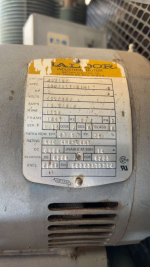
For example, I have a friend here in So. FL who serves 3 counties w/air compressors, new & used, parts, and service. I bought a used Saylor-Beall 705 80 gallon 1 Ph 240V Baldor, w/magnetic starter, that he pieced together for me, from used equipment, It's ~60 mile round-trip for the technician to deliver one to me, well-worth the $ for me not having to do anything but pay the man.

Businesses, when their compressor goes down, "bring me a new one, and get this @!&^$ junk outta-here!" He delivers.

This one is mine, before delivery.
1775757045026.png

This is one he got off an itinerant junk scrapper who picked this up in an industrial warehouse districe. He knew where to bring it. Also a S-B 705. In < 5 minutes, the shop owner removed it from the scrapper's trailer, and had it where he could test it. A forklift eases the work. The motor powered up and no clanking from the compressor, so promising signs.

1775757169412.png

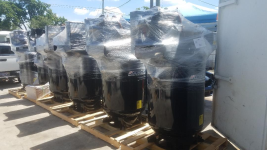
This bank of industrial compressors came off the delivery truck from the manufacturer, and went out from the dealer's shop to the industrial customers. They never went inside the dealer's shop, they went right to work.

1775760159865.png
 
Last edited:

mikedodge

Well-known member
Joined
Jun 27, 2017
Messages
2,764
If it's non commercial use any typical 60 or 80 gallon type compressor should last a while.

The downside of old ones is yeah they're built better but they've also got decades of use on them. I had a chance last year to buy one out of a shop for $300 and probably would have done it if I didn't already have what I need.
 

Steve_P

Well-known member
Joined
Sep 15, 2010
Messages
5,182
One of the keys to look for in a compressor is the motor RPM. If it's 34XX, it was built as cheaply as possible. If it's 17XX, it was built to last.

For occasional use and fairly short run times, one of the big-box store models will last quite a while but be careful......5HP is usually not actually 5HP. Look for the motor amps. 5HP single phase will be around 22 or so.

If you get an industrial model (like the Campion or the Saylor-Beale) and use it occasionally, your grandkids will be using it when they retire.......

No one will claim that a 3450 RPM motor is better than a 1725, but somehow my 3450 Quincy with 20+ CFM is just fine after 20+ years. They're both motors. They do their jobs. The ultimate isn't 99% necessary.

Don't forget to add in necessary pressure lube, disc valves, low oil pressure warning shutdown.... and come up with a $7K compressor for the OP
 

strutaeng

Well-known member
Joined
Dec 12, 2011
Messages
2,256
Location
Dallas, TX
I think the difference is there are those intended for DIY/serious DIY use, and as mentioned, will normally be cheaper and use motors spinning faster with smaller bore pumps. Cost probably on the $1500 range. Will be okay for light or occasional use, even to restore a car with light DA use and spray painting. Not for production work though.

An industrial unit will have things like: industrial motors like Leeson, Baldor, etc. and will be slower rpm. The pump will be a larger, heavier casting with larger diameter bore spinning slower, and will have better bearings, valves and stuff you can't even see. They'll usually have other features like magnetic starter, intercoolers, low-oil shut-down switches and things like that. That's why those are on the $3500-$4000+ range. They'll be driven hard for 8-5, 5 or days a week, for years.
 
To avoid these ads, REGISTER NOW!

moemc

Well-known member
Joined
Mar 12, 2025
Messages
356
If budget isnt in the equation, a rotary screw compressor is where its at. I picked up an Eaton a few years ago and its been great. But if it ever breaks, the repair alone will probably cost as much as 3-4 decent piston compressors. Sometimes I wish I held out for a low hours clean used Keiser since I know those can last decades.
 

Citation

Well-known member
Joined
Jan 20, 2016
Messages
3,212
Location
Indy
Assuming there are no serious problems with the Champion that would be an easy win. It's a design that has been around for a long time.

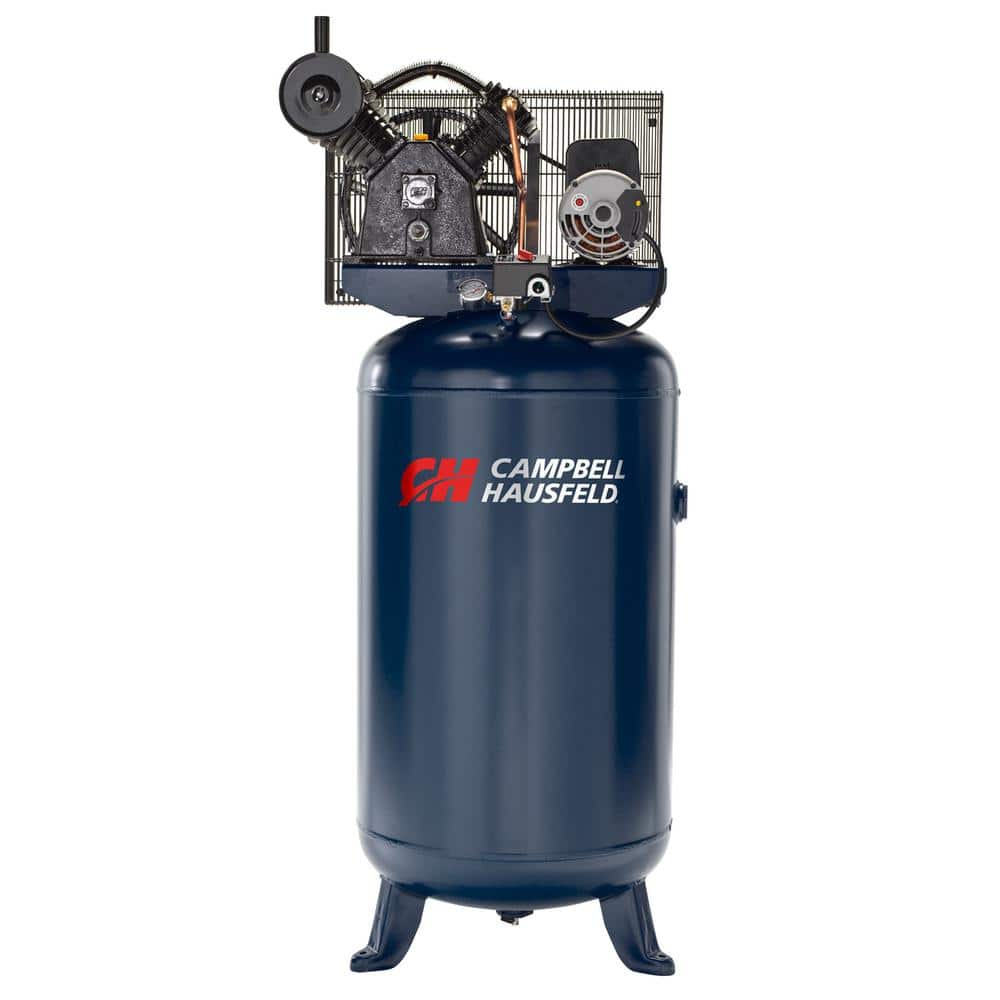
That said, depending on your normal use, a "prosumer" type compressor might also work. At the shop where I used to hang out (not a job, just an obstacle for others) they had a Champion that supported general use as well as occasional painting and sanding. Later when the owner downsized the operation he ended up with a big box, 80 gallon compressor that I think is made by Campbell Hausfeld. He still does the occasional blast cabinet job and uses things like air drills frequently. With his new use case, the 80 gallon prosumer setup is just fine.
This is very similar to the prosumer model I'm talking about

Basically, if you are going to be a daily, reasonably heavy user, go for something like the Champion. If you are going to be the heavy use one weekend a month, perhaps prosumer is fine.

But if that Champion is in decent shape I would take that, especially for the price.
 

NUTTSGT

Super Moderator
Staff member
Joined
Sep 14, 2009
Messages
50,870
Location
Northern Central Ohio
My choice would start with at least 60 gallon, maybe 80 and 240V. I would window shop until Black Friday ads come out and go from there.
I might add 2 more things. I would be looking at vertical tanks for the sole purpose of taking up less floor space.

Secondly, I'm not much of buying a "used" compressor just because a lack of history/PM knowledge. However, if you keep an eye out on Govdeals, you can find some decent looking compressors out there. Buyer beware, go inspect them before bidding.
 

PoorUB

Well-known member
Joined
Mar 29, 2021
Messages
11,622
Location
Fargo, ND
Years ago I bought a "7 HP" Porter Cable, (really only 3 HP) It served me well for 15 years and I ran across a used 5 HP 80 gallon Curtis for $100! I bought the Curtis and sold the Porter Cable to my neighbor for $200. He is still using it. It is about 25 years old. Granted it was just hobby use, week end warrior, but do not disregard these 3 HP units for the guy just messing around in his spare time.
The Porter Cable was a bit short for hours of random orbit sanding. It would drop down to about 60 PSI and run constantly and it was enough air to run the sander so i just kept on working.

The 5 HP Curtis I have now keeps up with everything I can give it, but I am slowing down and my requirements are getting less. Today i think the Porter Cable would be more than I need. I have considered selling the Curtis and run a 2 HP 20 gallon unit I acquired from my dad when he passed away. The last few years all I need is a blast from an air impact and blow up a tire or two. I don't see myself doing any major body work or auto restoration.
 

engineer2

Well-known member
Joined
Dec 13, 2009
Messages
11,795
Location
Chicago burbs
Champion is good, but the low oil safety switch is known to fail. Easy enough to bypass but then you need to manually keep an eye on oil level and hours.
 

b-dog

Well-known member
Joined
Apr 24, 2015
Messages
238
Location
Lakewood, CO
OP, do you want something quiet or is the compressor outside/elsewhere? When I was shopping a few years ago to replace my old tired Craftsman oil-less compressor, something quieter was one of my requirements.
 
OP
K

kingcobb

Active member
Joined
Mar 4, 2026
Messages
31
I'm completely deaf when not wearing my cochlear implant which adjusts the sound automatically, so noise isnt a huge concern for me.
 

dr_clyde

Well-known member
Joined
Jan 7, 2009
Messages
6,431
Location
Holland, MI
Air compressors are actually fairly complex units when you start to look into the finer details.

Things to consider:

Type of compressor. Most common style for small users is a reciprocating piston comp, but in industry rotary screw compressors are king. Small scroll compressors also exist, which are usually lower output in pressure/volume, but make up for it with quiet operation. If you need intermittent air at lower volumes, a piston compressor is usually the play. LOTS of air or air at a very steady stream? Rotary screw is the way to go.

Type of lubrication. Less expensive piston drives use splash lubrication, which is usually sufficient, but not as reliable under more heavy duty use. The connecting rods literally have little dipper arms on them that dip into the oil sump and splash the oil into the places it's needed. A pressure lubricated compressor uses an oil pump like your car's engine to pump oil where it is needed. This is usually considered to be the more reliable and long lived option, but at greater expense.

HP of motor driving the pump. Most of the time this scales with pressure and volume, but a home shop can run just fine on 5 HP. The more important thing to look at is the RPM of the motor, and the phase of the motor. 3 phase motors are preferred, but you will need a VFD to start one if you don't have 3 phase. This is nice because you can soft start/ramp the compressor up so you don't pop a breaker or can use a smaller breaker than a single phase would normally need due to the inrush current. Cheap compressors typically use higher RPM motors to spin the pump faster to get more air out of a smaller setup. This wears them out faster and makes more noise. Higher quality compressors will typically run a larger pump at a slower speed to produce the same air. This is not a hard and fast rule, as some are obviously designed for running faster or what have you, but in general, slower speeds on bigger pistons is preferred.

CFM and pressure of pump. This is the most important part of the air compressor. You typically want the highest volume you can afford. A single stage compressor will push out a lot of volume at around 120 psi. If you need pressure, that will usually come at the expense of volume. This is achieved by compressing the air a second time in a second stage, thus for a given HP you get either higher volume or higher pressure. Most tools and uses want VOLUME not pressure, so a two stage compressor isn't always the big win you would think it is. Most air tools are designed to work at 90 psi. That isn't 90 psi static, that is 90 psi in operation. When you pull the trigger on a die grinder, you'll have a pressure drop. What you really want is a compressor that will feed that tool at 90 psi IN USE while the tool is working. If you set your linework to 95 psi, you probably will only see 60-70 at the tool.

Volume of receiver. This is tied to the pump type. A single stage pump will usually want a LARGE receiver, as it isn't packing as much air into the tank. A two stage pump can pack a lot more air into a given tank size, but it will do it slower. I don't think you would want to go less than 50 gallons, personally speaking.

Type of receiver. Vertical or horizontal are your two choices. Horizontal has it's benefits, primarily when you get in the bigger capacity. Vertical is usually better for smaller spaces as it takes up less square footage. They also drain easier and rig easier.

Duty cycle. How much will your compressor run before it overheats? If you're just using a rattle wrench and the occasional spray gun, this probably doesn't matter. But if you're getting into sandblasting, you can EASILY outrun most compressors. I used to rent a tow behind screw just to blast with because a pressure pot blaster uses so much air. Same with the big power hammers in the blacksmith shop.

At the end of the day, most any compressor will work in a home shop. The true test is in industry, so you won't push anything you buy to the breaking point in your garage.

That said, I would personally buy a pressure lubricated Quincy, Saylor-Beall or Ingersoll Rand for my home shop. 5 HP is plenty. I'd get a vertical tank, 50-80 gallons with a timer on the drain. I'd use an air dryer. I would use a 3 phase motor with a soft start VFD. And I would run 3/4" or 1" main lines to my drops, black iron pipe, with moisture drains at each drop.

For my industrial shop, I have a 10HP Atlas Copco screw compressor, and you'll never convince me to go back to a piston drive in a pro setting due to the astronomical difference in noise and air volume per HP the screw provides. I gave my dad my 5 HP Quincy configured like I described above and he uses it in his home shop very happily.
 

T444e

Well-known member
Joined
Feb 25, 2016
Messages
448
I went with a Quincy QT-5, 2018 if I remember correctly. I have the problem of when I want something I want it now so used is out of the equation. The main requirement was that I could run a blast cabinet off it and figured the QT-7.5 would draw the utilities attention as they don't want anything over 3 hp on a residential service. I believe I have about 60 hours run time on it so far.
 

u3b3rg33k

Well-known member
Joined
Dec 18, 2017
Messages
4,047
We've got a 10HP Eaton VFD and a 25hp QR25 at work. just rebuilt the starter on the QR25.
the eaton has thousands of hours on it, as it load follows. the QR25 runs when the eaton can't keep up.

both are V4 2 stage with poppet valves and oil pumps.

1776223570537.png1776223575615.png
 

Grant Gunderson

Well-known member
Joined
May 17, 2013
Messages
2,319
Location
Bellingham, WA
Air compressors are actually fairly complex units when you start to look into the finer details.

Things to consider:

Type of compressor. Most common style for small users is a reciprocating piston comp, but in industry rotary screw compressors are king. Small scroll compressors also exist, which are usually lower output in pressure/volume, but make up for it with quiet operation. If you need intermittent air at lower volumes, a piston compressor is usually the play. LOTS of air or air at a very steady stream? Rotary screw is the way to go.
What’s the recommendation these days for a 5hp screw type that’s not astronomical in price?
 

dr_clyde

Well-known member
Joined
Jan 7, 2009
Messages
6,431
Location
Holland, MI
What’s the recommendation these days for a 5hp screw type that’s not astronomical in price?
I honestly can't answer that for you. What is astronomical to you might be very reasonable to someone else.

Screw compressors are targeted towards industrial users with budgets to match. If you're making money with your tools, you can budget and invest appropriately.

I would want a Kaeser, Atlas-Copco or Gardner-Denver if I was buying a new screw tomorrow. Personally.
 
To avoid these ads, REGISTER NOW!
Top Bottom