To avoid these ads, REGISTER NOW!

AC ductwork and dampers

stickshift

Well-known member
Joined
Nov 16, 2011
Messages
1,215
Location
northeastern US
I've got an old central air unit (1980s) Ductwork is metal. It's a one zone system. At some point this is going to die or the R22 will escape. I hate the idea of one zone AC because of inefficiency of cooling parts of the house that aren't in use, such as downstairs at night, or upstairs bedrooms during the day. But I am not a fan of minisplits in terms of how they look on the exterior of the house or how the wall mounted head units look, or the work involved in proper maintenance of the head units. Plus I have ducts, so minisplits seem wasteful.

My understanding is that with an old system, I shouldn't be adding dampers to close off certain ducts because the air handler wasn't designed for the increase in pressure that would result. But with a new system that uses the existing ducts, can it be set up with dampers to create what is essentially a 2 zone system?
 
To avoid these ads, REGISTER NOW!

Dagny

Well-known member
Joined
Jul 25, 2014
Messages
2,980
Location
Northern Wi.
I know mini splits are very popular on here. But there are a lot of better options available today. My biggest gripe is they are pretty much throw aways any major parts for them cost as much as a new one.

This is a trend in many consumer goods. Investor groups buy up HVAC companies and fire most of the good repairmen and send salesmen out to sell you a new one. This is true with appliances also.
 

PoorUB

Well-known member
Joined
Mar 29, 2021
Messages
11,622
Location
Fargo, ND
But with a new system that uses the existing ducts, can it be set up with dampers to create what is essentially a 2 zone system?
Possibly! Really it is hard to say without looking over the system. You will certainly need a bypass duct to relieve extra air flow when one side of the system dampers are closed.
It can also get expensive. Dampers are $150-$200 a piece, the controls $200 plus a bunch of wiring. Depending on the system it might take many dampers. I considered doing to my house, but it would require 14 dampers, plus the other parts of the system. I could buy it all at distributor cost and it would have cost about $2,000! Needless to say, I didn't do it.
 

larry4406

Well-known member
Joined
Jan 27, 2006
Messages
19,073
Location
Northern Virginia
I would rethink the idea of depriving the upstairs of cooling during the day while allowing it to heat soak all day long and then expecting it to suddenly be cool when you enable air flow for sleeping at night.
 

larry4406

Well-known member
Joined
Jan 27, 2006
Messages
19,073
Location
Northern Virginia
My last community had a new house type for us. It is around 5100 SF with a basement, first floor, and second floor.

It has single zone 5 ton gas heat AC system in the basement. The second floor has dedicated supply. The first floor and basement share two supply trunks.

There is a zone damper for the second floor trunk, two more for the shared basement/first floor trunks, and a bypass damper system as @PoorUB mentioned being needed. There are thermostats on the first floor level and the second floor. Computer controller monitors both inputs and biases the flow.

First couple units had teething problems during commissioning. Mis-wired dampers, incorrect thermostats, etc. We also had noise issues when the bypass damper was placed to close to the return. These all got sorted before delivery.

When the 2nd floor damper was not behaving properly, no air was delivered upstairs. Would not recover in a reasonable period of time.

I disliked the system.
 
OP
S

stickshift

Well-known member
Joined
Nov 16, 2011
Messages
1,215
Location
northeastern US
I would rethink the idea of depriving the upstairs of cooling during the day while allowing it to heat soak all day long and then expecting it to suddenly be cool when you enable air flow for sleeping at night.
This is a good point, but adequately ventilating the roof has made a big difference in this regard. Much less heat soaking and much quicker drop in second floor ceiling temp when sun goes down. Last summer, I found the AC got second floor to desired sleeping temp much quicker than it used to, which I attribute to the much improved attic ventilation.
 

gagecalman

Well-known member
Joined
Feb 5, 2020
Messages
194
Location
MD
I'm not an HVAC guy so take this for what it's worth.

I believe you'll have a lot more issues with the newer systems with ECM blowers if you create zones and don't design a bypass in it as PoorUB stated. Too much static pressure will take it's toll on the ECM.

Have you thought about two systems. One for each level? Probably could get by with a smaller unit downstairs and maybe just AC for upstairs. That is what I have. Definitely more money but works great.

Also there's a good chance the ductwork for the old system is going to be restrictive for the ECM blower. They didn't design them big enough.
 

DGersic

Well-known member
Joined
Mar 12, 2017
Messages
6,281
Location
DeKalb, IL
My understanding is that with an old system, I shouldn't be adding dampers to close off certain ducts because the air handler wasn't designed for the increase in pressure that would result. But with a new system that uses the existing ducts, can it be set up with dampers to create what is essentially a 2 zone system?

I had my HVAC retrofitted to a two zone system. It wasn’t the easiest thing to get done, but I’m very happy with the results.

My house is an L shaped ranch. The front, rectangular section, is a 1950 ranch with blown in cellulose insulation (walls were originally not insulated, empty cavities) and new vinyl windows. Inside walls are all plaster over rock lath. The house faces south, with a huge picture window. A maple tree provides shade in the summer.

The back of the house, the leg of the L shape, was added in the 1970s. Sheetrock and fibreglass insulation, with north facing windows, and a cathedral ceiling. The thermostat was centrally located, in the front half of the house.

I have a high efficiency furnace, relatively new, with a variable speed motor. I also have a heat pump. The heat pump further complicates things. The ductwork fed each room in the front with a 9” round duct, and there was added on a large rectangular duct trunk to feed the back half of the house.

The problems were that these two halves offer very different heating and cooling action.

In the winter, sun through the picture window would heat the front of the house up, keeping the thermostat from calling for heat, and the back half of the house would cool off to uncomfortable temperatures.

In the summer, cooling the front would freeze the back.

I could, and did play with the dampers to balance this, but only at night when the sun wasn’t a factor.

I made changes to build this in to a two zone system:

The old 9” ducts were cut off the existing plenum on top of the furnace. A new horizontal rectangle plenum was built, and the ducts reattached to it. This allowed for two zones, front and back, with a minimum of new dampers.

Two of these electronic dampers were added:
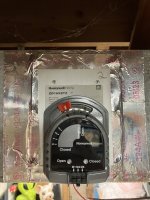
IMG_9129.jpeg

A new set of controls were installed:

IMG_9130.jpeg

And a bypass damper was added:

IMG_9131.jpeg

The house now has two wireless thermostats. One for the front zone, one for the back. I went wireless because there was no way to get to the inside wall to mount and wire the rear zone ‘stat. The front zone could have been wired, but wireless is convenient.

The controller needed for this has to understand two zones, and be dual fuel capable. It is responsible for calling for heat from the heat pump when above the BECOP, or the furnace below it. Or cooling from the heat pump. The furnace itself has two heating levels, with the variable fan kicking up for “high” heat when called for.

The results are almost perfect. I can set the temperature at the thermostats, and then proceed to forget that they exist until it’s time to change them from heat to cool, or change the batteries. The house is now reasonably well balanced at all times, regardless of the time of day or how much sun we’re getting.
 

Ohmthis

Well-known member
Joined
Jan 20, 2013
Messages
3,009
Location
Outside of Louisville KY
I have put in dozens of zoned systems. A retrofit can be the most difficult to design and install. As stated above, a thorough inspection of the original system needs to be done to see how the ductwork is laid out. Keeping the velocity and flow is extremely important to newer systems with ECM or variable speed blowers. That means the ductwork sizing and layout needs to be done correctly. When one zone is closed the pressure increases in the other(s). I’m not a huge fan of the bypass dampers anymore. Again, as stated above, the size, and location can make or break it. I like using a zone system that incorporates pressure transducers in the ductwork. When the pressure increases, the pressure is read by the certain zone and “bleeds” the pressure into another. You can set this up in small increments with other zones or one. Cost wise, it may be the same or higher than a separate system. I’ve used the Honeywell like shown above on my last house that I built. We sold it 10 years ago and the system still works fine. Some equipment manufacturers have their own zone systems, not all are the same so do some research.
 

danski0224

Well-known member
Joined
Jan 29, 2005
Messages
13,357
Location
Near Naperville, IL
I hate the idea of one zone AC because of inefficiency of cooling parts of the house that aren't in use, such as downstairs at night, or upstairs bedrooms during the day.
Zoning is for comfort- it will absolutely NEVER save any money.

Comfort, if it is installed properly. I have not seen many zoned systems, and of those, none of them worked properly.

Most residential equipment can't modulate capacity, certainly not the lower priced stuff that is mentioned in this forum the most.
But I am not a fan of minisplits in terms of how they look on the exterior of the house or how the wall mounted head units look, or the work involved in proper maintenance of the head units. Plus I have ducts, so minisplits seem wasteful.
Then there are all of the drain connections.
My understanding is that with an old system, I shouldn't be adding dampers to close off certain ducts because the air handler wasn't designed for the increase in pressure that would result.
Yes. Residential stuff does not work well when dampers are closed off.
But with a new system that uses the existing ducts, can it be set up with dampers to create what is essentially a 2 zone system?
That's a big maybe.

I am reading a desire for zoning to "save money". If this is the intent, it will NOT work.

More often than not, at least from what I have seen, ductwork at the furnace location can be changed to improve airflow, which will primarily improve comfort and might have some operational cost savings as a side benefit.
 

PoorUB

Well-known member
Joined
Mar 29, 2021
Messages
11,622
Location
Fargo, ND
I have not seen many zoned systems, and of those, none of them worked properly.
I have installed many zone systems. From 2,000 sqft homes, to 200,000 sqft office buildings. If you start from scratch they can work very well.

Modifying an existing system takes some thought and many installers don't want to think and more than that have to, so you get a poorly designed system. It isn't that the system doesn't work, the installer failed to do the work properly.

One thing I often did was to never close a zone completely. Leave the zone damper open a bit, maybe 10-20%, even when the zone isn't calling. I have seen systems with no bypass damper and one of the zones was small, like 6" run for a bedroom, then close off the other zones completely. The poor fan in the air handler is dying from trying to move air and no place to send it. Another thing is you can buy a freeze protection thermostat for the air conditioner. It is a simple clip on thermostat that clips on the suction line off the A-coil and if the suction line temp drops close to freezing temp it shuts off the AC until it warms up a few degrees. It doesn't hurt to put in a shot cycle timer on the AC too so when the freeze 'stat turns back on it isn't slamming the AC back on after it was off for a short time.
 

fitter30

Well-known member
Joined
Jun 23, 2019
Messages
2,967
Location
Peace Valley,mo
Don't think much of damper systems for residential. Two ways to limit capacity of a older system with only one stage of cooling is to bypass air back into the return and cycle compressor on discharge air temp or pipe in the refrigeration system to make it hot gas bypass. Compressor doesn't cycle but compressor stays running and some of the refrigerate flow ( hot gas)is bypassed into the suction line. Damper system with variable refrigerate flow will work better. Would want a system that can talk with every component. It's looking at damper posistion , blower speed ,compressorloading and temperatures. Best dampers for air flow are opposed blade with rubber blade seals or a air valve that uses a flow ring that measures air pressure and adjusts minimum and maximum cfm.
 
Last edited:
To avoid these ads, REGISTER NOW!
OP
S

stickshift

Well-known member
Joined
Nov 16, 2011
Messages
1,215
Location
northeastern US
Zoning is for comfort- it will absolutely NEVER save any money.
That seems counterintuitive. If my desired temp is 70*F, and I only need half the house cooled instead of the whole house, seems like this should consume less electricity. Is the lack of cost savings because of the upfront cost of the extra equipment required for a damper system, or the higher maintenance costs of such a system, or does such a system not save on operational costs (electricity) on a monthly basis?
 

danski0224

Well-known member
Joined
Jan 29, 2005
Messages
13,357
Location
Near Naperville, IL
That seems counterintuitive.
It's not, because you do not know how the equipment works.
If my desired temp is 70*F, and I only need half the house cooled instead of the whole house, seems like this should consume less electricity. Is the lack of cost savings because of the upfront cost of the extra equipment required for a damper system, or the higher maintenance costs of such a system,
A typical residential system cannot modulate output.

If there is a 100,000 btu furnace and 3 ton air conditioner, the equipment is still operating at full capacity, even if 1/2 of the ducting is "shut off". The dump zone recirculates the excess capacity back into the system, and can cause short cycling if not designed properly.

Only one type of equipment, that I know of, can modulate output and work with zoning, and that is the Carrier Infinity stuff and their controls. I have never installed it.

Properly sized and installed equipment- with good ductwork- will operate at the lowest cost.

or does such a system not save on operational costs (electricity) on a monthly basis?
You will absolutely never recover the investment in zoning if the purpose is to "save money on utility costs". Nor does it work if one goes from a properly sized 80% AFUE furnace to a properly sized "95%" AFUE furnace.

If the house and existing ductwork can be split up and re-worked with 2 separate systems, then this is the best, and most expensive, option.

Unless your house is a 20,000 SF mansion, it would take tens of years to break even, much less "make money".

Adding insulation and air sealing will do more than anything else. It will likely be cheaper to do retrofit spray foam than to try and "save money on energy" through a fancy HVAC system with zoning that won't work when it is done.

I had an estimate to do retrofit spray foam on my house, in the walls. It was about $5,600.00. That's about 1/3 the cost of some of the "fancy" HVAC replacements I have seen recently.
 
Last edited:
OP
S

stickshift

Well-known member
Joined
Nov 16, 2011
Messages
1,215
Location
northeastern US
Unless your house is a 20,000 SF mansion, it would take tens of years to break even, much less "make money".

Adding insulation and air sealing will do more than anything else. It will likely be cheaper to do retrofit spray foam than to try and "save money on energy" through a fancy HVAC system with zoning that won't work when it is done.

I had an estimate to do retrofit spray foam on my house, in the walls. It was about $5,600.00. That's about 1/3 the cost of some of the "fancy" HVAC replacements I have seen recently.
Thanks, that puts things in perspective. And air sealing and insulation is DIY friendly and cheap.
 

DGersic

Well-known member
Joined
Mar 12, 2017
Messages
6,281
Location
DeKalb, IL
It's not, because you do not know how the equipment works.

You’re ignoring human factors. If wife is cold and turns up thermostat, heating the entire house an extra 5-10 degrees to get the room she’s in to be comfortable, it’s going to cost more than using zones to account for the desired comfort and house conditions.

You seem dead set against zoned systems. I’m not claiming that they’re the solution to all problems, but a useful tool in the toolbox.
 

danski0224

Well-known member
Joined
Jan 29, 2005
Messages
13,357
Location
Near Naperville, IL
You’re ignoring human factors. If wife is cold and turns up thermostat, heating the entire house an extra 5-10 degrees to get the room she’s in to be comfortable, it’s going to cost more than using zones to account for the desired comfort and house conditions.

You seem dead set against zoned systems. I’m not claiming that they’re the solution to all problems, but a useful tool in the toolbox.
The OP wants zoning to "save money" by turning off the HVAC to "unused" parts of the house.

It doesn't work that way. The equipment, with rare exception, does not modulate capacity.

The desire to change temperature in an area is an unusual example for residential HVAC zoning.

The common reason for zoning in my experience is a desire to even out the temperature in the house, which is typically caused by ****** ductwork.

Why install a crutch (zoning) if fixing the ductwork (or part of the ductwork) can usually fix the problem?

I have not experienced the "I want to raise or lower the temperature in this area by X degrees" reason for zoning.
 

gba2331

Well-known member
Joined
Sep 22, 2021
Messages
762
there is a 100,000 btu furnace and 3 ton air conditioner, the equipment is still operating at full capacity, even if 1/2 of the ducting is "shut off". The dump zone recirculates the excess capacity back into the system, and can cause short cycling if not designed properly.
But doesn’t the system run for a shorter time since there is less load to satisfy?

I can see why it’s less efficient so the savings would not be proportional.
 

98ssuck

Well-known member
Joined
Oct 21, 2012
Messages
347
Location
British columbia
That seems counterintuitive. If my desired temp is 70*F, and I only need half the house cooled instead of the whole house, seems like this should consume less electricity. Is the lack of cost savings because of the upfront cost of the extra equipment required for a damper system, or the higher maintenance costs of such a system, or does such a system not save on operational costs (electricity) on a monthly basis?
Is the space between your proposed zones insulated? Even separated by closing doors?
 

lmg

Well-known member
Joined
Mar 17, 2023
Messages
96
I've got an old central air unit (1980s) Ductwork is metal. It's a one zone system. At some point this is going to die or the R22 will escape. I hate the idea of one zone AC because of inefficiency of cooling parts of the house that aren't in use, such as downstairs at night, or upstairs bedrooms during the day. But I am not a fan of minisplits in terms of how they look on the exterior of the house or how the wall mounted head units look, or the work involved in proper maintenance of the head units. Plus I have ducts, so minisplits seem wasteful.

My understanding is that with an old system, I shouldn't be adding dampers to close off certain ducts because the air handler wasn't designed for the increase in pressure that would result. But with a new system that uses the existing ducts, can it be set up with dampers to create what is essentially a 2 zone system?
Based on my experience with older duct systems, I would not use a 1980s duct system without at least a duct leakage test. Also, I believe that a "duct blaster" can be connected to the duct system and set to produce the design flow of the proposed upgraded system, and measure static pressure to obtain the design flow in order to determine if the new air handler will perform satisfactorily. If ducts are leaky, but not accessible for sealing, a system called Aero Seal sprays a mastic into the system which goes to the leakage sites and bridges the holes until leakage is eliminated. I have personally seen older systems with no attempt at sealing the joints when constructed, and also with disconnected joints which were never secured, and also holes large enough to put 4 of my fingers into up to my knuckles. If ducts are fully within the thermal boundary, at least leakage is not to outside, but the air will probably not ever get to where you need it.
 

DGersic

Well-known member
Joined
Mar 12, 2017
Messages
6,281
Location
DeKalb, IL
The OP wants zoning to "save money" by turning off the HVAC to "unused" parts of the house.

It doesn't work that way. The equipment, with rare exception, does not modulate capacity.

The desire to change temperature in an area is an unusual example for residential HVAC zoning.

The common reason for zoning in my experience is a desire to even out the temperature in the house, which is typically caused by ****** ductwork.

Why install a crutch (zoning) if fixing the ductwork (or part of the ductwork) can usually fix the problem?

I have not experienced the "I want to raise or lower the temperature in this area by X degrees" reason for zoning.

Agreed that the OP’s “save money” probably won’t. IMHO, the system works best when a set temperature is maintained. Incurring heat debt by turning on/off the system is inefficient and the debt has to be made up later.

Replacing ductwork isn’t easy. Tearing out walls to reach it isn’t cheap or easy.

My zones have evened out the house temperature nicely. Crutch? Maybe so. Beats tearing out walls.
 

BurtEggley

Well-known member
Joined
Oct 8, 2024
Messages
861
you need to run a TESP on the system to see where it is at now. There are steps in getting what you want.

The total capacity of the system needed must be calculated
The air flow for that system must be calculated
The filtering for that system must be calculated. Many people want high efficiency filters these days on systems that the filtering does not have enough surface area. Are you going to be running high merv filters instead of the cheap fiberglass ones? Will you have a 4" or 5" built in filter?
The total external static pressure has to be calculated once the above is dealt with. This assumes that the system is clean and serviced. The coils are clean etc.
If the tesp is around .5 or less then the system is usually operateing within limits. You can then tape off a duct with some cardboard and check again - see what the tesp does. However if you are starting with a tesp at .5 or above, it is not likely you can pull off what you want to do.

That said, many vents have louvers in them that can be adjusted. Have you checked to see if any have that? Do you leave the bedroom doors open all the time so not to build up pressure in the bedrooms. Closing the door if there is not enough space under the door for conditioned air to escape does about the same as partially closing off a duct.
 
To avoid these ads, REGISTER NOW!
Top Bottom