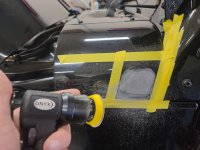
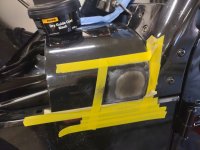
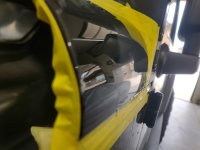
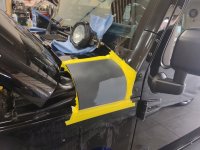
Scott, you are correct, the concept is to get the dolly behind the panel and then depending on the dent you either hammer "on dolly" or "off dolly" depending on whether you need to raise an area or lower a surrounding area. Access behind that small corner cowl is pretty restricted, but if you look at the picture immediately after the badge removal you will see a dolly with a long stem or handle on it. That is what I used to reach in behind the dent and then by hammering "off dolly" I was able to raise the lowered part of the dent.
I'm far from a pro like Robert, aka
@MP&C , but I've done quite a bit in a former life when I was building street rods and restorations so I can hold my own, but I'm still always trying to learn and improve my skillset. That being said, one thing I have found when trying to show someone is that beginners tend to overpull or overwork the metal and raise it too much above the parent material. They are so anxious and excited to get to the body filler stage that they then fight the highs and usually end up having to knock them back down. Take your time and get the metal as close as possible so only a very, very thin skim coat of filler is required. You don't want much at all. Everything I've read is no thicker than 1/4", but I always shoot for much, much less.
Where the metal has already been stretched from the dent, there's going to be some filler, so the key is to keep the metal lower than the parent material very slightly, only enough for a small skim coat of filler, and then sand down to where it is "almost" flush. Then switch to finer paper and refine the scratches. Where I'm not a body shop rushing an insurance job, I always try to put a coat of epoxy primer down over 80-grit scratches for the filler to have not only a mechanical tooth, but also a chemical tooth for adhesion as well as corrosion protection.
Then the next day I will begin my filler work. Let the filler cure, then sand with 80-grit to where it is close and switch to 180-grit and refine the 80-grit scratches. Then I will use a glazing or icing filler to fill those scratches as well as the 80 and 180 scratches to the surrounding areas and finish that out with 320-grit before going to primer.
When I first started out back in the 80's I learned by going very coarse in the beginning to knock things down quickly, that was just the way people did it, like 36-grit. However, I found you then have to worry about filling those 36-grit scratches or they WILL come back to bite you in the ***. Maybe not right away, but a month or a year down the road you'll see those puppies come right through as everything shrinks back. When the high build primers came into the scene they all ranted and raved about being able to fill 36-grit scratches, and they would, initially and for a while. PPG had a K200 (yellow) back in the day that was almost like spraying liquid body filler, but I got bit doing a complete for a guy and had to end up going back six months later and refinishing several sections where the scratches pulled back and were visible. I think what was happening was the heavy primer was actually bridging across the course scratches rather than getting into the valleys of them and filling them. Then as the sun beat down on the paint and all of the solvents finally flashed off, the primer shrunk.
Since then I quit using such coarse paper and start with 80 and refine scratches from there all the way up to 320-grit before I even think about mixing up some primer. I also don't use the high build primer very often. Very seldom in fact. I prefer to get the body work nearly perfect so the primer is only needed for scratch refinement and uniformity. I have sprayed some of the polyester high build primer from Evercoat and actually quite like it. Being catalyzed it is more liken to body filler than actually a 2k primer surfacer. I will use that if I need to level out a large panel or area before going to a standard 2k primer surfacer. I then will use the epoxy primer slightly reduces as a sealer before going to basecoat as I feel it gives just that little extra adhesion and corrosion protection, especially if there are any areas where I cut through the primer.
Sorry for the long drawn-out explanation Scott. Hope it was helpful and you maybe you can avoid falling subject to some of my similar earlier mistakes, but I would suggest grabbing a panel from a salvage yard and practicing not only dent removal, but also filler applications, sanding and priming all before moving on to something that really matters.
I've been blessed with a lot of work over the years that really helped me refine much of my skills long before I tackled our first high end street rod build. Our 1940 Chev coupe was my first high end job and I was thankful I had painted a half dozen or so before tackling that one. Our '40 coupe was riddled with bullet holes and large sections of body were taken by rust so this was a true test.
Funny story, we were at the UVSC (Utah Valley State College) in Orem, UT, long before it was UVU (Utah Valley University) and there were about 400 cars there for a state invitational car show. This was around 2001 before my dad passed (2002) and once we arrived and got the car setup, I got the lawn chair out for my dad to sit in and he was just grinning ear to ear talking with people as they walked by. My BIL and I decided to walk around, and we bumped into Hondo John who is a world-renowned custom painter here in Utah. I was a nobody back then just dipping my big toe into the custom world with my first build, hell I'm still a nobody

, but Hondo John had 3 cars he had painted in that show. An 80's El Camino, a 1940 Studebaker Pro-Streeter and a 1934 3-window Ford coupe. All absolutely beautiful works of rolling art with flawless paint and body work.
As my BIL and I walked away I told him I thought the 1934 Ford 3-window was going to win best paint award and he thought it was going to be the El Camino. The El Camino with those long quarter panels were perfectly flat and the paint looked about 3' thick so I conceded he may be right. As we were standing around and they were announcing awards, we received a People's Choice award and then they got to the big daddy awards such as best 30's, best 40's and best paint. Hondo John's won best 30's, we won best 40's and THEN they announced the best paint award and I was blown over when they called my name. I was in shock, my wife gave me a big ole' hug and to see the grin on my dad's face was something I will never forget. As I was walking down from grabbing the award Hondo John came up to me and congratulated me and shook my hand. I will never forget that event.
All with this car, built by a complete nobody and his first attempt at building a street rod.

Then a few years later I had the opportunity to build this one for a client and it turned out even better than our '40 coupe. I was quite blessed to have been able to build another 2 cars for this same client.

After building a couple more cars for this same client, I did a stupid thing in 2008~ish. I told him I was getting out of building custom cars and diving all in the sand dune pond. He asked why and I stated that cars are great to build, but so much can be hidden and with a tube chassis such as a sand rail or quad, nothing can be hidden. EVERYTHING is right out in the open for the whole world to see and I really wanted to see if my workmanship was good enough to hang in that world. While we did well with the sand dune toys and we made a name for ourselves in the local duning community, I can't help to think that I shot my d**k off by telling my client I was no longer building cars. What a dumb move that was as he was a great client and great guy. He had money but didn't flash it about nor boast about it. Just a great guy who allowed me to collaborate with him to build a couple of amazing projects.
Sorry for the detour and trip down memory lane.











 My father has been gone for 24 years now and I still miss him daily. Some days much more than others and I know he would be proud of his grandson and the great young man he has turned into and I wish he could see his great-grandchildren. He became softer as he aged and maybe that is why I had a better relationship with him than my older siblings did.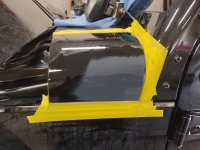








 Don't ask me how I know.
  I thought I had put those days behind me.