To avoid these ads, REGISTER NOW!

Craftsman Dunlap Lathe Model 101.06242 Thrust Bearing Location

SurferRosa

Member
Joined
Apr 1, 2026
Messages
12
Hello All,
This is my first post here, but I have been poaching great ideas from this Forum for years.
I am recently retired and have taken to reviving older wood and metal working equipment.

My current project is an older Craftsman Wood Lathe.
There are no tags that I can see, but from my research it appears to be a 101.06242, as all the components have corresponding part numbers in the castings.

My question to membership is about the spindle and Thrust Bearing placement.
As I was disassembling I noted the placement of the Thrust Bearing was between the Spindle Nose Collar and the Headstock face (which appears to be correct),
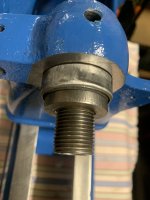
Headstock Face.jpg
Headstock Back End.jpg
Headstock Top.jpg

but I have noticed images on the web, and video postings of similar Lathes, that these Bearings have been placed in other areas on the spindle (on either side of the Spindle Pulley, and sometimes on the back end of the Headstock. I have also seen what looks like additional thrust bearings added to the assembly.

The components list does not orientate in order of installation unfortunately, but only shows one Thrust Bearing and two "Thrust and Shoulder Collars". The Thrust and Shoulder Collars are left hand thread, so the only place they can go is on the back end of the spindle.

Screenshot 2026-04-22 at 6.27.22 PM.png

The Spindle Pulley is shorter than the distance between yokes of the Headstock, and there are no shims to make up the gap. It seems it is just aligns with the set-screw dimples on the spindle and floats between the yolks?

Instructions to remove Spindle End Play note to tighten the Thrust and Shoulder Collars, securing the adjacent headstock bearing until snug (but not so that it binds) against the headstock face.

One final concern I have is about tightening set-screws into those left handed threads on the back of the spindle, for fear of damaging the threads. I was thinking about dropping a 3/16" brass disc in there to protect the threads.

Interested in any helpful insights that might be out there

Thanks
 
To avoid these ads, REGISTER NOW!

tombell572

Well-known member
Joined
Oct 3, 2015
Messages
1,034
Location
Sea Cliff, NY & Portland, OR
Surfer--on older machines where a set screw bears against the threaded portion of a shaft, it was common to drop a small piece of bass cut from a brass rod the diameter of the screw into the hole. As you note, this will protect the thead and provide a good surface to tighten the screw against. Some machine builders when using headless set screws would double them up, the second screw locking in the first. Always a good idea when removing a stuck pulley from a shaft to check for a second set screw.

Tom B.
 

FrankLee

Well-known member
Joined
Sep 13, 2010
Messages
3,577
Location
seMI, 48317
My question to membership is about the spindle and Thrust Bearing placement.
As I was disassembling I noted the placement of the Thrust Bearing was between the Spindle Nose Collar and the Headstock face (which appears to be correct),
I'm not so sure that the thrust bearing on your machine is the correct part. All photos I looked at on VM do not show that thick bearing. I suspect that a sintered bronze bearing (washer) was the oe part. The left-handed thread end of your pulley sghaft looks short.

What is the part number on the bearing itself? It looks like a standard shielded ball bearing to me. Thrust ball bearings of that era are usually NICE brand.
 
OP
S

SurferRosa

Member
Joined
Apr 1, 2026
Messages
12
Hey Tom,

Thanks for this.
I was thinking of punching some brass flat stock, but rod will be easier and I can get it a little thicker.

Hadn't thought of a double set screw, but if I have the depth, I will try that too
 
OP
S

SurferRosa

Member
Joined
Apr 1, 2026
Messages
12
I'm not so sure that the thrust bearing on your machine is the correct part. All photos I looked at on VM do not show that thick bearing. I suspect that a sintered bronze bearing (washer) was the oe part. The left-handed thread end of your pulley sghaft looks short.

What is the part number on the bearing itself? It looks like a standard shielded ball bearing to me. Thrust ball bearings of that era are usually NICE brand.
Hi Frank
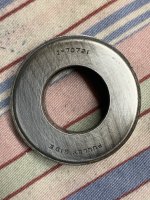
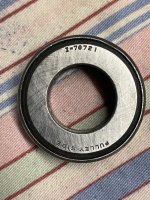
Here’s a few images of the Bearing
IMG_5889.jpeg
IMG_5888.jpeg
OD is 1.4”, and it is .42” thick.

I thought about replacing, but these are difficult to find. Ones of the correct size seem to have limited RPM
 

FrankLee

Well-known member
Joined
Sep 13, 2010
Messages
3,577
Location
seMI, 48317
Hi Frank
Here’s a few images of the Bearing


OD is 1.4”, and it is .42” thick.

I thought about replacing, but these are difficult to find. Ones of the correct size seem to have limited RPM
Thanks for the pics. That's interesting.
 
OP
S

SurferRosa

Member
Joined
Apr 1, 2026
Messages
12
I'm not so sure that the thrust bearing on your machine is the correct part. All photos I looked at on VM do not show that thick bearing. I suspect that a sintered bronze bearing (washer) was the oe part. The left-handed thread end of your pulley sghaft looks short.

What is the part number on the bearing itself? It looks like a standard shielded ball bearing to me. Thrust ball bearings of that era are usually NICE brand.
Frank, I might have seen that VM post before, and it is part of the reason for this thread. It looks like the restorer of that lathe chose to install the Thrust Bearing between the small end of the pulley and the rear spindle yoke. This is also why his spindle seems longer, his Spindle Nose Collar is sitting flush against the headstock face.

I have seen other posts similar this, it just didn't feel correct to have it installed here...
Removing End Play would require tightening the Thrust & Shoulder Collars against the Pulley Set Screws.
 

OccupantRJ

Well-known member
Joined
May 15, 2009
Messages
11,017
Location
Eastern North Carolina
I would think that the thrust bearing should be as shown in your first picture due to the pressure towards the headstock when faceplate turning a bowl and such.
 
To avoid these ads, REGISTER NOW!

FrankLee

Well-known member
Joined
Sep 13, 2010
Messages
3,577
Location
seMI, 48317
I would think that the thrust bearing should be as shown in your first picture due to the pressure towards the headstock when faceplate turning a bowl and such.
Frank, I might have seen that VM post before, and it is part of the reason for this thread. It looks like the restorer of that lathe chose to install the Thrust Bearing between the small end of the pulley and the rear spindle yoke. This is also why his spindle seems longer, his Spindle Nose Collar is sitting flush against the headstock face.
I missed seeing that bearing. Perhaps that "PULLEY SIDE" is confusing.

I have seen other posts similar this, it just didn't feel correct to have it installed here...
Removing End Play would require tightening the Thrust & Shoulder Collars against the Pulley Set Screws.
Yep.
I agree with @OccupantRJ... I believe your bearing is installed correctly.

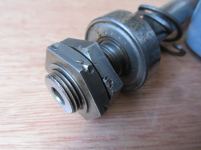
However, I do think your set screw collar should be on the outboard side of the shaft. Or maybe both collars have a set screw?

Later King-Seeley ball bearing models employed hex jam nuts there.
1776946926227.png
 
Last edited:
OP
S

SurferRosa

Member
Joined
Apr 1, 2026
Messages
12
Agreed, "Pulley Side" written on both sides sounds like some kind of Machinists inside joke...

Yes, Thrust & Shoulder Collars are identical, both have setscrews.
Hex design is definitely easier to remove without marring than these round ones.
Previous owners did a number on these things... must be why they made the change.
 

RonnieC

Well-known member
Joined
Aug 7, 2013
Messages
795
Location
Orlando, FL
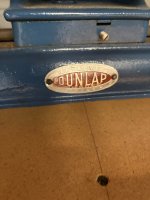
I have the same lathe under Sears’ Dunlap labeling with part number 534.0601. Bought it about 15 years ago and restored it. Just took a couple pics. My thrust bearing is, like in the VM pictures, to the left of the stepped pulley.
I vaguely remember struggling with the best place to install the bearing and I probably copied what I saw on VM. Your setup may be the more correct one.
Don’t overlook that this has oilite bronze bushings in the headstock and needs a generous amount of thin oil added to the oil caps.
IMG_6007.jpegIMG_6008.jpegIMG_6009.jpegIMG_6011.jpeg
 

FrankLee

Well-known member
Joined
Sep 13, 2010
Messages
3,577
Location
seMI, 48317
I have the same lathe under Sears’ Dunlap labeling with part number 534.0601. Bought it about 15 years ago and restored it. Just took a couple pics. My thrust bearing is, like in the VM pictures, to the left of the stepped pulley.
I vaguely remember struggling with the best place to install the bearing and I probably copied what I saw on VM. Your setup may be the more correct one.
Don’t overlook that this has oilite bronze bushings in the headstock and needs a generous amount of thin oil added to the oil caps.
That is also quite interesting. Model prefix 534 is Power King Tool Corp (now Clausing Industrial).

@SurferRosa, @RonnieC,

So, with the pulley correctly placed on the shaft with the set screws in their recesses, how does each bearing configuration position the pulley spacing for the indexing pin?
 
OP
S

SurferRosa

Member
Joined
Apr 1, 2026
Messages
12
Hi Ronnie

Appreciate your insight and photos.

There are a number of people that have those bearings exactly where you have them.

Maybe it is not as big a deal as I thought it was…

I was a little confused about those bushings, I didn’t see a hole that lined up with the oiler.
Manual says they are porous and not to drill them out. Glad I saw that.

I’ll make sure to get them oiled up good before I run it.

Thanks!
 
OP
S

SurferRosa

Member
Joined
Apr 1, 2026
Messages
12
That is also quite interesting. Model prefix 534 is Power King Tool Corp (now Clausing Industrial).

@SurferRosa, @RonnieC,

So, with the pulley correctly placed on the shaft with the set screws in their recesses, how does each bearing configuration position the pulley spacing for the indexing pin?
That is a good point.
The indexing pin does have some travel to it, but unfortunately my indexing pulley was sheared off at the large groove, so I have no way to check alignment (I am shopping for a replacement).
 

RonnieC

Well-known member
Joined
Aug 7, 2013
Messages
795
Location
Orlando, FL
So, with the pulley correctly placed on the shaft with the set screws in their recesses, how does each bearing configuration position the pulley spacing for the indexing pin?
The bearing being to the left of the pulley allows the indexing pin to lock the spindle.
 

RonnieC

Well-known member
Joined
Aug 7, 2013
Messages
795
Location
Orlando, FL
That is a good point.
The indexing pin does have some travel to it, but unfortunately my indexing pulley was sheared off at the large groove, so I have no way to check alignment (I am shopping for a replacement).
Ooh boy! At the time I restored mine, I bought a generic stepped pulley to put on the motor shaft. I don’t know if you’ll be able to track down one with indexing holes. Maybe you’ll be able to drill them yourself. That said, I never used the indexing capability anyway!
 
OP
S

SurferRosa

Member
Joined
Apr 1, 2026
Messages
12
Ooh boy! At the time I restored mine, I bought a generic stepped pulley to put on the motor shaft. I don’t know if you’ll be able to track down one with indexing holes. Maybe you’ll be able to drill them yourself. That said, I never used the indexing capability anyway!
I think I found one. Part number is not quite right L2-3A (should be L2-3B), but it seems correct.
A little more than I wanted to spend, but I should have just about everything else I need.
 
OP
S

SurferRosa

Member
Joined
Apr 1, 2026
Messages
12
Hi All,
Just an Update:

I got my new pulley installed, and with the set-screw aligned with the rear spindle dimple, and the Thrust Bearing between the Spindle Nose Collar and the Headstock face, the Indexing pin engages with the detentes on the pulley when almost completely extended.
IMG_5904.jpeg
IMG_5905.jpeg

Again, I am not sure if this is the intended placement, and ultimately it may not matter much, but I like it there and it seems to function correctly.

I appreciate all the great feedback!
 
To avoid these ads, REGISTER NOW!
Top Bottom