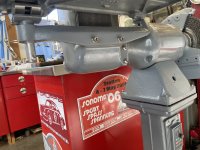
The good: it runs smooth and quiet, and the motor’s got lots of power at its rated rpm. The Atlas looks like it was made to mount to the Baldor and the size is just right. The tracking and adjustment of the belt on the Atlas are rock solid. The cast-iron construction quality of both units just go together like peanut butter and jelly.
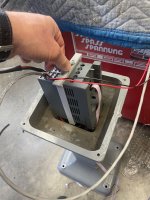
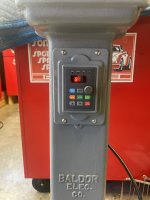
I really like how I was able to mount the VFD inside the base, and incorporate the control panel in what I feel as an elegant manner. I also really like what I have learned about what is possible with these modern engineering grade filaments for 3d printing. I was able to do in printed nylon what I was sure would have to be at least machined aluminum when I started this project.
The bad: the Atlas has a drive wheel of just 3.25 inch diameter. So at the 1800 RPM of the Baldor grinder the belt on the Atlas is only turning 1530 surface feet per minute. I knew this math going in, which is why I wanted to use a three phase grinder with a VFD. I had read a lot about being able to spin a four pole motor up to 120 Hz or more without problem. If that was the case and I could spin the grinder to 3600 RPM plus, the belt speed would’ve been at least 3060 ft./min. Not optimal, but probably good enough. BUT the Baldor will not spin up to 120 Hz under any kind of load. It is an old non-inverter rated motor, and it really doesn’t want to spin much beyond 80 Hz. When you do try to spin it up to 120 it starts to get too hot too fast and bogs down. So that being in the case, I’m really not able to spin the belt on the Atlas fast enough to do what I want to do. It works, but is sub optimal. So unfortunately, at this point, this seems to be an unsuccessful experiment.
Hello RSW,
Beautiful work and creativity!
I briefly owned ( about 3 years ago) a 1937 Baldor 1021 (I think it was a w model)) and it was a beautiful machine. It weighed about 178# !
No stand unfortunately, its footprint was massive. Anyway, I ended up speaking with one of the oldest living original Baldor employees ( a former early 70s era manufacturing plant/repair tech turned sales rep) who helped me identify the year ( the metal ID badge was partially worn out) by pictures, etc.
He related that the windings were quite special in comparison to the higher rpm models-they were designed to stay cooler during longer run times.
These 10” 1725/1800 slow speed motors were engineered to be machinist’s tool grinders, to keep from overheating expensive tool bits. They are also MUCH safer and pleasant when using a wire wheel.
Mine was a torque monster 1 hp single phase 120V. I think it was 9 amp?
Are you going to return it to the original slow speed grinder configuration ? Your hidden VFD/retro 3D switch plate creation is FANTASTIC.
I’ve since purchased a late 40s skill 10” 1 hp slow speed grinder and have been enjoying it greatly.
If you can, please share any updates on this one…it’s a beautiful machine and you have much to be proud of!
Best regards,
Shawn