To avoid these ads, REGISTER NOW!

Any concerns with finishing drywall and painting garage in a unheated garage in a colder climate

bakmopar

Well-known member
Joined
May 28, 2013
Messages
389
Location
Northeast Ohio
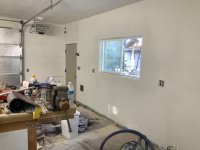
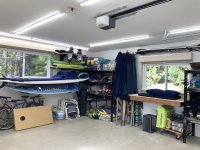
My detached garage currently has drywall on the walls. I am considering having the drywall taped, mudded, and painted. This space is not heated. I live in northern Ohio, so it does get cold.

Should I be concerned that the mudding is going to crack due to the cold (or anything else weather/temperature related)? Has anyone else experienced any issues?

It would be look great to have it all finished, but I would hate to do this if in time it is going to look bad.

Thanks.
 
To avoid these ads, REGISTER NOW!

gizardlizard

Well-known member
Joined
Aug 29, 2019
Messages
726
Location
Madison, WI
I live in Wisconsin and did it twice. Had ceiling cracks in both. Redid the second one and kept the garage at 40 degrees. No more cracks. One winter before I added the furnace, frost formed on walls and ceiling both of which were heavily insulated
 

MovingAlong

Well-known member
Joined
Aug 17, 2013
Messages
1,210
My detached garage currently has drywall on the walls. I am considering having the drywall taped, mudded, and painted. This space is not heated. I live in northern Ohio, so it does get cold.

Should I be concerned that the mudding is going to crack due to the cold (or anything else weather/temperature related)? Has anyone else experienced any issues?

It would be look great to have it all finished, but I would hate to do this if in time it is going to look bad.

Thanks.

It looks bad now.. (ok, not actually, just trying to make a point ;))

Are a few cracks really going to keep you from enjoying a more finished space? :coffee:
 

WisJim

Well-known member
Joined
Dec 20, 2010
Messages
2,271
Location
Menomonie, WI
I've not had any cracking in taped drywall joints in unheated shop/garage spaces, or in a house that was left unheated in the winter, all in Western or northwestern Wisconsin.
 

marak

Well-known member
Joined
Jan 26, 2015
Messages
338
Location
Anchorage, Alaska
No issues here in Alaska. Drywall has been up for over 10 years, no cracks, not even after a sizeable earthquake. Temperature range inside the detached garage/metal shop is 10F to 65F, heated with a barrel stove.
 

gahrajmahal

Well-known member
Joined
Dec 12, 2008
Messages
2,527
Location
Cincinnati, Ohio
My mother-in-law owned a condo in Cleveland. All the units had stomped ceiling and walls in the in unconditioned garages and all units had falling drywall in them. I wet and scraped it down prior to selling the condo. I primered the drywall which had not been done initially. The tapped seams failed too.
 

mikedodge

Well-known member
Joined
Jun 27, 2017
Messages
2,770
It's not the cold that would cause problems but more temperature fluctuations if you're regularly going from freezing to normal room temperature. Or humidity.
 

four.cycle

Well-known member
Joined
Oct 19, 2015
Messages
28,631
Location
Tacoma, Washington
Ideally, interior latex paint should be applied when the ambient temperature is above 60° F, oil base (alkyd resin) even higher.
That doesn't necessarily mean you can't apply it when the temperature is lower, but it's not going to lay down the same way, and it may take more effort to apply it.
Heat isn't what makes latex paint dry. Air circulation does.

I can't comment on the mud part - it just doesn't get that cold here, and if it was cold, I wouldn't be painting or mudding drywall.
 

Beerhippie

Well-known member
Joined
Oct 13, 2023
Messages
9,703
Location
Far NE Oregon
Use or spec "hot mud" It's a self-setting drywall mud. It's a PITA to sand, so do a good job of lying it down.

For the paint, see if you can rent a portable electric heater. As 4C says above, paint cures poorly below about 60F.
 
OP
B

bakmopar

Well-known member
Joined
May 28, 2013
Messages
389
Location
Northeast Ohio
The work would all be done during warmer months, like during May to Sept of this year. It would not get painted at cooler temperatures.
 
To avoid these ads, REGISTER NOW!

Beerhippie

Well-known member
Joined
Oct 13, 2023
Messages
9,703
Location
Far NE Oregon
The work would all be done during warmer months, like during May to Sept of this year. It would not get painted at cooler temperatures.
You should be fine. Drywall in outbuildings that aren't heated most of the winter here holds up just fine. We get some pretty good stretches of sub-zero F most winters. Ditto latex paints.
 

BurtEggley

Well-known member
Joined
Oct 8, 2024
Messages
860
don't mud or paint in an unheated space when it is near freezing. The water in the mud and paint need time to do their thing before they get that cold. If a room was done during the warmer part of the year, and one is seeing cracks in winter, one might suspect something is moving.
 

gahrajmahal

Well-known member
Joined
Dec 12, 2008
Messages
2,527
Location
Cincinnati, Ohio
Use or spec "hot mud" It's a self-setting drywall mud. It's a PITA to sand, so do a good job of lying it down.

For the paint, see if you can rent a portable electric heater. As 4C says above, paint cures poorly below about 60F.

After reading the replies I believe Beerhippie is on to something. I never want to wait on drywall mud and can smear it on plenty smooth, (parents owned bakery and I had to ice cakes, the many years doing auto body smearing bondo). I don’t think the self setting mud sands any different than air dry mud. The stomp ceilings in the condos is done with watered down air dry mud. All it took was some mild moisture from a pump up sprayer to reactivate it and turn mushy after 40 years on the garage walls and ceilings. The areas on the walls that were painted did not “unadhere” from the drywall when wet down and I bet the self setting drywall mud would be more resistant to that too.
 

Beerhippie

Well-known member
Joined
Oct 13, 2023
Messages
9,703
Location
Far NE Oregon
After reading the replies I believe Beerhippie is on to something. I never want to wait on drywall mud and can smear it on plenty smooth, (parents owned bakery and I had to ice cakes, the many years doing auto body smearing bondo). I don’t think the self setting mud sands any different than air dry mud. The stomp ceilings in the condos is done with watered down air dry mud. All it took was some mild moisture from a pump up sprayer to reactivate it and turn mushy after 40 years on the garage walls and ceilings. The areas on the walls that were painted did not “unadhere” from the drywall when wet down and I bet the self setting drywall mud would be more resistant to that too.
"Hot mud" is very resistant to moisture.

It comes as a dry powder you mix with water. Once mixed, the clock starts ticking. It comes in different setting time, expressed in minutes (I don't know about Metric mud (micro years?))--I usually use 90-minute setting mud as it gives me time to do a fair amount and get tools cleaned before the mud sets. Letting hot mud set up in your pan is a lesson you won't need to learn twice.
 

pcmeiners

Well-known member
Joined
Aug 13, 2009
Messages
7,875
Location
In the only town in Pennsylvania, Bloomsburg.
"I live in northern Ohio, so it does get cold"

The issue is not so much temperature but how often the temperature drops below the dew point which results in condensation. With condensation and a temperature which lowers below freezing you end up with expansion and moisture which remains in the dry wall for a long period. Same issue with the drywall mud, it is not meant to freeze with heavy moisture within it repeatedly.
 

GrayFlattop

Well-known member
Joined
Jan 18, 2018
Messages
1,039
Location
Chicago
No issues here, but I do keep the space between 45-50F in the winter. I did use a setting-type of mud - Durabond 90. Original paint still looks good after 36 years.
 

mm08822

Well-known member
Joined
Jan 13, 2012
Messages
5,884
Location
NJ
I've seen several unheated attached garages where the tape had lifted from the joint compound. Not sure how well the original jobs were done. Curing of the initial tape coat is very important to reduce shrinkage/cracking.
I've also seen plenty that looked "great" decades later. Some were painted and others never even primed. No idea of the humidity levels in either. Did the floor have no vapor barrier? Were vehicle brought in loaded with snow to melt?

Hot mud and mesh tape is supposed to be more durable to moisture as it cures due to chemical reaction not evaporation. The mesh tape is required for hot mud to reduce blisters/adhesion problems between it and paper tape.

Evaporative type mud can be impacted by later bursts of high humidity. Paper tape can even foster mold.

If I were doing a garage today, I would use 90 minute hot mud and mesh tape at least to set the tape and do the majority of joint filling. You may want to prefill larger joints first before taping. Make sure both surfaces of the joint edge are securely fastened, regardless of method.

Hot mud is a PIA due to needing small batches before it sets up. Clean your pan well between batches for maximum pot life of the next mixed batch. Putting on less is better to eliminate sanding, even if it means another coat (less work).

The top coat(s) which are thinner could be the finer evaporative type mud as it skims/feathers thinner and is easier sanding.
 

Jazz1

Well-known member
Joined
Jan 3, 2016
Messages
4,184
Location
Thunder Bay On.
Obviously the vast majority are better mudders than myself,,no cracks in walls but ceiling has a 20’ crack on seam…my garage is generally heated with the wood stove but no fire for a week and its cool,,32F..
 

pcmeiners

Well-known member
Joined
Aug 13, 2009
Messages
7,875
Location
In the only town in Pennsylvania, Bloomsburg.
Hot mud is no better than compound as to water content ( and it's issue) though it does adhere to wall board/tape better.

Plaster of Paris has a remarkable property of setting into a hard mass on wetting with water.
{\displaystyle {\mathrm {CaSO} {\vphantom {A}}_{\smash[{t}]{4}}\,{\cdot }\,{\mathchoice {\textstyle {\frac {1}{2}}}{\frac {1}{2}}{\frac {1}{2}}{\frac {1}{2}}}\,\mathrm {H} {\vphantom {A}}_{\smash[{t}]{2}}\mathrm {O} {}+{}1~{\mathchoice {\textstyle {\frac {1}{2}}}{\frac {1}{2}}{\frac {1}{2}}{\frac {1}{2}}}\,\mathrm {H} {\vphantom {A}}_{\smash[{t}]{2}}\mathrm {O} {}\mathrel {\longrightarrow } {}\mathrm {CaSO} {\vphantom {A}}_{\smash[{t}]{4}}\,{\cdot }\,2\,\mathrm {H} {\vphantom {A}}_{\smash[{t}]{2}}\mathrm {O} }}
 

njk4o5

Well-known member
Joined
Dec 9, 2015
Messages
115
Location
Boston, MA
i drywalled/taped/mudded my whole house and now doing the garage, only 1 crack so far where i forgot to tape the joint lol
 
To avoid these ads, REGISTER NOW!
Top Bottom