To avoid these ads, REGISTER NOW!

Above 1200 Sq/FT The Cow Pasture Garage - Australia

Wokspaces above 1200 squarefeet.
To avoid these ads, REGISTER NOW!

Geoff289

Well-known member
Joined
Nov 10, 2013
Messages
1,220
Location
Melbourne, Australia
I've always wanted a 1992-97 OBS Power Stroke F-250 or F-350, as they're the last of the simple full size US Ford pickups.

The Australian government banned the importation of them around 2021 (?), no doubt under the pressure of Ford, Holden (Chevrolet) etc. who were already importing or getting ready to import (e.g. F-150) new pickups. The government did this by setting a threshold for the maximum GVM (gross vehicle mass) of 3500 kg (7900 lb) for older light commercial vehicles that can be imported.

This is my dream truck. Currently bid to USD65000 which is amazing considering what this would have cost new. It's quite a rare Centurion conversion with rear single drive wheels, as most were dualies. Know doubt our American friends know more. BaT link 35k mile '96 F-350 XLT Crew Cab Centurion Power Stroke 4 x 4.

1996 Ford F-350 XLT Centurion Crew Cab Power Stroke 4×4.png
Yeah, that's nice. It would put a big hole in the bank account, though, even at the current bid, with the crappy exchange rate and transport costs. At least its old enough to avoid the cost of a RHD conversion.
 
OP
K

kitdoctor

Well-known member
Joined
Oct 30, 2010
Messages
503
Location
Sunshine Coast, Australia
Yeah, that's nice. It would put a big hole in the bank account, though, even at the current bid, with the crappy exchange rate and transport costs. At least its old enough to avoid the cost of a RHD conversion.
@Geoff289 I can only dream...Hard to believe that truck was $33,027 brand new in 1996 and here it is now almost double that.

This F-350 below set the BaT record at USD96,000 1997 Ford F-350 XLT Crew Cab Power Stroke 4 x 4. The BaT community is watching to see if the Centurion will surpass USD100,000.

1997 Ford F-350 XLT Crew Cab Power Stroke 4×4.png
 
Last edited:
OP
K

kitdoctor

Well-known member
Joined
Oct 30, 2010
Messages
503
Location
Sunshine Coast, Australia
Lots of work and thought put into setting up all of that drainage.
@hewey, it took about 12 months working with consulting firm Tonkin to complete the civil engineering design, 26 drawings in total.

The documentation was quite good but I did put a lot into it thinking about the tiniest of details and checking everything to avoid problems on site during construction. At the end of the day, there were those couple of alignment changes to the driveway, a couple of small sections of retaining wall were deleted (a saving) because they were not needed and that berm at the entrance was constructed to deflect the runoff from the neighbour's block to the north.

Even the cut/fill balance came in spot on and no fill had to brought in from offsite. The only fill we've ended up with is that from excavating the building foundations. This is being used to fill low spots in the pasture and holes where rocks have been removed.

At the end of the process they complemented me, saying it was refreshing to work with an informed client with an engineering background. Though, towards the end I could tell they wanted to finalise the project. I did make them work hard for their fee. It was the most expensive professional services fee, even more than the architectural work.
 
OP
K

kitdoctor

Well-known member
Joined
Oct 30, 2010
Messages
503
Location
Sunshine Coast, Australia
I would normally at best think about drainage a bit, then just go with the flow :)
Seriously though , 100 percent agree
@Coolabah, lol.

Just out of interest, the peak design flow rate for that little gully, that only flows some of the time, is 1600 L/s (25,360 US gpm).

I'm hoping I don't get to witness that.
 
Last edited:
OP
K

kitdoctor

Well-known member
Joined
Oct 30, 2010
Messages
503
Location
Sunshine Coast, Australia
Post #0067 - Compost tumblers - Part LXII

Here’s a small project that my wife and I worked on together.

She’s a bit of a green thumb, coming from a family that grew small crops in the Redlands, an area south of Brisbane, Queensland. Anyway, she wants to eventually establish a vegetable garden and orchard, so putting together a composting setup seemed a logical project to tackle.

We don’t qualify for a green waste rubbish bin due to our land’s zoning, so it makes sense to compost. I do get the local council’s logic, in that they think you’ve got enough room to manage the waste on-site through composting, mulching and burning.

My neighbours in the street on 2000 m2 lots (0.5 acre) do qualify for green waste bins, so the waste collection truck actually comes down the street. Although our food waste could go in the general waste bin, it too can go toward making compost. When we lived in Darwin because it was so hot and humid, if you had any common sense, you’d freeze your food waste and throw it in the general waste bin when you took that bin out to the kerb.

I don’t think composting will be enough to dispose of all our green waste, for example, tree branches, sticks etc., so another high priority project, in the absence of a fire pit, is to establish a simple incinerator.

During our house sits I’d seen a few collapsed and or failed compost bins or tumblers and styles I didn’t like, so I had an idea of what made a good or bad compost bin or tumbler. It had to be a drum style rotating on a horizontal shaft, with the drum essentially of one-piece construction, made from corrosion resistant materials and be Australian made.

For me, all projects start with some research and eventually I narrowed in on compost tumblers from Rapid Results. They are an Australian company based in Victoria. Their range comprises 200 L, 300 L and 400 L (53, 79 and 106 US gallons) compost tumblers with the drums made from recycled plastic. We decided to purchase three 400 L tumblers.

The freight cost on these was eye watering as Rapid Results were 1900 km away (1200 miles). After some toing and froing, it became apparent the owners were driving to a garden show in Queensland to display their products and also delivering a compost tumbler to a school on the Gold Coast that would put them within a few hours of our location. So yes, the freight bill was still expensive, but they were able to deliver them directly to us.

Post #0067 - Photo No. 1.jpg

Here’s the three of them stacked behind our shipping container.

Post #0067 - Photo No. 2.jpg

The plan was to build a temporary station with the frames kept off the ground to limit corrosion. So, we laid black plastic to keep the area drier and then we went off to get some plastic pallets. We’d use the pallets to raise the frames off the ground.

Post #0067 - Photo No. 3.jpg

To get the compost out of the tumblers, the A-frames are set wide enough apart and the barrel is set high enough to allow a wheelbarrow under the barrel. The access lid can then be opened and the compost dumped into the wheelbarrow.

With the frames planned to sit on pallets, some pavers could be laid in front of the pallets to provide a step up to the pallets. We went to the local Mitre 10 hardware store and bought some of these Apex Masonry 400 mm x 400 mm x 40 mm (16” x 16” x 1.5”) charcoal coloured concrete pavers.

Post #0067 - Photo No. 4.jpg

Post #0067 - Photo No. 5.jpg

The climate here tends to promote mould growth, so being concrete pavers and quite porous, I decided to seal them. I had no idea just how expensive these sealers are. It’s not unusual to pay AUD400-500 for a high quality 4 L (1.1 US gallon) container of sealant that will require application every 3-5 years.

I ended up buying a package including the products and some applicators from JUSTSEALIT.

Post #0067 - Photo No. 6.jpg

I sprayed the pavers with a small, hand-pressurised pump bottle. It can be a little tricky avoiding ending up with white blotches (see photo below), if the sprayer doesn’t consistently atomise the product. A lot of product is wasted if the sides of the pavers are coated.

Post #0067 - Photo No. 7.jpg

Here’s the station starting to take shape.

Post #0066 - Photo No. 8.jpg

Post #0066 - Photo No. 9.jpg

Here’s the finished result with all three tumblers assembled and in place.

Post #0066 - Photo No. 10.jpg

Now to make use of them.
 
OP
K

kitdoctor

Well-known member
Joined
Oct 30, 2010
Messages
503
Location
Sunshine Coast, Australia
Post #0068a - Construction work continues - Downpipes connected into stormwater - Part LXIII

Just to recap, when the civil works were undertaken in 2024, including the construction of the building pads, all the major underground stormwater pipes were laid.

This was necessary because, once the buildings were built, there simply wouldn’t be enough physical room for large machines to work around the perimeter of a building due to the presence of the building itself and adjacent retaining walls, drop-offs, difficult slopes etc.

Here’s an example at the garage building pad. On this pad, there are three stormwater pits, one where the excavator is and two others, one on the left of the photo and the one in the middle of the photo. The pits collect any surface runoff. The vertical, white PVC pipe markers locate junctions inserted in the stormwater pipeline where building downpipes are planned to be connected into. These downpipes will carry roof water runoff.

This stormwater pipeline then connects to the pit (around which the turf is laid) which also picks up the surface runoff that is collected by the swale drain, located behind the top of the retaining wall, that diverts water around the entire building pad. From the pit all the water is diverted under the driveway and discharged at a headwall. This same approach of perimeter drainage systems, swale drains and diversion of water under the driveways is used at all three building pads.

Post #0068 - Photo No. 1.jpg

Fast forward and the time had now arrived to connect the shed’s and garage’s external downpipes into the below ground stormwater system, from where it would be either conveyed to storage tanks or discharged to the environment.

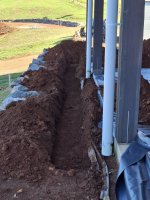
During the design phase I had carefully thought through the congestion problem at the very east side of the shed’s carport. Here the shed’s pad was in fill, so to control costs the design intent was to minimise just how far the fill extended beyond the edge of the carport’s slab, because the further it extended, the deeper the fill was getting and the higher the retaining wall became. However, there was still the need to provide sufficient room for a small excavator to excavate the trench for the pipeline that would pick up the downpipes on that side of the carport.

The other risk that was considered was that there was a chance that the trenching activity would disturb the geofabric, filter material and at worst the boulders making up the retaining wall.

So, my plumber procured the smallest excavator he could get hold of, with the narrowest bucket that met the minimum trench width requirement in the plumbing and drainage code and got started.

Post #0068 - Photo No. 2.jpg

Given the lack of space, some of the spoil was dropped onto a plastic sheet laid on the carport slab. The drop off the edge of the retaining wall is about 1.8 m (6’).

Post #0068 - Photo No. 3.jpg

If you look closely, it’s possible to see where the concrete foundation extends beyond the vertical edge of the slab (the heaped spoil is sitting on it). Back in update post #0025 (see page 3, GJ post ID #116) I mentioned how I was caught off guard by the slab foundation extending beyond the vertical edge of the slab panel. It wasn’t shown that way on the structural drawings and the potential problem it created was that the slab now extended into areas like that shown below, where the working space was very constrained.

Fortunately, although I didn’t think of this specific problem arising, I did allow for the obstruction created by the vertical downpipes when I sized the width needed to accommodate the excavator. The foundation didn’t extend too far beyond the downpipes, so everything still worked.

Post #0068 - Photo No. 4.jpg

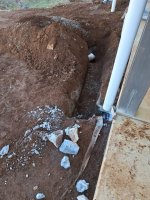
Here’s the excavation work at the south end of the shed. That capped pipe sticking out of the ground will be for a proposed surface access point to the sanitary drainage system (that had already been laid before the slab was poured).

Post #0068 - Photo No. 5.jpg

Here’s that same pipe but photographed from the opposite direction. That second capped pipe sticking out of the ground in the background will also be for a proposed surface access point to the sanitary drainage system.


Post #0068 - Photo No. 6.jpg

At the garage, near the pit, that’s one of the junctions to be connected into.

Post #0068 - Photo No. 7.jpg

Providing the markers really made it easy for my plumber to find buried junctions and end caps.

Post #0068 - Photo No. 8.jpg

Back at the shed, the plumber’s offsider was busy jackhammering out concrete that was in the way of the vertical downpipe. While I was still annoyed about it, they said they encounter the same issue all the time. It’s only time and money…

You can see how the point of connection to the existing stormwater is visible. What my civil contractor had done was extend it closer to surface, so that it wouldn’t be a mammoth task for my plumber to dig down to connect to it and risk disturbing the retaining wall.

Post #0068 - Photo No. 9.jpg

Rinse and repeat, many times.

Post #0068 - Photo No. 10.jpg

Continued below.
 
OP
K

kitdoctor

Well-known member
Joined
Oct 30, 2010
Messages
503
Location
Sunshine Coast, Australia
Post #0068b - Construction work continues - Downpipes connected into stormwater continued - Part LXIII

When I took this next photo I was a little concerned because for a moment, I thought the downpipe had been connected to. It looked like the whole installation would be too shallow and thus vulnerable. However, what they’d done was just temporarily connected a section of horizontal pipe to the pit’s grate that’s under the plastic, just in case it had rained overnight.

Not too happy about the jack hammer left leaning against the shed’s cladding. Metal cladding is just so susceptible to damage.

Post #0068 - Photo No. 11.jpg

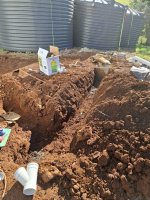
Here, to the left, they’re trenching for what will be the inlet pipe to the non-potable (outdoor usage) water tank. To the right, they’re about to break into a stormwater pit to connect a first flush disposal point. As the pipeline to the non-potable (outdoor usage) water tank is a charged pipe, this will allow me to occasionally flush its content to waste.

Post #0068 - Photo No. 12.jpg

This is the same area (photographed from the opposite direction) now backfilled. That PVC pipe sticking out of the ground will become the inlet to the non-potable (outdoor usage) water tank.

Post #0068 - Photo No. 13.jpg

Back at the carport, here’s the trench now backfilled. In the background, the dairy cattle are in the adjacent paddock.

Post #0068 - Photo No. 14.jpg

With this work completed, it was now possible to undertake the installation of the water tanks.

Would that mean we’d have water more easily available? Well, not quite because we’d need at least an outdoor tap installed, but we were getting closer.
 
OP
K

kitdoctor

Well-known member
Joined
Oct 30, 2010
Messages
503
Location
Sunshine Coast, Australia
So- are you planning to have a way to monitor how full your tanks are ( rhetorical question , I KNOW you do :) )
Details please !!
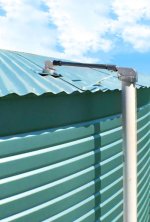
@Coolabah I was planning to monitor the levels with the Liquidator 2 from YAKTEK Industries. It's a simple mechanical indicator that provides a visual indication of the tank's water level.

Post #576 - Liqiudator 2 .jpg

When I spoke to my plumber his general opinion was that these mechanical indicators aren't reliable, so I'm reconsidering.

In that photo, there would be some work involved to achieve an effective seal on a corrugated metal tank roof.

A more smart system I've come across is smartwater.

Post #576 - smartwater.jpeg

Another one is Tank Level Pro from Fully Tanked Up.

Post #576 - Fully Tanked Up TLP-Fuel.jpg

Is this something you've looked into?
 

Coolabah

Well-known member
Joined
Jun 6, 2010
Messages
1,370
Location
2nd Floor, 3rd on the Right,Narooma, Australia
@Coolabah I was planning to monitor the levels with the Liquidator 2 from YAKTEK Industries. It's a simple mechanical indicator that provides a visual indication of the tank's water level.


When I spoke to my plumber his general opinion was that these mechanical indicators aren't reliable, so I'm reconsidering.

In that photo, there would be some work involved to achieve an effective seal on a corrugated metal tank roof.

A more smart system I've come across is smartwater.

Another one is Tank Level Pro from Fully Tanked Up.


Is this something you've looked into?
I looked at self build electronics kinda things years ago as a fun project but never acted on any of my ideas as I saw a cheap tank guage and thought I'd try that as a stop-gap measure ("Rain Harvesting" brand tank guage , around $26 from the big green hardware store )- on a couple of my tanks, they seem to last around 10 years before becoming so sun affected that you can't read the guage or else the spring mechanism for the weight stops working so the guage no longer reflects a true reading. On another of my tanks there is a drainage tap at the bottom so I connected a clear plastic tube to it , ran it vertically to the top of the tank, and you have a (obviously very accurate) readout. I tended to leave the tap off unless checking in an abundance of caution.
With a metal tank you can usually just feel the temperature difference between water and air in the tank, with your hand so I haven't thought much about it lately.
I do like your thorough thought processes hence my keen interest in your eventual choice, I expect to steal your research :) !
 
OP
K

kitdoctor

Well-known member
Joined
Oct 30, 2010
Messages
503
Location
Sunshine Coast, Australia
I saw a cheap tank guage and thought I'd try that as a stop-gap measure ("Rain Harvesting" brand tank guage , around $26 from the big green hardware store )- on a couple of my tanks, they seem to last around 10 years before becoming so sun affected that you can't read the guage or else the spring mechanism for the weight stops working so the guage no longer reflects a true reading.
@Coolabah when the annual cost is determined that was a pretty good option.

On another of my tanks there is a drainage tap at the bottom so I connected a clear plastic tube to it , ran it vertically to the top of the tank, and you have a (obviously very accurate) readout.
The sight gauge option is another simple and reliable approach.

My plan is to remove the work from my plumber's scope of work and add it to my TO DO list. Man, that list is getting long 😩, so it will move down to the low priority group.
I think I'll tackle it when I add in a weather station (also on the TO DO list) but first we have to obviously complete the build and get the basics sorted, so we can live here and bring the house sitting to an end.

Also, as the good times in residential property markets come to an end, it's time to sell our house in Darwin and our last two rental properties here in QLD. I'm seeing a lot of grim news, including the upcoming changes to capital gains tax (CGT) and negative gearing as they apply to investment properties. Of course too, there is this intense focus on the cost of living crisis and interest rate increases.

The thing is, most people can't see what's really coming, a full blown recession once the property market run ends and the broader implications of this filter into the economic outlook. This, combined with some form of trigger or scandal (e.g. the bust that's starting in the private credit market, the AI bubble or something) will then spook investment markets like it did in 2007/2008. Believe me, if you know, you know that this is inevitable.

I should say the same will happen in the USA too. There are experts on the ground there that are saying, in a broad sense, the property market has already peaked (last time it was 2006). The share price of home building stocks peaked in 2024 (last time it was 2005). The sequence goes, home builder share prices peak first, then property values peak and then the broader stock market peaks and collapses (last time it was 2007).

We have been planning for this for almost 20 years knowing that 2025 would be the last good year and by no later than mid to late 2026 we want to have exited the property market.

I listened to a podcast yesterday (a reasonably good one) and it mentioned that modelling predicted a less than one percent fall in property values due to the proposed changes to capital gains tax (CGT) and negative gearing. The reality will be that property values will fall 30 percent in a recession. This may not be reflected in dwelling median price statistics but this is what really occurs.
 
Last edited:
OP
K

kitdoctor

Well-known member
Joined
Oct 30, 2010
Messages
503
Location
Sunshine Coast, Australia
Post #0069a - Construction work continues - Weatherboard cladding installation completed - Part LXIV

Back in update post #0062 I showed the start of the process to clad the exteriors of the accommodation model and workshop, including the mezzanine storage room above the workshop (see page 13, GJ posts ID #503). Here’s a photo showing the progress at that point, with some of the accommodation module clad.

Post#0069 - Photo No. 1.jpg

Here’s a closer look at the JamesHardie fibre cement Axent trim around the circuit box. The penetrations through the wall are for the hot water heat pump system storage tank. It was placed inside to maintain a cleaner looking exterior and to improve operating efficiency during winter.

Post #0069 - Photo No. 2.jpg

In this next photo, what is the back side of the bathroom wall has now been clad. It’s possible to see how the sanitary system vent pipe has been boxed in to conceal it.

Post #0069 - Photo No. 3.jpg

At this point, the crew was using what I’ll describe as the low height trestles and planks. In total, they used three different sets of equipment to clad the walls to full height.

Post #0069 - Photo No. 4.jpg

This next photo shows the low height and mid height trestles and planks.

Post #0069 - Photo No. 5.jpg

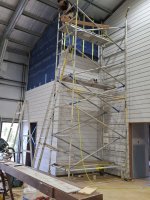
To reach right to the top two sets of scaffolding were used.

Post #0069 - Photo No. 6.jpg

Post #0069 - Photo No. 7.jpg

By the time they reached the highest level they’d run out of the 20 mm (3/4”) thick blue ATI CaviBreak thermal break strips and had to sandwich two 10 mm (3/8”) yellow strips together.

Post #0069 - Photo No. 8.jpg

Continued below.
 
Last edited:
OP
K

kitdoctor

Well-known member
Joined
Oct 30, 2010
Messages
503
Location
Sunshine Coast, Australia
Post #0069b - Construction work continues - Weatherboard cladding installation completed continued - Part LXIV

Over at the workshop, the timber cladding was now finished. Just the last remaining section of the south wall of the mezzanine storage room was left to clad. Here a carpenter can be seen installing the door to the storage room.

Post #0069 - Photo No. 9.jpg

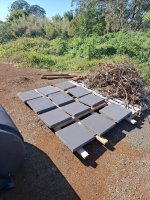
Here’s the completed north wall of the accommodation module. That’s a pile of tiles sitting on the pallet.

Post #0069 - Photo No. 10.jpg

Here’s all the cladding now complete at the accommodation module and the scaffolding etc. has been disassembled and stacked ready for collection.

Post #0069 - Photo No. 11.jpg

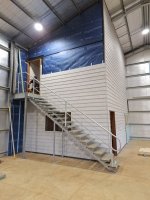
At the staircase landing to the mezzanine storage room (and below it), rather than continue the timber cladding along the wall of the shed, Zincalume corrugated metal sheet will be used instead. I thought using the timber cladding would look odd, so opted for the different Zincalume sheet.

Post #0069 - Photo No. 12.jpg
 
To avoid these ads, REGISTER NOW!

Mr onetwo

Well-known member
Joined
Apr 6, 2011
Messages
2,006
Location
Coastal Maine
Yes, for sure. Waiting for things to dry up and the roads to be un-posted. Had a track steer with a mulcher head on my land cleaning up the spot for our first little cabin build.Today I am going to drill some test holes.
 

Attachments

  • IMG_2906.jpg
    IMG_2906.jpg
    647 KB · Views: 28
OP
K

kitdoctor

Well-known member
Joined
Oct 30, 2010
Messages
503
Location
Sunshine Coast, Australia
Yes, for sure. Waiting for things to dry up and the roads to be un-posted. Had a track steer with a mulcher head on my land cleaning up the spot for our first little cabin build.Today I am going to drill some test holes.
Yes, for you guys you're heading into summer and it's time to do projects, bring classic cars out of hibernation, go fishing etc.

They say those skid steers with the mulcher attachment make good money. My civil contractor had a CAT skidsteer and it was something like AUD280000 brand new. More expensive than an 8 tonne excavator which is physically a far bigger machine. I could use one to reshape the gully.
 
Last edited:
OP
K

kitdoctor

Well-known member
Joined
Oct 30, 2010
Messages
503
Location
Sunshine Coast, Australia
That cladding is looking great, really finishes that space off.
@hewey wait until you see the cladding paint colours. I have not gone for greyish tones because the shed floor will be a medium grey.

Not bold colours by any means but two different colours were chosen to highlight the two areas (accommodation vs workshop) are used for different purposes. Also, there is one small surprise :cool:
 

Coolabah

Well-known member
Joined
Jun 6, 2010
Messages
1,370
Location
2nd Floor, 3rd on the Right,Narooma, Australia
@hewey wait until you see the cladding paint colours. I have not gone for greyish tones because the shed floor will be a medium grey.

Not bold colours by any means but two different colours were chosen to highlight the two areas (accommodation vs workshop) are used for different purposes. Also, there is one small surprise :cool:
OK, just a question , no pressure ( but pretty sure you will have both Aussies travelling, and worldwide flying to Australia).

...
....
.......
.........

So , when's The Housewarming Shed Party , and will you have other beers apart from XXXX on tap ?
Inquiring minds want to know.
Just asking for a friend . :sneaky::unsure:;):):):):)
 
OP
K

kitdoctor

Well-known member
Joined
Oct 30, 2010
Messages
503
Location
Sunshine Coast, Australia
So , when's The Housewarming Shed Party , and will you have other beers apart from XXXX on tap ?
Inquiring minds want to know.
Just asking for a friend . :sneaky::unsure:;):):):):)
@Coolabah it would be sooner but between selling three houses, packing up and moving our personal effects from Darwin, relocating eight cars from Tasmania, Western Australia and the Northern Territory plus a hoist, plus getting a new two-post hoist, setting up six Carcoons...Is this painting a picture of the months ahead? I'll be lucky to survive the year!

I do have a nice 10-seat oak dining table for outside and 10 chairs. Just got to collect that from the parents-in-law's place plus various car parts and other stuff collected over 15 years. I think we need an assistant.

I know we are locked in to host the street's Xmas party this year, so I think that will be the first trial. I would like the Torino's former owner from the USA to visit too. He is such a great guy.

I think we have a good spot for a second queen size bed for visitors.

Drinks, of course but mostly cans and bottles. Beer, cider, ginger beer...
 
Last edited:

Coolabah

Well-known member
Joined
Jun 6, 2010
Messages
1,370
Location
2nd Floor, 3rd on the Right,Narooma, Australia
@Coolabah it would be sooner but between selling three houses, packing up and moving our personal effects from Darwin, relocating eight cars from Tasmania, Western Australia and Northern Territory plus a hoist, plus getting a new two-post hoist, setting up six Carcoons...Is this painting a picture of the months ahead? I'll be lucky to survive the year!

I do have a nice 10-seat oak dining table for outside and 10 chairs. Just got to collect that from the parents-in-law's place plus various car parts and other stuff collected over 15 years. I think we need an assistant.

I know we are locked in to host the street's Xmas party this year, so I think that will be the first trial. I would like the Torino's former owner from the USA to visit too. He is such a great guy.

I think we have a good spot for a second queen size bed for visitors.

Drinks, of course but mostly cans and bottles. Beer, cider, ginger beer...
Ha ! Yes, I was not actually angling for an invite of course, just wanted to plant the PARTY idea in your head with a bit of added jest. A good shed needs a good party , a GREAT shed needs a GREAT party !
Indeed, sounds like you are still going to be WAY busy for some time now.
I'm just winding down from a (much smaller build than yours. Actually , it is like you decided to add a cupboard to your build :) ) addition of a second story at my daughter's place. I was the designated wannabe tradie dad for the kitchen, as well as automation/ security system install, as well as all the painting. (Apologies to Dr Seuss:) I do not like painting, no I do not like painting at all..
Anyway, enough about me , back to you !
 
OP
K

kitdoctor

Well-known member
Joined
Oct 30, 2010
Messages
503
Location
Sunshine Coast, Australia
Ha ! Yes, I was not actually angling for an invite of course, just wanted to plant the PARTY idea in your head with a bit of added jest. A good shed needs a good party , a GREAT shed needs a GREAT party !
@Coolabah yes, that was understood but I was thinking let's have a GJ members party!

We have a few tough months ahead. Maybe that explains why I feel a bit on edge but we will get through it.
 
OP
K

kitdoctor

Well-known member
Joined
Oct 30, 2010
Messages
503
Location
Sunshine Coast, Australia
Post #0070a - Shed site tidy up No. 2 - Part LXV

With the last of the drainage pipes installed, some tidying up was in order and necessary.

We also did a similar exercise at the garage, but I won’t cover this as it’s much the same.

This is what we started with. It’s not that bad, with most of the large rocks removed. I think I did this task over a couple of days.

Post #0070a - Photo No. 1.jpg

The bigger issue to be dealt with was dealing with this left-over spoil from the excavation. The plan was to use it to regrade the exposed perimeter areas toward the drainage pits.

Typical of the material though, it comprises rocks of all sizes that need to be sifted out to leave the useable component.

Post #0070a - Photo No. 2.jpg

With lots of raking and sifting it looks much better. The civil contractor was always on top of the minute details. Here the stormwater pit grate is wrapped in geofabric to stop fill getting into the pit.

Post #0070a - Photo No. 3.jpg

The offcuts from the timber columns came in handy as weights to hold the plastic sheet down. Believe me, we have lifted and carried plenty of sizeable rocks to use as weights, so using something closer to hand made sense.

Post #0070a - Photo No. 4.jpg

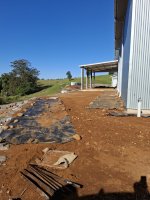
Once the area is regraded, black plastic will be laid to keep the underlying material dry over the course of the changing seasons. This is how I’m dealing with the reactive clay material by keeping the perimeter as dry as possible.

Post #0070a - Photo No. 5.jpg

Post #0070a - Photo No. 6.jpg

Post #0070a - Photo No. 7.jpg

In this next photo, we are part way through tidying the south end of the pad.

Post #0070a - Photo No. 8.jpg

Here’s the finished result.

Post #0070a - Photo No. 9.jpg

Post #0070a - Photo No. 10.jpg

Continued below.
 
OP
K

kitdoctor

Well-known member
Joined
Oct 30, 2010
Messages
503
Location
Sunshine Coast, Australia
Post #0070b - Shed site tidy up No. 2 continued - Part LXV

Here’s the south-west corner of the shed pad nice and tidy.

By this point we’d already added some more black plastic up against the side wings of the retaining wall to help with weed management.

Post #0070b - Photo No. 11.jpg

The capped pipe is for the ORG (overflow relief gully) on the sanitary drainage system. In the event the sanitary drain blocks, the ORG is the point outside of a dwelling at which overflow will occur.

Because of this, the level it’s set at is important, so it must be set lower than the lowest fixture inside the dwelling which in our case are the floor drains in the laundrette and bathroom.

The ORG will also be used to receive air conditioning condensate from the lounge room air conditioner.

Post #0070b - Photo No. 12.jpg

At the north-east end we decided to leave it as is and wait until the three tanks were installed. Once the excavation needed to install them was completed, we’d then tidy the area up.

Post #0070b - Photo No. 13.jpg

Post #0070b - Photo No. 14.jpg

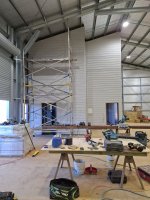
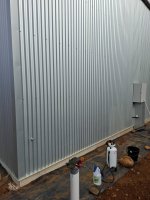
The north wall of the shed did need a clean though. It can’t be seen in the photo because the black plastic is obscuring it, but the plumber had notched out the concrete foundation using a masonry saw (and water). This was done in preparation for installing the tanks, to allow each tank to sit closer to the wall of the shed.

In this next photo, it’s easy to see where the wall’s been cleaned and the part that’s not clean. What can’t be seen though is just how high the wet concrete dust had been flicked up the wall. The mess extended way beyond that row of screws that can be seen and went as high as the downpipe that’s hung on the north wall of the shed.

Post #0070b - Photo No. 15.jpg

It made sense to do the task before the tanks were installed and in the way.

Post #0070b - Photo No. 16.jpg

There is some crossfall on the area were the tanks sit to allow for drainage, so the footprint where each tank will sit will need to be excavated to match in with the low side and to allow for a crusher dust foundation. Once all the tanks are installed, the crossfall will be reestablished and landscaped with stones.

The concrete plinth is for the two transfer pumps.

Post #0070b - Photo No. 17.jpg

The circuit board also got a clean inside and out.

Post #0070b - Photo No. 18.jpg

One pipe is for the water that will be drawn from Tank 3 (outdoor water) and the other is for the water that will be drawn from Tank 2 (indoor water).

Post #0070b - Photo No. 19.jpg

Here’s the finished result.

Post #0070b - Photo No. 20.jpg

Continued below.
 
OP
K

kitdoctor

Well-known member
Joined
Oct 30, 2010
Messages
503
Location
Sunshine Coast, Australia
Post #0070c - Shed site tidy up No. 2 continued - Part LXV

No more pile of spoil, yay!

Pretty dirty concrete though.

Post #0070c - Photo No. 21.jpg

Neat piles of sifted dirt ready to be spread once the bases of the downpipes are painted, one day…

Post #0070c - Photo No. 22.jpg

In this next photo it’s possible to see some of the smaller, typical rubbish that was sifted out of the spoil.

Post #0070c - Photo No. 23.jpg

Well, job done.

Up next, some more yard work duties.
 
To avoid these ads, REGISTER NOW!
Top Bottom