
You are using an out of date browser. It may not display this or other websites correctly.
You should upgrade or use an alternative browser.
You should upgrade or use an alternative browser.
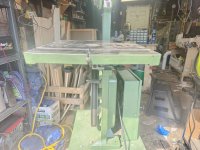
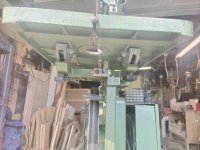
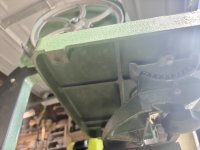
Cast iron bandsaw table has a bow in it.
- Thread starter jorp_porp
- Start date
RoninB4
Well-known member
-You can't "bend" a casting, it's rigid and will fracture/break when attempting to do so. Did you place a straight edge across the section you feel is bowed? I can't tell just by an unaccompanied photo. A cast table like that was ground at the factory and "should" be flat but sometimes the castings from the 3rd world (imports) will have residual stress that warps over time. Quantify the bow in photos if you can.
aquinob
Well-known member
+1. Back in the day when the US made tools with cast iron components it was common to let the sit a while before they were milled. I think the referred to it as "seasoned". That allowed the stresses to dissipate with repeated temperature changes so that when it was finally milled, it would stay flat.-You can't "bend" a casting, it's rigid and will fracture/break when attempting to do so. Did you place a straight edge across the section you feel is bowed? I can't tell just by an unaccompanied photo. A cast table like that was ground at the factory and "should" be flat but sometimes the castings from the 3rd world (imports) will have residual stress that warps over time. Quantify the bow in photos if you can.
That is a common saw, a clone from a Delta 14". You may find a table from one or a clone that might fit those trunnions on the bottom. Otherwise you just have to live with it or find another saw.
larry4406
Well-known member
Or find a friend with a surface grinder or milling machine.
It would be a labor of love but if I didn't want to pay someone with a surface grinder or a Blanchard grinder to do it, would probably hit it with the shell Mill on the milling machine to get it close and then go over it with a Norton Stone by hand.
RoninB4
Well-known member
+1 ^ Even with extruded material and machined metal there's stress in it that can/will warp the piece. The term "seasoned" mentioned by @aquinob is correct for castings. For machined pieces it's called stress relieving and is critical for the same reasons. Warp is sometimes called "creep" as it moves with age. When heat treating tool steels warp is notorious to happen.+1. Back in the day when the US made tools with cast iron components it was common to let the sit a while before they were milled. I think the referred to it as "seasoned". That allowed the stresses to dissipate with repeated temperature changes so that when it was finally milled, it would stay flat.
-I suppose it could also be Blanchard ground but replacing it might be cheaper. Machining it might just cause more induced warp from the stress, hard to predict this.That is a common saw, a clone from a Delta 14". You may find a table from one or a clone that might fit those trunnions on the bottom. Otherwise you just have to live with it or find another saw.
Oof. I was hoping that I could like.. bolt a piece of steel across the bottom, or something like that.
It's significant. I can measure it when I get home, but the center is like half an inch lower than the sides.
Welcome to Garage Journal where the solution to fixing a $20 part involves a 5,000 lb machine with thousands of dollars in specialty tooling.
RoninB4
Well-known member
-Or spend a few more dollars to purchase better quality parts/equipment that isn't problematic to begin with. As someone's father once commented "The cheap man pays the most".Welcome to Garage Journal where the solution to fixing a $20 part involves a 5,000 lb machine with thousands of dollars in specialty tooling.
Welcome to Garage Journal where the solution to fixing a $20 part involves a 5,000 lb machine with thousands of dollars in specialty tooling.
I don't think there's any fixing that
He's just going to have to set up his own forge and make a new one
4xdog
Well-known member
-Or spend a few more dollars to purchase better quality parts/equipment that isn't problematic to begin with. As someone's father once commented "The cheap man pays the most".
The way my father used to say it was, “We’re not rich enough to afford cheap tools.”
larry4406
Well-known member
Could you clean the table extremely well, wrap its perimeter with a thin band creating a raised edge, then pouring in an epoxy that cures flat and level?
Then strip and recut the saw kerf.
Spit balling here.
Then strip and recut the saw kerf.
Spit balling here.
whateg01
Well-known member
Really, a stone? The only right best garage journal way to get it flat is hand scrape it!It would be a labor of love but if I didn't want to pay someone with a surface grinder or a Blanchard grinder to do it, would probably hit it with the shell Mill on the milling machine to get it close and then go over it with a Norton Stone by hand.
whateg01
Well-known member
The top is only so thick. I don't think it's real 1/2" of warp, but the top is probably only 1/4" thick to begin with.+1 ^ Even with extruded material and machined metal there's stress in it that can/will warp the piece. The term "seasoned" mentioned by @aquinob is correct for castings. For machined pieces it's called stress relieving and is critical for the same reasons. Warp is sometimes called "creep" as it moves with age. When heat treating tool steels warp is notorious to happen.
-I suppose it could also be Blanchard ground but replacing it might be cheaper. Machining it might just cause more induced warp from the stress, hard to predict this.
alfadan
Well-known member
There's a good chance the bottom of the casting is or looks bowed, but the actual working surface, the top, is flat.
Or at least flat enough for a bandsaw.
Or at least flat enough for a bandsaw.
There's a good chance the bottom of the casting is or looks bowed, but the actual working surface, the top, is flat.
Or at least flat enough for a bandsaw.
That sure looks bowed/bent to me....
These have a tendency to get tipped over. I picked one up dirt cheap as I was buying a trailer full of woodworking equipment. So cheap I didn't look at it.
Switch was missing as it exploded when it tipped. Base is all sorts of off kilter, and the mounts for the table are cracked. It's a reliant, I paid like $50 for it. At some point I'll find parts or just make a table..will work fine for 90% of the times I need a saw this size.
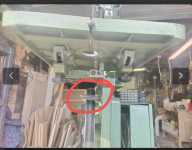
I bet OP went over as well:
RTM
Well-known member
I wouldn't put the effort into that. Friend of mine had one of those spent a while thinking and talking and found a friend with Access to a surface grinder and when he finished a month or three later it was tweaked again
Last edited:
Old Man Roger
Well-known member
Throw it on top of a nice bonfire, get it nice and red, then clamp something flat to it till it cools. Buried in sand while cooling would probably help. 
aquinob
Well-known member
One of the mistakes people make when moving bandsaws is that they leave the table on. I NEVER leave the table on, that is the quickest part to get F'd up if somehow the saw ends up shifting or falling a bit. The trunnions, especially on the original delta and clone saws are pot metal and will crack if you look at them wrong.
That table on the OP's saw doesn't look very thick and I doubt would survive removing much metal off the top. And even if you did, then the insert wouldn't have its place to sit.
He could, conceivably make a top out of it from wood. All you really need is something flat and stable like a small piece of butcher block. Drill holes on the bottom and put some threaded inserts so the trunnions bolt up. Drill a hole for the blade along with a slot and Bobs your uncle. It never was and never will be a piece of precision machinery.
That table on the OP's saw doesn't look very thick and I doubt would survive removing much metal off the top. And even if you did, then the insert wouldn't have its place to sit.
He could, conceivably make a top out of it from wood. All you really need is something flat and stable like a small piece of butcher block. Drill holes on the bottom and put some threaded inserts so the trunnions bolt up. Drill a hole for the blade along with a slot and Bobs your uncle. It never was and never will be a piece of precision machinery.
Last edited:
Depends on the "precision" expected and parts coming off of it, but the simplest band-aid is just clamp on a sheet of 3/4" cabinet plywood and throw a shim under it.....even use foam in a can for shim.
Worst case, glue up 2 pieces of 3/4" and miter the top for a sliding square.
Worst case, glue up 2 pieces of 3/4" and miter the top for a sliding square.
alfadan
Well-known member
And probably is especially since it's in the same plane as the blade cut in the table. Need to put a straight edge to be sure.That sure looks bowed/bent to me....
These have a tendency to get tipped over. I picked one up dirt cheap as I was buying a trailer full of woodworking equipment. So cheap I didn't look at it.
Switch was missing as it exploded when it tipped. Base is all sorts of off kilter, and the mounts for the table are cracked. It's a reliant, I paid like $50 for it. At some point I'll find parts or just make a table..will work fine for 90% of the times I need a saw this size.
I bet OP went over as well:
Mine has had the trunions welded on, so probably fell over too. If mine were bent, I'd mill it flat, but if I couldn't, it would still be serviceable I think.
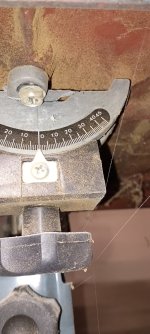
So, that means you're slightly off-kilter?I checked, mines flat but the trunions are cracked:
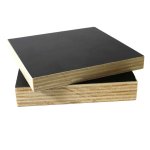
I randomly have some of this 'phenolic plywood' stuff that I was going to use for a drill press table. Might clamp a piece of this down.
And looking at just how warped my table is, I find it plausible that it was tipped over at some point. Qt the end of the day, this thong is still miles better than my inherited 9" protech.
Edit- i refuse to fix these typos
And looking at just how warped my table is, I find it plausible that it was tipped over at some point. Qt the end of the day, this thong is still miles better than my inherited 9" protech.
Edit- i refuse to fix these typos
Attachments
Cruzan80
Well-known member
I was kind of thinking the same thing. Is the main issue just getting it hot enough and the finding something "smooth/flat" enough (co-planar) to ensure it flattens? Or is there not enough residual "creep" post casting?Throw it on top of a nice bonfire, get it nice and red, then clamp something flat to it till it cools. Buried in sand while cooling would probably help.
Old Man Roger
Well-known member
Originally, as you know, it would have been left in a cast till it cooled. In this case it would need to be clamped to something flat while it cools to keep the creep from happening.I was kind of thinking the same thing. Is the main issue just getting it hot enough and the finding something "smooth/flat" enough (co-planar) to ensure it flattens? Or is there not enough residual "creep" post casting?
I think a couple a three lengths of angle iron would do the job. I’d want to keep them out of the fire and clamp them on after.
yhprum
Well-known member
I think I would make up a new top with some quality plywood. Maybe add a wear resistant top if that’s a concern. Look up woodgears bandsaw for some ideas.

RTM
Well-known member
Run away and leave it as is.I smacked the bottom real good with a 3lbs mallet and now it's only off by half a mil
Some story about 8" jumps to mind here.

alfadan
Well-known member
Aaakshuallyyyy....
A mil is conventionaly .001 inch.
A mil is conventionaly .001 inch.
RoninB4
Well-known member
-Yes and no. With import castings they're made from whatever the recipe for the day calls for. The only thing known is that they're made from the cheapest material they can get away with. Even real CI is a generic term, there's so many different flavors you can't just presume to know what the mix is comprised of. With the older, American made CI there was some amount of predictable behavior, with the imported stuff from the last 45 years it's been a price point decision for what things are made from. Imported castings tend to be porous and weaker than older CI made in the US or Europe name brands. I wouldn't trust attempting to "tweak" a table like that for fear that it will add further stress enough to simply propagate a fracture all the way through.Is the main issue just getting it hot enough and the finding something "smooth/flat" enough (co-planar) to ensure it flattens?
-With residual stress there's no real way of predicting what it's going to do, especially with import castings that already demonstrated that it wants to warp. JMOOr is there not enough residual "creep" post casting?
rsanter
Well-known member
Put it on a flat surface and clamp it flat.
if it moves reasonably easy as I think it will then you can shim in as needed and reclamp it to try to work the bow out.
if the bow does not come all the way out after releasing the clamps then you can bolt a bar to the bottom to hold it flat, but make it to where the bar can be easily removed for changing the blade
if it moves reasonably easy as I think it will then you can shim in as needed and reclamp it to try to work the bow out.
if the bow does not come all the way out after releasing the clamps then you can bolt a bar to the bottom to hold it flat, but make it to where the bar can be easily removed for changing the blade
Lassen Forge
Well-known member
I was gonna say, if it's off by a mil,
I was gonna say if it's only off by a mil, I'd be thrilled to jeepers. But y'alls beat me to it! You're not going to unf***... er, unwarp that table without it both rewarping at best, or going "ping" at worst. CI is pretty unforgiving stuff...
What I would do (and did do), go to your local friendly metal jobbers, buy a cut piece of 3/8" cold rolled that's already milled flat. Cut the slot and drill the relief hole for the blade, then shim, drill and mount it to the top of your saw. Confirm level and fergeddaboudit. Even if it's a 40 year old "el producto" saw, you don't throw away a machine that works and buy a new one (which will likely be worse!), you make it work. And if possible work better.
There's a difference between mm and mil...
I was gonna say if it's only off by a mil, I'd be thrilled to jeepers. But y'alls beat me to it! You're not going to unf***... er, unwarp that table without it both rewarping at best, or going "ping" at worst. CI is pretty unforgiving stuff...
What I would do (and did do), go to your local friendly metal jobbers, buy a cut piece of 3/8" cold rolled that's already milled flat. Cut the slot and drill the relief hole for the blade, then shim, drill and mount it to the top of your saw. Confirm level and fergeddaboudit. Even if it's a 40 year old "el producto" saw, you don't throw away a machine that works and buy a new one (which will likely be worse!), you make it work. And if possible work better.
Firebrick43
Well-known member
Cast iron will move, we did it all the time setting up large milling machines, mill turns, and lathes. It will take a set over time as well if its twisted or allowed to sag.
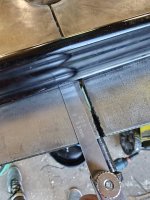
I would drill 75 percent of the rib deep and tap with 5/16x18 at the 4 arrows. I would then make a matching 2x2 steel bar with milled slots at the red points and a plain thru hole at the arrow. Then you could loosen all the holes and pivot it away without removing the bar completely on the yellow bolt to change blades.
Asdic

I would drill 75 percent of the rib deep and tap with 5/16x18 at the 4 arrows. I would then make a matching 2x2 steel bar with milled slots at the red points and a plain thru hole at the arrow. Then you could loosen all the holes and pivot it away without removing the bar completely on the yellow bolt to change blades.
Asdic